Hail history in Florida
We counted the days with NOAA hail reports within 15 miles of the center of 16 Florida cities since 2010.
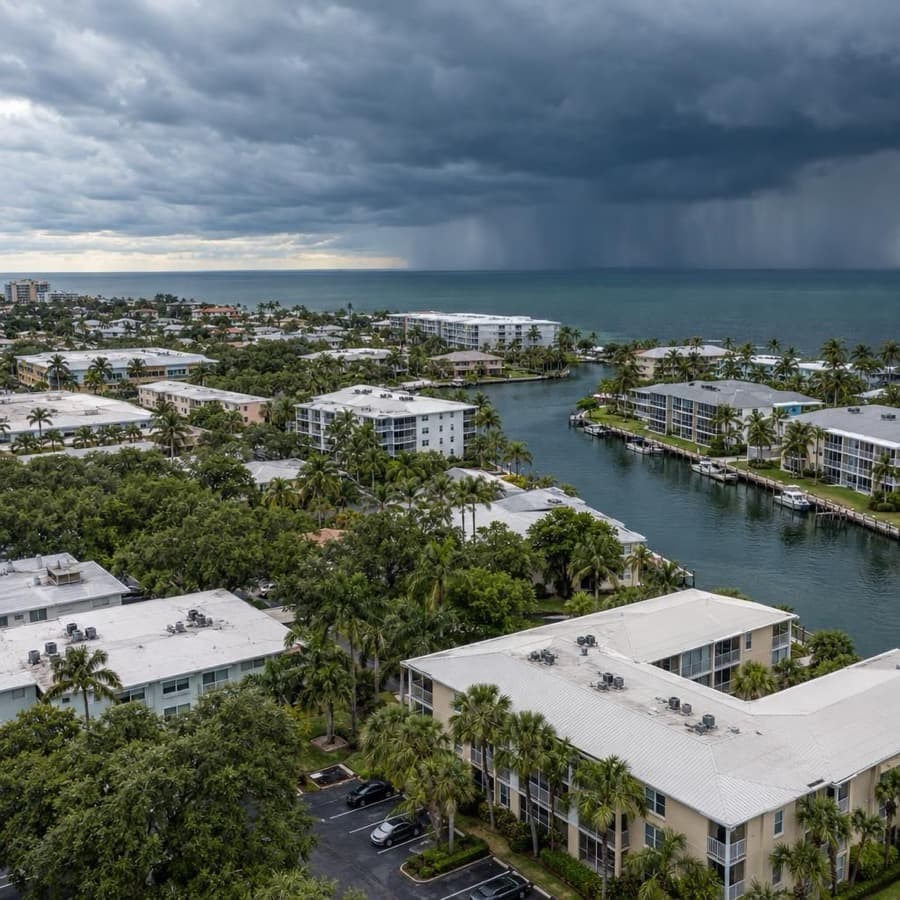
- Hail days near Jacksonville since 2010, the most in Florida
- 62
- Largest hail reported, near Miami
- 3.0 in
- Florida cities tracked
- 16
Source: NOAA/NWS Storm Prediction Center
Data through November 1, 2026
Florida cities by hail days
Source: NOAA/NWS Storm Prediction Center
Data through November 1, 2026
| City | Hail days since 2010 | Largest hail |
|---|---|---|
| Jacksonville | 62 | 2.0 in |
| Orlando | 49 | 2.0 in |
| Miami | 34 | 3.0 in |
| Gainesville | 30 | 2.5 in |
| Port St. Lucie | 25 | 2.0 in |
| Tallahassee | 25 | 2.0 in |
| Pensacola | 22 | 2.0 in |
| Tampa | 21 | 1.5 in |
| Deltona | 21 | 3.0 in |
| Lakeland | 20 | 1.75 in |
| Ocala | 20 | 3.0 in |
| Palm Bay | 17 | 2.0 in |
| Naples | 17 | 1.5 in |
| Cape Coral | 10 | 1.25 in |
| North Port | 8 | 1.75 in |
| Crestview | 5 | 1.0 in |
About this data
- Each city counts reports within 15 miles of its center, not of any one property.
- Reports come from trained spotters and the public, so they cluster near towns and roads.
- No report does not mean no hail. Hail can fall where no one is there to report it.
- This is not a damage or insurance assessment.
Storm risk in Florida
Hurricanes are the storm risk that matters most for buildings in Florida, followed by flooding from surge and heavy rain, then the wind, tornadoes and hail of the most active thunderstorm climate in the US. NOAA counts 120 hurricane direct hits on Florida from 1851 to 2018, 37 of them major, and 40 percent of all US hurricanes hit Florida. Hail is less common than the thunderstorm count suggests, because the freezing level in Florida storms is so high that hail often melts before it reaches the ground.2,3
How often storms hit Florida
| Hazard | How often | What it means for buildings |
|---|---|---|
| Hurricanes and tropical storms | 120 hurricane direct hits from 1851 to 2018, 37 of them Category 3 or stronger. The Atlantic season runs June 1 to November 30. | Wind tears roof coverings, edges and openings, letting rain inside. Surge floods low coastal buildings. |
| Flooding | More than 1.7 million NFIP flood policies were in force in Florida in late 2023, nearly 35 percent of all NFIP policies. The state says 80 percent of residents live or work along or near the coast. | Surge, tropical rain and slow storms flood ground floors, parking levels, elevator pits and electrical rooms. |
| Damaging thunderstorm wind | More thunderstorm activity than any other part of the US, with over 80 days of thunder and lightning a year in the western half of the peninsula. | Straight-line winds from downbursts cause more wind damage than tornadoes and are often mistaken for them. Intense macrobursts can do damage like an F3 tornado to roofs, edge metal and rooftop units. |
| Tornadoes | More tornadoes per 10,000 square miles than any other state, and more tornadoes than any other Southeast state. EF4 and EF5 tornadoes are uncommon, but EF3s have struck in nearly every month. | Tornadoes form in hurricanes as well as with spring fronts and summer storms. |
| Hail | From 5 hail days near Crestview to 62 near Jacksonville since 2010, across the 16 cities tracked. The largest hail near any of them was 3 inches, and the state has about a dozen reported events of hail over 3 inches. | Most Florida hail is small, but large stones dent metal roofing and rooftop units and crack skylights. |
| Hard freezes | NWS Tallahassee's 1991 to 2020 normals put the average first hard freeze, 25°F, on December 23 at Tallahassee and December 25 at Panama City. | In north Florida, exposed pipes, sprinkler lines and outdoor equipment can freeze and burst. |
A hail day is a day since 2010 with at least one NOAA hail report within 15 miles of a city's center. It shows how often hail falls near a city, not whether it hit a given building, and reports cluster near towns and roads because people make them.1
Of Florida's 120 direct hits, 47 were Category 1 and 36 were Category 2. Texas, the next most often hit state, counts 64.2
Rules owners in Florida should know
- Insurer of last resort: Citizens Property Insurance Corporation, a state government entity, insures residential and commercial property for owners who can't get coverage in the private market, including wind-only policies in areas once served by the Florida Windstorm Underwriting Association. A condominium association or apartment building offered private coverage that includes wind isn't eligible unless that premium is more than 20 percent above Citizens' (Florida Statutes 627.351).8
- Claim notice deadlines: A new or reopened property claim is barred unless the insurer gets notice within 1 year after the date of loss, and a supplemental claim within 18 months. For hurricanes the date of loss is the landfall date; for tornadoes, windstorms and severe rain it is the date NOAA verifies the event (Florida Statutes 627.70132).9
- Lawsuit deadlines: A suit for breach of a property insurance contract must be filed within 5 years of the date of loss (Florida Statutes 95.11). The policyholder must first give written notice of intent to sue through the Department of Financial Services at least 10 business days before filing (Florida Statutes 627.70152).10,11
- Prompt payment: Insurers must pay or deny a claim within 60 days of notice, and late payments bear interest. This covers residential policies, which in Florida include condominium association, cooperative and apartment building policies, and commercial structures of 10,000 square feet or less, but not nonresidential commercial policies covering property in more than one state (Florida Statutes 627.70131 and 627.4025).12,13
- Hurricane deductibles: Under a residential policy, a hurricane lasts from the first National Hurricane Center hurricane warning for any part of Florida until 72 hours after the last hurricane watch or warning ends (Florida Statutes 627.4025). Insurers must offer commercial residential policyholders a choice of a hurricane deductible that applies once per calendar year or one that applies to each hurricane (Florida Statutes 627.701).13,14
- State mediation: Personal lines and commercial residential policyholders can use the Department of Financial Services mediation program for disputed claims, and the insurer generally pays its cost. It doesn't apply to commercial coverages (Florida Statutes 627.7015).15
- Assignment of benefits: Under residential and commercial property policies issued on or after January 1, 2023, post-loss benefits can't be assigned to a contractor or anyone else, and any attempt is void. The ban doesn't cover a later buyer of the property or a power of attorney that lets a management company act on the claim (Florida Statutes 627.7152).16
- 25 percent roof rule: The Florida Building Code bars repairing, replacing or recovering more than 25 percent of a roof or roof section in any 12-month period unless the whole roof or section meets current code. For a roof built, repaired or replaced under the 2007 Florida Building Code or later, only the part being worked on must meet current code, and local governments can't change that (Florida Statutes 553.844).17,18
Before the next storm
- Evacuation zones: Look up each property on the Florida Division of Emergency Management's Know Your Zone map. Evacuation zones mark low-lying, flood-prone areas, and Zone A is typically the first evacuated.19
- Hurricane season timing: Make policy changes for wind and water damage before hurricane season starts on June 1. The Department of Financial Services advises calling the agent before then, since insurers stop taking new applications once a hurricane nears Florida.23
- Flood waiting period: Allow 30 days for new flood coverage. FEMA says an NFIP policy typically takes effect 30 days after purchase.21
- Deductibles and documents: Know each hurricane deductible in dollars, and keep policies and the insurer's claims number where staff can reach them after an evacuation. That number may differ from the agent's, the Department of Financial Services notes.20
- Roof inspections: Have low-slope roofs inspected in spring, in fall and after high winds, edges and rooftop equipment first. FEMA says the roof border is at more risk from wind uplift and wind-driven rain than the rest of the roof.22
Sources
Written by the Cloudbreak team. Numbers, dates and rules cite the published sources below.
- 1. Cloudbreak: NOAA/NWS Storm Prediction Center storm reports, as counted on the Cloudbreak hail history page for Florida
- 2. NOAA Atlantic Oceanographic and Meteorological Laboratory, Hurricane Research Division: TCFAQ E19: How many direct hits by hurricanes of various categories have affected each state?
- 3. Florida Climate Center, Office of the State Climatologist: Thunderstorms
- 4. Florida Climate Center, Office of the State Climatologist: Tornadoes
- 5. NOAA National Hurricane Center: Tropical Cyclone Climatology
- 6. Florida Division of Emergency Management: State Floodplain Management Program
- 7. NOAA National Weather Service Tallahassee: Frost and Freeze Information for the NWS Tallahassee Area
- 8. The Florida Legislature: Florida Statutes 627.351, Insurance risk apportionment plans (Citizens Property Insurance Corporation)
- 9. The Florida Legislature: Florida Statutes 627.70132, Notice of property insurance claim
- 10. The Florida Legislature: Florida Statutes 95.11, Limitations other than for the recovery of real property
- 11. The Florida Legislature: Florida Statutes 627.70152, Suits arising under a property insurance policy
- 12. The Florida Legislature: Florida Statutes 627.70131, Insurer's duty to acknowledge communications regarding claims; investigation
- 13. The Florida Legislature: Florida Statutes 627.4025, Residential coverage and hurricane coverage defined
- 14. The Florida Legislature: Florida Statutes 627.701, Liability of insureds; coinsurance; deductibles
- 15. The Florida Legislature: Florida Statutes 627.7015, Alternative procedure for resolution of disputed property insurance claims
- 16. The Florida Legislature: Florida Statutes 627.7152, Assignment agreements
- 17. The Florida Legislature: Florida Statutes 553.844, Windstorm loss mitigation; requirements for roofs and opening protection
- 18. The Florida Senate: 2022D Bill Summaries: SB 4-D, Building Safety
- 19. Florida Division of Emergency Management: Know Your Zone, Know Your Home
- 20. Florida Department of Financial Services, Office of the Insurance Consumer Advocate: Disaster Preparation Checklist
- 21. Federal Emergency Management Agency: Waiting Period for Activating Flood Policy?
- 22. Federal Emergency Management Agency: FEMA P-2181, Fact Sheet 3.3.2: Roof Systems, Low-Slope Roofs (March 2022)
- 23. Florida Department of Financial Services: Hurricane Ready
Storms in Florida
In east central Florida, NWS Melbourne's 1991 to 2020 records show hail reports peak in May and severe wind reports peak in June, and Orange County logged the most hail reports.1
Notable storms
- October 9, 2024Hurricane Milton made landfall on Siesta Key as a Category 3 hurricane. On October 9 it produced 45 tornadoes on land across southern and central Florida, including 3 rated EF3, and one EF3 killed 6 people near Fort Pierce and Vero Beach. NOAA estimated $34.3 billion in US damage, almost all in Florida.2
- May 10, 2024Two EF2 tornadoes with winds up to 115 mph crossed Tallahassee at the same time, and straight-line winds gusted to 84 mph. In all, 174 structures were counted as destroyed and 742 had major damage, and 2 people died. NOAA's Storm Events Database says the city of Tallahassee had at least $50 million in damage, not counting homes.3,4
- September 28, 2022Hurricane Ian came ashore on Cayo Costa with winds of 130 knots (150 mph), then again near Punta Gorda. Surge reached 10 to 15 feet above ground on Fort Myers Beach, where about 900 structures were destroyed. In Lee County, 5,369 structures were destroyed and 14,245 had major damage. NOAA estimated $109.5 billion in damage in Florida.5
- April 4, 2022Golf ball size hail, 1.75 inches across, fell near Sebring and Avon Park in Highlands County. Near Sebring it broke windows, punched holes in home siding and shattered car windshields. NOAA's Storm Events Database lists $500,000 in property damage.6,7
- May 21, 2020Hail 2 to 3 inches across fell over Sanford and Lake Mary in Seminole County, the largest mainly along Lake Mary Boulevard. Golf ball size hail fell in Buena Ventura Lakes, southwest of Orlando International Airport.8,9
- February 24, 2013Golf ball size hail fell around Buck Lake in Leon County. An NWS employee there reported that about 80 houses had roof damage and needed new roofs, and NOAA's Storm Events Database lists $720,000 in property damage.10
Warnings and alerts
NWS offices in Tallahassee, Jacksonville, Tampa Bay, Melbourne, Miami and Key West, plus Mobile, Alabama, each cover part of Florida.11 The Florida Division of Emergency Management's AlertFlorida page lets people look up, by county or city, how to get emergency alerts where they live.12
Sources
- 1. NWS Melbourne: East Central Florida Severe Weather Climatology: A Look at the Last 30 Years
- 2. NOAA National Hurricane Center: Tropical Cyclone Report: Hurricane Milton
- 3. NWS Tallahassee: May 10, 2024 Tornadoes
- 4. NOAA NCEI Storm Events Database: Tornado, Fort Braden, Leon County, FL, May 10, 2024
- 5. NOAA National Hurricane Center: Tropical Cyclone Report: Hurricane Ian
- 6. NOAA NCEI Storm Events Database: Hail, Sebring Shores, Highlands County, FL, April 4, 2022
- 7. NOAA NCEI Storm Events Database: Hail, Avon Park, Highlands County, FL, April 4, 2022
- 8. NWS Melbourne: East Central Florida Large Hail Event on May 21, 2020
- 9. NOAA NCEI Storm Events Database: Hail, New Upsala, Seminole County, FL, May 21, 2020
- 10. NOAA NCEI Storm Events Database: Hail, Fallschase, Leon County, FL, February 24, 2013
- 11. National Weather Service: Florida NWS SKYWARN Program
- 12. Florida Division of Emergency Management: AlertFlorida: Statewide Notification Initiative
Hail history in other states
- Alabama
- Alaska
- Arizona
- Arkansas
- California
- Colorado
- Connecticut
- District of Columbia
- Georgia
- Hawaii
- Idaho
- Illinois
- Indiana
- Iowa
- Kansas
- Kentucky
- Louisiana
- Maine
- Maryland
- Massachusetts
- Michigan
- Minnesota
- Mississippi
- Missouri
- Montana
- Nebraska
- Nevada
- New Hampshire
- New Jersey
- New Mexico
- New York
- North Carolina
- North Dakota
- Ohio
- Oklahoma
- Oregon
- Pennsylvania
- Rhode Island
- South Carolina
- South Dakota
- Tennessee
- Texas
- Utah
- Virginia
- Washington
- West Virginia
- Wisconsin
- Wyoming