Hail history in Minnesota
We counted the days with NOAA hail reports within 15 miles of the center of 3 Minnesota cities since 2010.
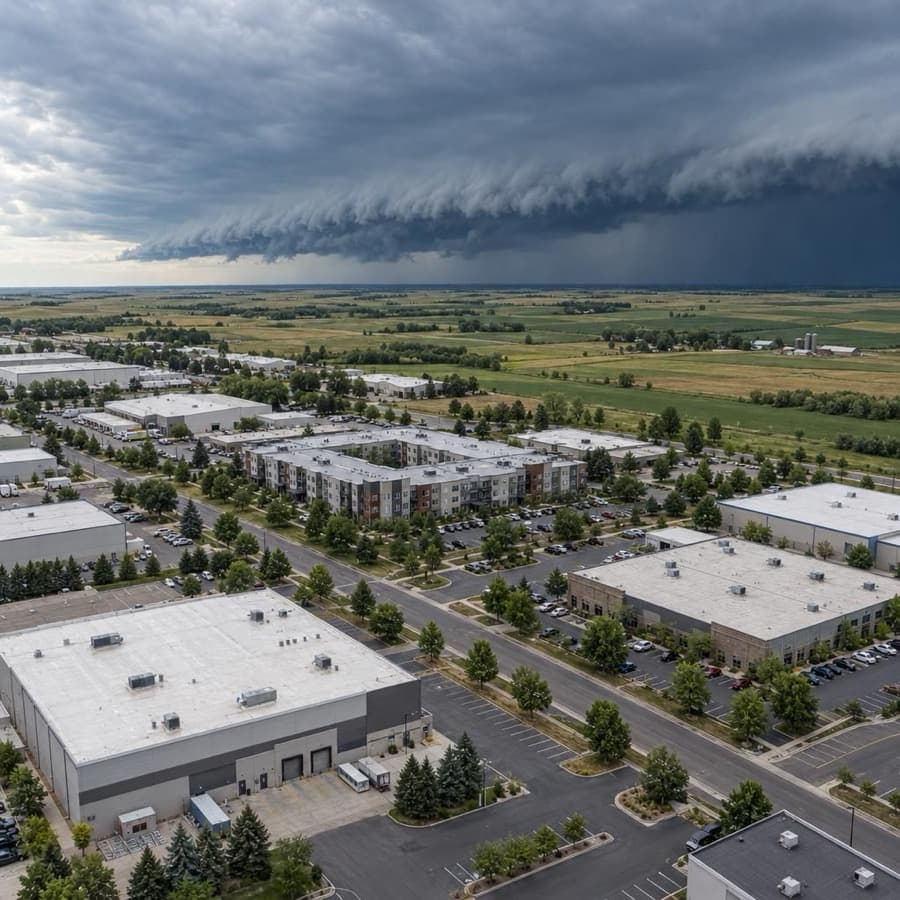
- Hail days near Minneapolis since 2010, the most in Minnesota
- 82
- Largest hail reported, near Minneapolis
- 3.0 in
- Minnesota cities tracked
- 3
Source: NOAA/NWS Storm Prediction Center
Data through November 1, 2026
Minnesota cities by hail days
Source: NOAA/NWS Storm Prediction Center
Data through November 1, 2026
| City | Hail days since 2010 | Largest hail |
|---|---|---|
| Minneapolis | 82 | 3.0 in |
| Rochester | 58 | 2.75 in |
| Duluth | 46 | 2.0 in |
About this data
- Each city counts reports within 15 miles of its center, not of any one property.
- Reports come from trained spotters and the public, so they cluster near towns and roads.
- No report does not mean no hail. Hail can fall where no one is there to report it.
- This is not a damage or insurance assessment.
Storm risk in Minnesota
Hail is the storm risk that matters most for buildings in Minnesota, with damaging thunderstorm wind close behind, then tornadoes, heavy snow and flash floods. The state lies along the north edge of the area with the most tornadoes in the US and averages 46 tornadoes a year.2,3,4 Hail falls somewhere in Minnesota on 40 days or more in a typical year. From 1980 to 2006, the area within 124 nautical miles of the Minneapolis radar ranked 25th of 141 US radar areas for significant severe weather: hail 2 inches or larger, gusts of 65 knots or more and tornadoes rated F2 or stronger.2,4
How often storms hit Minnesota
| Hazard | How often | What it means for buildings |
|---|---|---|
| Hail | 82 hail days since 2010 within 15 miles of Minneapolis and 46 near Duluth, with hail up to 3 inches near Minneapolis. Statewide, hail 2 inches or larger falls on 7 to 8 days a year and 3 inches or larger on 2 to 3. | Hail breaks roof covers, skylights and rooftop unit fins and dents siding, gutters and metal panels. |
| Damaging thunderstorm wind | Damaging wind reports on an average of 32 days a year from 1980 to 2006 within 124 nautical miles of the Minneapolis radar, including 554 reports of gusts of 65 knots or more. | Straight-line winds peel roof membranes and edge metal, topple rooftop equipment and drop trees across wide areas, often in the same storms that bring hail. |
| Tornadoes | 46 a year on average from 1991 to 2020, from 15 in 2013 to 113 in 2010. No year in more than seven decades has passed without one. | Most damage roofs, siding and trees, and the strongest destroy buildings. Tornadoes have struck both Minneapolis and St. Paul, despite the myth that they avoid cities. |
| Flooding | Flash floods, defined in NOAA's state climate narrative as 6 inches or more of rain in 24 hours, occur about three times a year somewhere in the state. | Water damages basements, ground floors, elevator pits and site work. State rules set how high new floors must sit in regulated floodplains. |
| Winter storms and cold | Average snowfall of 30 to 60 inches a year over most of the state, up to 70 inches along the Canadian border and 90 inches along the Lake Superior shore. | FEMA says drifting snow, rain on snow and ice dams can load a roof past its design. Hard cold freezes pipes and sprinkler lines in unheated spaces. |
A hail day is a day since 2010 with at least one NOAA hail report within 15 miles of a city's center. It shows how often hail falls near a city, not whether it hit a given building, and because people make the reports, they cluster near towns and roads.1
Size matters more than frequency. The State Climatology Office says most Minnesota hail is small and does no damage, that hail about an inch across is where it becomes dangerous, and that damage potential climbs as stones grow. Hail 4 inches or larger is reported somewhere in the state on about 5 to 6 days a decade.2
Rules owners in Minnesota should know
- FAIR Plan: the Minnesota FAIR Plan insures property for owners who have been canceled, nonrenewed or otherwise rejected in the private market, and an applicant with an offer from a standard insurer doesn't qualify (Minn. Stat. 65A.34). It writes small commercial property, and its underwriting guidelines cap a commercial risk's actual cash value at 1.5 million dollars per building, or $400,000 for manufacturing. Risks that qualify for surplus lines coverage are not eligible.8,9,10
- Claim deadlines: insurers must acknowledge a claim within 10 business days and accept or deny it within 30 business days of notice, or explain in that time why the investigation isn't complete and when it will be. After a properly executed proof of loss, the decision is due within 60 business days, and a denial must be in writing and cite the policy provision it relies on (Minn. Stat. 72A.201).11
- Suit deadline: the Minnesota standard fire policy bars suit unless it starts within two years after the loss begins, and policies that add other perils must give at least those rights for fire losses (Minn. Stat. 65A.01). An insurer must warn an insured who has an unresolved claim and no attorney at least 60 days before a statute of limitations expires (Minn. Stat. 72A.201).12,11
- Code upgrades: where an insurer offers replacement cost coverage, it must cover repairing or rebuilding to the minimum code required by state or local authorities, and can't require rebuilding at the original location when zoning forces a move (Minn. Stat. 65A.10). The State Building Code is the construction standard throughout Minnesota, though a city enforces it only where it has adopted the code by ordinance.13,14
- Bad faith costs: if an insurer denies benefits without a reasonable basis and knows it or acts in reckless disregard, a court may add half of the amount awarded above the insurer's offer made at least 10 days before trial, up to $250,000, plus up to $100,000 in attorney fees. These costs aren't available for a claim resolved by appraisal or arbitration (Minn. Stat. 604.18).15
- Floodplain elevation: Minnesota standards typically require a building's lowest floor, basement included, to sit at or above the regulatory flood protection elevation, at least 1 foot above the 100-year flood, with electrical, heating and cooling equipment above it too. No buildings are allowed in the floodway, and many communities require 2 or 3 feet of freeboard (Minnesota DNR).16
- Cosmetic damage terms: the Department of Commerce says state law does not address policy exclusions for cosmetic hail or wind damage, and it has seen policies that cover wind and hail only when siding or shingles are punctured or torn and no longer keep water out.17
Before the next storm
- Hail-rated roofs: when a roof is due for replacement, choose a cover with a hail impact rating. IBHS recommends FM 4470 Class 1-SH or UL 2218 Class 4 for low-slope roofs and UL 2218 Class 4 or FM 4473 Class 3 or 4 for steep roofs.18
- Rooftop units: fit hail guards over condenser fins and air intakes, and check that skylights carry a hail impact rating. IBHS recommends both, since hail on unguarded fins and intakes can impair a unit's operation.18
- Wind and hail deductible: know each building's wind and hail deductible in dollars before storm season. The Department of Commerce warns that a separate deductible of 1 percent or more of replacement value can be a significant expense.17
- Snow drifts: after heavy snow, have a qualified person check drifts at parapets, roof steps and rooftop equipment. FEMA's warning signs of an overloaded roof include sagging ceiling tiles, sprinkler heads dropping below the ceiling and doors that stick.7
Sources
Written by the Cloudbreak team. Numbers, dates and rules cite the published sources below.
- 1. Cloudbreak: NOAA/NWS Storm Prediction Center storm reports, as counted on the Cloudbreak hail history page for Minnesota
- 2. Minnesota State Climatology Office (Minnesota DNR): Giant Hail, Heavy Rain, Strong Winds, July 31 to August 1, 2024 (very large hail statistics)
- 3. Minnesota State Climatology Office (Minnesota DNR): Minnesota Tornado History and Statistics
- 4. NOAA Storm Prediction Center: MPX (Minneapolis) Severe Weather Climatology, 1980 to 2006
- 5. NOAA NCEI and North Carolina Institute for Climate Studies: Minnesota: 2025 State Climate Summaries
- 6. NOAA National Climatic Data Center (Minnesota Legislative Reference Library copy): Climate of Minnesota
- 7. Federal Emergency Management Agency: Snow Load Safety Guidance (FEMA P-957)
- 8. Minnesota FAIR Plan: Welcome to Minnesota FAIR Plan
- 9. Minnesota FAIR Plan: Appendix A: Underwriting Guidelines (March 16, 2016)
- 10. Minnesota Office of the Revisor of Statutes: Minn. Stat. 65A.34: FAIR plan application and inspections
- 11. Minnesota Office of the Revisor of Statutes: Minn. Stat. 72A.201: Regulation of claims practices
- 12. Minnesota Office of the Revisor of Statutes: Minn. Stat. 65A.01: Minnesota standard fire insurance policy
- 13. Minnesota Office of the Revisor of Statutes: Minn. Stat. 65A.10: Replacement cost insurance
- 14. Minnesota Department of Labor and Industry: Overview of the Minnesota State Building Code
- 15. Minnesota Office of the Revisor of Statutes: Minn. Stat. 604.18: Remedies for denial of insurance benefits
- 16. Minnesota Department of Natural Resources: Floodplain Elevation Requirements
- 17. Minnesota Department of Commerce: Consumer alert: MN Commerce advises Minnesota homeowners to check insurance coverage for wind, hail limits (August 15, 2022)
- 18. IBHS: Commercial Roofs Best Practices Guide
Storms in Minnesota
Minnesota tornadoes come most often in June, with July close behind, and more than 85 percent occur from May through August, the State Climatology Office says.1 Hail season starts in late May in southern Minnesota and in early June in the north, a retired University of Minnesota climatologist told MPR News.2
Notable storms
- June 20, 2025A late-night derecho brought straight-line winds of 80 to 120 mph, by NWS survey estimate, along a 30-mile swath through Bemidji, where the airport measured a 92-knot (106 mph) gust. Roofs on homes and commercial buildings were damaged or destroyed, windows broke, and garages were destroyed. NOAA's Storm Events Database lists $15 million in property damage.3,4
- July 31, 2024A hailstone about 6 inches across fell 4 miles northwest of Chokio in Stevens County. The State Climatology Office calls it the largest hail confirmed in Minnesota in at least 38 years and possibly the state record. Hail up to 4 inches fell near Graceville in Big Stone County.5,6
- August 11, 2023Hail up to 3 inches fell in Minneapolis and up to 3.75 inches near Dassel in Meeker County. NOAA's National Centers for Environmental Information counted the storms as a billion-dollar disaster in Minnesota.7,8
- July 1, 2011Storm Events records estimate sustained winds of 70 to 90 mph lasting 10 to 15 minutes in Yellow Medicine County, damaging outbuildings and a few homes. In Lyon County, winds tore parts of roofs off homes. Hail up to 4.25 inches fell in Meeker County.9,10,11
- May 22, 2011An EF1 tornado tracked about 6 miles from St. Louis Park through Golden Valley and North Minneapolis, damaging many homes and garages. City officials said more than 600 buildings needed major repairs and 35 homes could not be lived in. One person died and 48 were injured. NOAA's Storm Events Database lists $166 million in property damage.12
- June 17, 2010Minnesota had 48 tornadoes in 22 counties in about six hours, a state record for one day, three of them rated EF4. The EF4 at Wadena, with peak winds near 170 mph, flattened homes and wrecked public and industrial buildings in the western half of the city. Three people died statewide. Hail up to 4.25 inches fell around Millerville in Douglas County.13,14,15,16
Warnings and alerts
Six NWS offices forecast for Minnesota: Twin Cities/Chanhassen, Duluth, Grand Forks (North Dakota), La Crosse (Wisconsin), Sioux Falls (South Dakota) and Aberdeen (South Dakota).17
Sources
- 1. Minnesota State Climatology Office (Minnesota DNR): Minnesota Tornado History and Statistics
- 2. MPR News: When is the peak of hail season in Minnesota?
- 3. NOAA NCEI Storm Events Database: Thunderstorm Wind, Beltrami County, Minnesota, June 20, 2025
- 4. NOAA NCEI Storm Events Database: Thunderstorm Wind, Bemidji Airport, Minnesota, June 20, 2025
- 5. Minnesota State Climatology Office (Minnesota DNR): Giant Hail, Heavy Rain, Strong Winds, July 31 to August 1, 2024
- 6. NOAA NCEI Storm Events Database: Hail, Big Stone County, Minnesota, July 31, 2024
- 7. NOAA NCEI Storm Events Database: Hail, Hennepin County, Minnesota, August 11, 2023
- 8. NOAA NCEI Storm Events Database: Hail, Meeker County, Minnesota, August 11, 2023
- 9. NOAA NCEI Storm Events Database: Thunderstorm Wind, Yellow Medicine County, Minnesota, July 1, 2011
- 10. NOAA NCEI Storm Events Database: Thunderstorm Wind, Lyon County, Minnesota, July 1, 2011
- 11. NOAA NCEI Storm Events Database: Hail, Meeker County, Minnesota, July 1, 2011
- 12. NOAA NCEI Storm Events Database: Tornado, Hennepin County, Minnesota, May 22, 2011
- 13. Minnesota State Climatology Office (Minnesota DNR): Deadly tornadoes: June 17, 2010
- 14. Minnesota State Climatology Office (Minnesota DNR): Top Five Weather Events of 2010 in Minnesota
- 15. NOAA NCEI Storm Events Database: Tornado, Wadena County, Minnesota, June 17, 2010
- 16. NOAA NCEI Storm Events Database: Hail, Douglas County, Minnesota, June 17, 2010
- 17. National Weather Service: 2024 Minnesota Fire Weather Operating Plan
Hail history in other states
- Alabama
- Alaska
- Arizona
- Arkansas
- California
- Colorado
- Connecticut
- District of Columbia
- Florida
- Georgia
- Hawaii
- Idaho
- Illinois
- Indiana
- Iowa
- Kansas
- Kentucky
- Louisiana
- Maine
- Maryland
- Massachusetts
- Michigan
- Mississippi
- Missouri
- Montana
- Nebraska
- Nevada
- New Hampshire
- New Jersey
- New Mexico
- New York
- North Carolina
- North Dakota
- Ohio
- Oklahoma
- Oregon
- Pennsylvania
- Rhode Island
- South Carolina
- South Dakota
- Tennessee
- Texas
- Utah
- Virginia
- Washington
- West Virginia
- Wisconsin
- Wyoming