Hail history in New York
We counted the days with NOAA hail reports within 15 miles of the center of 8 New York cities since 2010.
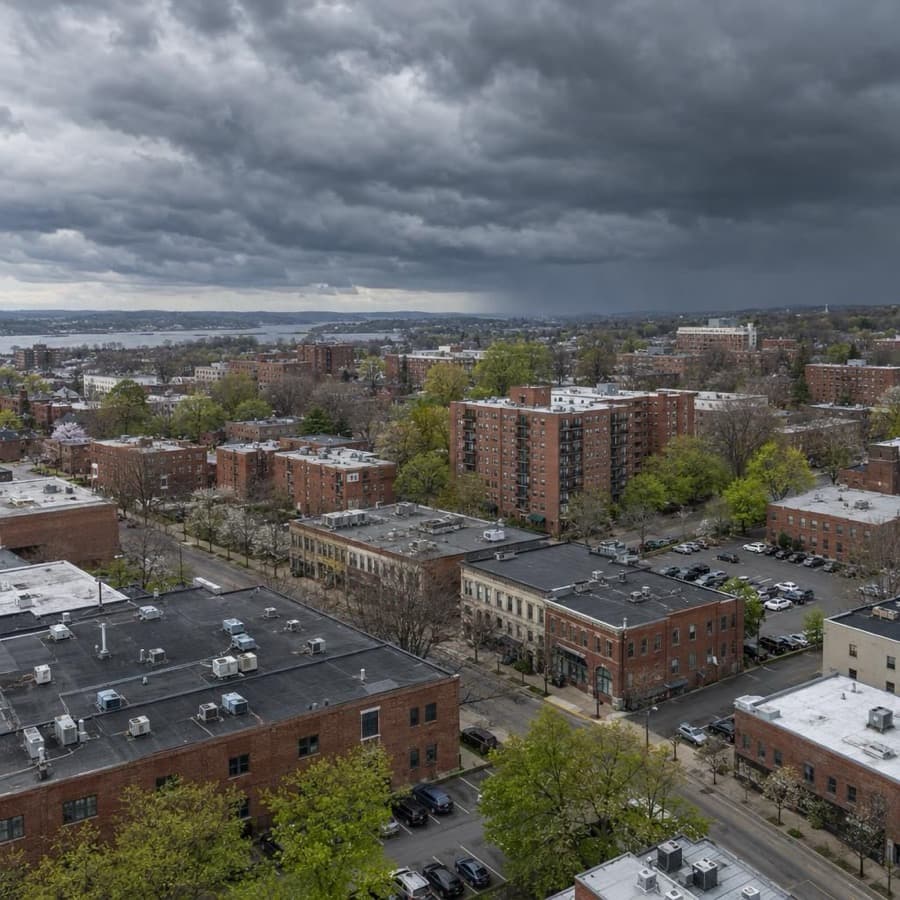
- Hail days near Albany since 2010, the most in New York
- 44
- Largest hail reported, near Albany
- 3.0 in
- New York cities tracked
- 8
Source: NOAA/NWS Storm Prediction Center
Data through November 1, 2026
New York cities by hail days
Source: NOAA/NWS Storm Prediction Center
Data through November 1, 2026
| City | Hail days since 2010 | Largest hail |
|---|---|---|
| Albany | 44 | 3.0 in |
| Binghamton | 40 | 3.0 in |
| Utica | 39 | 2.0 in |
| Syracuse | 32 | 1.75 in |
| New York | 23 | 3.0 in |
| Poughkeepsie | 23 | 1.75 in |
| Rochester | 20 | 1.5 in |
| Buffalo | 13 | 1.5 in |
About this data
- Each city counts reports within 15 miles of its center, not of any one property.
- Reports come from trained spotters and the public, so they cluster near towns and roads.
- No report does not mean no hail. Hail can fall where no one is there to report it.
- This is not a damage or insurance assessment.
Storm risk in New York
For commercial and multifamily buildings in New York, hurricanes and tropical storms cause the largest losses, through wind, storm surge and inland flooding. Damaging thunderstorm wind and winter storms strike far more often, and hail and tornadoes are less common than in the Plains.2,3 Tropical cyclones caused 81.1 percent of the cost of New York's billion-dollar weather disasters from 1980 to 2024, and winter storms made up 21 of the 95 events, NOAA counts. New York does not rank among the top 10 states for large hail events.2,3
How often storms hit New York
| Hazard | How often | What it means for buildings |
|---|---|---|
| Hail | 13 to 44 hail days since 2010 within 15 miles of each of the eight New York cities on this page, with hail up to 3 inches near New York City, Albany and Binghamton. Around the Albany radar, hail was reported on 20 days a year on average (1980 to 2006). | Hail dents and cracks roof covers, skylights and rooftop condenser fins, though repeat hits in one season are rarer than in the Plains. |
| Damaging thunderstorm wind | Damaging wind reports on 36 days a year on average within 124 nautical miles of the Albany radar, and on 32 days around the New York City radar (1980 to 2006). Nor'easters can also bring hurricane-force winds. | Gusts peel roof edges and membranes, shift rooftop units and drop trees on buildings, cars and power lines. |
| Tornadoes | The Northeast averages about 17 a year, yet New York alone had 32 in 2024. About 77 percent in New York and New England are weak, and at any one point within 124 nautical miles of the Albany radar the yearly chance of a tornado is 0.008 percent. | Most damage roofs, siding and trees, but strong tornadoes can tear roofs from apartment and commercial buildings. |
| Hurricanes and tropical storms | 15 hurricanes struck New York from 1851 to 2018, 3 of them major. Tropical cyclones were 16 of the state's billion-dollar disasters since 1980. | Coastal buildings face wind, windborne debris and storm surge. Sea level along the coast has risen about 13 inches since 1880, which makes surge reach farther. |
| Flooding | 5 billion-dollar flood events since 1980, on top of flooding from tropical storms. Extreme rain events of 2 inches or more have become much more frequent. | Water fills basements, ground floors, mechanical rooms and below-grade parking, often far from any river or coast. |
| Winter storms and cold | 21 billion-dollar winter storms since 1980. Lake-effect bands downwind of Lakes Erie and Ontario can be extreme: in November 2014 more than 5 feet fell just east of Buffalo. The state's long-term average is 16 nights a year at 0°F or below. | Deep or drifting snow and rain on snow can overload roofs, ice dams back water under roof covers, and cold snaps freeze pipes and sprinkler lines. |
The city counts are days with at least one hail report within 15 miles of each city's center since 2010, so they show how often hail falls near a city, not on one building. The Storm Prediction Center radar figures cover a much larger circle, 124 nautical miles around each radar, and come from 1980 to 2006 reports.1,4,8
For an owner, the split matters. Wind, hail and snow cause frequent damage that a building can be prepared for each season, while hurricanes and floods are rarer at any one address but cause the largest single losses.
Rules owners in New York should know
- NYPIUA: the New York Property Insurance Underwriting Association, made up of every insurer selling fire insurance in the state, writes dwelling and commercial buildings and commercial contents. Its basic form covers fire plus wind (including hurricane) and hail, generally at actual cash value, with no liability, flood or theft cover. Occupied commercial building limits run from $600,000 for frame to $1,200,000 for fire resistive construction.9
- NYPIUA hurricane deductible: Broad Form policies in the Bronx, Brooklyn, Manhattan, Queens, Staten Island, Nassau, Suffolk and Westchester carry a 2 percent hurricane deductible. It applies from 12 hours before to 12 hours after a Category 2 or stronger hurricane makes landfall anywhere in New York.9
- Claim timing (11 NYCRR 216): an insurer must acknowledge a claim within 15 business days, and accept or reject it in writing within 15 business days of receiving the proof of loss and items it asked for. If it needs more time it must say why, then write again every 90 days. Agreed amounts must be paid within 5 business days, and a rejection must point to any policy clause that limits the right to sue.10,11
- Suit deadline (Insurance Law 3404): fire policies on New York property must follow the state's standard fire policy or terms no less favorable to the insured. Its suit clause bars an action on the policy unless it begins within 24 months after the inception of the loss.12
- Public adjusters: they must hold a license from the Department of Financial Services, and their fee may not exceed 12.5 percent of the recovery (11 NYCRR 25.7). The owner may cancel the signed agreement without penalty until midnight of the third business day, and adjusters may not solicit between 6 p.m. and 8 a.m.13,14
- Building code: the state Uniform Code sets minimum construction standards everywhere in New York except New York City, which keeps its own code. Cities, towns and villages may adopt stricter rules.15
- Floodplain rebuilds: a building in the mapped 1 percent annual chance floodplain is substantially damaged when repairs, from any cause, cost 50 percent or more of its pre-damage market value. In New York, a substantially damaged commercial building must then be elevated or floodproofed to 2 feet above the base flood elevation.16
Before the next storm
- Hurricane season: finish coastal preparations before June 1. The Atlantic season runs to November 30, and the first hurricane usually forms in early to mid-August.17
- Flood coverage timing: check each building's flood zone and flood policy well ahead of storms. New York's Department of Financial Services notes a new NFIP policy normally starts 30 days after purchase, and covers up to $500,000 on a non-residential building and its contents.18
- Snow loads: after heavy snow, have a qualified person check drifts at parapets, roof steps and rooftop equipment. IBHS says to remove snow once the estimated load passes 20 to 25 pounds per square foot, and FEMA lists sagging ceilings and sprinkler heads dropping below the ceiling as warning signs.19,20
- Severe weather plan: name a shelter area in each building and make sure staff can get NWS warnings on phones or NOAA Weather Radio. NWS Albany notes a tornado warning means a tornado is close, and sheltering lasts 45 minutes or less.5
Sources
Written by the Cloudbreak team. Numbers, dates and rules cite the published sources below.
- 1. Cloudbreak: NOAA/NWS Storm Prediction Center storm reports, as counted on the Cloudbreak hail history page for New York
- 2. NOAA NCEI: Billion-Dollar Weather and Climate Disasters: New York Summary
- 3. Insurance Information Institute: Facts + Statistics: Hail
- 4. NOAA Storm Prediction Center: ENX (Albany) Severe Weather Climatology, 1980 to 2006
- 5. NWS Albany: Severe Weather Awareness Week: Tornadoes (Public Information Statement, April 23, 2026)
- 6. NOAA AOML Hurricane Research Division: TCFAQ E19: How many direct hits by hurricanes of various categories have affected each state?
- 7. NOAA NCEI and North Carolina Institute for Climate Studies: New York State Climate Summary 2022
- 8. NOAA Storm Prediction Center: OKX (New York City) Severe Weather Climatology, 1980 to 2006
- 9. New York Property Insurance Underwriting Association: Product Information and Eligibility
- 10. New York Department of Financial Services: 11 NYCRR 216.4: Failure to acknowledge pertinent communications
- 11. New York Department of Financial Services: 11 NYCRR 216.6: Standards for prompt, fair and equitable settlements
- 12. New York Consolidated Laws: New York Insurance Law 3404: Standard fire insurance policy
- 13. New York Department of Financial Services: Adjusters, Appraisers & Umpires
- 14. New York Department of Financial Services: 11 NYCRR 25.7: Public adjusters, maximum compensation
- 15. New York Department of State: Uniform Fire Prevention and Building Code
- 16. New York State Department of Environmental Conservation: Flood Response and Substantial Damage in New York State: Quick Guide
- 17. National Hurricane Center: Tropical Cyclone Climatology
- 18. New York Department of Financial Services: Homeowners Insurance: Flood Insurance
- 19. IBHS: Commercial Risk Engineering Bulletin: Winter Weather
- 20. FEMA: Snow Load Safety Guidance (FEMA P-957)
Storms in New York
Around New York City, severe storms bring damaging winds, large hail and tornadoes, and the season peaks from June through August, NWS New York says.1
Notable storms
- July 3, 2025Hail damaged homes and vehicles across a swath about 2.5 miles wide and 5 miles long at Binghamton, where spotters reported golf ball size hail. NOAA's Storm Events Database lists $20 million in property damage in Binghamton.2
- September 1, 2021Remnants of Hurricane Ida dropped 7.19 inches of rain on Central Park, and flash flooding closed roads and subways and flooded basements across New York City. NOAA's Storm Events Database counts 13 deaths in the city, several in flooded basement apartments in Queens and Brooklyn, and an estimated $300 million in damage citywide.3,4
- May 22, 2014One storm dropped hail 4 inches across in Amsterdam, then produced an EF3 tornado with peak winds estimated at 140 mph along a 7-mile path through Duanesburg. NWS Albany found numerous homes, barns and vehicles damaged along the path.5,6,7
- October 29, 2012Sandy's surge pushed the storm tide at the Battery in Manhattan to a record 14.06 feet, and New York had 48 direct deaths. NHC cites a New York City estimate of $19 billion in damage to the city, and about 100,000 homes on Long Island were severely damaged or destroyed.8
- August 1, 2011Hail up to 3 inches across fell in East Williston in Nassau County and in White Plains, and baseball size hail hit Bayside, Queens. In New Hyde Park the hail damaged about 150 cars, shattering several windshields, NOAA's Storm Events Database says.9,10,11
- September 16, 2010Two tornadoes and a macroburst with winds estimated at 109 knots (125 mph) hit Queens and Brooklyn. In Flushing, the EF1 tornado peeled siding off houses and caused structural and roof damage to residential buildings. NOAA's Storm Events Database lists $17.2 million in property damage from the Queens tornado and $8.5 million from the Brooklyn tornado.12,13,14
Warnings and alerts
NWS offices for New York City, Albany, Binghamton and Buffalo cover most of New York, and NWS Burlington, Vermont covers Clinton, Essex, Franklin and St. Lawrence counties.15 New York State's free NY-Alert service sends emergency alerts by phone, email, text or fax to people who sign up at alert.ny.gov.16
Sources
- 1. NWS New York: NWS New York NY Severe Weather Page
- 2. NOAA NCEI: Storm Events Database: Hail, Broome County, July 3, 2025
- 3. NOAA NCEI: Storm Events Database episode: Remnants of Ida, southeast New York, September 1 to 2, 2021
- 4. NOAA NCEI: Storm Events Database: Flash Flood, Kings County, September 1, 2021
- 5. NOAA NCEI: Storm Events Database episode: Eastern New York, May 22, 2014
- 6. NOAA NCEI: Storm Events Database: Hail, Montgomery County, May 22, 2014
- 7. NWS Albany: The May 22nd 2014 Tornado (Stormbuster, Summer 2014)
- 8. National Hurricane Center: Tropical Cyclone Report: Hurricane Sandy (AL182012)
- 9. NOAA NCEI: Storm Events Database: Hail, Nassau County, August 1, 2011
- 10. NOAA NCEI: Storm Events Database: Hail, Westchester County, August 1, 2011
- 11. NOAA NCEI: Storm Events Database: Hail, Queens County, August 1, 2011
- 12. NOAA NCEI: Storm Events Database: Tornado, Queens County, September 16, 2010
- 13. NOAA NCEI: Storm Events Database: Tornado, Kings County, September 16, 2010
- 14. NOAA NCEI: Storm Events Database: Thunderstorm Wind, Queens County, September 16, 2010
- 15. National Weather Service: NWS public forecast zones, Eastern Region
- 16. New York State: NY-Alert
Hail history in other states
- Alabama
- Alaska
- Arizona
- Arkansas
- California
- Colorado
- Connecticut
- District of Columbia
- Florida
- Georgia
- Hawaii
- Idaho
- Illinois
- Indiana
- Iowa
- Kansas
- Kentucky
- Louisiana
- Maine
- Maryland
- Massachusetts
- Michigan
- Minnesota
- Mississippi
- Missouri
- Montana
- Nebraska
- Nevada
- New Hampshire
- New Jersey
- New Mexico
- North Carolina
- North Dakota
- Ohio
- Oklahoma
- Oregon
- Pennsylvania
- Rhode Island
- South Carolina
- South Dakota
- Tennessee
- Texas
- Utah
- Virginia
- Washington
- West Virginia
- Wisconsin
- Wyoming