Hail history in South Carolina
We counted the days with NOAA hail reports within 15 miles of the center of 6 South Carolina cities since 2010.
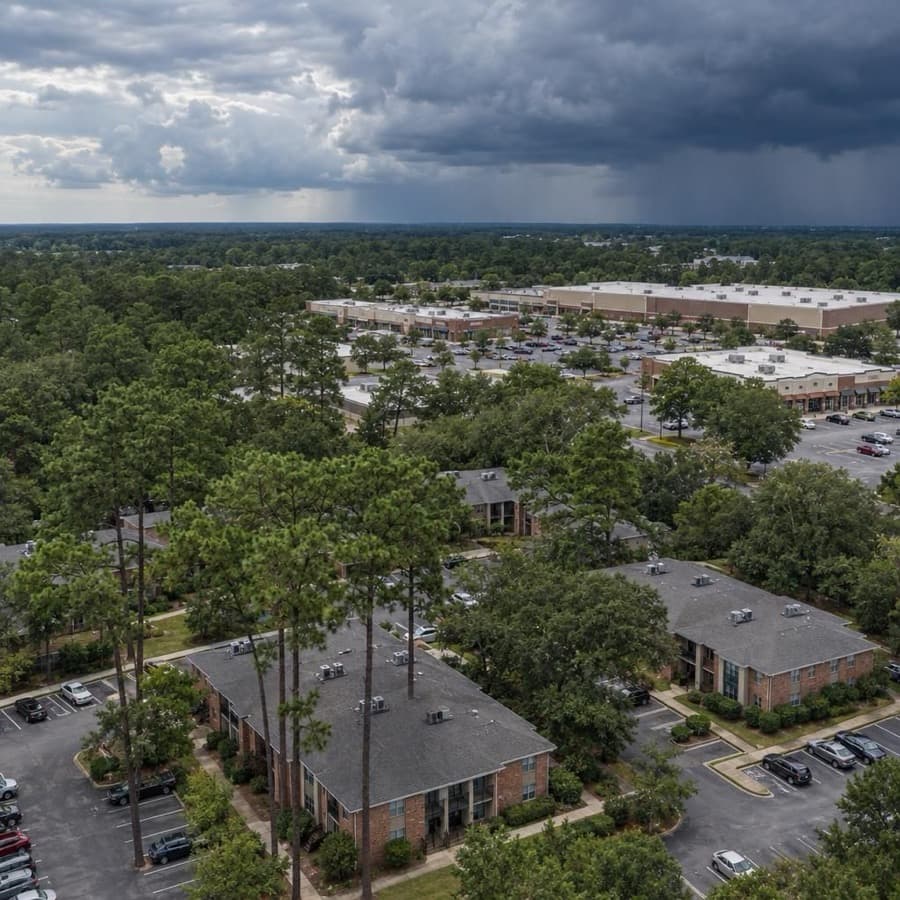
- Hail days near Greenville since 2010, the most in South Carolina
- 89
- Largest hail reported, near Myrtle Beach
- 4.5 in
- South Carolina cities tracked
- 6
Source: NOAA/NWS Storm Prediction Center
Data through November 1, 2026
South Carolina cities by hail days
Source: NOAA/NWS Storm Prediction Center
Data through November 1, 2026
| City | Hail days since 2010 | Largest hail |
|---|---|---|
| Greenville | 89 | 3.0 in |
| Spartanburg | 64 | 2.5 in |
| Charleston | 57 | 2.75 in |
| Columbia | 43 | 2.75 in |
| Myrtle Beach | 40 | 4.5 in |
| Hilton Head Island | 15 | 2.5 in |
About this data
- Each city counts reports within 15 miles of its center, not of any one property.
- Reports come from trained spotters and the public, so they cluster near towns and roads.
- No report does not mean no hail. Hail can fall where no one is there to report it.
- This is not a damage or insurance assessment.
Storm risk in South Carolina
For commercial and multifamily buildings in South Carolina, damaging thunderstorm wind and hail are the most frequent storm risks, hurricanes and tropical storms bring the largest losses on the coast and heavy rain far inland, and tornadoes, flooding and ice follow. South Carolina ranks 8th in the US for tornadoes per square mile, and its 30 hurricane strikes from 1851 to 2018 trail only Florida, Texas, North Carolina and Louisiana.5,6
How often storms hit South Carolina
| Hazard | How often | What it means for buildings |
|---|---|---|
| Hail | Hail days since 2010 within 15 miles of the city center: Greenville 89, Spartanburg 64, Charleston 57, Columbia 43, Myrtle Beach 40 and Hilton Head Island 15. The largest was 4.5 inches near Myrtle Beach. | Roof covers, skylights and rooftop HVAC condenser fins take the hits, and the same roof can be struck more than once in a season. |
| Damaging thunderstorm wind | Wind damage reports on 64 days a year on average within 124 nautical miles of the Greenville-Spartanburg radar and on 63 days around the Columbia radar (1980 to 2006). | Straight-line gusts peel roof edges and membranes, shift rooftop units, break windows and drop trees on buildings and parking. |
| Tornadoes | 14 a year on average from 1950 to 2019, and 25 a year from 1994 to 2019 as radar detection improved. Most are EF0 or EF1, but stronger tornadoes come 2 to 4 times a year. | Most are weak, including those spun up by tropical storms, and damage roofs and siding; strong ones are rare at any one site but can destroy buildings. |
| Hurricanes and tropical storms | 30 hurricanes struck South Carolina from 1851 to 2018, 5 of them major (Category 3 or stronger). | Coastal buildings face wind, windborne debris and storm surge, and slow storms bring flooding rain well inland. |
| Flooding | Streams flood somewhere in the state every year. River flooding can come in any month but is most likely with slow-moving tropical cyclones. | Water reaches ground floors, basements, mechanical rooms and site work, and storm surge adds to it on the coast. |
| Ice and winter storms | Sleet and freezing rain come 3.75 times a year in Chesterfield County and less than 0.75 times a year in the Lowcountry. Measurable snow falls one to three times a winter outside the Lowcountry. | Freezing rain breaks wires and poles and brings down trees, and cold snaps freeze pipes and sprinkler lines. |
The city counts are days with at least one hail report within 15 miles of each city's center since 2010, so they show how often hail falls near a city, not on one building. The State Climatology Office's rate for one spot is far lower: 1 to 1.5 hail days a year in the Midlands, Piedmont and Foothills and 0.5 in the Lowcountry. The Storm Prediction Center figures cover a much larger circle, 124 nautical miles around each radar, and come from 1980 to 2006 reports.1,4,2,3
Rules owners in South Carolina should know
- Wind pool: the South Carolina Wind and Hail Underwriting Association sells wind and hail coverage only in the coastal area that state law defines, parts of Beaufort, Colleton, Charleston, Georgetown and Horry Counties (S.C. Code 38-75-310), to owners who can't buy it in the standard market. Commercial risks can be insured for up to $2.5 million per location, counting building, contents and business income.7,8,9
- Wind pool eligibility: farm and manufacturing property, buildings over water, and buildings begun on or after September 15, 1971 that were not built in substantial compliance with the building code, including its design-wind requirements, are ineligible. A new policy or a limit increase takes effect on the 16th calendar day after it is submitted, except a new policy at a closing with a new mortgage.10,7
- Deductible disclosure: an insurer may not issue or renew a personal or commercial property policy with a hurricane, named storm or wind/hail deductible unless it shows how the deductible works on a $100,000 policy and prints a warning on the policy face and declarations page. Adding or raising one at renewal needs the named insured's signature or initials, and only a storm named by the National Weather Service or National Hurricane Center can trigger a named storm deductible (S.C. Code Regs. 69-56).11
- Mitigation notice: every new and renewed South Carolina commercial property policy must include a notice that a lower premium may be available for steps taken to prevent or reduce windstorm damage (S.C. Code 38-75-755).12
- Building codes: every South Carolina county and city must enforce the building codes the Building Codes Council adopts (S.C. Code 6-9-10). The 2021 editions with state changes have applied since January 1, 2023, and the 2024 South Carolina codes take effect January 1, 2027.13,14,15
- Suit deadline: a lawsuit on a contract, or on a fire insurance policy or a loss under it, must be filed within three years, whatever the policy says (S.C. Code 15-3-530), and a clause setting a shorter period does not bar a suit filed within that time (S.C. Code 15-3-140).16,17
- Attorneys' fees: if an insurer refuses to pay a covered claim within 90 days after the policyholder's demand and the trial judge finds the refusal was without reasonable cause or in bad faith, the insurer owes reasonable attorneys' fees of up to one third of the judgment (S.C. Code 38-59-40).18
Before the next storm
- Evacuation zone: look up each coastal property on SCEMD's Know Your Zone map. State and local authorities announce hurricane evacuations by these zones, which show storm surge risk.21
- Coverage timing: put coverage in place before hurricane season, which runs June 1 to November 30. The South Carolina Department of Insurance says insurers typically freeze new policies and coverage changes once a storm is named and likely to hit, and a new flood policy has at least a 30-day waiting period.24,19,20
- Hail-rated roofs: when reroofing, choose low-slope covers rated FM 4470 Class 1-SH or UL 2218 Class 4 and fit hail guards over condenser fins and air intakes, as IBHS recommends, because Greenville has had hail on 89 days since 2010.22,1
- Roof edges: IBHS calls for edge flashing, coping and counterflashing that meet ANSI/SPRI/FM 4435/ES-1 for the site's design wind pressures, because thunderstorm wind damage is reported on more than 60 days a year around the Columbia and Greenville-Spartanburg radars.22,2,3
- Freeze plan: heat sprinkler control valve rooms, insulate pipes that enter through exterior walls, and keep vacant space at 55°F or warmer and never below 40°F, as IBHS advises. IBHS notes that pipes in southern buildings often run outside the insulation.23
Sources
Written by the Cloudbreak team. Numbers, dates and rules cite the published sources below.
- 1. Cloudbreak: NOAA/NWS Storm Prediction Center storm reports, as counted on the Cloudbreak hail history page for South Carolina
- 2. NOAA Storm Prediction Center: CAE (Columbia) Severe Weather Climatology, 1980 to 2006
- 3. NOAA Storm Prediction Center: GSP (Greenville-Spartanburg) Severe Weather Climatology, 1980 to 2006
- 4. South Carolina State Climatology Office (SC Department of Natural Resources): South Carolina Climate
- 5. South Carolina Emergency Management Division (SCEMD): Tornadoes
- 6. NOAA Hurricane Research Division (Chris Landsea, NHC): TCFAQ E19: How many direct hits by hurricanes of various categories have affected each state?
- 7. South Carolina Legislature (text via Justia): South Carolina Code Section 38-75-310, Definitions (Wind and Hail Underwriting Association)
- 8. South Carolina Wind and Hail Underwriting Association: About Us
- 9. South Carolina Wind and Hail Underwriting Association: Q & A
- 10. South Carolina Wind and Hail Underwriting Association: Rates, Rules, and Forms Manual, November 2025 Edition
- 11. South Carolina Department of Insurance (text via Cornell LII): S.C. Code Regs. 69-56, Hurricane, Named Storm or Wind/Hail Deductible
- 12. South Carolina Legislature (text via Justia): South Carolina Code Section 38-75-755, Notification to applicants or renewing policyholders
- 13. South Carolina Legislature: South Carolina Code Title 6, Chapter 9, Building Codes (Section 6-9-10)
- 14. South Carolina Building Codes Council (SC LLR): Building Codes in Effect for South Carolina
- 15. South Carolina Department of Labor, Licensing and Regulation: South Carolina Building Codes Council
- 16. South Carolina Legislature (text via Justia): South Carolina Code Section 15-3-530, Three years
- 17. South Carolina Legislature (text via Justia): South Carolina Code Section 15-3-140, Contract provision shortening statutory period
- 18. South Carolina Legislature (text via Justia): South Carolina Code Section 38-59-40, Liability for attorneys' fees where insurer has refused to pay claim
- 19. South Carolina Department of Insurance: Hurricane Preparedness
- 20. South Carolina Department of Insurance: Pre-Disaster Planning
- 21. South Carolina Emergency Management Division (SCEMD): Know Your Zone
- 22. Insurance Institute for Business & Home Safety (IBHS): Commercial Roofs Best Practices Guide
- 23. Insurance Institute for Business & Home Safety (IBHS): Commercial Risk Engineering Bulletin: Winter Weather
- 24. NOAA National Hurricane Center: Tropical Cyclone Climatology
Storms in South Carolina
SPC counts for 1980 to 2006 around the Columbia and Greenville-Spartanburg radars show hail reports peaking in May and damaging wind reports peaking in June and July.1,2 A tropical cyclone affected South Carolina in 42 of the 50 years from 1976 to 2025, and most arrive in September and October.3,4
Notable storms
- September 27, 2024Helene's wind gusts and flooding did the most damage in the northwest mountains and western Piedmont, and Laurens measured a 67-knot (77 mph) gust. Greenville County had 50 homes and buildings destroyed and 650 with major damage, and Anderson County 53 destroyed and 642 with major damage. NHC counts 24 wind deaths in the state.5
- April 20, 2024Hail from 2 inches to baseball size fell from York through Rock Hill, driven by downburst gusts near 90 mph. In Rock Hill the hail broke windows and tore up roofs and siding, and hundreds of structures and thousands of vehicles were damaged. NOAA's Storm Events Database lists $25 million in property damage from the hail.6,7
- April 13, 2020An EF4 tornado with 175 mph winds tracked about 24 miles through Hampton County, destroying homes near Estill and Nixville, killing 5 people and injuring 60. An EF3 tornado damaged numerous homes in Seneca and killed 1 person, and NOAA's Storm Events Database lists $100 million in property damage from it.8,9
- October 8, 2016Hurricane Matthew made landfall just south of McClellanville as a Category 1 hurricane with 75-knot (86 mph) winds. Many Horry County homes lost siding and shingles, and county emergency managers put damage above $67 million. Georgetown County had 5 structures destroyed and 54 with major damage.10,11,12
- May 23, 2014Hail up to 3 inches across broke car windshields in Union, and golf ball size hail hit west Spartanburg and north Rock Hill. NOAA's Storm Events Database lists $3 million in property damage in each of those two areas.13,14,15
- May 10, 2011Softball size hail, 4.5 inches across, damaged homes and vehicles near Highway 501 by Conway and also fell at Hannah in Florence County and near New Hope in Georgetown County. Baseball size hail damaged dozens of cars in Woodcreek in Horry County.16,17,18,19
Warnings and alerts
NWS Greenville-Spartanburg covers the northwest counties, NWS Columbia the middle of the state, NWS Charleston the southern counties from Berkeley and Charleston to Beaufort and Jasper, and NWS Wilmington, North Carolina, the northeast counties including Florence, Horry and Georgetown.20 The South Carolina Emergency Management Division sends CodeRED alerts by phone, text and email to people who enroll online.21
Sources
- 1. NOAA Storm Prediction Center: CAE Severe Weather Climatology
- 2. NOAA Storm Prediction Center: GSP Severe Weather Climatology
- 3. South Carolina State Climatology Office: South Carolina Hurricanes Comprehensive Summary
- 4. South Carolina State Climatology Office: Early Season South Carolina Hurricanes
- 5. National Hurricane Center: Tropical Cyclone Report: Hurricane Helene
- 6. NOAA NCEI: Storm Events Database: York County hail, April 20, 2024
- 7. NOAA NCEI: Storm Events Database: Rock Hill downburst, April 20, 2024
- 8. NOAA NCEI: Storm Events Database: Hampton County EF4 tornado, April 13, 2020
- 9. NOAA NCEI: Storm Events Database: Oconee County EF3 tornado, April 13, 2020
- 10. National Hurricane Center: Tropical Cyclone Report: Hurricane Matthew
- 11. NOAA NCEI: Storm Events Database: Hurricane Matthew in coastal Horry County, October 8, 2016
- 12. NOAA NCEI: Storm Events Database: Hurricane Matthew in coastal Georgetown County, October 8, 2016
- 13. NOAA NCEI: Storm Events Database: Union County hail, May 23, 2014
- 14. NOAA NCEI: Storm Events Database: Spartanburg hail, May 23, 2014
- 15. NOAA NCEI: Storm Events Database: Rock Hill hail, May 23, 2014
- 16. NOAA NCEI: Storm Events Database: Horry County hail near Conway, May 10, 2011
- 17. NOAA NCEI: Storm Events Database: Florence County hail at Hannah, May 10, 2011
- 18. NOAA NCEI: Storm Events Database: Georgetown County hail near New Hope, May 10, 2011
- 19. NOAA NCEI: Storm Events Database: Horry County hail in Woodcreek, May 10, 2011
- 20. National Weather Service: South Carolina County Warning Forecast Areas
- 21. South Carolina Emergency Management Division: CodeRED Alerts
Hail history in other states
- Alabama
- Alaska
- Arizona
- Arkansas
- California
- Colorado
- Connecticut
- District of Columbia
- Florida
- Georgia
- Hawaii
- Idaho
- Illinois
- Indiana
- Iowa
- Kansas
- Kentucky
- Louisiana
- Maine
- Maryland
- Massachusetts
- Michigan
- Minnesota
- Mississippi
- Missouri
- Montana
- Nebraska
- Nevada
- New Hampshire
- New Jersey
- New Mexico
- New York
- North Carolina
- North Dakota
- Ohio
- Oklahoma
- Oregon
- Pennsylvania
- Rhode Island
- South Dakota
- Tennessee
- Texas
- Utah
- Virginia
- Washington
- West Virginia
- Wisconsin
- Wyoming