Hail history in Arizona
We counted the days with NOAA hail reports within 15 miles of the center of 3 Arizona cities since 2010.
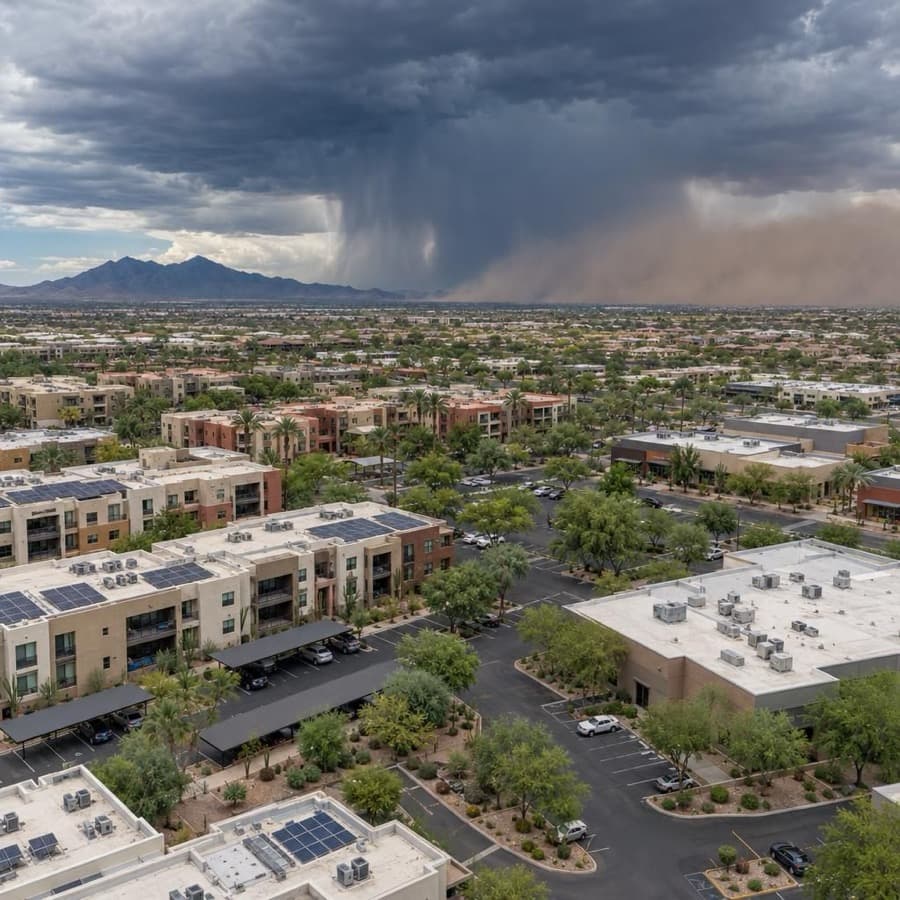
- Hail days near Tucson since 2010, the most in Arizona
- 36
- Largest hail reported, near Phoenix
- 2.5 in
- Arizona cities tracked
- 3
Source: NOAA/NWS Storm Prediction Center
Data through November 1, 2026
Arizona cities by hail days
Source: NOAA/NWS Storm Prediction Center
Data through November 1, 2026
| City | Hail days since 2010 | Largest hail |
|---|---|---|
| Tucson | 36 | 1.75 in |
| Phoenix | 25 | 2.5 in |
| Prescott Valley | 24 | 1.75 in |
About this data
- Each city counts reports within 15 miles of its center, not of any one property.
- Reports come from trained spotters and the public, so they cluster near towns and roads.
- No report does not mean no hail. Hail can fall where no one is there to report it.
- This is not a damage or insurance assessment.
Storm risk in Arizona
For commercial and multifamily buildings in Arizona, the storm risks that matter most are monsoon thunderstorm wind, then hail, flash flooding and wildfire; tornadoes are rare and mostly weak. Severe storms come far less often than on the Plains, with severe weather reports on 29 days a year on average around the Phoenix radar against 80 around Oklahoma City, but one storm can be very costly: NOAA's records put property damage from the October 5, 2010 Phoenix hail and wind storms at $2.811 billion.2,4,5
How often storms hit Arizona
| Hazard | How often | What it means for buildings |
|---|---|---|
| Damaging thunderstorm wind | Damaging wind reports on 22 days a year on average within 124 nautical miles of the Phoenix radar and 19 around Tucson (1980 to 2006). NWS Phoenix says the strongest monsoon gusts can exceed 100 mph and do damage similar to a tornado. | Downbursts lift roof edges and membranes, shift rooftop units and signs, and throw loose items into glass. Thunderstorm outflow also raises dust storms. |
| Hail | Hail days since 2010 within 15 miles of the city center: Tucson 36, Phoenix 25, Prescott Valley 24, with hail up to 2.5 inches near Phoenix. Large hail reports on 11 days a year on average around the Phoenix radar and 8 around Tucson (1980 to 2006). | Less frequent than wind, but costly when it hits a metro. On October 5, 2010, hail estimated at upwards of 2 inches punctured 34 skylights at one Phoenix warehouse, and thousands of roofs were damaged. |
| Flooding | Monsoon rain varies widely from year to year, and rain tied to a decaying eastern Pacific hurricane flooded the Phoenix area on September 8, 2014. | Flash floods fill washes, underpasses and low parking and ground floors within minutes. FEMA says flood risk stays much higher below a burn area for up to 5 years after a wildfire. |
| Wildfire | Drought covered much or all of the state from 2002 to 2025, and the 2011 Wallow Fire burned more than 500,000 acres, the largest on state record. | Embers and flames ignite roofs, vents and landscaping near wildland edges, and the burn scar raises flood and debris flow risk downstream. |
| Tornadoes | Reports on about 2 days a year within 124 nautical miles of the Phoenix radar; 3 of the 73 tornadoes reported there from 1980 to 2006 were rated F2 or stronger. | Most are brief and weak, so straight-line thunderstorm wind is the larger threat to roofs and rooftop equipment. |
The city counts are days with at least one hail report within 15 miles of each city's center since 2010, so they show how often hail falls near a city, not on one building. The Storm Prediction Center radar figures cover a much larger circle, 124 nautical miles around each radar, and come from 1980 to 2006 reports.1,2,3
For an owner, wind is the everyday storm risk and hail is the rare but expensive one. Both arrive with the same summer thunderstorms that cause flash floods, so roof, rooftop equipment and drainage problems tend to show up together after one storm.
Rules owners in Arizona should know
- Deadline to sue: Under A.R.S. 20-1115, the time to sue on an Arizona property policy is one year from the date of the event that caused the loss, unless the insurer extends it in the policy. Most other insurance may not set a limit under two years.9
- Claim handling times: Arizona's claims rule (A.A.C. R20-6-801) requires an insurer to acknowledge a claim within 10 working days, finish investigating within 30 days unless that can't reasonably be done, and accept or deny within 15 working days after a properly executed proof of loss. If it needs more time it must say why, then write again every 45 days.10
- Time limit warning: The same rule bars an insurer from continuing settlement talks with a first party claimant who has no attorney until a policy or statute time limit runs, without written notice 30 days before the limit may expire.10
- Floodplain building rule: Arizona county flood control districts, and cities that take over floodplain management, must require commercial and industrial buildings in a floodplain to be flood proofed or elevated to the regulatory flood elevation, and residential buildings to have the lowest floor at or above it. That elevation is one foot above the base flood elevation (A.R.S. 48-3609 and 48-3601).11,12
- Repairs to older buildings: Under A.R.S. 48-3609, an addition, alteration or repair that raises a nonconforming building's flood damage potential by fifty percent or more must be flood proofed or elevated to the regulatory flood elevation.11
Before the next storm
- Monsoon wind check: NWS Phoenix advises securing or moving indoors loose outdoor items before the monsoon, since even weak storms blow them around. On the roof, IBHS calls for rooftop equipment attached for ASCE 7 wind loads and edge flashing and coping that meet ANSI/SPRI/FM 4435/ES-1.6,13
- Hail-rated skylights: IBHS recommends skylights rated FM 4431 Severe Hail or ASTM E1996 impact rated, hail guards over condenser fins, and low-slope roof covers rated FM 4470 Class 1-SH or UL 2218 Class 4, because hail through an unrated skylight lets rain into the building.13
- Flood policy timing: A new NFIP flood policy generally starts after a 30-day waiting period. FEMA waives the wait for private property flooded because of a wildfire on federal land if the policy was bought before the fire was contained or within 60 days after.8,14
Sources
Written by the Cloudbreak team. Numbers, dates and rules cite the published sources below.
- 1. Cloudbreak: NOAA/NWS Storm Prediction Center storm reports, as counted on the Cloudbreak hail history page for Arizona
- 2. NOAA Storm Prediction Center: IWA (Phoenix) Severe Weather Climatology, 1980 to 2006
- 3. NOAA Storm Prediction Center: EMX (Tucson) Severe Weather Climatology, 1980 to 2006
- 4. NOAA Storm Prediction Center: TLX (Oklahoma City) Severe Weather Climatology, 1980 to 2006
- 5. NOAA NCEI: Storm Events Database: Hail, Maricopa County, October 5, 2010
- 6. NWS Phoenix: Monsoon Safety Page
- 7. NOAA NCEI and North Carolina Institute for Climate Studies: Arizona: 2025 State Climate Summaries
- 8. FEMA: Flood Risks Increase After Fires (fact sheet)
- 9. Arizona State Legislature: A.R.S. 20-1115: Void policy restrictions
- 10. Arizona Department of Insurance and Financial Institutions (text via Cornell LII): Ariz. Admin. Code R20-6-801: Unfair Claims Settlement Practices
- 11. Arizona State Legislature: A.R.S. 48-3609: Floodplain delineation; regulation of use
- 12. Arizona State Legislature: A.R.S. 48-3601: Definitions (regulatory flood elevation)
- 13. Insurance Institute for Business & Home Safety (IBHS): Commercial Roofs Best Practices Guide
- 14. FEMA (Code of Federal Regulations): 44 CFR 61.11: Effective date and time of coverage under the Standard Flood Insurance Policy
Storms in Arizona
An NWS Tucson study of Arizona's hazardous weather finds damaging hail most common from June through August, with many very large hail reports in September, and thunderstorm wind reports clustered in July and August, the peak of the monsoon.1 Severe thunderstorm wind reports are most concentrated in the state's southernmost climate regions, the same study says.1
Notable storms
- October 21, 2026A supercell crossed central Phoenix near Interstate 17 with hail up to 2 inches across that dented vehicles, shattered auto glass and broke residential windows. The night before, another supercell brought 1 to 2 inch hail to Chandler and Mesa. NWS Phoenix called the October 20 to 22 outbreak Arizona's most significant severe weather since October 2010.2
- November 19, 2025Two supercells crossed Phoenix. One left several inches of small hail on Interstate 10 at 75th Avenue in Tolleson, and the other dropped hail up to 1.75 inches on Loop 202 in Ahwatukee and Tempe, denting some cars, NWS Phoenix said.3
- July 14, 2024A line of intense thunderstorms crossed Tucson from midtown northwest into Marana, with a measured gust of 66 knots (76 mph). NOAA's Storm Events Database lists $25 million in property damage, including roof and building damage across the Tucson metro area.4
- October 8, 2016A late night storm dropped hail up to 2.5 inches across Safford and Solomon, damaging homes and vehicles. Some Safford schools stayed closed for two weeks for repairs. NOAA's Storm Events Database lists $1.5 million in property damage.5
- October 6, 2010At least 11 tornadoes touched down in northern Arizona that morning, the largest tornado outbreak in state history, NWS Flagstaff said, and hail up to baseball size was reported. One tornado damaged over 100 homes in Bellemont.6,7
- October 5, 2010Supercells crossed metro Phoenix with hail up to 3 inches across. One storm dropped golf ball to baseball size hail from south of Chandler to Glendale and Peoria, damaging thousands of roofs and vehicles. NOAA's Storm Events Database lists $1.8 billion in property damage from that storm.8,9
Warnings and alerts
NWS offices in Phoenix, Tucson and Flagstaff cover most of Arizona, and NWS Las Vegas covers Mohave County.10 The state's Arizona Emergency Information Network links to each county's emergency alert sign-up.11
Sources
- 1. NWS Tucson: Hazardous Weather Climatology for Arizona (NOAA Technical Memorandum NWS WR-282)
- 2. NWS Phoenix: October 20-22, 2026: Supercells with Large Hail and Damaging Winds
- 3. NWS Phoenix: November 17-20, 2025: Flooding, Large & Accumulating Hail, and Tornado
- 4. NOAA NCEI: Storm Events Database: Thunderstorm Wind, Pima County, July 14, 2024
- 5. NOAA NCEI: Storm Events Database: Hail, Graham County, October 8, 2016
- 6. NWS Flagstaff: Tornadoes October 2010
- 7. NWS Flagstaff: Month in Review for Northern Arizona, October 2010
- 8. NWS Phoenix: October 5, 2010 - Largest Hail Recorded in Phoenix
- 9. NOAA NCEI: Storm Events Database: Hail, Maricopa County, October 5, 2010
- 10. National Weather Service: NWS public forecast zones, Western Region
- 11. Arizona Emergency Information Network (Arizona DEMA): Ready, Set, Go!
Hail history in other states
- Alabama
- Alaska
- Arkansas
- California
- Colorado
- Connecticut
- District of Columbia
- Florida
- Georgia
- Hawaii
- Idaho
- Illinois
- Indiana
- Iowa
- Kansas
- Kentucky
- Louisiana
- Maine
- Maryland
- Massachusetts
- Michigan
- Minnesota
- Mississippi
- Missouri
- Montana
- Nebraska
- Nevada
- New Hampshire
- New Jersey
- New Mexico
- New York
- North Carolina
- North Dakota
- Ohio
- Oklahoma
- Oregon
- Pennsylvania
- Rhode Island
- South Carolina
- South Dakota
- Tennessee
- Texas
- Utah
- Virginia
- Washington
- West Virginia
- Wisconsin
- Wyoming