Hail history in Nevada
We counted the days with NOAA hail reports within 15 miles of the center of 2 Nevada cities since 2010.
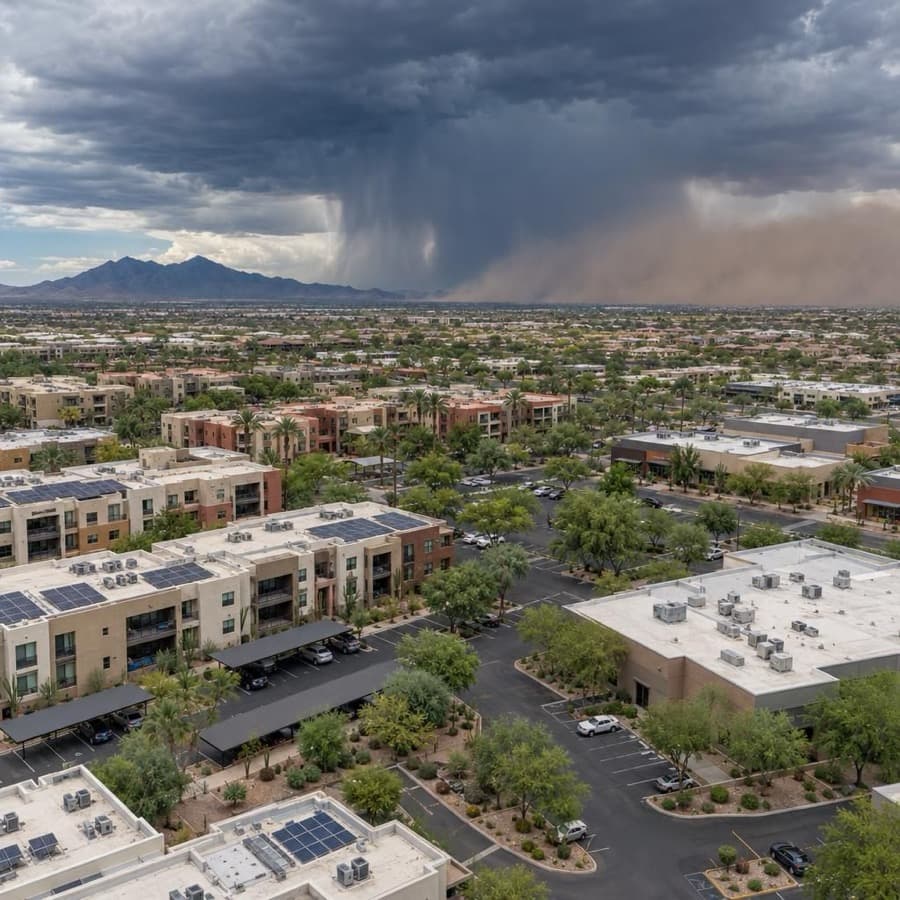
- Hail days near Las Vegas since 2010, the most in Nevada
- 21
- Largest hail reported, near Las Vegas
- 2.0 in
- Nevada cities tracked
- 2
Source: NOAA/NWS Storm Prediction Center
Data through November 1, 2026
Nevada cities by hail days
Source: NOAA/NWS Storm Prediction Center
Data through November 1, 2026
| City | Hail days since 2010 | Largest hail |
|---|---|---|
| Las Vegas | 21 | 2.0 in |
| Reno | 9 | 1.5 in |
About this data
- Each city counts reports within 15 miles of its center, not of any one property.
- Reports come from trained spotters and the public, so they cluster near towns and roads.
- No report does not mean no hail. Hail can fall where no one is there to report it.
- This is not a damage or insurance assessment.
Storm risk in Nevada
For commercial and multifamily buildings in Nevada, the weather hazards that matter most are flooding and wildfire, which the state hazard mitigation plan rates high risk, then straight-line wind and winter storms at medium risk. Hail, thunderstorms and tornadoes rate low.2 Nevada ranks 41st of the 50 states for tornadoes, and the plan describes hailstorms as generally very localized. It also notes that flood damage occurs regularly and that every county is exposed to windstorms that have damaged property.2
How often storms hit Nevada
| Hazard | How often | What it means for buildings |
|---|---|---|
| Hail | Hail days since 2010 within 15 miles of the city center: Las Vegas 20, with hail up to 2 inches, and Reno 9, with hail up to 1.5 inches. | Hail cracks roof covers and skylights and bends the fins on rooftop condensers, which can stop a unit from working. |
| Damaging wind | Strong cold fronts can bring widespread gusts over 60 mph, and thunderstorms add local downbursts. Clark County averages 26 thunderstorms a year, by State Climatologist counts. | Wind damages roofs, signs and rooftop equipment. FEMA says the roof edge takes more wind uplift and wind-driven rain than the rest of a low-slope roof. |
| Tornadoes | Roughly 1 to 2 touchdowns in an average year (1991 to 2015). Every tornado on record that caused injury or damage was rated EF0 to EF2. | A direct hit on one building is rare, but tornadoes rated EF1 and higher typically cause property damage. |
| Flooding | Rated high risk, and the plan puts the chance of future damaging floods as high. Cloudbursts send flash floods down dry washes and alluvial fans, and warm rain on snow swells rivers. | Water and debris reach ground floors, parking and site work. The Nevada Division of Water Resources says about 25 percent of flood damage occurs outside mapped high-risk zones. |
| Winter storms and cold | Snow, rain and windstorms come every winter in northern and central Nevada. Southern Nevada is used to strong wind but less used to heavy snow. | Drifted snow loads roofs in the north. In warm-climate buildings, IBHS says pipes often run outside the insulation, so rare cold snaps can freeze and burst them. |
| Wildfire | Rated high risk. Since 1985, Nevada has had nine fire years with more than 500,000 acres burned. | Embers can travel long distances and land on roofs or blow into vents, IBHS says, so buildings away from the fire front can still ignite. |
The city counts are days with at least one hail report within 15 miles of each city's center since 2010, so they show how often hail falls near a city, not on one building. The high, medium and low ratings are the ones Nevada's 2023 state hazard mitigation plan assigns to each hazard.1,2
For an owner, the pattern is frequent wind damage to roofs and rooftop equipment, with flash floods and wildfire rarer at any one site but able to put a building out of use.
Rules owners in Nevada should know
- Claim deadlines: an insurer must acknowledge a claim within 20 working days (NAC 686A.665) and accept or deny it within 30 working days after receiving proof of loss, or say in writing why it needs more time and update the claimant every 30 days. An accepted claim must be paid within 30 days, with interest at the NRS 99.040 rate if late, and any part not in dispute must be paid despite a dispute over the rest (NAC 686A.675).7,8
- Deadline warning: an insurer working out a settlement directly with a claimant who has no attorney must give written notice at least 60 days before a statute of limitations or a policy time limit may expire (NAC 686A.675).8
- Unfair claim practices: NRS 686A.310 lists practices such as failing to affirm or deny coverage within a reasonable time after proof of loss, and offering substantially less than an insured later recovers in court, and makes the insurer liable to its insured for damages those practices cause.9
- Nonrenewal notice: an insurer must give at least 60 days' notice before declining to renew a commercial or business policy, or else renew it on identical terms (NRS 687B.340). A renewal with changed coverage or rates needs 30 days' written notice (NRS 687B.350), and if a notice does not state its reasons with reasonable precision, the insurer must supply them within 6 days of a written request (NRS 687B.360).10
Before the next storm
- Flood zone check: in Clark County, the Regional Flood Control District's Flood Zone tool shows whether a property sits in a 100-year flood zone. A site outside the zone can still flood, so note where washes and drainage ways run past the building.11,4
- Flood timing: arrange or change flood coverage early, since FEMA says an NFIP policy typically takes effect 30 days after purchase.12
- Roof inspections: have low-slope roofs inspected in spring, in fall and after high winds, edges and rooftop equipment first. FEMA singles out the roof border as the part most at risk from wind uplift.3
- Hail guards: fit guards over condenser fins and air intakes on rooftop units. IBHS recommends them for any rooftop component that hail could damage enough to impair its operation.6
- Fire-rated roofs: when replacing a roof in a wildfire-prone area, use a Class A fire-rated cover and check whether the rating is by assembly, which needs extra layers under the cover. IBHS rates Class A as the best protection from embers.6
Sources
Written by the Cloudbreak team. Numbers, dates and rules cite the published sources below.
- 1. Cloudbreak: NOAA/NWS Storm Prediction Center storm reports, as counted on the Cloudbreak hail history page for Nevada
- 2. Nevada Division of Emergency Management: 2023 Nevada Enhanced State Hazard Mitigation Plan
- 3. FEMA: FEMA P-2181, Fact Sheet 3.3.2: Roof Systems, Low-Slope Roofs (March 2022)
- 4. Nevada Division of Water Resources: The National Flood Insurance Program in Nevada: Quick Guide
- 5. Insurance Institute for Business & Home Safety (IBHS): Commercial Risk Engineering Bulletin: Winter Weather
- 6. Insurance Institute for Business & Home Safety (IBHS): Commercial Roofs Best Practices Guide
- 7. Nevada Division of Insurance (text via Cornell LII): NAC 686A.665: Insurer to acknowledge receipt of claim notice within certain period
- 8. Nevada Division of Insurance (text via Cornell LII): NAC 686A.675: Standards applicable to all insurers
- 9. Nevada Legislature: NRS Chapter 686A, including NRS 686A.310: Unfair practices in settling claims; liability of insurer for damages
- 10. Nevada Legislature: NRS Chapter 687B, including NRS 687B.340 to 687B.360: Nonrenewals and notices
- 11. Clark County Regional Flood Control District: Floodplain Management (FloodView and Flood Zone tools)
- 12. FEMA: Waiting Period for Activating Flood Policy?
Storms in Nevada
In Las Vegas, thunderstorms come mainly with the monsoon in July and August, averaging 4.5 thunderstorm days in July and 3.8 in August, and their gusty winds sometimes cause damage.1,2 Windstorms with widespread gusts over 50 mph hit the lee side of the Sierra Nevada, including the Reno area, 3 to 6 times per winter on average, NWS Reno says.3
Notable storms
- July 15, 2026Hail of golf ball to baseball size, up to 2.75 inches, fell in a swath several hundred yards wide on US 93 just north of Contact in Elko County.4
- May 15, 2021Hail up to 1.5 inches fell in Eureka County, and 1-inch hail damaged windows, homes and vehicles in the town of Eureka. NOAA's Storm Events Database lists $500,000 in property damage.5,6
- June 30, 2016Hail of 1 to 2 inches fell in a swath across the Las Vegas Valley and damaged numerous vehicles. NOAA's Storm Events Database lists $50 million in property damage for the hail.7
- February 6, 2015Gusts of 60 to 79 mph spread from Minden north to the Palomino Valley, with 80 to 90 mph southwest of Gardnerville and over 100 mph at Galena. Numerous roofs and fences were damaged.8
- July 19, 2013Severe storms raked the Las Vegas Valley for over an hour, with a 62-knot (71 mph) gust at Nellis Air Force Base. Falling trees damaged buildings and vehicles, and several other buildings were damaged. NOAA's Storm Events Database lists $2 million in property damage.9
- July 15, 2012Hail up to 1.25 inches fell in a swath from Summerlin to North Las Vegas, damaging vehicles. NOAA's Storm Events Database lists $50 million in property damage.10
Warnings and alerts
NWS Reno covers western Nevada, NWS Elko covers northern and central Nevada, and NWS Las Vegas covers Clark, Lincoln, Esmeralda and southern Nye counties.11
Sources
- 1. NWS Las Vegas: Climate of Las Vegas
- 2. NWS Las Vegas: Average Number of Days With Thunderstorms, Las Vegas
- 3. NWS Reno: Using the Weather Event Simulator as a Training Tool for Predicting High Winds in the Lee of the Sierra Nevada
- 4. NOAA NCEI: Storm Events Database: Elko County hail, July 15, 2026
- 5. NOAA NCEI: Storm Events Database: Eureka County hail, May 15, 2021
- 6. NOAA NCEI: Storm Events Database: Eureka County hail, May 15, 2021 (1.5 inches)
- 7. NOAA NCEI: Storm Events Database: Clark County hail, June 30, 2016
- 8. NOAA NCEI: Storm Events Database: Reno, Carson City and Minden area high wind, February 6, 2015
- 9. NOAA NCEI: Storm Events Database: Clark County thunderstorm wind, July 19, 2013
- 10. NOAA NCEI: Storm Events Database: Clark County hail, July 15, 2012
- 11. National Weather Service: Nevada County Warning Forecast Areas
Hail history in other states
- Alabama
- Alaska
- Arizona
- Arkansas
- California
- Colorado
- Connecticut
- District of Columbia
- Florida
- Georgia
- Hawaii
- Idaho
- Illinois
- Indiana
- Iowa
- Kansas
- Kentucky
- Louisiana
- Maine
- Maryland
- Massachusetts
- Michigan
- Minnesota
- Mississippi
- Missouri
- Montana
- Nebraska
- New Hampshire
- New Jersey
- New Mexico
- New York
- North Carolina
- North Dakota
- Ohio
- Oklahoma
- Oregon
- Pennsylvania
- Rhode Island
- South Carolina
- South Dakota
- Tennessee
- Texas
- Utah
- Virginia
- Washington
- West Virginia
- Wisconsin
- Wyoming