Hail history in Alaska
NOAA hail reports within 15 miles of the center of Anchorage since 2010: 0 hail days.
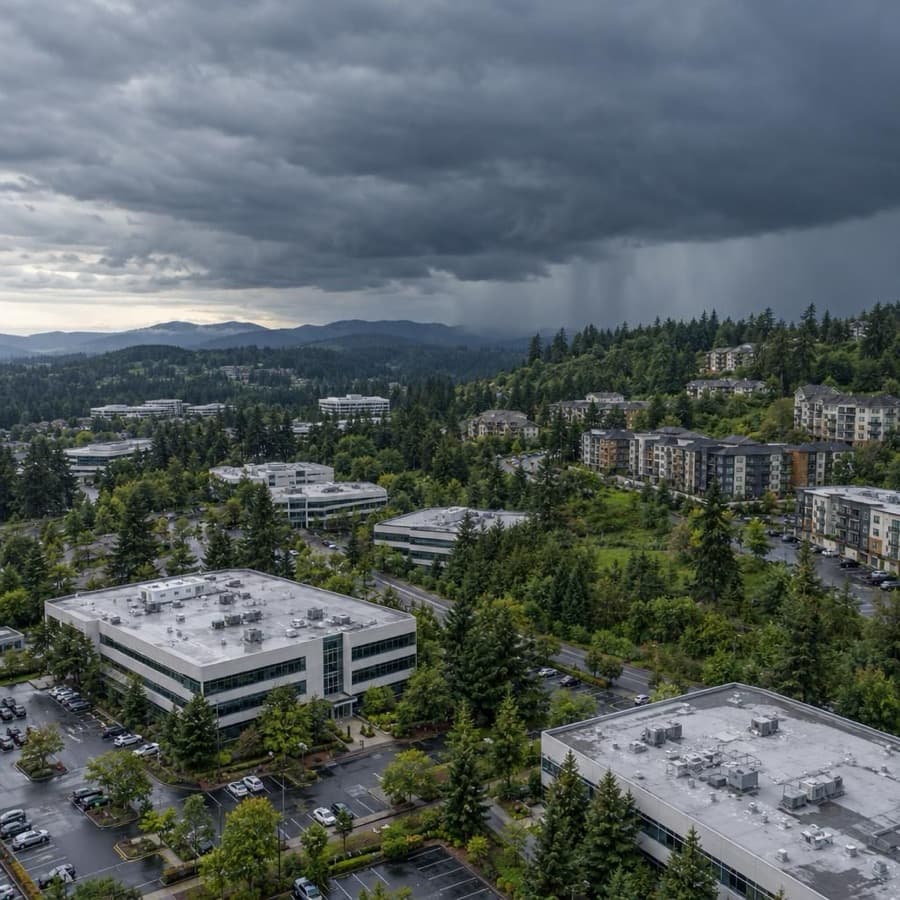
- Hail days near Anchorage since 2010, the most in Alaska
- 0
- Alaska city tracked
- 1
Source: NOAA/NWS Storm Prediction Center
Data through November 1, 2026
Alaska cities by hail days
Source: NOAA/NWS Storm Prediction Center
Data through November 1, 2026
| City | Hail days since 2010 | Largest hail |
|---|---|---|
| Anchorage | 0 | No reports |
About this data
- Each city counts reports within 15 miles of its center, not of any one property.
- Reports come from trained spotters and the public, so they cluster near towns and roads.
- No report does not mean no hail. Hail can fall where no one is there to report it.
- This is not a damage or insurance assessment.
Storm risk in Alaska
Alaska's storm risks for buildings are not hail. They are high wind, coastal storms and storm surge, flooding (the state hazard plan calls it Alaska's most common disaster), heavy snow, extreme cold and wildfire.2 The state plan says Alaska hail is small and fairly rare, and tornadoes are rare and seldom pass the weakest rating, so the hail belt rules of thumb used in the Lower 48 don't fit here.2
How often storms hit Alaska
| Hazard | How often | What it means for buildings |
|---|---|---|
| High wind | Winds above 60 mph occur frequently along the Bering Sea and Gulf of Alaska coasts, and downslope windstorms off mountain slopes can top 120 mph. | Wind tears off roofing and siding, breaks windows, topples rooftop equipment and trees, and drives snow into blizzards. |
| Coastal storms and storm surge | Storm surge is a significant cause of property damage in Alaska. West coast communities usually flood in late summer or early fall, and later sea ice freeze-up raises the risk of erosion and surge. | Surge and waves flood waterfront buildings, and erosion can take the ground out from under them. |
| Flooding | Alaska's most common disaster, often costing more than $1 million a year. Most river flooding comes with spring ice breakup and heavy rain, and near Juneau the ice-dammed lake in Suicide Basin at Mendenhall Glacier has flooded every year since 2011. | Water and ice push into ground floors, foundations and mechanical rooms, and glacial outburst floods have damaged riverside property along the Mendenhall River. |
| Heavy snow and winter storms | Every part of the state is exposed. In tundra regions, high winds can lift fallen snow and pile it against structures. | Excessive snow can collapse roofs and bring down trees and power lines, and drifts load roofs unevenly. |
| Extreme cold | Usually minus 20 to minus 50°F, and it can disrupt infrastructure for days or sometimes weeks. | Water and sewer pipes freeze and rupture, then flood when they thaw, and liquid fuels can congeal, cutting heat and power. |
| Wildfire | 300 to 800 fires a year; from 2017 through 2022, 2,728 fires burned more than 7 million acres. Beetle-killed spruce in southcentral and interior Alaska raises the risk of catastrophic fires. | Development keeps spreading into the wildland urban interface, where embers and burning trees can ignite roofs, decks and walls. |
| Hail | 0 hail days since 2010 within 15 miles of Anchorage's center. Statewide, the conditions needed for damaging hail are highly unusual. | Hail is not a main risk for Alaska buildings. |
Alaska's storm risk depends heavily on location: the west coast faces surge and erosion, river towns face ice jam floods, mountain slopes face downslope wind, and the interior faces wildfire and deep cold. The state plan notes that many floods are not reported or measured and very few communities have a 100-year flood analysis, so the odds of coastal flooding at a given site are hard to put a number on.2
Rules owners in Alaska should know
- Claim deadlines: Under Alaska's unfair claim settlement rules, an insurer must acknowledge a claim in writing within 10 working days (3 AAC 26.040) and accept or deny it in writing within 15 working days after a properly executed proof of loss, unless the policy sets another time. If it needs longer, it must say why and update the claimant at least every 45 working days, and it must pay undisputed portions within 30 working days (3 AAC 26.070).3,4
- Dominant cause: The Alaska Division of Insurance explains that an insurer may not deny a claim when a covered peril is the dominant cause of the loss and an excluded peril played only a secondary part in the chain of causes (AS 21.36.096).3
- Plan review: The Division of Fire and Life Safety is the state building official and applies the 2021 International Building Code (13 AAC 50.020). Construction, repair, remodeling or additions to any building except housing of three units or fewer need State Fire Marshal approval before work starts, and starting early brings an extra fee equal to the review fee. Anchorage, Fairbanks, Juneau and several other communities review plans locally.5,6
- Anchorage design loads: Anchorage replaces the national wind map with its own Three Second Gust Wind Zone Map (AMC 23.15.1609.3), whose zones set minimum design wind speeds from 120 to 165 mph. City design data call for a flat roof snow load of at least 40 psf and a ground snow load of 50 psf up to 500 feet of elevation, plus 7 psf for each 100 feet above that; in Girdwood the ground snow load is 140 psf up to 300 feet.7,8,9
- Flood insurance: NFIP flood policies are sold only in communities that join the program, and as of December 2022, 32 Alaska municipalities took part, the Department of Commerce, Community, and Economic Development reports. Federally backed lenders require flood insurance for property in a mapped special flood hazard area.10
Before the next storm
- Heat and pipes: IBHS advises keeping a building at 55°F or more and never below 40°F, insulating pipes that enter through exterior walls, and keeping backup power ready to hold building temperature, since the state plan notes that extreme cold freezes and ruptures water and sewer pipes.11,2
- Snow on the roof: IBHS advises having roof snow removed once the estimated load passes 20 to 25 pounds per square foot, and notes that drifts pile up at parapets, rooftop units and next to taller buildings.11
- Defensible space: The Alaska Division of Forestry advises removing trees and branches within 10 feet of a building, keeping plants near buildings under 18 inches tall, and making a three-foot nonflammable barrier, such as rock, around the building.12
- Flood coverage timing: Check whether the community takes part in the NFIP. Where it does, new flood policies take effect 30 days after purchase, with few exceptions, so coverage has to be in place before breakup or storm season.10,13
- Roof edges and rooftop units: In high-wind areas, IBHS recommends roof edge flashing and coping that meet ANSI/SPRI/FM 4435/ES-1, and rooftop equipment attachments designed with an added safety factor over ASCE 7 wind loads.14
Sources
Written by the Cloudbreak team. Numbers, dates and rules cite the published sources below.
- 1. Cloudbreak: NOAA/NWS Storm Prediction Center storm reports, as counted on the Cloudbreak hail history page for Alaska
- 2. Alaska Division of Homeland Security and Emergency Management: 2023 State of Alaska Hazard Mitigation Plan, Section 4: Hazard Identification and Risk Assessment
- 3. Alaska Division of Insurance: Your Property Casualty Claims Rights
- 4. Alaska Administrative Code (text via Cornell LII): 3 AAC 26.070: Standards for prompt, fair, and equitable settlements
- 5. Alaska Department of Public Safety, Division of Fire and Life Safety: Building Plan Review
- 6. Alaska Administrative Code (text via Cornell LII): 13 AAC 50.020: International Building Code
- 7. Municipality of Anchorage: AMC Chapter 23.15: Local Amendments to the International Building Code
- 8. Municipality of Anchorage: Three Second Gust Wind Zones
- 9. Municipality of Anchorage, Development Services: Plan Review: Design Data
- 10. Alaska Department of Commerce, Community, and Economic Development, Division of Community and Regional Affairs: Report to the Alaska Legislature: FEMA National Flood Insurance Program Premium Analysis (December 20, 2022)
- 11. Insurance Institute for Business & Home Safety (IBHS): Commercial Risk Engineering Bulletin: Winter Weather
- 12. Alaska Department of Natural Resources, Division of Forestry: Firewise Alaska
- 13. FEMA National Flood Insurance Program (FloodSmart): What you need to know about buying flood insurance
- 14. Insurance Institute for Business & Home Safety (IBHS): Commercial Roofs Best Practices Guide
Storms in Alaska
Hail larger than 1 inch across is uncommon in northern Alaska, NWS Fairbanks says.1
Notable storms
- October 12, 2025The remnants of Typhoon Halong pushed water more than 6 feet above the normal highest tide line along the Kuskokwim Delta coast. In Kipnuk, 121 homes, about 90% of the village's homes, were destroyed, and an estimated 37 homes in Kwigillingok drifted off their foundations. One death was reported in Kwigillingok.2
- June 19, 2025Thunderstorms around Fairbanks dropped hail about 1 inch across near Sheep Creek Road, and photos showed hail piled up on the ground northeast of the city, NOAA's Storm Events Database says.3
- September 16, 2022The remnants of Typhoon Merbok raised water 8 to 13 feet above the normal high tide line on the southern Seward Peninsula coast. In Golovin, several homes were lifted off their foundations and many structures were damaged or destroyed. In Nome, surge and waves washed over Front Street, and some structures and roads along the coast were damaged or destroyed.4
- January 1, 2022A windstorm brought about 40 hours of hurricane-force winds to the Palmer Airport, with gusts peaking at 88 mph there and 91 mph at the Glenn and Parks Highway interchange. Windows broke, siding was torn off homes and businesses, and trucks blew over. NOAA's Storm Events Database lists $2 million in property damage in the Matanuska Valley.5
Warnings and alerts
NWS offices in Anchorage, Fairbanks and Juneau cover Alaska.6
Sources
- 1. NWS Fairbanks: NWS Fairbanks Spotter Program
- 2. NOAA NCEI: Storm Events Database: Coastal Flood, Kuskokwim Delta Coast and Nunivak Island, October 12, 2025
- 3. NOAA NCEI: Storm Events Database: Hail, Fairbanks Metro Area, June 19, 2025
- 4. NOAA NCEI: Storm Events Database: Coastal Flood, Southern Seward Peninsula Coast, September 16, 2022
- 5. NOAA NCEI: Storm Events Database: High Wind, Matanuska Valley, January 1, 2022
- 6. National Weather Service: NWS public forecast zones, Alaska Region
Hail history in other states
- Alabama
- Arizona
- Arkansas
- California
- Colorado
- Connecticut
- District of Columbia
- Florida
- Georgia
- Hawaii
- Idaho
- Illinois
- Indiana
- Iowa
- Kansas
- Kentucky
- Louisiana
- Maine
- Maryland
- Massachusetts
- Michigan
- Minnesota
- Mississippi
- Missouri
- Montana
- Nebraska
- Nevada
- New Hampshire
- New Jersey
- New Mexico
- New York
- North Carolina
- North Dakota
- Ohio
- Oklahoma
- Oregon
- Pennsylvania
- Rhode Island
- South Carolina
- South Dakota
- Tennessee
- Texas
- Utah
- Virginia
- Washington
- West Virginia
- Wisconsin
- Wyoming