Hail history in Iowa
We counted the days with NOAA hail reports within 15 miles of the center of 3 Iowa cities since 2010.
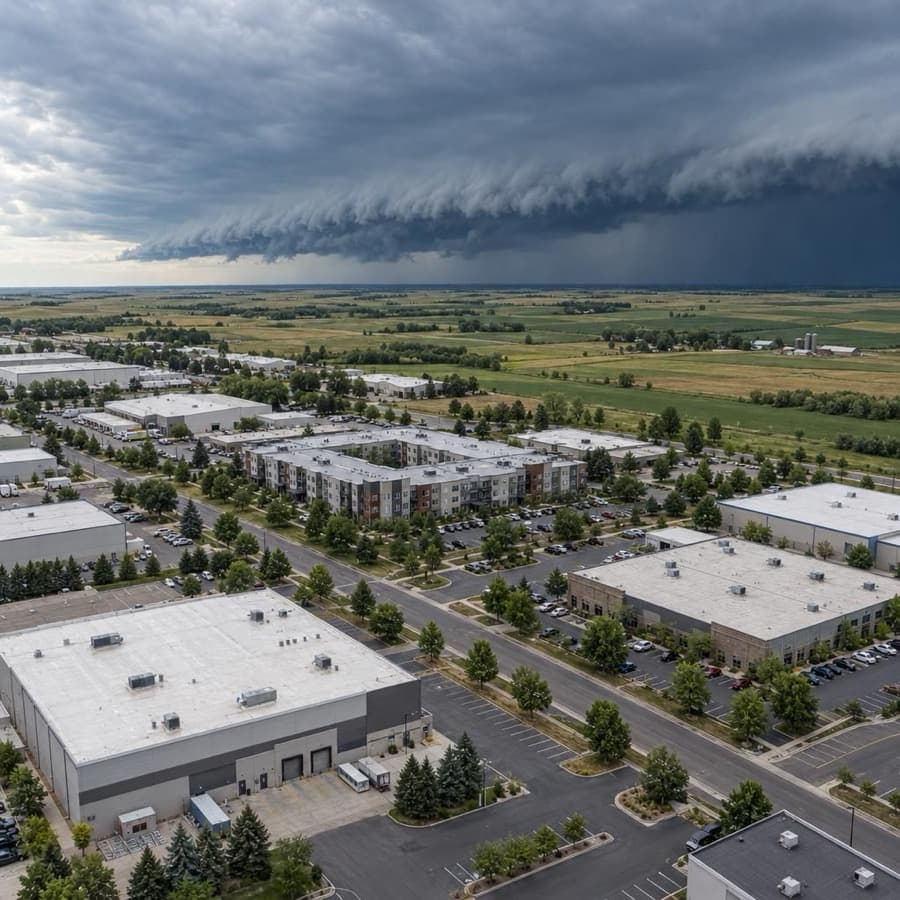
- Hail days near Des Moines since 2010, the most in Iowa
- 100
- Largest hail reported, near Davenport
- 4.0 in
- Iowa cities tracked
- 3
Source: NOAA/NWS Storm Prediction Center
Data through November 1, 2026
Iowa cities by hail days
Source: NOAA/NWS Storm Prediction Center
Data through November 1, 2026
| City | Hail days since 2010 | Largest hail |
|---|---|---|
| Des Moines | 100 | 3.25 in |
| Davenport | 67 | 4.0 in |
| Cedar Rapids | 55 | 2.75 in |
About this data
- Each city counts reports within 15 miles of its center, not of any one property.
- Reports come from trained spotters and the public, so they cluster near towns and roads.
- No report does not mean no hail. Hail can fall where no one is there to report it.
- This is not a damage or insurance assessment.
Storm risk in Iowa
For commercial and multifamily buildings in Iowa, hail and damaging thunderstorm wind are the most frequent storm risks, followed by tornadoes, river and flash flooding, and winter snow, ice and cold. Around the Des Moines radar, Storm Prediction Center reports show hail on 39 days and damaging wind on 40 days in an average year, and the area ranks 11th of 141 US radar areas for tornadoes per square mile.2 Flooding is the costliest of these when it comes: from 1955 to 1997, Iowa ranked first among states in flood losses.4
How often storms hit Iowa
| Hazard | How often | What it means for buildings |
|---|---|---|
| Hail | 55 to 100 hail days since 2010 within 15 miles of each of the three Iowa cities on this page (Des Moines 100, Davenport 67, Cedar Rapids 55), with hail up to 4 inches near Davenport. Around the Des Moines radar, hail reports came on 39 days a year on average (1980 to 2006). | Hail breaks roof covers, skylights and windows and dents rooftop unit fins, sometimes more than once a season. |
| Damaging thunderstorm wind | Damaging wind reports on 40 days a year on average around the Des Moines radar (1980 to 2006). The August 2020 derecho, a long-lived straight-line windstorm, produced winds greater than 100 mph. | Straight-line wind lifts roof edges and membranes, topples rooftop equipment and drops trees on buildings, often across a wide area at once. |
| Tornadoes | About 48 a year from 1980 to 2019, and 87 percent were rated EF0 or EF1. At any one point near the Des Moines radar, the yearly chance of a tornado is 0.034 percent. | Most damage roofs, siding and windows. A direct hit on one building is rare, but the 13 percent rated EF2 to EF5 can destroy structures. |
| Flooding | Iowa ranked first among states in flood losses from 1955 to 1997. In June 2008, 83 of 99 counties were declared disaster areas, with damage estimated at almost $10 billion. | River and flash floods soak ground floors, basements and mechanical rooms. Iowa DNR rules set how high new buildings in floodplains must sit. |
| Winter storms and cold | Snowstorms and ice storms are a frequent winter hazard. Snowfall averages about 20 inches a year in the south and more than 40 inches in the north, and the state has averaged 19.3 nights a year at 0°F or below since 1900. | FEMA says drifting snow piles into concentrated loads at parapets, roof steps and equipment, and rain on snow adds weight. Deep cold freezes pipes and sprinkler lines. |
The city counts are days with at least one hail report within 15 miles of each city's center since 2010, so they show how often hail falls near a city, not on any one building. The Storm Prediction Center radar figures cover a far larger circle, 124 nautical miles around the Des Moines radar, and come from 1980 to 2006 reports.1,2
Hail and straight-line wind cause frequent, repeat damage to roofs and rooftop equipment, while tornadoes and floods are rarer at any one address but cause the largest single losses.
Rules owners in Iowa should know
- Iowa FAIR Plan: the Iowa FAIR Plan Association, the state's insurer of last resort, writes commercial property policies only for primarily habitational property, and only after a notice of rejection, nonrenewal or cancellation from an insurer in the past six months. It sells basic property insurance, which state law defines by the standard fire policy with extended coverage, vandalism and malicious mischief endorsements. The limit is $1,000,000 per location, capped for the building at the lesser of actual cash value or market value, with a $2,500 deductible for all perils.5,6
- Claim timing (191 IAC 15.41 and 15.42): a property insurer must acknowledge a claim within 15 days and accept or deny it within 30 days after receiving a properly executed proof of loss. If it needs more time, it must say why within those 30 days and again every 45 days. It must pay within 30 days of accepting liability when the amount is set and not in dispute.7,8
- Proof of loss and suit deadlines (Iowa Code 515.109): Iowa's standard fire policy calls for immediate written notice of a loss, a sworn proof of loss within 60 days unless the insurer extends that in writing, and any suit within 12 months after the loss. Endorsements for other perils, such as wind and hail, may set different terms for those perils, so each policy's own conditions control.9
- Storm contractors (Iowa Code 103A.71 and 515.137A): on buildings for one to four families, a contractor repairing catastrophe damage may not offer to rebate the deductible or represent the owner on the insurance claim, and must give a written notice of these rights. A contract that breaks these rules is void, and a post-loss assignment of benefits to such a contractor can be canceled without penalty within five business days. Larger apartment and commercial buildings fall outside these sections.10,11
- Public adjusters (Iowa Code 522C.10): they need an Iowa license and a written contract on a form the commissioner approved. The fee can't exceed 15 percent of claim payments the insurer approves, or 10 percent after a catastrophic disaster.12
- Floodplain permits (567 IAC 72.5): building along most Iowa waterways needs an Iowa DNR floodplain development permit. Habitable residential and many commercial buildings must have the lowest floor, including the basement, at least 1 foot above the 100-year flood level, or for nonresidential buildings be floodproofed to that height. Many cities and counties set stricter rules.13,14,15
Before the next storm
- Hail-rated roofs: when a roof is due, choose a cover IBHS rates for hail-prone areas, FM 4470 Class 1-SH or UL 2218 Class 4 for low-slope roofs and UL 2218 Class 4 or FM 4473 Class 3 or 4 for steep roofs, and fit hail guards over rooftop condenser fins and air intakes. IBHS says hail on unguarded components can impair a unit's operation.16
- Roof edges: have single-ply roofs fitted with a perimeter peel-stop 1 to 2 feet from the edge and edge metal that meets ANSI/SPRI/FM 4435/ES-1, as IBHS recommends. Around the Des Moines radar, damaging wind is reported about as often as hail.16,2
- Flood coverage: check each building's flood risk and flood coverage well before storms. The Iowa Department of Insurance and Financial Services calls flooding one of the most common natural disasters in the state and notes a typical flood policy takes 30 days to take effect.17
- Snow on roofs: after heavy snow, have a qualified person check drifts at parapets, roof steps and rooftop equipment. FEMA's warning signs of overload include sagging ceiling tiles or sprinkler lines, popping or creaking noises, and doors or windows that stick.18
Sources
Written by the Cloudbreak team. Numbers, dates and rules cite the published sources below.
- 1. Cloudbreak: NOAA/NWS Storm Prediction Center storm reports, as counted on the Cloudbreak hail history page for Iowa
- 2. NOAA Storm Prediction Center: DMX (Des Moines) Severe Weather Climatology, 1980 to 2006
- 3. NWS Des Moines: Iowa Tornado Climatology 1980 to 2019
- 4. NOAA NCEI and North Carolina Institute for Climate Studies: Iowa: 2025 State Climate Summaries
- 5. Iowa FAIR Plan Association: Commercial Property Program
- 6. Iowa Legislature: Iowa Code 515F.32: Definitions (FAIR plan)
- 7. Iowa Insurance Division (Iowa Administrative Code): 191 IAC 15.41: Claims settlement guidelines for property and casualty insurance
- 8. Iowa Insurance Division (Iowa Administrative Code): 191 IAC 15.42: Acknowledgment of communications by property and casualty insurers
- 9. Iowa Legislature: Iowa Code 515.109: Fire insurance contract, standard policy provisions
- 10. Iowa Legislature: Iowa Code 103A.71: Residential contractors
- 11. Iowa Legislature: Iowa Code 515.137A: Post-loss assignment of rights or benefits to a residential contractor
- 12. Iowa Legislature: Iowa Code chapter 522C: Licensing of adjusters
- 13. Iowa Department of Natural Resources: Development Permits (flood plain management)
- 14. Iowa Department of Natural Resources: Permitting Requirements and Form: Buildings (DNR Form 542-1013)
- 15. Iowa Department of Natural Resources (Iowa Administrative Code): 567 IAC 72.5: Buildings (floodplain criteria)
- 16. Insurance Institute for Business & Home Safety (IBHS): Commercial Roofs Best Practices Guide
- 17. Iowa Department of Insurance and Financial Services: Protect Your Home and Finances: Iowa DIFS Shares Essential Disaster Preparedness Tips (September 16, 2026)
- 18. FEMA: Snow Load Safety Guidance (FEMA P-957)
Storms in Iowa
NWS Des Moines says May and June bring the most Iowa tornadoes, with June the peak month, though tornadoes have struck in every month.1 An Iowa Environmental Mesonet map of NWS reports of hail 1 inch or larger since 2003 shows fewer reports moving from southwest to northeast Iowa.2
Notable storms
- July 20, 2026Storms dropped baseball-size hail, 2.75 inches, north of Story City, and hail of 2 to 2.5 inches damaged vehicles near Roland. Gusts reached 80 mph near Sheffield, where roofs were damaged, and 70 to 80 mph in Centerville.3
- May 21, 2024An EF4 tornado with peak winds of 175 to 185 mph tracked about 44 miles through Adams and Adair counties, with EF4 damage in Greenfield. It killed 5 people and injured 35.4
- March 5, 2022An EF4 tornado with winds near 170 mph tracked 70.6 miles from near Macksburg through Winterset and Norwalk to Newton, killing 6 people and injuring 5. The same storms dropped baseball-size hail in Orient, Adair County, with significant damage to vehicles reported.5
- August 28, 2021Hail from tennis ball size to 4 inches across fell around Larchwood in Lyon County, and several cars and houses reportedly had all their windows broken out. NOAA's Storm Events Database lists a rough estimate of $300,000 in property damage.6
- August 10, 2020A derecho brought winds estimated at 110 to 140 mph to parts of Benton, Linn, Jones, Cedar and Clinton counties, with Cedar Rapids hit hardest. Several homes, apartment complexes and businesses had damage consistent with 130 to 140 mph winds. NOAA's Storm Events Database puts damage along the storm's path from Iowa through Illinois at an estimated $7.5 billion.7,8
- July 19, 2018Iowa had 21 tornadoes, including EF3s at Marshalltown and near Pella with winds to 144 mph. The Marshalltown tornado caused EF2 and EF3 damage to many structures in the business district and injured 22 people.9
Warnings and alerts
NWS offices in Des Moines, Quad Cities, Sioux Falls, Omaha and La Crosse cover Iowa's counties.10 Alert Iowa is the state's official emergency notification system, with sign-up through county websites, the Smart911 app or a text message.11
Sources
- 1. NWS Des Moines: Iowa Tornado Climatology 1980 to 2019
- 2. Iowa Environmental Mesonet, Iowa State University: Hail reports (IEM Daily Feature, June 4, 2013)
- 3. NWS Des Moines: Baseball-Sized Hail, Heavy Rain, and Wind Damage, July 20, 2026
- 4. NWS Des Moines: May 21, 2024 Iowa Tornadoes, Winds and Flooding
- 5. NWS Des Moines: March 5th, 2022 Tornadoes
- 6. NOAA NCEI: Storm Events Database: Lyon County hail, August 28, 2021
- 7. NWS Quad Cities: August 10, 2020 Derecho
- 8. NOAA NCEI: Storm Events Database: Benton County thunderstorm wind, August 10, 2020
- 9. NWS Des Moines: July 19, 2018 Tornadoes
- 10. National Weather Service: Iowa County Warning Forecast Areas
- 11. Iowa Homeland Security and Emergency Management: Alert Iowa
Hail history in other states
- Alabama
- Alaska
- Arizona
- Arkansas
- California
- Colorado
- Connecticut
- District of Columbia
- Florida
- Georgia
- Hawaii
- Idaho
- Illinois
- Indiana
- Kansas
- Kentucky
- Louisiana
- Maine
- Maryland
- Massachusetts
- Michigan
- Minnesota
- Mississippi
- Missouri
- Montana
- Nebraska
- Nevada
- New Hampshire
- New Jersey
- New Mexico
- New York
- North Carolina
- North Dakota
- Ohio
- Oklahoma
- Oregon
- Pennsylvania
- Rhode Island
- South Carolina
- South Dakota
- Tennessee
- Texas
- Utah
- Virginia
- Washington
- West Virginia
- Wisconsin
- Wyoming