Hail history in Alabama
We counted the days with NOAA hail reports within 15 miles of the center of 6 Alabama cities since 2010.
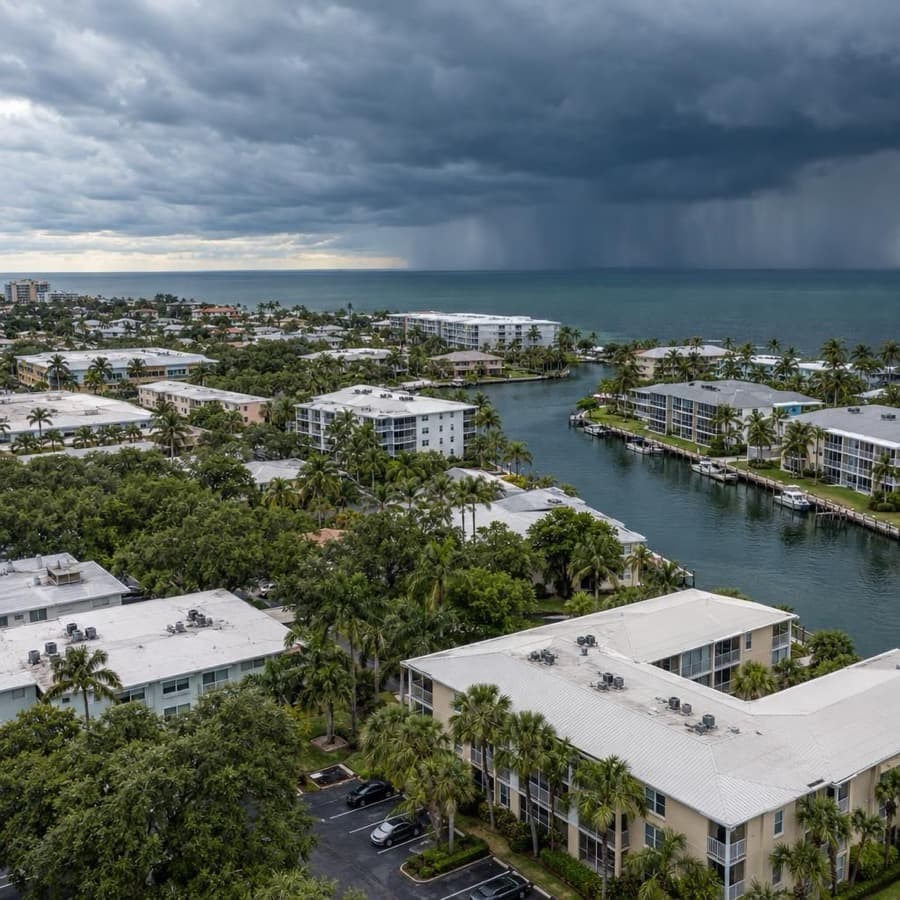
- Hail days near Huntsville since 2010, the most in Alabama
- 63
- Largest hail reported, near Huntsville
- 2.75 in
- Alabama cities tracked
- 6
Source: NOAA/NWS Storm Prediction Center
Data through November 1, 2026
Alabama cities by hail days
Source: NOAA/NWS Storm Prediction Center
Data through November 1, 2026
| City | Hail days since 2010 | Largest hail |
|---|---|---|
| Huntsville | 63 | 2.75 in |
| Birmingham | 50 | 2.5 in |
| Tuscaloosa | 23 | 2.5 in |
| Montgomery | 22 | 2.75 in |
| Mobile | 21 | 2.0 in |
| Daphne | 15 | 2.0 in |
About this data
- Each city counts reports within 15 miles of its center, not of any one property.
- Reports come from trained spotters and the public, so they cluster near towns and roads.
- No report does not mean no hail. Hail can fall where no one is there to report it.
- This is not a damage or insurance assessment.
Storm risk in Alabama
For commercial and multifamily buildings in Alabama, tornadoes and damaging thunderstorm wind are the storm risks that matter most, followed by hail, then hurricanes and flooding near the Gulf. An average of 57 tornadoes touched down in Alabama each year from 1995 to 2024, and the area around the Birmingham radar ranks 6th of 141 US radar areas for the yearly chance of a tornado at any one point. For hurricanes, NOAA counts 24 direct hits on Alabama from 1851 to 2018, against 120 for Florida and 54 for Louisiana.2,3,6
How often storms hit Alabama
| Hazard | How often | What it means for buildings |
|---|---|---|
| Tornadoes | 57 a year on average from 1995 to 2024. Around the Birmingham radar, the yearly chance of a tornado at any one point is 0.056 percent, the 6th highest of 141 radar areas. | A direct hit on one building is rare, but strong tornadoes can destroy a structure, and across many buildings the odds add up. NWS Birmingham notes they can come at any time of day or night. |
| Damaging thunderstorm wind | Damaging wind reports on 62 days a year on average within 124 nautical miles of the Birmingham radar, and on 50 days around the Mobile radar (1980 to 2006). | Straight-line gusts peel roof edges and membranes, shift rooftop units, break windows and drop trees on buildings and parking. |
| Hail | Hail days since 2010 within 15 miles of the city center: Huntsville 63, Birmingham 50, Tuscaloosa 23, Montgomery 22, Mobile 21, Daphne 15. The largest hail near any of them was 2.75 inches, near Huntsville and Montgomery. | Hail breaks roof covers, skylights and the fins of rooftop units, and the same roof can be hit more than once in a season. |
| Hurricanes and tropical storms | 24 hurricane direct hits from 1851 to 2018, 5 of them Category 3 or stronger. From 1900 to 2024, 144 tropical cyclones affected the state, 38 of them hurricanes. | Wind and windborne debris tear roofs and openings, and surge floods low coastal buildings: Katrina's storm tide reached 14 to 18 feet on the Alabama coast in 2005. |
| Flooding | Most of the state gets 50 to 60 inches of rain a year, and some coastal places more than 70. Days with 3 inches of rain or more have mostly been above the long-term average since the late 1990s. | Heavy rain and slow tropical storms flood ground floors, parking levels and electrical rooms, inside and outside mapped flood zones. |
The city counts are days with at least one hail report within 15 miles of each city's center since 2010, so they show how often hail falls near a city, not on one building. The radar figures come from Storm Prediction Center reports from 1980 to 2006 within 124 nautical miles of each radar, a far larger area.1,3,4
Wind and hail are the everyday losses: they strike somewhere many times a year and wear down roofs and rooftop equipment. Tornadoes and hurricanes reach any one address rarely, but they cause the largest single losses, which is where deductibles and limits are tested.
Rules owners in Alabama should know
- Beach pool: The Alabama Insurance Underwriting Association (AIUA) sells wind, hail and hurricane coverage only south of the 31st parallel in Baldwin and Mobile counties, for owners who can't get it in the standard market. Commercial policies are wind-only at actual cash value, up to $1,000,000 per building and $3,000,000 per location. Vacant property, buildings over water, and buildings in flood zones A or V without flood insurance at least equal to the AIUA limits or the NFIP maximum aren't eligible.7,8
- AIUA deductibles: A commercial wind-only policy has a flat deductible for wind other than hurricanes and a percentage deductible for hurricanes. When a building is worth more than the AIUA limit, the percentage applies to its total insurable value, not to the limit.8
- Wind exclusions: The Alabama Department of Insurance accepts wind and hail deductibles on commercial property anywhere in the state, but allows wind and hail exclusions only in the beach pool area, where the coverage can be bought back from AIUA. Either one must come with a premium credit.9
- Renewal notice: An insurer that adds a wind exclusion or hurricane deductible, or raises a hurricane deductible, for a group of existing policyholders at renewal must give each named insured written notice at least 120 days before renewal. The same notice applies when it nonrenews a group to cut its exposure to hurricanes or other catastrophes (Ala. Admin. Code 482-1-136).10
- FORTIFIED discounts: Alabama law requires insurers to give a premium discount or rate reduction on the wind coverage of commercial and residential property built or retrofitted to IBHS FORTIFIED standards and certified by an IBHS inspector (Ala. Code 27-31D). Under its Bulletin 2016-07, the Department of Insurance set benchmark discounts of 35 to 60 percent on the hurricane portion of the premium and 20 to 35 percent on the other wind portion.11,12,13
- Time to sue: Alabama law voids any agreement that limits the time to bring a lawsuit to less than the period the law sets, except as the Uniform Commercial Code allows (Ala. Code 6-2-15). Actions on written promises and other simple contracts must be brought within six years (Ala. Code 6-2-34).14,15
Before the next storm
- Plan FORTIFIED early: IBHS issues FORTIFIED Commercial designations in Alabama and currently designates buildings that are in design or construction, so the decision belongs at the start of a project. A designation stays with the building for 5 years, through a sale.16
- Beach pool timing: AIUA asks for applications 30 days before the date coverage should start, and it issues no new policy once a named storm is within 80 degrees west and 20 degrees north or a tropical storm watch or warning covers Baldwin or Mobile County. The Atlantic hurricane season runs June 1 to November 30.7,8,17
- Warnings at night: NWS Birmingham broadcasts NOAA Weather Radio around the clock from 10 central Alabama transmitters, and an alarm-equipped radio reaches staff and residents who are asleep when an overnight tornado warning comes.5
- Hail-rated roofs: When reroofing, IBHS calls for low-slope covers rated FM 4470 Class 1-SH or UL 2218 Class 4 in hail-prone areas, plus hail guards over rooftop condenser fins. Huntsville had 63 hail days since 2010.18,1
- Flood lead time: FEMA says a new NFIP flood policy typically takes effect 30 days after purchase, so it has to be bought well before a storm is named.19
Sources
Written by the Cloudbreak team. Numbers, dates and rules cite the published sources below.
- 1. Cloudbreak: NOAA/NWS Storm Prediction Center storm reports, as counted on the Cloudbreak hail history page for Alabama
- 2. NOAA NCEI and North Carolina Institute for Climate Studies: Alabama: 2025 State Climate Summaries
- 3. NOAA Storm Prediction Center: BMX (Birmingham) Severe Weather Climatology, 1980 to 2006
- 4. NOAA Storm Prediction Center: MOB (Mobile) Severe Weather Climatology, 1980 to 2006
- 5. NWS Birmingham: About the National Weather Service Office in Birmingham
- 6. NOAA Hurricane Research Division (Chris Landsea, NHC): TCFAQ E19: How many direct hits by hurricanes of various categories have affected each state?
- 7. Alabama Insurance Underwriting Association: AIUA Rules and Procedures for Submitting Applications (November 2025)
- 8. Alabama Insurance Underwriting Association: Frequently Asked Questions
- 9. Alabama Department of Insurance: Property, Casualty, and Surety Filing Info
- 10. Alabama Department of Insurance: Ala. Admin. Code Chapter 482-1-136: Notice Requirements for Coverage Restrictions of Existing Policies at Renewal and for Non-Renewal of Coverage
- 11. Alabama Legislature (text via Justia): Ala. Code 27-31D-1: Premium Discount or Insurance Rate Reduction, Construction and Certification
- 12. Alabama Legislature (text via Justia): Ala. Code 27-31D-3: Insurable Property
- 13. Alabama Department of Insurance: New Wind Mitigation Discounts (Bulletin 2016-07)
- 14. Alabama Legislature (text via Justia): Ala. Code 6-2-15: Agreement or Stipulation to Limit Time Prescribed Void; Exception
- 15. Alabama Legislature (text via Justia): Ala. Code 6-2-34: Commencement of Actions, Six Years
- 16. Insurance Institute for Business & Home Safety (IBHS): FORTIFIED Commercial FAQs
- 17. NOAA National Hurricane Center: Tropical Cyclone Climatology
- 18. Insurance Institute for Business & Home Safety (IBHS): Commercial Roofs Best Practices Guide
- 19. FEMA: Waiting Period for Activating Flood Policy?
Storms in Alabama
In the Birmingham area, severe thunderstorms and tornadoes are most likely in spring, especially March and April, NWS Birmingham says.1 Alabama also has a second severe weather season, usually from the beginning of November to mid December, NWS Birmingham says.2
Notable storms
- March 24, 2023Late on March 24, a line of storms brought winds of 60 to 90 mph to the Shoals, including Tuscumbia, Sheffield, Muscle Shoals and Florence. Many homes had roof damage or were hit by falling trees. NOAA's Storm Events Database lists $10 million in property damage in Colbert County.3
- April 10, 2021Two reports of hail up to 4 inches across, softball size, came from Orange Beach, the largest hail ever reported in Baldwin County. NOAA's Storm Events Database reports heavy hail damage to many vehicles and metal roofs in the area.4
- September 16, 2020Hurricane Sally made landfall at Gulf Shores with sustained winds of 95 knots (109 mph), and a gust of 119 knots (137 mph) was measured at Ingram Bayou. In Mobile and Baldwin counties, a few older homes were destroyed and many buildings had roof and siding damage. NOAA's Storm Events Database lists $234.48 million in property damage in coastal Baldwin County.5,6
- March 3, 2019An EF4 tornado with winds near 170 mph tracked 26.73 miles across Macon and Lee counties, through Beauregard to Smiths Station, killing 23 people and injuring 90. The NWS survey in Lee County found a well-built home leveled and several manufactured homes destroyed.7,8
- March 19, 2018Hail up to 5.38 inches across fell in Cullman County, the official Alabama record, NWS Huntsville says. Roofs and rooftop equipment at Cullman's industrial parks took heavy damage, and the city put damage to its own buildings, property and vehicles at slightly less than $6 million, the Cullman Tribune reported a year later.9,10
- April 27, 2011Alabama had 62 tornadoes that day, NWS Birmingham says. An EF5 with 210 mph winds struck Hackleburg, and an EF4 with 190 mph winds crossed Tuscaloosa and Birmingham's western suburbs. NOAA's Storm Events Database lists $1.5 billion in property damage in Tuscaloosa County from that tornado, and hail up to 4 inches across fell in Hamilton.11,12,13
Warnings and alerts
NWS offices in Birmingham, Huntsville and Mobile cover most of Alabama, and NWS Tallahassee covers Coffee, Dale, Geneva, Henry and Houston counties.14 Alabama EMA's statewide ALalert system sends emergency alerts to people who opt in at ema.alabama.gov or by texting ALalert to 77295.15
Sources
- 1. NWS Birmingham: Birmingham Area Climograph
- 2. NWS Birmingham: Fall Severe Weather Awareness Day
- 3. NOAA NCEI: Storm Events Database: Thunderstorm Wind, Colbert County, March 24, 2023
- 4. NOAA NCEI: Storm Events Database: Hail, Baldwin County, April 10, 2021
- 5. National Hurricane Center: Tropical Cyclone Report: Hurricane Sally (AL192020)
- 6. NOAA NCEI: Storm Events Database: Hurricane, Baldwin Coastal, September 15, 2020
- 7. NWS Birmingham: Tornadoes of March 3, 2019
- 8. NOAA NCEI: Storm Events Database: Tornado, Lee County, March 3, 2019
- 9. NWS Huntsville: Record Hailstone in AL
- 10. The Cullman Tribune: March 19, 2018 hailstorm: 1 year later
- 11. NWS Birmingham: Historic Outbreak of April 27, 2011
- 12. NOAA NCEI: Storm Events Database: Tornado, Tuscaloosa County, April 27, 2011
- 13. NOAA NCEI: Storm Events Database: Hail, Marion County, April 27, 2011
- 14. National Weather Service: NWS public forecast zones, Southern Region
- 15. Alabama Emergency Management Agency: Sign Up for Emergency Alerts
Hail history in other states
- Alaska
- Arizona
- Arkansas
- California
- Colorado
- Connecticut
- District of Columbia
- Florida
- Georgia
- Hawaii
- Idaho
- Illinois
- Indiana
- Iowa
- Kansas
- Kentucky
- Louisiana
- Maine
- Maryland
- Massachusetts
- Michigan
- Minnesota
- Mississippi
- Missouri
- Montana
- Nebraska
- Nevada
- New Hampshire
- New Jersey
- New Mexico
- New York
- North Carolina
- North Dakota
- Ohio
- Oklahoma
- Oregon
- Pennsylvania
- Rhode Island
- South Carolina
- South Dakota
- Tennessee
- Texas
- Utah
- Virginia
- Washington
- West Virginia
- Wisconsin
- Wyoming