Hail history in Texas
We counted the days with NOAA hail reports within 15 miles of the center of 50 Texas cities since 2010.
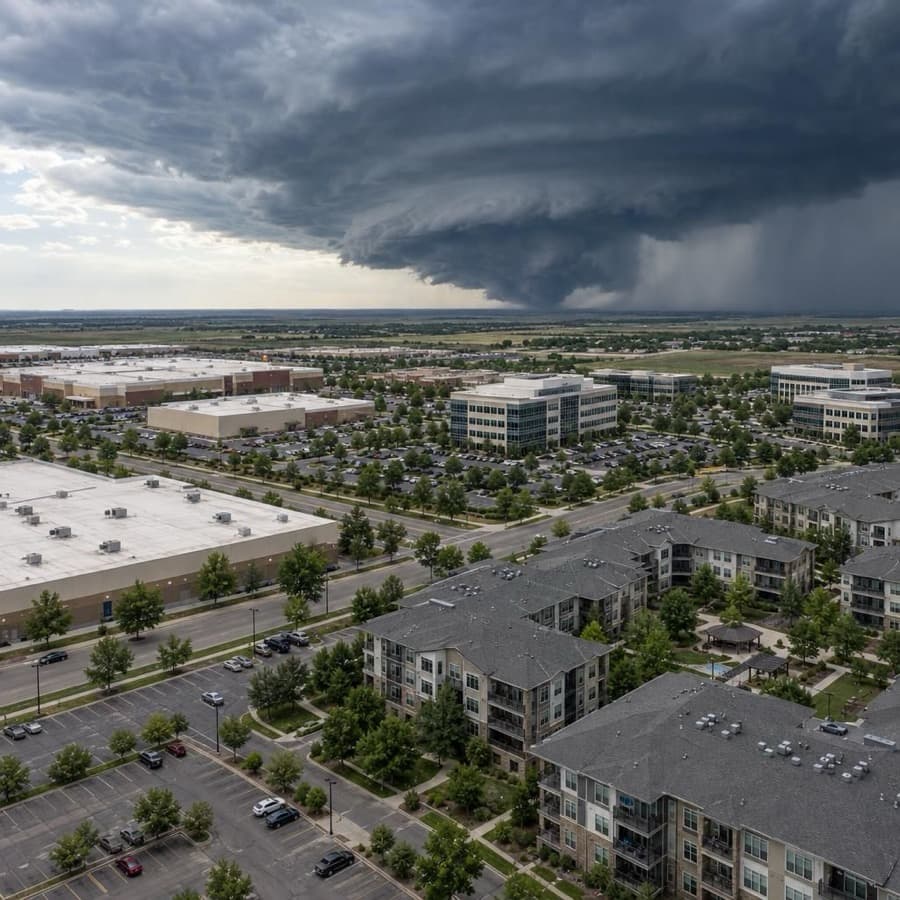
- Hail days near Fort Worth since 2010, the most in Texas
- 117
- Largest hail reported, near Denton
- 5.9 in
- Texas cities tracked
- 50
Source: NOAA/NWS Storm Prediction Center
Data through November 1, 2026
Texas cities by hail days
Source: NOAA/NWS Storm Prediction Center
Data through November 1, 2026
| City | Hail days since 2010 | Largest hail |
|---|---|---|
| Fort Worth | 117 | 4.5 in |
| Amarillo | 114 | 2.75 in |
| Plano | 113 | 5.25 in |
| Irving | 111 | 4.25 in |
| Carrollton | 111 | 4.25 in |
| Lewisville | 108 | 4.25 in |
| Arlington | 107 | 5.0 in |
| Frisco | 105 | 4.5 in |
| Richardson | 105 | 5.25 in |
| Grand Prairie | 104 | 5.0 in |
| Allen | 103 | 5.25 in |
| Denton | 102 | 5.9 in |
| Garland | 98 | 5.25 in |
| Dallas | 91 | 4.25 in |
| McKinney | 89 | 5.25 in |
| Lubbock | 87 | 4.5 in |
| Mesquite | 77 | 4.0 in |
| Abilene | 74 | 4.5 in |
| Odessa | 71 | 5.0 in |
| Tyler | 69 | 2.75 in |
| Wichita Falls | 68 | 5.33 in |
| San Antonio | 63 | 5.5 in |
| Round Rock | 61 | 4.0 in |
| Georgetown | 61 | 4.0 in |
| San Angelo | 61 | 4.0 in |
| Austin | 59 | 3.0 in |
| Midland | 57 | 5.0 in |
| Longview | 51 | 2.75 in |
| Temple | 49 | 5.68 in |
| Waco | 48 | 4.5 in |
| New Braunfels | 44 | 2.0 in |
| Killeen | 42 | 5.68 in |
| Pasadena | 37 | 2.75 in |
| San Marcos | 37 | 3.0 in |
| Pearland | 36 | 2.75 in |
| Houston | 34 | 2.5 in |
| League City | 31 | 4.5 in |
| Tomball | 31 | 2.75 in |
| Beaumont | 29 | 3.5 in |
| Sugar Land | 29 | 2.5 in |
| El Paso | 28 | 2.0 in |
| Edinburg | 25 | 4.5 in |
| McAllen | 24 | 4.5 in |
| College Station | 24 | 3.0 in |
| Conroe | 24 | 1.75 in |
| Laredo | 22 | 2.5 in |
| Katy | 21 | 2.5 in |
| Corpus Christi | 11 | 3.0 in |
| Galveston | 7 | 4.5 in |
| Brownsville | 5 | 2.0 in |
About this data
- Each city counts reports within 15 miles of its center, not of any one property.
- Reports come from trained spotters and the public, so they cluster near towns and roads.
- No report does not mean no hail. Hail can fall where no one is there to report it.
- This is not a damage or insurance assessment.
Storm risk in Texas
For commercial and multifamily buildings in Texas, hail and damaging thunderstorm wind are the most frequent storm risks, followed by tornadoes, then hurricanes, flooding and the occasional hard freeze. Texas had more large hail events than any other state in 2025 and averages more tornadoes a year than any other state, and Florida and Texas together have taken 88 percent of the major hurricane strikes on the US coast.2,3,6
How often storms hit Texas
| Hazard | How often | What it means for buildings |
|---|---|---|
| Hail | 902 hail events with stones 1 inch or larger in 2025, the most of any state (5,432 in the US). Hail days since 2010 within 15 miles of the city center: Dallas 91, San Antonio 63, Austin 59, Houston 34. | Roof covers, skylights and rooftop HVAC condenser fins take the hits, and the same roof can be struck more than once in a season. |
| Damaging thunderstorm wind | Damaging wind reports on 51 days a year on average within 124 nautical miles of the Dallas Fort Worth radar, and on 32 days around the Houston radar (1980 to 2006). | Straight-line gusts peel roof edges and membranes, shift rooftop units, break windows and drop trees on buildings and parking. |
| Tornadoes | 137 a year on average, the most of any state. At any one point within 124 nautical miles of the Dallas Fort Worth radar, the yearly chance of a tornado is 0.019 percent. | A direct hit on one building is rare, but across a portfolio of many buildings the odds add up, and strong tornadoes can destroy a structure. |
| Hurricanes and tropical storms | 64 hurricanes struck Texas from 1851 to 2018, 19 of them major. A tropical storm or hurricane comes 0.8 times a year on average, and a hurricane about every six years on any 50-mile stretch of coast. | Coastal buildings face wind, windborne debris and storm surge; storms that move inland bring heavy rain and flooding far from the coast. |
| Flooding | About 21 percent of Texas land (56,053 square miles) is in the 1 percent annual chance floodplain, with about 878,100 buildings inside it. | Weak tropical storms have caused some of the worst floods in Texas, and the State Climatologist projects urban flooding to increase. |
| Winter storms and hard freezes | Rare in most of the state. The February 11 to 19, 2021 freeze led to 510,772 insurance claims and about $11.2 billion in expected insured losses, with an average incurred loss of about $149,100 for commercial property policies (as of March 31, 2022). | Burst pipes and frozen sprinkler lines cause water damage, and the rarity is part of why it is dangerous: buildings and owners are less prepared. |
The city counts are days with at least one hail report within 15 miles of each city's center since 2010, so they show how often hail falls near a city, not on one building. The Storm Prediction Center radar figures cover a much larger circle, 124 nautical miles around each radar, and come from 1980 to 2006 reports.1,4,5
For an owner, the pattern matters more than any one storm. Hail and straight-line wind cause frequent, repeat damage to roofs and rooftop equipment, while tornadoes, hurricanes, floods and hard freezes are rarer at any one address but cause the largest single losses.
Rules owners in Texas should know
- Wind pool: TWIA (Texas Windstorm Insurance Association) sells wind and hail coverage only in the 14 first-tier coastal counties and parts of Harris County east of Highway 146. An applicant must have been denied by at least one authorized insurer writing wind and hail there, and the building must be in good repair. In V, VE or V1-30 flood zones, buildings built, altered, remodeled or enlarged on or after September 1, 2009 must show proof of flood insurance when NFIP coverage is available.11
- TWIA limit: TWIA's maximum limit for a commercial building and its contents is $4,424,000. TDI's Order 2026-10171 of October 1, 2026 kept that limit for policies issued or renewed on or after January 1, 2027.12
- Wind certification: TWIA requires a windstorm certificate of compliance (WPI-8 or WPI-8-E) showing a building meets applicable codes. New structures, additions, windows and doors, and replacing or significantly repairing a roof need one, and TDI has issued all certificates since June 1, 2020.13
- TWIA claim deadline: A TWIA policy must require a claim within one year of the date the damage occurred; the commissioner of insurance may extend that by up to 180 days for good cause. The policy must also explain TWIA's own appraisal and dispute process under chapter 2210 (Insurance Code 2210.205).14
- Prompt payment: Under Insurance Code chapter 542, a licensed insurer must acknowledge a claim within 15 days, accept or reject it within 15 business days after receiving everything it asked for (45 more days if it says why), and pay within 5 business days of accepting (20 for a surplus lines insurer). TDI can add 15 days after a disaster, and a late insurer may owe interest and attorney's fees.15,16
- Notice before suit: Before suing an insurer other than TWIA over property damage from hail, wind, a hurricane, flood or other forces of nature, the policyholder must give written notice at least 61 days ahead, stating the amount owed and attorney's fees so far (Insurance Code 542A.001 and 542A.003).17,18
- Policy deadlines: A Texas policy can't set a deadline to sue shorter than two years, and a clause requiring notice of a claim in less than 90 days is void (Civil Practice and Remedies Code 16.070 and 16.071, as TDI lists them for commercial property forms).19
Before the next storm
- Roof ratings: Check hail ratings before reroofing. IBHS calls for low-slope roof covers rated FM 4470 Class 1-SH or UL 2218 Class 4 in hail-prone areas, hail-rated skylights, and hail guards over rooftop condenser fins, because Texas had more large hail events than any other state in 2025.20,2
- Freeze prep: Before a hard freeze, insulate pipes in attics, outside walls and unheated rooms, keep vacant space at 55°F and never below 40°F, and keep heat in sprinkler valve rooms. IBHS notes that pipes in southern buildings often run outside the insulation.21
- TWIA timing: On the coast, make TWIA coverage changes early in hurricane season, which runs June 1 to November 30. TWIA can't issue a new policy or raise a limit while a hurricane is in the Gulf.22,23
- Flood coverage: Look up each building's flood zone and flood coverage dates before storm season. TDI says a new flood policy has a 30-day waiting period before coverage starts.24
Sources
Written by the Cloudbreak team. Numbers, dates and rules cite the published sources below.
- 1. Cloudbreak: NOAA/NWS Storm Prediction Center storm reports, as counted on the Cloudbreak hail history page for Texas
- 2. Insurance Information Institute (Triple-I): Facts + Statistics: Hail
- 3. NWS Houston/Galveston: Spring Weather Safety Campaign: Tornadoes
- 4. NOAA Storm Prediction Center: FWS (Dallas Fort Worth) Severe Weather Climatology, 1980 to 2006
- 5. NOAA Storm Prediction Center: HGX (Houston Galveston) Severe Weather Climatology, 1980 to 2006
- 6. NOAA Hurricane Research Division (Chris Landsea, NHC): TCFAQ E19: How many direct hits by hurricanes of various categories have affected each state?
- 7. NOAA National Weather Service, Weather Prediction Center: Texas Hurricane History (David Roth)
- 8. Texas Water Development Board: 2024 State Flood Plan, Volume I
- 9. Office of the Texas State Climatologist, Texas A&M University: Assessment of Historic and Future Trends of Extreme Weather in Texas, 1900-2036: 2024 Update
- 10. Texas Department of Insurance: Insured Losses Resulting from the February 2021 Texas Winter Weather Event (data as of March 31, 2022)
- 11. Texas Windstorm Insurance Association: Coverage & Eligibility
- 12. Texas Department of Insurance: Commissioner's Order No. 2026-10171: TWIA Policy Maximum Liability Limits (October 1, 2026)
- 13. Texas Windstorm Insurance Association: Windstorm Certification
- 14. Texas Legislature (text via Justia): Texas Insurance Code Section 2210.205, Required Policy Provisions: Deadline for Filing Claim
- 15. Texas Department of Insurance: Consumer rights for commercial property insurance
- 16. Texas Legislature (text via Public.Law): Texas Insurance Code Section 542.057, Payment of Claim
- 17. Texas Legislature (text via Public.Law): Texas Insurance Code Section 542A.001, Definitions
- 18. Texas Legislature (text via Public.Law): Texas Insurance Code Section 542A.003, Notice Required
- 19. Texas Department of Insurance: Review Requirements Checklist: Commercial Property
- 20. Insurance Institute for Business & Home Safety (IBHS): Commercial Roofs Best Practices Guide
- 21. Insurance Institute for Business & Home Safety (IBHS): Commercial Risk Engineering Bulletin: Winter Weather
- 22. NOAA National Hurricane Center: Tropical Cyclone Climatology
- 23. Texas Windstorm Insurance Association: Moratoriums
- 24. Texas Department of Insurance: Commercial property insurance guide
Storms in Texas
Amarillo tornadoes are most common from April to June.1 In West Central Texas, severe hail is especially common in April, May and June, the peak period for severe thunderstorms there, and May is the most active month.2 In Dallas/Fort Worth, thunderstorms and severe weather peak in spring, and large hail, damaging winds, flooding and tornadoes occur in the Metroplex nearly every year.3
Notable storms
- April 28, 2026Supercells moved from near Wichita Falls across North and Central Texas, producing 6 confirmed tornadoes and dozens of reports of hail up to softball size, the largest near Godley and Itasca. An EF3 tornado with winds up to 145 mph struck northeast Mineral Wells and injured 5 people.4
- May 16, 2024A derecho brought a swath of winds over 100 mph through the Houston metro, causing widespread damage and a couple of tornadoes. KPRC reported a Harris County death toll believed to be 8 and over 2,500 skyscraper windows damaged downtown.5,6
- April 28, 2021A supercell crossing Medina County dropped a 6.4-inch hailstone in Hondo, which the State Climate Extremes Committee confirmed as the Texas record. The storm also brought straight-line winds up to 110 mph and an EF1 tornado, with hail and wind damage from Sabinal through D'Hanis, Hondo and Castroville.7,8
- April 12, 2016A storm dropped a large swath of very large hail just north of downtown San Antonio, with multiple reports of 2 to 3 inch hail and a 4.5-inch stone about 3 miles southeast of Helotes. NWS Austin/San Antonio cites damage estimates of about $1.36 billion.9
- December 26, 2015Twelve tornadoes hit North and Central Texas and killed 13 people. The strongest, an EF4 through Sunnyvale, Garland and Rowlett, killed 10 and, in Dallas County, injured 468 and destroyed nearly 400 homes. NOAA's Storm Events Database lists $26 million in property damage from it in Dallas County.10,11
- June 13, 2012Isolated storms hit parts of Dallas, Collin and Fannin counties with hail the size of baseballs (2.75 inches), oranges (3 inches) and softballs (4.25 inches). NWS Fort Worth reported numerous cars and houses severely damaged by the hail.12
Warnings and alerts
NWS Southern Region lists 10 Texas forecast offices: Amarillo, Lubbock, Midland/Odessa, El Paso, San Angelo, Dallas/Fort Worth, Austin/San Antonio, Houston/Galveston, Corpus Christi and Brownsville.13
Sources
- 1. NWS Amarillo: Climate Narrative for Amarillo
- 2. NWS San Angelo: Analysis of Historical Hail Size Distribution Across the West Central Texas Region
- 3. NWS Fort Worth: Dallas/Fort Worth Climate Narrative
- 4. NWS Fort Worth: April 24-29, 2026 Severe Storms & Tornadoes
- 5. NWS Houston/Galveston: May 2024 Regional Climate Summary
- 6. KPRC 2 Houston: 1 year later: Remembering the devastating Houston derecho of 2024
- 7. NWS Austin/San Antonio: Record Sized Hail, Wind, Tornado, Heavy Rainfall Events, 28 April to 1 May 2021
- 8. NOAA NCEI State Climate Extremes Committee: SCEC Report for Texas Hailstone 28 April 2021
- 9. NWS Austin/San Antonio: San Antonio Hail April 12, 2016
- 10. NWS Fort Worth: North and Central Texas December 26, 2015 Tornado Outbreak
- 11. NOAA NCEI: Storm Events Database: Dallas County tornado, December 26, 2015
- 12. NWS Fort Worth: June 13th 2012 Severe Storms
- 13. NWS Southern Region: NWS Weather Forecast Offices
Hail history in other states
- Alabama
- Alaska
- Arizona
- Arkansas
- California
- Colorado
- Connecticut
- District of Columbia
- Florida
- Georgia
- Hawaii
- Idaho
- Illinois
- Indiana
- Iowa
- Kansas
- Kentucky
- Louisiana
- Maine
- Maryland
- Massachusetts
- Michigan
- Minnesota
- Mississippi
- Missouri
- Montana
- Nebraska
- Nevada
- New Hampshire
- New Jersey
- New Mexico
- New York
- North Carolina
- North Dakota
- Ohio
- Oklahoma
- Oregon
- Pennsylvania
- Rhode Island
- South Carolina
- South Dakota
- Tennessee
- Utah
- Virginia
- Washington
- West Virginia
- Wisconsin
- Wyoming