Hail history in Georgia
We counted the days with NOAA hail reports within 15 miles of the center of 4 Georgia cities since 2010.
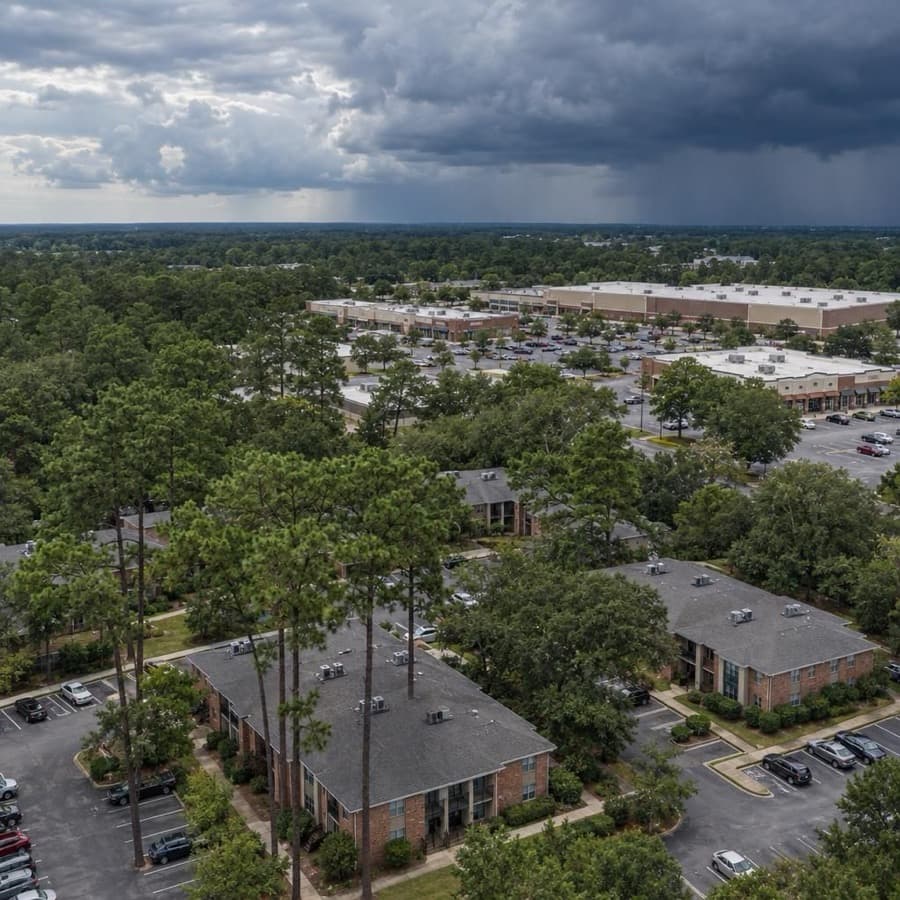
- Hail days near Atlanta since 2010, the most in Georgia
- 57
- Largest hail reported, near Savannah
- 2.5 in
- Georgia cities tracked
- 4
Source: NOAA/NWS Storm Prediction Center
Data through November 1, 2026
Georgia cities by hail days
Source: NOAA/NWS Storm Prediction Center
Data through November 1, 2026
| City | Hail days since 2010 | Largest hail |
|---|---|---|
| Atlanta | 57 | 1.75 in |
| Savannah | 47 | 2.5 in |
| Augusta | 45 | 2.0 in |
| Columbus | 25 | 2.0 in |
About this data
- Each city counts reports within 15 miles of its center, not of any one property.
- Reports come from trained spotters and the public, so they cluster near towns and roads.
- No report does not mean no hail. Hail can fall where no one is there to report it.
- This is not a damage or insurance assessment.
Storm risk in Georgia
For commercial and multifamily buildings in Georgia, damaging thunderstorm wind and hail are the most frequent storm risks, followed by tornadoes, tropical storms and hurricanes that cross the state, flash flooding and the occasional ice storm. Georgia was not among the 10 states with the most large hail events in 2025, but the yearly chance of a tornado at any one point around the Atlanta radar ranks 14th nationally among the radar areas the Storm Prediction Center studied, and 22 hurricanes struck the state from 1851 to 2018.3,2,5
How often storms hit Georgia
| Hazard | How often | What it means for buildings |
|---|---|---|
| Hail | Hail days since 2010 within 15 miles of the city center: Atlanta 57, Savannah 47, Augusta 45, Columbus 25, with hail up to 2.5 inches near Savannah. Within 124 nautical miles of the Atlanta radar, large hail fell on 38 days a year on average (1980 to 2006). | Roof covers, skylights and rooftop HVAC condenser fins take the hits, and the same roof can be struck more than once in a season. |
| Damaging thunderstorm wind | Damaging wind reports on 63 days a year on average around the Atlanta radar (1980 to 2006), more days than hail or tornadoes. | Straight-line gusts peel roof edges and membranes, shift rooftop units and drop trees on buildings, parking and power lines. |
| Tornadoes | Tornadoes are reported on 6 days a year on average, and 37 percent are EF2 or stronger. At any one point around the Atlanta radar, the yearly chance of a tornado is 0.049 percent. | A direct hit on one building is rare, but across a portfolio the odds add up, and strong tornadoes can destroy a structure. |
| Hurricanes and tropical storms | 22 hurricanes struck Georgia from 1851 to 2018, 3 of them major. Direct landfalls are rare, but storms crossing the state bring strong wind and heavy rain inland; Hurricane Michael in 2018 was the first major hurricane to directly affect Georgia since the 1890s. | Wind, falling trees and long power outages reach buildings far from the coast, and coastal buildings also face storm surge. |
| Flooding | A typical weather station records about one day a year with 3 inches of rain or more (0.9 on average, 1900 to 2024), and 2020 to 2024 had the highest five-year average on record. Coastal sea level rose about 8 inches from 1970 to 2020. | Flash floods reach ground floors, basements and parking, and higher seas make coastal flooding more frequent and more severe. |
| Winter storms and hard freezes | Rare. Days that stay at or below 32°F average 0.7 a year statewide (1900 to 2024), and snowfall averages under 5 inches a year even in the northern mountains. | Ice brings down trees and power lines, and pipes run outside the building insulation can freeze and burst, along with sprinkler lines. |
The city counts are days with at least one hail report within 15 miles of each city's center since 2010, so they show how often hail falls near a city, not on one building. The Storm Prediction Center radar figures cover a far larger circle, 124 nautical miles around the radar, and come from 1980 to 2006 reports.1,2
For an owner, wind and hail cause the frequent, repeat damage to roofs, rooftop equipment and trees, while tornadoes, hurricanes and floods are rarer at any one address but cause the largest single losses.
Rules owners in Georgia should know
- FAIR Plan: The Georgia Underwriting Association (GUA) runs Georgia's FAIR Plan under O.C.G.A. 33-33-1 and writes commercial property policies for owners who can't find coverage in the private market. Its limit is $2,000,000 per building and $20,000,000 for a complex of related buildings, and the Office of Commissioner of Insurance calls it a last resort, with premiums generally higher and coverage often more limited.7,8
- Coastal wind and hail: In Bryan, Camden, Chatham, Glynn, Liberty and McIntosh counties and the listed offshore islands, GUA can write a windstorm-only policy where other insurers have excluded wind. A building there constructed within 10 years before the application must meet the applicable International Code Council code, including its design-wind requirements, shown by a letter from a building inspector, contractor, engineer or architect.7,8
- Bad faith penalty: Under O.C.G.A. 33-4-6, an insurer that refuses in bad faith to pay a covered loss within 60 days after the policyholder's demand can owe up to 50 percent of its liability for the loss or $5,000, whichever is greater, plus reasonable attorney's fees. The policyholder must mail the demand and complaint to the Commissioner of Insurance within 20 days of suing.9
- Suit deadline: Georgia's standard fire policy allows two years from the loss to sue, but in White v. State Farm (2012) the Georgia Supreme Court held that only the fire portion of a multiple line policy must match it and enforced a one-year deadline on a theft claim. A shorter deadline written into the policy can therefore apply to losses other than fire.10
- Building codes: Georgia's mandatory state codes apply to all construction whether or not the city or county enforces them, the Department of Community Affairs says. The building code in force is the 2024 International Building Code with Georgia amendments.11,12
Before the next storm
- Hurricane timing: Apply to GUA or raise limits well before a storm forms. The Atlantic season runs June 1 to November 30, and GUA takes no new application or coverage increase while a hurricane is inside 70 degrees West longitude and 20 degrees North latitude, until 24 hours after the warning is lifted.13,7
- Hail-rated roofs: When reroofing, choose covers IBHS recommends for hail-prone areas, FM 4470 Class 1-SH or UL 2218 Class 4 on low-slope roofs, and fit hail guards over rooftop condenser fins, since hail on unguarded fins can impair a unit. Atlanta alone had hail on 57 days since 2010.14,1
- Freeze protection: Before a hard freeze, insulate or heat pipes in attics, crawl spaces and outside walls, keep heat in sprinkler valve rooms, and hold vacant space at 55°F and never below 40°F. IBHS says winter weather is a risk even in the warmer South and warns against pipes outside the building insulation.15
- Flood coverage dates: Look up each building's flood zone and flood coverage before hurricane season. FEMA says a new flood policy typically has a 30-day waiting period before it takes effect.16
Sources
Written by the Cloudbreak team. Numbers, dates and rules cite the published sources below.
- 1. Cloudbreak: NOAA/NWS Storm Prediction Center storm reports, as counted on the Cloudbreak hail history page for Georgia
- 2. NOAA Storm Prediction Center: FFC (Atlanta) Severe Weather Climatology, 1980 to 2006
- 3. Insurance Information Institute (Triple-I): Facts + Statistics: Hail
- 4. NWS Atlanta/Peachtree City: Georgia Severe Weather Preparedness Week: Tornado Safety
- 5. NOAA Hurricane Research Division (Chris Landsea, NHC): TCFAQ E19: How many direct hits by hurricanes of various categories have affected each state?
- 6. NOAA NCEI and North Carolina Institute for Climate Studies: Georgia: 2025 State Climate Summaries
- 7. Georgia Underwriting Association: Amended and Restated Plan of Operation (effective January 1, 2019)
- 8. Georgia Office of Commissioner of Insurance: The Business Guide to Insurance
- 9. Georgia General Assembly (text via Justia): O.C.G.A. 33-4-6: Liability of insurer for damages and attorney's fees
- 10. Supreme Court of Georgia (text via FindLaw): White v. State Farm Fire and Casualty Co. (Ga. 2012)
- 11. Georgia Department of Community Affairs: Mandatory and Permissive State Codes
- 12. Georgia Department of Community Affairs: Current State Minimum Codes for Construction
- 13. NOAA National Hurricane Center: Tropical Cyclone Climatology
- 14. Insurance Institute for Business & Home Safety (IBHS): Commercial Roofs Best Practices Guide
- 15. Insurance Institute for Business & Home Safety (IBHS): Commercial Risk Engineering Bulletin: Winter Weather
- 16. FEMA: Waiting Period for Activating Flood Policy?
Storms in Georgia
Around the Atlanta radar, SPC data for 1980 to 2006 show hail reports peaking in April and May, damaging wind reports peaking in June and July, and tornadoes most common in March through May and again in November.1
Notable storms
- September 27, 2024Hurricane Helene crossed south and east Georgia overnight, with gusts of 87 knots (100 mph) at Alma and 71 knots (82 mph) at the Augusta airport. NHC reports 80 to 85 percent of homes damaged in Coffee County and, around Augusta, at least 362 homes and buildings destroyed and 3,000 with major damage.2
- June 14, 2023Storms in southwest Georgia dropped hail up to 4 inches across in Colquitt County and up to 3.75 inches in Dougherty County, including 3-inch hail on the Marine Corps Logistics Base in Albany, NOAA's Storm Events Database shows.3,4,5
- October 10, 2018Hurricane Michael's center passed just west of Albany, with a 100-knot (115 mph) gust at Donalsonville. NHC reports damage to 99 percent of homes in Seminole County and 3,000 homes damaged, 49 destroyed, in Dougherty County. NCEI estimated $4.7 billion in damage in Georgia.6
- January 22, 2017An EF3 tornado with winds up to 150 mph tracked more than 70 miles from Albany through Worth, Turner and Wilcox counties and killed 5 people in Albany. Storm Events lists $300 million in property damage in Dougherty County. Hours earlier, another EF3 killed 11 in Brooks, Cook and Berrien counties and destroyed about 35 manufactured homes in Cook County.7,8,9
- March 18, 2013Two hailstorms crossed Henry County with hail up to 2.75 inches across at Stockbridge and Hampton, and Storm Events lists $9.43 million in property damage for each. Hail up to golf ball size fell at Atlanta's airport, numerous windshields were broken on Interstate 85, and 2.5-inch hail fell in Fayetteville.10,11,12,13
- March 26, 2011Most severe weather reports in a two-day outbreak across north and central Georgia were hail, NWS Peachtree City says. In southern Coweta County, from Grantville and Moreland to Senoia, hail up to 4.25 inches across caused extensive damage to vehicles and home roofs, and Storm Events lists $6.53 million in property damage there.14,15
Warnings and alerts
NWS Peachtree City covers most of Georgia. NWS Tallahassee covers the southwest, Jacksonville the southeast, Charleston the Savannah area, Columbia the Augusta area and Greenville-Spartanburg the northeast corner.16
Sources
- 1. NOAA Storm Prediction Center: FFC Severe Weather Climatology
- 2. National Hurricane Center: Tropical Cyclone Report: Hurricane Helene
- 3. NOAA NCEI Storm Events Database: Storm Events: Hail, Colquitt County, June 14, 2023
- 4. NOAA NCEI Storm Events Database: Storm Events: Hail, Dougherty County, June 14, 2023
- 5. NOAA NCEI Storm Events Database: Storm Events: Hail, Dougherty County, June 14, 2023
- 6. National Hurricane Center: Tropical Cyclone Report: Hurricane Michael
- 7. NOAA NCEI Storm Events Database: Storm Events: Tornado, Dougherty County, January 22, 2017
- 8. NWS Tallahassee: Deadly Tornado Outbreak, January 22, 2017
- 9. NOAA NCEI Storm Events Database: Storm Events: Tornado, Cook County, January 22, 2017
- 10. NOAA NCEI Storm Events Database: Storm Events: Hail, Henry County, March 18, 2013
- 11. NOAA NCEI Storm Events Database: Storm Events: Hail, Henry County, March 18, 2013
- 12. NOAA NCEI Storm Events Database: Storm Events: Hail, Clayton County, March 18, 2013
- 13. NOAA NCEI Storm Events Database: Storm Events: Hail, Fayette County, March 18, 2013
- 14. NWS Peachtree City: Severe Weather and Tornadoes, March 26-27, 2011
- 15. NOAA NCEI Storm Events Database: Storm Events: Hail, Coweta County, March 26, 2011
- 16. National Weather Service: Georgia County Warning Forecast Areas
Hail history in other states
- Alabama
- Alaska
- Arizona
- Arkansas
- California
- Colorado
- Connecticut
- District of Columbia
- Florida
- Hawaii
- Idaho
- Illinois
- Indiana
- Iowa
- Kansas
- Kentucky
- Louisiana
- Maine
- Maryland
- Massachusetts
- Michigan
- Minnesota
- Mississippi
- Missouri
- Montana
- Nebraska
- Nevada
- New Hampshire
- New Jersey
- New Mexico
- New York
- North Carolina
- North Dakota
- Ohio
- Oklahoma
- Oregon
- Pennsylvania
- Rhode Island
- South Carolina
- South Dakota
- Tennessee
- Texas
- Utah
- Virginia
- Washington
- West Virginia
- Wisconsin
- Wyoming