Hail history in Oklahoma
We counted the days with NOAA hail reports within 15 miles of the center of 3 Oklahoma cities since 2010.
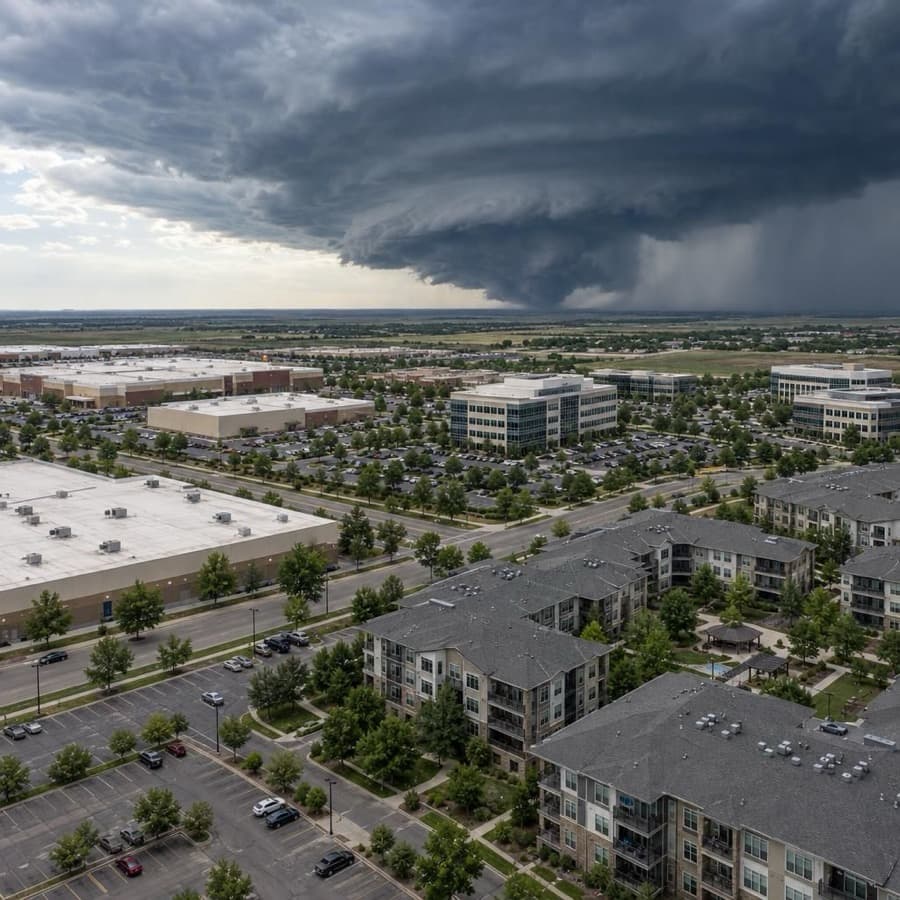
- Hail days near Oklahoma City since 2010, the most in Oklahoma
- 142
- Largest hail reported, near Oklahoma City
- 4.6 in
- Oklahoma cities tracked
- 3
Source: NOAA/NWS Storm Prediction Center
Data through November 1, 2026
Oklahoma cities by hail days
Source: NOAA/NWS Storm Prediction Center
Data through November 1, 2026
| City | Hail days since 2010 | Largest hail |
|---|---|---|
| Oklahoma City | 142 | 4.6 in |
| Tulsa | 116 | 4.25 in |
| Norman | 109 | 4.6 in |
About this data
- Each city counts reports within 15 miles of its center, not of any one property.
- Reports come from trained spotters and the public, so they cluster near towns and roads.
- No report does not mean no hail. Hail can fall where no one is there to report it.
- This is not a damage or insurance assessment.
Storm risk in Oklahoma
For commercial and multifamily buildings in Oklahoma, hail and damaging thunderstorm wind are the most frequent storm risks, followed by tornadoes, then flash floods, ice storms and wind-driven wildfire. Oklahoma had 369 large hail events in 2025, the third most of any state, and the Oklahoma City radar area ranks first of 141 US radar areas for both severe weather reports and tornadoes per square mile.2,3
How often storms hit Oklahoma
| Hazard | How often | What it means for buildings |
|---|---|---|
| Hail | 369 hail events with stones 1 inch or larger in 2025, third most of any state (5,432 in the US). Hail days since 2010 within 15 miles of the city center: Oklahoma City 142, Tulsa 116, with hail up to 4.6 inches near Oklahoma City. Hail reports on 63 days a year on average within 124 nautical miles of the Oklahoma City radar and 58 around Tulsa (1980 to 2006). | Roof covers, skylights, siding and rooftop HVAC condenser fins take repeat hits, and the same roof can be struck more than once in a season. |
| Damaging thunderstorm wind | Damaging wind reports on 58 days a year on average around the Oklahoma City radar and 56 around Tulsa (1980 to 2006). | Straight-line gusts peel roof edges and membranes, topple rooftop units and signs, and drop trees on buildings and parking. |
| Tornadoes | 69 a year on average from 1995 to 2024. At any one point within 124 nautical miles of the Oklahoma City radar, the yearly chance of a tornado is 0.052 percent, and 18 violent F4 or F5 tornadoes struck that area from 1980 to 2006. | A direct hit on one building is rare, but across many buildings the odds add up. FEMA says most buildings not designed as shelters or safe rooms suffer catastrophic damage from a direct hit by a violent tornado. |
| Flooding | Flood prevention programs have cut river flooding, but flash flooding of creeks and small streams remains a serious threat in urban and suburban areas. The number of 2-inch rain events has generally been above average since the late 1980s. | Runoff fills low parking, ground floors and below-grade rooms within minutes. |
| Ice storms and hard freezes | Freezing rain is a regular part of winter, especially in central and eastern Oklahoma. Six ice storms left widespread ice of at least 1 inch from December 2000 to December 2007, and in February 2021 temperatures stayed below freezing for 10 straight days. | Ice brings limbs and power lines down onto roofs and parking, and long freezes burst pipes and sprinkler lines. |
| Wildfire | Drought raises the risk. In March 2025, wind-driven fires burned 175,000 acres and destroyed over 500 homes and businesses. | Grass fires pushed by strong wind reach the edges of towns, where embers ignite roofs, siding and landscaping. |
The city counts are days with at least one hail report within 15 miles of each city's center since 2010, so they show how often hail falls near a city, not on one building. The Storm Prediction Center radar figures cover a much larger circle, 124 nautical miles around each radar, and come from 1980 to 2006 reports.1,3,4
For an owner, hail and straight-line wind set the routine: frequent, repeat damage to roofs and rooftop equipment that makes roof ratings and claim deadlines matter every year. Tornadoes, ice storms and wildfire are rarer at any one address but cause the largest single losses.
Rules owners in Oklahoma should know
- Claim decision time: Under 36 O.S. 1250.7, a property insurer must tell a first party claimant within 60 days of receiving a properly executed proof of loss whether it accepts or denies the claim or needs more investigation, and the investigation may not run past 120 days except for supported suspicion of fraud or arson. After a weather catastrophe the Governor declares, the Insurance Commissioner may add 20 days to each deadline.8
- Settlement offer: Under 36 O.S. 3629, an insurer must send a written offer of settlement or rejection within 60 days of receiving a proof of loss. In a lawsuit, costs and attorney fees go to the prevailing party, which is the insurer when the judgment does not exceed its written offer; when the insured prevails, the court adds 15 percent yearly interest from the date the loss was payable.9
- Deadline to sue: 36 O.S. 3617 voids any property policy clause that limits the time to sue to less than one year from the date of the event that caused the loss. Under 36 O.S. 1250.7, an insurer still dealing with a claimant who has no attorney must give written notice one year after the loss that a time limit is expiring.10,8
- Roofer registration: Every roofing contractor in Oklahoma must register each year with the Construction Industries Board, and commercial roofing also needs a commercial roofer endorsement (59 O.S. 1151.3).11,18
- Deductible offers: A residential or commercial roofing contractor may not promise to pay all or part of an insurance deductible, and if one does, the insurer need not consider that contractor's estimate. The contractor must give written notice of this rule with its first estimate (59 O.S. 1151.30).12
- Public adjuster contracts: An insured may cancel a public adjuster agreement until midnight of the third business day after receiving it, and the contract must state the exact percentage fee. If the insurer pays or commits in writing to pay the policy limits within 72 hours of the claim report, the adjuster gets no percentage fee on that coverage (36 O.S. 6216.2).13
Before the next storm
- Hail-rated roofs: When a roof is due, IBHS recommends low-slope covers rated FM 4470 Class 1-SH or UL 2218 Class 4 and steep-slope covers rated UL 2218 Class 4 or FM 4473 Class 3 or 4, because Oklahoma City and Tulsa have each had more than 100 hail days since 2010.14,1
- Rooftop units and skylights: IBHS recommends hail guards over condenser fins and air intakes and skylights rated FM 4431 Severe Hail or ASTM E1996 impact rated, since hail on unguarded fins can impair a unit and a broken skylight lets rain in.14
- Tornado refuge areas: Have an architect or engineer pick each building's best available refuge areas using FEMA P-431 and FEMA's checklist. FEMA treats these areas as an interim step until a safe room built to FEMA P-361 is available.15,16
- Flood policy timing: Look up each building's flood zone and coverage before storm season, because a new NFIP flood policy generally takes effect only after a 30-day waiting period.17
Sources
Written by the Cloudbreak team. Numbers, dates and rules cite the published sources below.
- 1. Cloudbreak: NOAA/NWS Storm Prediction Center storm reports, as counted on the Cloudbreak hail history page for Oklahoma
- 2. Insurance Information Institute (Triple-I): Facts + Statistics: Hail
- 3. NOAA Storm Prediction Center: TLX (Oklahoma City) Severe Weather Climatology, 1980 to 2006
- 4. NOAA Storm Prediction Center: INX (Tulsa) Severe Weather Climatology, 1980 to 2006
- 5. NOAA NCEI and North Carolina Institute for Climate Studies: Oklahoma: 2025 State Climate Summaries
- 6. Oklahoma Climatological Survey: Oklahoma Climate
- 7. Oklahoma Climatological Survey, Oklahoma Mesonet and NWS Tulsa (AMS extended abstract): Development and Testing of an Ice Accumulation Algorithm (McManus et al.)
- 8. Oklahoma Legislature (text via Justia): 36 O.S. 1250.7: Property and casualty insurer, denial or acceptance of claim
- 9. Oklahoma Legislature (text via Justia): 36 O.S. 3629: Forms of proof of loss, offer of settlement or rejection of claim
- 10. Oklahoma Legislature (text via Justia): 36 O.S. 3617: Policy restrictions voided
- 11. Oklahoma Legislature (text via Justia): 59 O.S. 1151.3: Roofing contractor registration
- 12. Oklahoma Legislature (text via Justia): 59 O.S. 1151.30: Offer to pay insurance deductible or to compensate for providing service
- 13. Oklahoma Legislature (text via Justia): 36 O.S. 6216.2: Contract for services of public adjuster, cancellation
- 14. Insurance Institute for Business & Home Safety (IBHS): Commercial Roofs Best Practices Guide
- 15. FEMA: Tornado Protection: Selecting Refuge Areas in Buildings (FEMA P-431)
- 16. FEMA: Best Available Refuge Area Checklist
- 17. FEMA (Code of Federal Regulations): 44 CFR 61.11: Effective date and time of coverage under the Standard Flood Insurance Policy
- 18. Oklahoma Insurance Department: Oklahoma Insurance Department Shares Guidance After Storms Impact State (March 9, 2026)
Storms in Oklahoma
Late spring and early summer are Oklahoma's peak thunderstorm season, with spring storms bringing very large hail, damaging winds and tornadoes, and fall brings a second, less active severe season, the Oklahoma Climatological Survey says.1 Three-fourths of Oklahoma tornadoes have come in April, May and June, and May averages the most.1
Notable storms
- May 8, 2026Wind-driven hail up to 2.25 inches damaged homes, vehicles, outbuildings and trailers in Collinsville in Rogers County, and hail up to 2 inches damaged homes and vehicles in Verdigris. NOAA's Storm Events Database lists $2 million in property damage in Collinsville.2,3
- April 27, 2024An EF4 tornado destroyed large commercial buildings on the west side of Marietta near I-35, and an EF3 destroyed or badly damaged numerous businesses and buildings in downtown Sulphur. Each killed one person. Storm Events lists $150 million in property damage for the Marietta tornado in Love County.4,5
- March 14, 2024Hail up to 6 inches across fell on Ada, with many stones up to 4 inches, damaging vehicles and buildings across the town. Storm Events lists $2 million in property damage in Ada.6,7
- June 17, 2023Wind gusts over 100 mph at times swept across eastern Oklahoma late on June 17, causing widespread damage to homes and businesses. Storm Events lists at least $160 million in damage in Tulsa County.8
- May 20, 2013An EF5 tornado up to 1.1 miles wide tracked about 14 miles from Newcastle through south Oklahoma City and Moore, killing 24 people and injuring 212. Over 300 homes took EF4 or EF5 damage, and Storm Events lists $2 billion in property damage in Cleveland County.9,10
- May 29, 2012Hail up to 3 inches hit the Oklahoma City area. In Edmond and Nichols Hills, 8,000 to 10,000 vehicles and numerous homes were damaged, and several buildings in Oklahoma City had window and roof damage. Storm Events puts estimated damage across the metro at $400 to $500 million.11,12
Warnings and alerts
NWS Norman covers 48 counties of western, central and southern Oklahoma, including Oklahoma City. NWS Tulsa covers the east, NWS Amarillo the Panhandle and NWS Shreveport the far southeast corner.13,14
Sources
- 1. Oklahoma Climatological Survey: Oklahoma Climate
- 2. NOAA NCEI: Storm Events Database: Hail, Rogers County, May 8, 2026 (Collinsville)
- 3. NOAA NCEI: Storm Events Database: Hail, Rogers County, May 8, 2026 (Verdigris)
- 4. NOAA NCEI: Storm Events Database: Tornado, Love County, April 27, 2024
- 5. NOAA NCEI: Storm Events Database: Tornado, Murray County, April 27, 2024
- 6. NOAA NCEI: Storm Events Database: Hail, Pontotoc County, March 14, 2024 (6 inches)
- 7. NOAA NCEI: Storm Events Database: Hail, Pontotoc County, March 14, 2024 (4 inches)
- 8. NOAA NCEI: Storm Events Database: Thunderstorm Wind, Tulsa County, June 17, 2023
- 9. NWS Norman: The Tornado Outbreak of May 20, 2013
- 10. NOAA NCEI: Storm Events Database: Tornado, Cleveland County, May 20, 2013
- 11. NOAA NCEI: Storm Events Database: Hail, Oklahoma County, May 29, 2012 (Nichols Hills)
- 12. NOAA NCEI: Storm Events Database: Hail, Oklahoma County, May 29, 2012 (Oklahoma City)
- 13. NWS Norman: Frequently Asked Questions
- 14. National Weather Service: Oklahoma County Warning Forecast Areas (map)
Hail history in other states
- Alabama
- Alaska
- Arizona
- Arkansas
- California
- Colorado
- Connecticut
- District of Columbia
- Florida
- Georgia
- Hawaii
- Idaho
- Illinois
- Indiana
- Iowa
- Kansas
- Kentucky
- Louisiana
- Maine
- Maryland
- Massachusetts
- Michigan
- Minnesota
- Mississippi
- Missouri
- Montana
- Nebraska
- Nevada
- New Hampshire
- New Jersey
- New Mexico
- New York
- North Carolina
- North Dakota
- Ohio
- Oregon
- Pennsylvania
- Rhode Island
- South Carolina
- South Dakota
- Tennessee
- Texas
- Utah
- Virginia
- Washington
- West Virginia
- Wisconsin
- Wyoming