Hail history in Idaho
NOAA hail reports within 15 miles of the center of Boise since 2010: 8 hail days, largest 1.5 in.
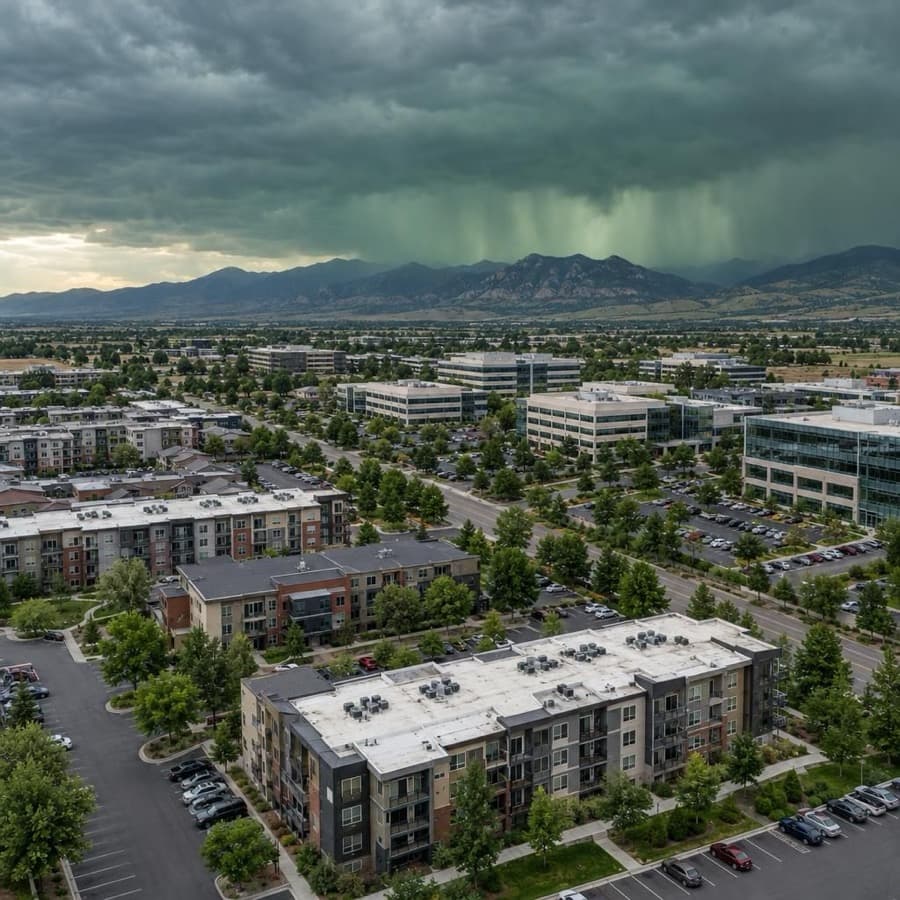
- Hail days near Boise since 2010, the most in Idaho
- 8
- Largest hail reported, near Boise
- 1.5 in
- Idaho city tracked
- 1
Source: NOAA/NWS Storm Prediction Center
Data through November 1, 2026
Idaho cities by hail days
Source: NOAA/NWS Storm Prediction Center
Data through November 1, 2026
| City | Hail days since 2010 | Largest hail |
|---|---|---|
| Boise | 8 | 1.5 in |
About this data
- Each city counts reports within 15 miles of its center, not of any one property.
- Reports come from trained spotters and the public, so they cluster near towns and roads.
- No report does not mean no hail. Hail can fall where no one is there to report it.
- This is not a damage or insurance assessment.
Storm risk in Idaho
For commercial and multifamily buildings in Idaho, the storm risks that matter most are thunderstorm wind and hail, winter storms and heavy snow, floods from snowmelt and rain, and wildfire, which the state hazard mitigation plan says is a significant hazard in every Idaho county.2 Idaho has a low tornado risk compared with the Midwest and the South, and the same plan rates its potential for significant hail as relatively low, noting that hail falls most often in the southern and central Plains.2
How often storms hit Idaho
| Hazard | How often | What it means for buildings |
|---|---|---|
| Hail | Boise has had 8 hail days since 2010 within 15 miles of its center, with hail up to 1.5 inches. Statewide, NOAA recorded 1,044 hail events from 1956 to 2022, about 15 a year. | Hail cracks roof covers and skylights and bends the fins on rooftop condensers, which can stop a unit from working. |
| Damaging thunderstorm wind | 1,926 thunderstorm events from 1956 to 2022, about 28 a year. A storm counts as severe at gusts of 58 mph or more. | Downbursts peel roof edges and membranes, topple rooftop equipment and drop trees on buildings and parking. |
| Tornadoes | About 3 a year (217 from 1950 to 2023), most rated EF0 or EF1 with minimal damage. | A direct hit on any one building is rare; most damage is to roofs, siding and trees. |
| Flooding | About 10 flood events a year (439 floods and 286 flash floods from 1956 to 2022), and 18 federal flood disaster declarations since 1956. | Snowmelt, rain on snow, ice jams and cloudbursts flood ground floors, basements and site work. Wildfire burn scars speed up runoff. |
| Winter storms and snow | About 11 winter storm events a year (777 from 1956 to 2022). | FEMA says drifting snow and rain on snow can load a roof past its design. Cold snaps freeze pipes and sprinkler lines. |
| Wildfire | NOAA recorded 384 wildfire events from 1956 to 2022, about 7 a year. | Embers can travel long distances and land on roofs or blow into vents, IBHS says, so buildings away from the fire front can still ignite. |
The Boise count is days with at least one hail report within 15 miles of the city center since 2010, so it shows how often hail falls near the city, not on one building. The statewide counts are NOAA storm events compiled for Idaho's 2023 hazard mitigation plan and cover the whole state, so they run far higher than what any single site sees.1,2
For an owner, wind and hail bring the most frequent roof repairs, while heavy snow, floods and wildfire strike any one site less often but can put a building out of use.
Rules owners in Idaho should know
- Late payment and attorney's fees: an insurer that fails to pay the amount justly due within 30 days after proof of loss is furnished must also pay the policyholder's reasonable attorney's fees, as the court sets them, in a later suit or arbitration. No fees are owed if the insurer tendered the full amount justly due before the case began, or if nothing is found due (Idaho Code 41-1839).5
- Time to sue: Idaho Code 29-110 voids any contract term that limits the time within which a party may enforce its rights under the contract, and Idaho Code 5-216 allows five years to sue on a written contract.6,7
- Claim handling: it is an unfair practice, when done intentionally or often enough to be a general business practice, for an insurer to refuse to pay without a reasonable investigation, to fail to affirm or deny coverage within a reasonable time after proof of loss, or to fail to explain the policy basis for a denial or a compromise offer (Idaho Code 41-1329).8
- Public adjusters: anyone acting as a public adjuster in Idaho needs an Idaho license (Idaho Code 41-5803). The contract must be in writing and state the fee, the insured may rescind it in writing within three business days, and if the insurer pays or commits in writing to pay the policy limit within 72 hours of the loss report, the adjuster may take no percentage fee, only reasonable pay for time and expenses (Idaho Code 41-5815).9,10
- Local building codes: each city or county decides whether to run a building code program. Those that issue permits must adopt the International Building Code as the Idaho building code board adopts it, and may amend it for local concerns if the protection stays at least equivalent (Idaho Code 39-4116). Design snow and wind loads for a reroof or addition therefore come from the local building department.11
Before the next storm
- Snow drift check: have a structural engineer confirm that drift-prone areas, such as parapets, roof steps and spots around rooftop equipment, can carry the weight of drifted snow, as IBHS recommends. FEMA's warning signs of an overloaded roof include sagging ceiling tiles, sprinkler heads dropping below the ceiling and doors that stick.4,3
- Freeze protection: keep building heat above 40°F, hold vacant space at 55°F or more, and heat unheated sprinkler valve and fire pump rooms. IBHS notes that cold air reaching pipes through gaps in the building can freeze and burst them even in buildings built for cold climates.12
- Fire-rated roofs: when replacing a roof in a wildfire-prone area, use a Class A fire-rated cover and check whether the rating is by assembly, which needs extra layers under the cover. IBHS rates Class A as the best protection from embers.4
- Flood timing: arrange or change flood coverage well before the spring snowmelt, since FEMA says an NFIP policy typically takes effect 30 days after purchase.13
- Hail guards: fit guards over condenser fins and air intakes on rooftop units. IBHS recommends them for any rooftop component that hail could damage enough to impair its operation.4
Sources
Written by the Cloudbreak team. Numbers, dates and rules cite the published sources below.
- 1. Cloudbreak: NOAA/NWS Storm Prediction Center storm reports, as counted on the Cloudbreak hail history page for Idaho
- 2. Idaho Office of Emergency Management: State of Idaho Hazard Mitigation Plan (October 2023)
- 3. FEMA: Snow Load Safety Guidance (FEMA P-957)
- 4. Insurance Institute for Business & Home Safety (IBHS): Commercial Roofs Best Practices Guide
- 5. Idaho State Legislature: Idaho Code 41-1839: Allowance of attorney's fees in suits against or in arbitration with insurers
- 6. Idaho State Legislature: Idaho Code 29-110: Limitations on right to sue under contract
- 7. Idaho State Legislature: Idaho Code 5-216: Action on written contract
- 8. Idaho State Legislature: Idaho Code 41-1329: Unfair claim settlement practices
- 9. Idaho State Legislature: Idaho Code 41-5803: Public adjuster license required
- 10. Idaho State Legislature: Idaho Code 41-5815: Contract between public adjuster and insured
- 11. Idaho State Legislature: Idaho Code 39-4116: Local government adoption and enforcement of building codes
- 12. Insurance Institute for Business & Home Safety (IBHS): Commercial Risk Engineering Bulletin: Winter Weather
- 13. FEMA: Waiting Period for Activating Flood Policy?
Storms in Idaho
Idaho's 2018 state hazard mitigation plan says hail falls somewhere in the state every year, mostly in minor events, and significant hailstorms are most common in summer.1 The same plan expects about 23 straight-line wind events a year statewide, possibly more in northern Idaho, and about three tornadoes a year, generally minor.1
Notable storms
- September 17, 2026Night storms tracked from American Falls through Blackfoot to Idaho Falls and Rexburg, with hail up to golf ball size, largest in Bingham County. People reported hail damage to homes, cars and camping trailers, and heavy rain flooded basements and several buildings in Rexburg.2
- August 11, 2022Wind-driven hail up to 2 inches broke windows and damaged siding on multiple homes around Cottonwood, where NOAA's Storm Events Database lists $50,000 in property damage. Hail up to an estimated 2.75 inches fell around Hauser in Kootenai County.3,4
- August 9, 2019Hail mostly the size of eggs, with some up to baseball size (2.75 inches), fell between Slate Creek and Riggins along Highway 95. It damaged greenhouse roofs, fences, vehicles and orchards, and NOAA's Storm Events Database lists $150,000 in property damage.5
- April 7, 2018At least 28 reports of 1 to 2 inch hail came from Idaho Falls and Ammon, where homes and businesses took extensive damage. About 2,600 structures and 1,800 vehicles were damaged, and NOAA's Storm Events Database lists $29.75 million in property damage in Bonneville County.6
- July 20, 2012Hail up to 2.75 inches fell near Summit in Nez Perce County. Later, winds downed hundreds of trees across the northern Panhandle, caused extensive damage to cabins and RVs throughout Priest Lake State Park, and killed one driver near Nordman when a tree fell on a moving vehicle.7,8,9
- August 21, 2010Winds gusted to 68 mph at the Boise airport and downed trees and power lines in the Treasure Valley. Temporary structures collapsed at the Western Idaho Fair, causing 70 minor injuries, and one person died at Grimes Creek near Idaho City, where many trees fell.10,11
Warnings and alerts
NWS Boise covers southwest Idaho, including Boise and Twin Falls. NWS Pocatello covers eastern and south central Idaho, including Pocatello, Idaho Falls and Burley. NWS Spokane covers the Panhandle south to Lewiston, and NWS Missoula covers Clearwater, Idaho and Lemhi counties.12
Sources
- 1. Idaho Office of Emergency Management: State of Idaho Hazard Mitigation Plan 2018, Chapter 3.3: Severe Storms
- 2. East Idaho News: Severe thunderstorm causes considerable flooding and damage across eastern Idaho
- 3. NOAA NCEI: Storm Events Database: Hail, Cottonwood, Idaho County, August 11, 2022
- 4. NOAA NCEI: Storm Events Database: Hail, State Line to Hauser, Kootenai County, August 11, 2022
- 5. NOAA NCEI: Storm Events Database: Hail, Slate Creek to Riggins, Idaho County, August 9, 2019
- 6. NOAA NCEI: Storm Events Database: Hail, Idaho Falls, Bonneville County, April 7, 2018
- 7. NOAA NCEI: Storm Events Database: Hail, Summit, Nez Perce County, July 20, 2012
- 8. NOAA NCEI: Storm Events Database: Thunderstorm Wind, Priest Lake State Park, Bonner County, July 20, 2012
- 9. NOAA NCEI: Storm Events Database: Thunderstorm Wind, Nordman, Bonner County, July 20, 2012
- 10. NOAA NCEI: Storm Events Database: Thunderstorm Wind, Boise airport, Ada County, August 21, 2010
- 11. NOAA NCEI: Storm Events Database: Thunderstorm Wind, Idaho City, Boise County, August 21, 2010
- 12. National Weather Service: Public zone and county listing, Western Region
Hail history in other states
- Alabama
- Alaska
- Arizona
- Arkansas
- California
- Colorado
- Connecticut
- District of Columbia
- Florida
- Georgia
- Hawaii
- Illinois
- Indiana
- Iowa
- Kansas
- Kentucky
- Louisiana
- Maine
- Maryland
- Massachusetts
- Michigan
- Minnesota
- Mississippi
- Missouri
- Montana
- Nebraska
- Nevada
- New Hampshire
- New Jersey
- New Mexico
- New York
- North Carolina
- North Dakota
- Ohio
- Oklahoma
- Oregon
- Pennsylvania
- Rhode Island
- South Carolina
- South Dakota
- Tennessee
- Texas
- Utah
- Virginia
- Washington
- West Virginia
- Wisconsin
- Wyoming