Hail history in Arkansas
We counted the days with NOAA hail reports within 15 miles of the center of 2 Arkansas cities since 2010.
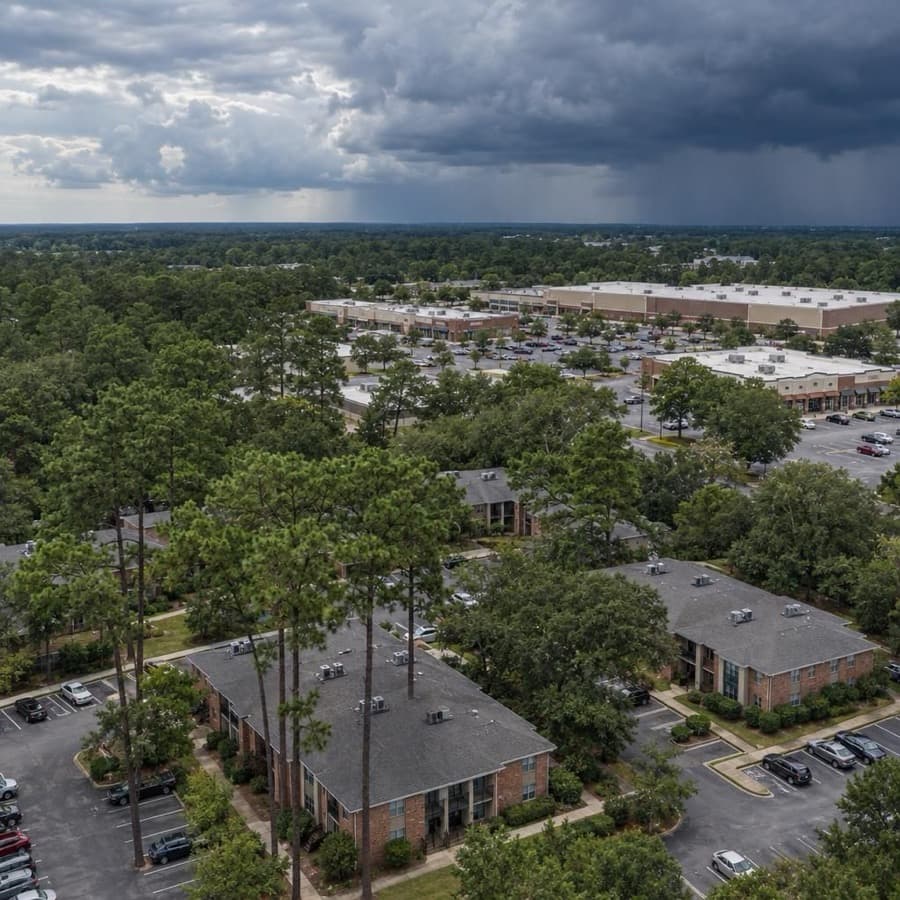
- Hail days near Little Rock since 2010, the most in Arkansas
- 85
- Largest hail reported, near Fayetteville
- 5.0 in
- Arkansas cities tracked
- 2
Source: NOAA/NWS Storm Prediction Center
Data through November 1, 2026
Arkansas cities by hail days
Source: NOAA/NWS Storm Prediction Center
Data through November 1, 2026
| City | Hail days since 2010 | Largest hail |
|---|---|---|
| Little Rock | 85 | 2.0 in |
| Fayetteville | 65 | 5.0 in |
About this data
- Each city counts reports within 15 miles of its center, not of any one property.
- Reports come from trained spotters and the public, so they cluster near towns and roads.
- No report does not mean no hail. Hail can fall where no one is there to report it.
- This is not a damage or insurance assessment.
Storm risk in Arkansas
For commercial and multifamily buildings in Arkansas, hail and damaging thunderstorm wind are the most frequent storm risks, followed by tornadoes, flooding, which the state calls its most common and costly natural disaster, and the occasional ice storm.3,6 Arkansas had 154 hail events with stones 1 inch or larger in 2025, the 10th most of any state, and the area within 124 nautical miles of the Little Rock radar ranks 6th of 141 US radar areas for how often F2 or stronger tornadoes strike per square mile.2,3
How often storms hit Arkansas
| Hazard | How often | What it means for buildings |
|---|---|---|
| Hail | 154 hail events with stones 1 inch or larger in 2025, 10th among states (5,432 in the US). Hail days since 2010 within 15 miles of the city center: Little Rock 85, with hail up to 2 inches; Fayetteville 65, with hail up to 5 inches. | Roof covers, skylights and rooftop HVAC condenser fins take the hits, and the same roof can be struck more than once in a season. |
| Damaging thunderstorm wind | Damaging wind reports on 57 days a year on average within 124 nautical miles of the Little Rock radar, against hail on 47 days (1980 to 2006). | NWS Little Rock says straight-line winds, usually from bow echoes, can do as much damage as a weak tornado: torn roof edges, broken windows and fallen trees. |
| Tornadoes | About 37 a year (1991 to 2020 average). Of 971 from 2000 through 2024, 81 percent were rated EF1 or weaker; the 35 rated EF3 or stronger caused 80 percent of tornado deaths. | Most damage roofs, siding and trees. In strong tornadoes, NWS damage surveys find winds remove the roof first and then the outer walls. |
| Flooding | The state's most common and costly natural disaster, with major flood disaster declarations nearly every year. | Property in a mapped Special Flood Hazard Area has a 26 percent chance of flooding over a 30-year mortgage, and about 25 percent of flood damage happens outside the mapped flood zone. |
| Winter storms and ice | Not common: normal seasonal snowfall is under 10 inches in most of the state, but every part of Arkansas has had a snowfall of 10 inches or more and damaging ice. | Ice brings trees and power lines down on roofs and parking, and long outages leave pipes and wet sprinkler lines to freeze. IBHS notes pipes in southern buildings often run outside the insulation. |
The city counts are days with at least one hail report within 15 miles of each city's center since 2010, so they show how often hail falls near a city, not on one building. The Storm Prediction Center radar figures cover a much larger circle, 124 nautical miles around the radar, and come from 1980 to 2006 reports, so they compare regions rather than sites.1,3
For an owner, the pattern matters more than any one storm. Hail and straight-line wind bring frequent, repeat damage to roofs and rooftop equipment, while strong tornadoes, floods and ice storms are rarer at any one address but cause the largest single losses.
Rules owners in Arkansas should know
- Valued policy law: when insured real property is a total loss from fire or a natural disaster other than flood or earthquake, Arkansas treats the policy as owing its full stated amount, less the deductible on a commercial policy. The rule doesn't apply to personal property or to a blanket policy covering two or more buildings, where the first payment is each building's value used to rate the policy (Ark. Code 23-88-101).8
- Labor depreciation: a policy may deduct depreciation on labor, materials and services only if it carries a notice in a form the Insurance Commissioner approved, and the insurer must explain in writing how it calculated that depreciation. It can't be applied to total losses paid under the valued policy law (Ark. Code 23-88-106, AID Bulletin 10-2017).9
- Late payment penalty: an insurer that fails to pay a loss within the time the policy sets after demand owes 12 percent of the loss on top of it, plus reasonable attorney's fees. Recovering less than the demand still earns both if the amount is within 20 percent of what was demanded (Ark. Code 23-79-208).10
- Time to sue: a suit on a property insurance claim may be brought within the period for written contracts, five years after the claim accrues, and any policy clause setting a shorter deadline is void (Ark. Code 23-79-202 and 16-56-111).11,12
- Commercial renewals: on commercial policies other than large commercial risks, an insurer must mail notice of nonrenewal at least 60 days before expiration, warn of a renewal increase of 25 percent or more (60 days ahead to the agent, 30 to the insured), and get the insured's signature on mid-term endorsements that cut coverage the insured didn't ask for. Notice of a claim to the insurer's authorized agent counts as notice to the insurer (Ark. Code 23-79-303 and 23-79-307).13,14
- Rural risks: every licensed property insurer belongs to the Arkansas Rural Risk Underwriting Association, which offers property insurance on risks in areas its board designates as rural. An applicant who meets its approved underwriting standards is entitled to insurance through it (Ark. Code 23-88-303 and 23-88-306).15,16
Before the next storm
- Hail-rated roofs: when a roof is due, IBHS calls for low-slope covers rated FM 4470 Class 1-SH or UL 2218 Class 4 in hail-prone areas and hail guards over rooftop condenser fins, because Arkansas had the 10th most large hail events of any state in 2025.18,2
- Tornado shelter areas: mark interior rooms on the lowest floor as shelter and set up NOAA Weather Radio. NWS Little Rock says destructive winds remove a roof first and then outer walls, and few warning sources will wake people at night.4
- Freeze protection: before an ice storm or hard freeze, protect pipes in attics, crawl spaces and outside walls and keep heat above 40°F where wet sprinkler pipes run. IBHS calls burst pipes the leading cause of property damage from winter weather.17
- Contractor checks: line up licensed roofers before storm season. The Arkansas Insurance Department advises confirming a license with the Arkansas Contractors Licensing Board and avoiding contractors who offer to waive the deductible.19
- Flood coverage timing: look up each building's flood zone and flood coverage well before heavy rain. FEMA says a new flood policy typically has a 30-day waiting period before it takes effect.20
Sources
Written by the Cloudbreak team. Numbers, dates and rules cite the published sources below.
- 1. Cloudbreak: NOAA/NWS Storm Prediction Center storm reports, as counted on the Cloudbreak hail history page for Arkansas
- 2. Insurance Information Institute (Triple-I): Facts + Statistics: Hail
- 3. NOAA Storm Prediction Center: LZK (Little Rock) Severe Weather Climatology, 1980 to 2006
- 4. NWS Little Rock: Severe Weather in Arkansas: Questions and Answers
- 5. NWS Little Rock: Historic Ice Storms in Arkansas (Public Information Statement)
- 6. Arkansas Department of Agriculture, Natural Resources Division: Floodplain Management Programs
- 7. Arkansas Department of Agriculture, Natural Resources Division: Floodplain Management
- 8. Arkansas General Assembly (text via Justia): Arkansas Code 23-88-101, Valued policy law
- 9. Arkansas Insurance Department: Bulletin No. 10-2017: Act 279 of 2017 Rescinds Bulletin 13B-2013 Prohibiting Depreciation of Labor
- 10. Arkansas General Assembly (text via Justia): Arkansas Code 23-79-208, Damages and attorney's fees on loss claims
- 11. Arkansas General Assembly (text via Justia): Arkansas Code 23-79-202, Limitation of actions
- 12. Arkansas General Assembly (text via Justia): Arkansas Code 16-56-111, Notes and instruments in writing and other writings
- 13. Arkansas General Assembly (text via Justia): Arkansas Code 23-79-303, Commercial property and casualty policies: applicability and exceptions
- 14. Arkansas General Assembly (text via Justia): Arkansas Code 23-79-307, Commercial property and casualty policies: standards
- 15. Arkansas General Assembly (text via Justia): Arkansas Code 23-88-303, Arkansas Rural Risk Underwriting Association: plan of property insurance
- 16. Arkansas General Assembly (text via Justia): Arkansas Code 23-88-306, Provisions of plan
- 17. Insurance Institute for Business & Home Safety (IBHS): Commercial Risk Engineering Bulletin: Winter Weather
- 18. Insurance Institute for Business & Home Safety (IBHS): Commercial Roofs Best Practices Guide
- 19. Arkansas Insurance Department: Insurance Commissioner Provides Post-Storm Tips to Consumers
- 20. FEMA: Waiting Period for Activating Flood Policy?
Storms in Arkansas
Tornado seasons in Arkansas peak in spring and fall, NWS Little Rock says, and almost 4 in 10 of the state's tornadoes from 2000 to 2022 came between September and February.1,2 Around the Little Rock radar, SPC data for 1980 to 2006 show hail reports peaking in April and May and damaging wind reports in May through July.3 Baseball size or larger hail fell somewhere in Arkansas every year from 1980 through 2022 except 2005 and 2013, NWS Little Rock found.4
Notable storms
- April 25, 2026Late on April 25, storms dropped 4.5-inch hail at Alpine and 4-inch hail at Amity in Clark County, and 2.75-inch hail at Glenwood and Hope. The Arkadelphian reported that the hail damaged many homes and vehicles in the Amity area.5,6
- March 14, 2025Fourteen tornadoes hit Arkansas overnight into March 15, two of them rated EF4. One EF4 tracked 117 miles from near Fifty-Six in Stone County into Missouri, and an EF3 from near Cushman in Independence County to near Corning in Clay County killed 3 people.7
- March 31, 2023An EF3 tornado with peak winds of 165 mph tracked just over 34 miles from west Little Rock through North Little Rock, Sherwood and Jacksonville to Cabot, affecting at least 2,700 structures and killing 1 person. That afternoon, another EF3 struck Wynne, where NOAA's Storm Events Database lists 4 deaths and 26 injuries.8,9
- May 4, 2020Morning supercells dropped hail up to 5 inches across near Johnson in Washington County, and grapefruit size hail damaged vehicles, homes and businesses nearby. NWS Little Rock lists the 5-inch stones as tied for the largest hail on record in Arkansas.10,11,4
- June 19, 2019Softball size or larger hail fell between Vandervoort and Cove in Polk County. Researchers measured one stone at 4.6 inches across, just short of the 5-inch state record, NWS Little Rock said.12,4
- April 27, 2014An EF4 tornado tracked 41 miles through Mayflower and Vilonia in Faulkner County to near El Paso in White County. NWS Little Rock estimated 400 to 500 homes destroyed and counted 16 deaths, the most from a single Arkansas tornado since 1968.13
Warnings and alerts
NWS Little Rock covers most of Arkansas, with NWS Tulsa, Memphis, Shreveport and Jackson covering counties along the northwest, east, southwest and southeast edges.14 The state's Arkansas.gov portal links to official alert and notification sign-ups.15
Sources
- 1. NWS Little Rock: Severe Weather Awareness Week: Tornadoes
- 2. NWS Little Rock: Fall Severe Weather Awareness
- 3. NOAA Storm Prediction Center: LZK Severe Weather Climatology
- 4. NWS Little Rock: Massive Hail on April 2-3, 2006
- 5. NWS Little Rock: Arkansas Weather Statistics for 2026
- 6. The Arkadelphian: Late-night thunderstorms leave Gurdon, Prescott in the dark; hail damage in Amity
- 7. NWS Little Rock: Arkansas Weather Statistics for 2025
- 8. NWS Little Rock: Destructive Tornadoes on March 31, 2023
- 9. NOAA NCEI: Storm Events Database: Tornado, Cross County, March 31, 2023
- 10. NOAA NCEI: Storm Events Database: Hail, Washington County, May 4, 2020 (5 inches)
- 11. NOAA NCEI: Storm Events Database: Hail, Washington County, May 4, 2020 (4 inches)
- 12. NOAA NCEI: Storm Events Database: Hail, Polk County, June 19, 2019
- 13. NWS Little Rock: Tornadoes/Flooding on April 27-28, 2014
- 14. National Weather Service: NWS public forecast zones, Southern Region
- 15. Arkansas.gov: Citizen Alert & Notification Systems
Hail history in other states
- Alabama
- Alaska
- Arizona
- California
- Colorado
- Connecticut
- District of Columbia
- Florida
- Georgia
- Hawaii
- Idaho
- Illinois
- Indiana
- Iowa
- Kansas
- Kentucky
- Louisiana
- Maine
- Maryland
- Massachusetts
- Michigan
- Minnesota
- Mississippi
- Missouri
- Montana
- Nebraska
- Nevada
- New Hampshire
- New Jersey
- New Mexico
- New York
- North Carolina
- North Dakota
- Ohio
- Oklahoma
- Oregon
- Pennsylvania
- Rhode Island
- South Carolina
- South Dakota
- Tennessee
- Texas
- Utah
- Virginia
- Washington
- West Virginia
- Wisconsin
- Wyoming