Hail history in Pennsylvania
We counted the days with NOAA hail reports within 15 miles of the center of 9 Pennsylvania cities since 2010.
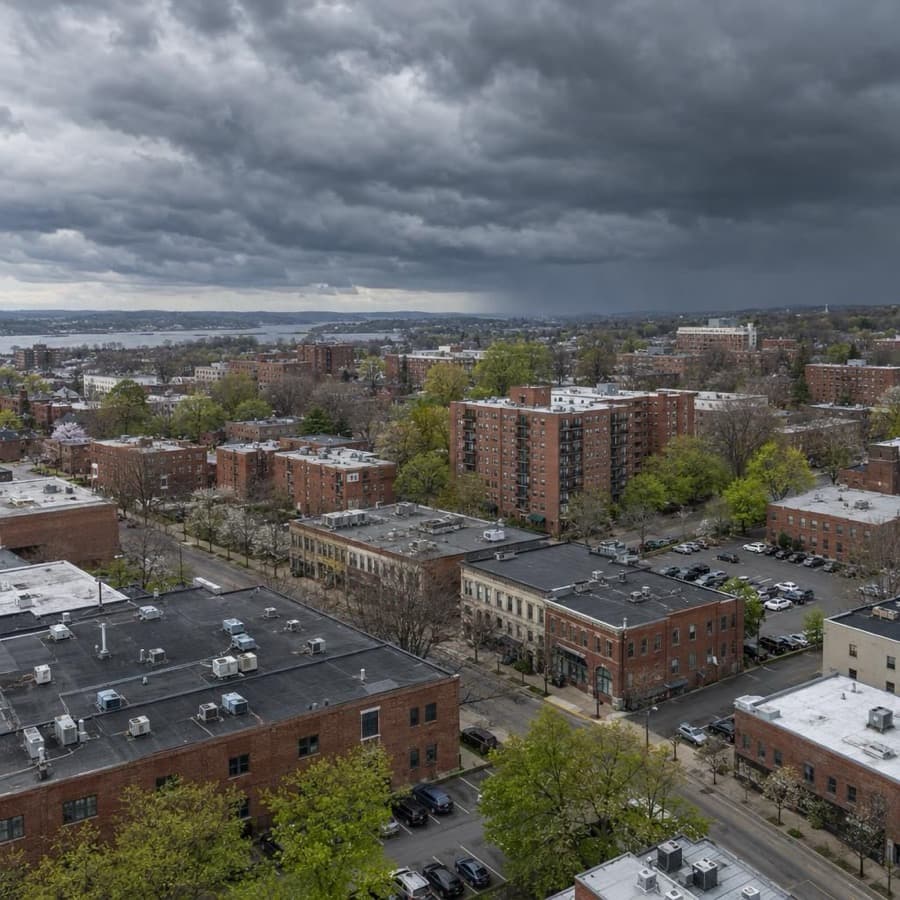
- Hail days near Pittsburgh since 2010, the most in Pennsylvania
- 64
- Largest hail reported, near Scranton
- 2.75 in
- Pennsylvania cities tracked
- 9
Source: NOAA/NWS Storm Prediction Center
Data through November 1, 2026
Pennsylvania cities by hail days
Source: NOAA/NWS Storm Prediction Center
Data through November 1, 2026
| City | Hail days since 2010 | Largest hail |
|---|---|---|
| Pittsburgh | 64 | 2.0 in |
| Allentown | 43 | 2.5 in |
| Philadelphia | 41 | 2.5 in |
| Harrisburg | 35 | 1.75 in |
| York | 35 | 2.0 in |
| Reading | 32 | 2.5 in |
| Lancaster | 31 | 1.75 in |
| Scranton | 28 | 2.75 in |
| Erie | 17 | 2.0 in |
About this data
- Each city counts reports within 15 miles of its center, not of any one property.
- Reports come from trained spotters and the public, so they cluster near towns and roads.
- No report does not mean no hail. Hail can fall where no one is there to report it.
- This is not a damage or insurance assessment.
Storm risk in Pennsylvania
For commercial and multifamily buildings in Pennsylvania, damaging thunderstorm wind and flooding are the most frequent and costly storm risks, followed by hail, the remnants of tropical storms, winter storms and tornadoes. Severe storms account for most of the 114 weather disasters with losses over $1 billion that affected the state from 1980 to 2024, FEMA calls flooding the most common natural disaster in Pennsylvania, and the state ranks in the top 25 for tornadoes.7,6,5
How often storms hit Pennsylvania
| Hazard | How often | What it means for buildings |
|---|---|---|
| Damaging thunderstorm wind | Damaging wind reports on 45 days a year on average within 124 nautical miles of the Pittsburgh radar and on 39 around the Philadelphia radar (1980 to 2006). Of 141 US radar areas studied, Pittsburgh ranks 44th for any severe weather per square mile. | Straight-line gusts peel roof edges and membranes, shift rooftop units and drop trees on buildings and parking. |
| Flooding | FEMA calls flooding the most common natural disaster in the state. Days with 2 inches of rain or more have increased since the 1960s, and rain falling on spring snowmelt causes especially damaging floods. | Flooding hits hardest along smaller streams and tributaries; water damages basements, lower floors, mechanical rooms and parking. |
| Hail | Hail days since 2010 within 15 miles of the city center: Pittsburgh 64, Allentown 43, Philadelphia 41, Harrisburg 35, York 35, Erie 17, with stones up to 2.75 inches near Scranton. Large hail fell on 27 days a year on average around the Pittsburgh radar and on 18 around Philadelphia (1980 to 2006). | Hail cracks roof covers and skylights and bends the fins on rooftop units, and a busy year can bring more than one damaging storm to the same roof. |
| Remnants of tropical storms | Not a landfall risk, but remnants bring heavy rain: Tropical Storm Agnes in 1972 dropped more than 10 inches in parts of the state, with damage estimated at almost $3 billion, and the remnants of Irene and Lee caused historic flooding in 2011. | The main danger is days of heavy rain and river flooding far from the coast. |
| Winter storms and cold | Snow ranges from under 20 inches a year in the southeastern lowlands to over 100 inches in the northwestern Lake Erie snowbelt. The state has averaged 6.1 nights a year at 0°F or below over the long term. | FEMA says drifting snow piles into concentrated loads at parapets and roof steps, and IBHS notes cold air reaching pipes can freeze and burst them. |
| Tornadoes | About 15 a year, most weaker than on the plains, though strong tornadoes do occur. At any one point within 124 nautical miles of the Pittsburgh radar, the yearly chance of a tornado is 0.025 percent. | The odds for one address are small but add up across a portfolio, and a strong tornado can tear off roofs and walls. |
The city counts are days with at least one hail report within 15 miles of each city's center since 2010, so they show how often hail falls near a city, not on one building. The Storm Prediction Center radar figures cover a much larger circle, 124 nautical miles around each radar, and come from 1980 to 2006 reports.1,3,4
For an owner, the pattern is frequent summer wind and hail damage to roofs and rooftop equipment, plus flooding that can reach buildings well outside mapped flood zones, with rarer but larger losses from tropical rain, heavy snow and tornadoes.
Rules owners in Pennsylvania should know
- FAIR Plan: The Pennsylvania FAIR Plan, formally the Insurance Placement Facility of Pennsylvania, makes basic property insurance available to owners who can't get it in the voluntary market (Act 233 of 1968). Its commercial policy covers fire, lightning, explosion, windstorm or hail, smoke, aircraft or vehicles, riot, sinkhole collapse, volcanic action, vandalism and sprinkler leakage, but not business income or other time element loss. Buildings vacant or unoccupied for more than 30 days are ineligible unless boarded up.8,10,9
- Claim handling: Under 31 Pa. Code 146.5 to 146.7, an insurer must acknowledge a claim within 10 working days and finish its investigation within 30 days unless it reasonably can't, then explain the delay in writing every 45 days. It must accept or deny a first-party claim within 15 working days after receiving proofs of loss, and a denial must be in writing and name the policy provision it relies on.11
- Suit deadline: Pennsylvania's required fire policy provisions bar a suit unless it starts within 12 months after inception of the loss (40 P.S. 636), a limit the state Supreme Court has upheld. An insurer dealing directly with a first-party claimant who has no lawyer must give written notice 30 days before a time limit may expire (31 Pa. Code 146.7(e)).13,11
- Bad faith: If a court finds an insurer acted in bad faith toward its insured, it may award interest on the claim at the prime rate plus 3 percent from the date of the claim, punitive damages, and court costs and attorney fees (42 Pa.C.S. 8371).12
Before the next storm
- Hail-rated roof covers: When reroofing, IBHS calls for low-slope covers rated FM 4470 Class 1-SH or UL 2218 Class 4, because Pittsburgh has had 64 hail days since 2010 and stones up to 2.75 inches have fallen near Scranton.14,1
- Rooftop unit guards: Fit hail guards over condenser fins and air intakes, since IBHS notes hail on these parts can impair a unit's operation.14
- Heat for sprinklers: Keep building heat above 40°F where wet sprinkler pipes run and seal openings in outside walls, because IBHS says cold air reaching pipes through penetrations can freeze and burst them.15
- Snow on roofs: After heavy snow, keep roof drains clear and have drifts at parapets, roof steps and equipment checked. FEMA lists sagging ceiling tiles and sprinkler heads dropping below the ceiling as warning signs of an overloaded roof.15,16
- Flood coverage dates: Check each building's flood coverage well before heavy rain is forecast, since FEMA says a new flood policy typically takes effect only after a 30-day wait.17
Sources
Written by the Cloudbreak team. Numbers, dates and rules cite the published sources below.
- 1. Cloudbreak: NOAA/NWS Storm Prediction Center storm reports, as counted on the Cloudbreak hail history page for Pennsylvania
- 2. NOAA NCEI and North Carolina Institute for Climate Studies: Pennsylvania: 2025 State Climate Summaries
- 3. NOAA Storm Prediction Center: PBZ (Pittsburgh) Severe Weather Climatology, 1980 to 2006
- 4. NOAA Storm Prediction Center: DIX (Philadelphia) Severe Weather Climatology, 1980 to 2006
- 5. NWS State College: Severe Weather Awareness Week in Pennsylvania
- 6. FEMA: Mitigating Flood Risk in Pennsylvania
- 7. Pennsylvania Emergency Management Agency: Strategic Plan 2025 to 2027
- 8. Pennsylvania FAIR Plan (Insurance Placement Facility of Pennsylvania): The Pennsylvania FAIR Plan
- 9. Pennsylvania FAIR Plan: General Rules Manual, Section II: Eligibility
- 10. Pennsylvania FAIR Plan: General Rules Manual, Section IV: Policy Provisions
- 11. Pennsylvania Code and Bulletin: 31 Pa. Code Chapter 146: Unfair Insurance Practices
- 12. Pennsylvania General Assembly (text via Justia): 42 Pa.C.S. 8371: Actions on insurance policies
- 13. Supreme Court of Pennsylvania (text via Justia): Schreiber v. Pennsylvania Lumberman's Mutual Insurance Co., 498 Pa. 21 (1982)
- 14. Insurance Institute for Business & Home Safety (IBHS): Commercial Roofs Best Practices Guide
- 15. Insurance Institute for Business & Home Safety (IBHS): Commercial Risk Engineering Bulletin: Winter Weather
- 16. FEMA: Snow Load Safety Guidance (FEMA P-957)
- 17. FEMA: Waiting Period for Activating Flood Policy?
Storms in Pennsylvania
An NWS State College study of 50 years of storm reports found that Pennsylvania's severe weather reports rise quickly in June and peak in July, with a smaller second peak in November.1
Notable storms
- April 29, 2025A line of storms crossed western Pennsylvania in the late afternoon with gusts measured up to 79 mph. NWS Pittsburgh reported siding and shingles stripped from homes in and near Burgettstown, Beaver, Robinson Township, Carnegie and Murrysville, and large trees fell on several houses in Oakmont. Near Carrolltown in Cambria County, an NWS survey estimated 120 mph winds that knocked over a cell tower.2,3
- August 12, 2023Evening storms dropped hail up to 3 inches near Claysville in Washington County, with tennis ball size hail north of town and 2-inch hail near Taylorstown.4,5,6
- September 1, 2021The remnants of Ida produced an EF2 tornado that ran about 8 miles from Fort Washington through Upper Dublin in Montgomery County. A number of homes lost part or nearly all of their roofs, many were left uninhabitable, and one person died. Flash flooding that evening flooded many buildings in Philadelphia, especially in Manayunk.7,8
- June 3, 2020A derecho crossed southeastern Pennsylvania around midday with gusts of 83 mph at Reading Regional Airport, 76 mph in Pottstown, 75 mph in Malvern and 71 mph in Philadelphia's Holmesburg section. NWS State College says the derecho killed 4 people.9
- May 28, 2019Storms dropped large hail across western and central Pennsylvania, up to 4 inches west of Asherton in Northumberland County and 3 inches in Linden in Lycoming County. In Mercer County, 2.75-inch hail near Sandy Lake broke windows in homes and badly damaged cars.10,11,12
- June 4, 2010Hail as large as grapefruit, 4 inches across, fell near New Richmond in Crawford County, and hail larger than baseballs fell near Blooming Valley. Many homes and vehicles were damaged, and NOAA's Storm Events Database lists $250,000 in property damage at each location.13,14
Warnings and alerts
NWS Central Pennsylvania covers the middle of the state, NWS Pittsburgh the western counties, NWS Philadelphia the southeast including Berks, Lehigh and Northampton, NWS Binghamton seven northeastern counties including Lackawanna and Luzerne, and NWS Cleveland covers Erie and Crawford counties.15
Sources
- 1. NWS State College (21st Conference on Severe Local Storms, American Meteorological Society): The Climatology and Character of Pennsylvania Severe Weather
- 2. NWS Pittsburgh: April 29th Severe Weather Event 2025
- 3. NOAA NCEI Storm Events Database: Thunderstorm Wind, Cambria County, Pennsylvania, April 29, 2025
- 4. NOAA NCEI Storm Events Database: Hail, Claysville, Washington County, Pennsylvania, August 12, 2023
- 5. NOAA NCEI Storm Events Database: Hail, Claysville, Washington County, Pennsylvania, August 12, 2023
- 6. NOAA NCEI Storm Events Database: Hail, Taylorstown, Washington County, Pennsylvania, August 12, 2023
- 7. NOAA NCEI Storm Events Database: Tornado, Montgomery County, Pennsylvania, September 1, 2021
- 8. NOAA NCEI Storm Events Database: Flash Flood, Philadelphia County, Pennsylvania, September 1, 2021
- 9. NWS State College: June 3, 2020 Derecho
- 10. NOAA NCEI Storm Events Database: Hail, Northumberland County, Pennsylvania, May 28, 2019
- 11. NOAA NCEI Storm Events Database: Hail, Linden, Lycoming County, Pennsylvania, May 28, 2019
- 12. NOAA NCEI Storm Events Database: Hail, Sandy Lake, Mercer County, Pennsylvania, May 28, 2019
- 13. NOAA NCEI Storm Events Database: Hail, New Richmond, Crawford County, Pennsylvania, June 4, 2010
- 14. NOAA NCEI Storm Events Database: Hail, Blooming Valley, Crawford County, Pennsylvania, June 4, 2010
- 15. National Weather Service: Public zone and county listing, Eastern Region
Hail history in other states
- Alabama
- Alaska
- Arizona
- Arkansas
- California
- Colorado
- Connecticut
- District of Columbia
- Florida
- Georgia
- Hawaii
- Idaho
- Illinois
- Indiana
- Iowa
- Kansas
- Kentucky
- Louisiana
- Maine
- Maryland
- Massachusetts
- Michigan
- Minnesota
- Mississippi
- Missouri
- Montana
- Nebraska
- Nevada
- New Hampshire
- New Jersey
- New Mexico
- New York
- North Carolina
- North Dakota
- Ohio
- Oklahoma
- Oregon
- Rhode Island
- South Carolina
- South Dakota
- Tennessee
- Texas
- Utah
- Virginia
- Washington
- West Virginia
- Wisconsin
- Wyoming