Hail history in Oregon
We counted the days with NOAA hail reports within 15 miles of the center of 4 Oregon cities since 2010.
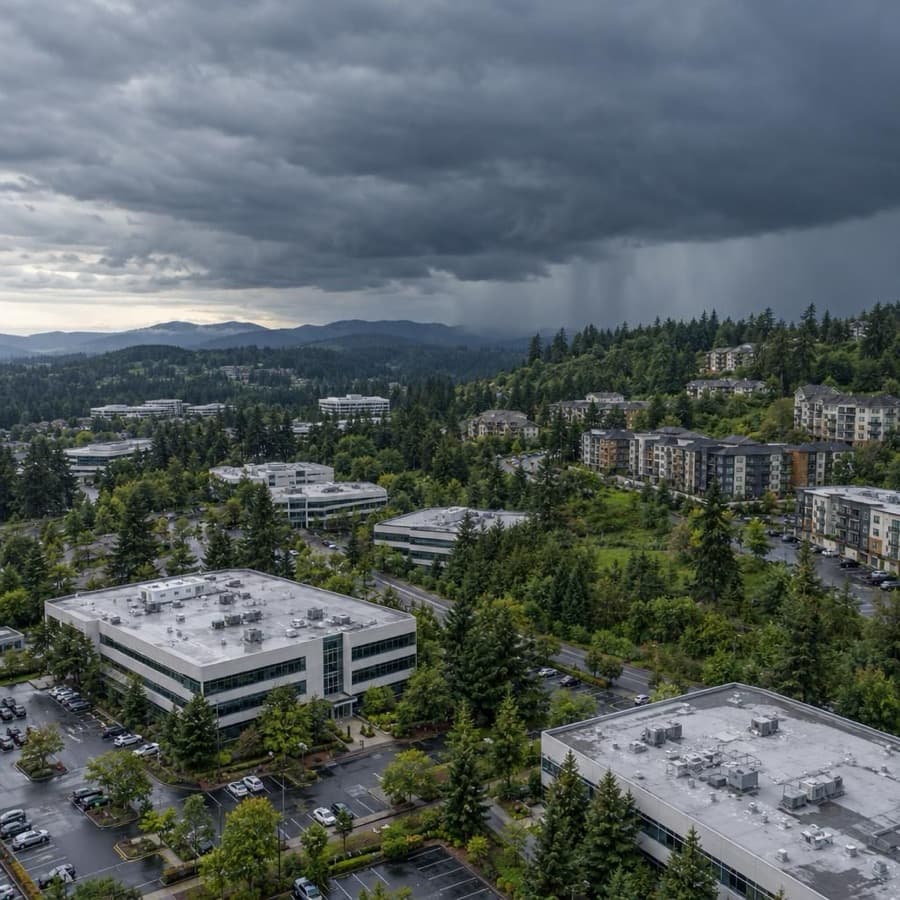
- Hail days near Bend since 2010, the most in Oregon
- 19
- Largest hail reported, near Bend
- 2.0 in
- Oregon cities tracked
- 4
Source: NOAA/NWS Storm Prediction Center
Data through November 1, 2026
Oregon cities by hail days
Source: NOAA/NWS Storm Prediction Center
Data through November 1, 2026
| City | Hail days since 2010 | Largest hail |
|---|---|---|
| Bend | 19 | 2.0 in |
| Eugene | 1 | 1.25 in |
| Portland | 0 | No reports |
| Salem | 0 | No reports |
About this data
- Each city counts reports within 15 miles of its center, not of any one property.
- Reports come from trained spotters and the public, so they cluster near towns and roads.
- No report does not mean no hail. Hail can fall where no one is there to report it.
- This is not a damage or insurance assessment.
Storm risk in Oregon
For commercial and multifamily buildings in Oregon, the storm risks that matter most are winter windstorms, ice and snow storms, the floods that come with them, and wildfire; hail and tornadoes are uncommon. Most of Oregon's 40 major disaster declarations since 1955 came from storm events, and flooding appears in over two-thirds of them.3,2 Windstorms are where the West Coast stands out: West Coast states see 26 to 30 high wind events a year against 15 to 20 in Midwestern states, and catastrophic windstorm losses are highest in the West and Northwest.4
How often storms hit Oregon
| Hazard | How often | What it means for buildings |
|---|---|---|
| Windstorms | West Coast states average 26 to 30 high wind events a year, most from Pacific low pressure systems in winter. The state hazard plan lists windstorms as a statewide hazard. | Gusts topple trees onto roofs, parking and power lines and peel roof edges and membranes, and long power outages often follow. |
| Winter storms and ice | The state hazard plan lists winter storms as a statewide hazard, and severe winter storms appear in many of Oregon's major disaster declarations. | Freezing rain and wet snow bring down trees and load roofs; IBHS says 1 inch of ice weighs about as much as a foot of snow. Pipes and sprinkler lines can freeze during outages. |
| Flooding | Flooding is reported in over two-thirds of Oregon's 40 major disaster declarations since 1955. | Winter rain floods rivers and low ground, and ground floors, basements and site utilities take the damage. |
| Wildfire | 73 fire management assistance declarations since 1955, and the state plan names wildfire with storms and floods as Oregon's primary chronic hazards. | Wind-blown embers ignite debris on roofs and in gutters and enter through vents, so buildings can burn well away from the fire front. |
| Hail and thunderstorms | Hail days since 2010 within 15 miles of the city center: Bend 19, with hail up to 2 inches; Eugene 1; Portland and Salem 0. Within 124 nautical miles of the Portland radar, hail fell on 3 days a year, damaging thunderstorm wind on 2 and tornadoes on 2 (1980 to 2006). | Rare west of the Cascades, but 2-inch hail still damages roof covers, skylights and rooftop units where it falls. |
The city counts are days with at least one hail report within 15 miles of each city's center since 2010, so they show how often hail falls near a city, not on one building. The Storm Prediction Center radar figures cover a circle of 124 nautical miles around the Portland radar and come from 1980 to 2006 reports.1,2
For an owner, the pattern differs from the hail belt. The large losses come from wide winter storms that bring wind, ice and flooding to many buildings at once, and from wildfire, rather than from repeat hail on the same roof.
Rules owners in Oregon should know
- FAIR Plan: the Oregon FAIR Plan is the state's insurer of last resort for owners who can't find coverage in the standard market, and it insures at actual cash value only. Its commercial program, typically retail, mercantile and apartment buildings (manufacturing is not eligible), uses the Standard Property Policy (CP 00 99) up to $1,000,000. Windstorm or hail is an optional added peril, and weight of ice, snow or sleet and freezing are not included.5,6
- Claim decisions: an insurer must tell a first-party claimant whether it accepts or denies the claim within 30 days after receiving properly executed proofs of loss, and a denial must be in writing and cite any policy provision it rests on. If it needs more time, it must say why by that 30th day and again in writing every 45 days while the investigation continues (OAR 836-080-0235).7
- Suit deadline: an Oregon fire policy must allow suit within 24 months after the inception of the loss (ORS 742.240). An insurer still settling a claim directly with a first-party claimant who has no attorney must warn in writing at least 30 days before it believes a policy time limit or statute of limitations may run out (OAR 836-080-0235).8,7
- Attorney fees: if a claim isn't settled within six months after proof of loss is filed, and the policyholder then sues and recovers more than the insurer tendered, the court adds reasonable attorney fees to the costs (ORS 742.061).11
Before the next storm
- Windstorm roof check: before winter, inspect roof edges and membrane perimeters. IBHS recommends a perimeter peel-stop 1 to 2 feet from the edge on single-ply roofs, and that ballast or pavers in high-wind areas meet uplift requirements.12
- Ice and snow loads: after a winter storm, have a qualified person check the roof. IBHS says 1 inch of ice adds about 5 pounds per square foot and advises removal when the load exceeds 20 to 25 pounds per square foot.9
- Freeze protection: protect pipes in attics, crawl spaces and outside walls and keep heat above 40°F where wet sprinkler pipes run, including during outages. IBHS calls burst pipes the leading cause of property damage from winter weather.9
- Wildfire hardening: IBHS recommends Class A rated roof covers, one-eighth inch noncombustible mesh over vents, a noncombustible zone 0 to 5 feet around the building and regular removal of debris from roofs and gutters, which wind-blown embers can ignite.10
- Flood coverage timing: look up each building's flood zone and flood coverage before the winter rains. FEMA says a new flood policy typically has a 30-day waiting period before it takes effect.13
Sources
Written by the Cloudbreak team. Numbers, dates and rules cite the published sources below.
- 1. Cloudbreak: NOAA/NWS Storm Prediction Center storm reports, as counted on the Cloudbreak hail history page for Oregon
- 2. NOAA Storm Prediction Center: RTX (Portland) Severe Weather Climatology, 1980 to 2006
- 3. Oregon Department of Land Conservation and Development and Oregon Department of Emergency Management: Oregon Natural Hazards Mitigation Plan 2025, Chapter 1: Introduction
- 4. Illinois State Water Survey and NOAA Midwestern Regional Climate Center: An Atlas of Windstorms in the United States and Their Impacts (Stanley A. Changnon)
- 5. Oregon Division of Financial Regulation: Guide to commercial property and casualty insurance
- 6. Oregon FAIR Plan Association: Commercial
- 7. Oregon Division of Financial Regulation (text via Public.Law): OAR 836-080-0235, Standards for Prompt and Fair Settlements: Generally
- 8. Oregon Legislature (text via Public.Law): ORS 742.240, Suit on policy
- 9. Insurance Institute for Business & Home Safety (IBHS): Commercial Risk Engineering Bulletin: Winter Weather
- 10. Insurance Institute for Business & Home Safety (IBHS): Business Protection: Reducing the Wildfire Risk
- 11. Oregon Legislature (text via Public.Law): ORS 742.061, Recovery of attorney fees in action on policy or contractor's bond
- 12. Insurance Institute for Business & Home Safety (IBHS): Commercial Roofs Best Practices Guide
- 13. FEMA: Waiting Period for Activating Flood Policy?
Storms in Oregon
NC State's 2025 climate summary for Oregon says the state seldom gets severe thunderstorms with damaging hail or tornadoes.1
Notable storms
- August 11, 2022Hail up to 1.5 inches across fell in La Grande in Union County and up to 2.5 inches in Wallowa on the afternoon of August 11, damaging siding and windows on homes and denting cars. The hail injured 4 people.2,3
- September 7, 2020East winds gusting 50 to 70 mph on September 7 and 8, in exposed areas including parts of the Portland metro area, drove the rapid spread of wildfires. Large parts of Detroit, Mehama and Gates were destroyed. NOAA's Storm Events Database lists $2 billion in property damage and 5 deaths in the North Oregon Cascades foothills.4
- May 30, 2020Severe storms crossed central and northeast Oregon, with multiple reports of 2-inch hail, including one 9 miles southeast of Sisters. Winds were estimated at 100 to 115 mph near Shaniko in Wasco County. Near Culver and Metolius in Jefferson County, straight-line winds tore part or all of the roof off at least two manufactured homes.5,6,7
- May 4, 2017Severe storms reached central Oregon late in the evening and dropped measured 2-inch hail in northwest Bend around 9:20 p.m. and 3 miles east of Sisters about half an hour later.8,9
- October 14, 2016An EF2 tornado with estimated peak winds of 125 to 130 mph came ashore from the Pacific as a waterspout and moved northeast through Manzanita in Tillamook County. NOAA's Storm Events Database lists $1 million in property damage.10
- December 14, 2010An EF2 tornado crossed Aumsville in Marion County on a 5-mile path up to 150 yards wide. NOAA's Storm Events Database reports 50 structures damaged, 2 minor injuries and an estimated $1.2 million in damage.11
Warnings and alerts
NWS Portland covers northwest Oregon, NWS Pendleton covers central and northeast Oregon including Deschutes County, NWS Medford covers the southwest plus Klamath and Lake counties, and NWS Boise covers Baker, Harney and Malheur counties.12 The state's OR-Alert site finds each local emergency alert sign-up by county, city or ZIP code, and texting a ZIP code to 888777 signs up for basic alerts.13
Sources
- 1. North Carolina Institute for Climate Studies, NC State University: Oregon - 2025 State Climate Summaries
- 2. NOAA NCEI Storm Events Database: Hail, Wallowa County, Oregon, August 11, 2022
- 3. NOAA NCEI Storm Events Database: Hail, Union County, Oregon, August 11, 2022
- 4. NOAA NCEI Storm Events Database: High Wind, North Oregon Cascades Foothills, September 7-8, 2020
- 5. NOAA NCEI Storm Events Database: Hail, Deschutes County, Oregon, May 30, 2020
- 6. NOAA NCEI Storm Events Database: Thunderstorm Wind, Wasco County, Oregon, May 30, 2020
- 7. NOAA NCEI Storm Events Database: Thunderstorm Wind, Jefferson County, Oregon, May 30, 2020
- 8. NOAA NCEI Storm Events Database: Hail, Bend, Deschutes County, Oregon, May 4, 2017
- 9. NOAA NCEI Storm Events Database: Hail, Deschutes County, Oregon, May 4, 2017
- 10. NOAA NCEI Storm Events Database: Tornado, Manzanita, Tillamook County, Oregon, October 14, 2016
- 11. NOAA NCEI Storm Events Database: Tornado, Aumsville, Marion County, Oregon, December 14, 2010
- 12. National Weather Service: Public zone and county listing, Western Region
- 13. State of Oregon: OR-Alert
Hail history in other states
- Alabama
- Alaska
- Arizona
- Arkansas
- California
- Colorado
- Connecticut
- District of Columbia
- Florida
- Georgia
- Hawaii
- Idaho
- Illinois
- Indiana
- Iowa
- Kansas
- Kentucky
- Louisiana
- Maine
- Maryland
- Massachusetts
- Michigan
- Minnesota
- Mississippi
- Missouri
- Montana
- Nebraska
- Nevada
- New Hampshire
- New Jersey
- New Mexico
- New York
- North Carolina
- North Dakota
- Ohio
- Oklahoma
- Pennsylvania
- Rhode Island
- South Carolina
- South Dakota
- Tennessee
- Texas
- Utah
- Virginia
- Washington
- West Virginia
- Wisconsin
- Wyoming