Hail history in New Hampshire
NOAA hail reports within 15 miles of the center of Manchester since 2010: 34 hail days, largest 1.75 in.
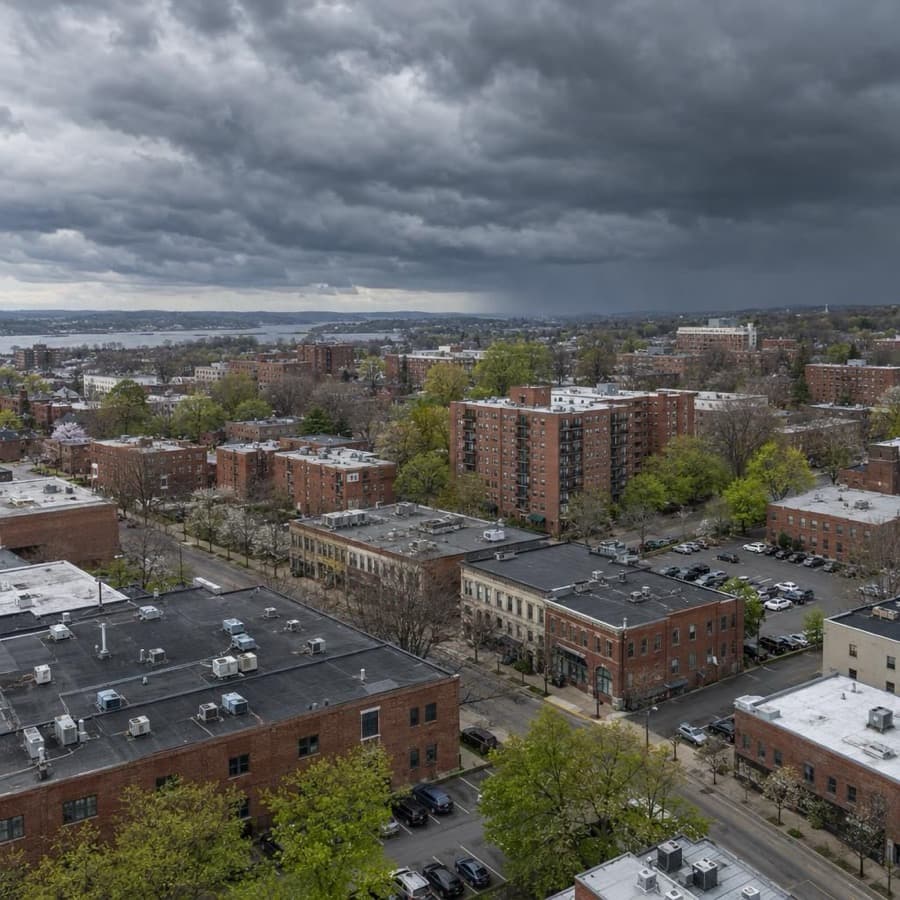
- Hail days near Manchester since 2010, the most in New Hampshire
- 34
- Largest hail reported, near Manchester
- 1.75 in
- New Hampshire city tracked
- 1
Source: NOAA/NWS Storm Prediction Center
Data through November 1, 2026
New Hampshire cities by hail days
Source: NOAA/NWS Storm Prediction Center
Data through November 1, 2026
| City | Hail days since 2010 | Largest hail |
|---|---|---|
| Manchester | 34 | 1.75 in |
About this data
- Each city counts reports within 15 miles of its center, not of any one property.
- Reports come from trained spotters and the public, so they cluster near towns and roads.
- No report does not mean no hail. Hail can fall where no one is there to report it.
- This is not a damage or insurance assessment.
Storm risk in New Hampshire
For commercial and multifamily buildings in New Hampshire, winter storms and flooding matter most, followed by damaging thunderstorm wind, with hail, tornadoes and hurricanes much less frequent. State environmental officials call flooding the state's most common and costly natural disaster. The state averages about two tornadoes a year, and NOAA counts no direct hit by a major hurricane since 1851.8,6,7
How often storms hit New Hampshire
| Hazard | How often | What it means for buildings |
|---|---|---|
| Winter storms and cold | Several storms of 5 inches of snow or more in most years, about 60 inches of seasonal snowfall on average in the south, and average winter lows from above 15°F in the south to below 5°F in the far north. | Drifts at parapets and rooftop units add load, ice around roof drains and at eaves traps meltwater, and IBHS calls burst pipes the leading cause of winter property damage. |
| Flooding | The state's most common and costly natural disaster. Spring rain, snowmelt, ice jams, flash floods and coastal storms all cause it, and 219 communities take part in the NFIP. | Water reaches basements, ground floors and mechanical rooms. About one-third of NFIP policy losses in the state have been outside the mapped Special Flood Hazard Area. |
| Damaging thunderstorm wind | Damaging wind reports on 17 days a year on average within 124 nautical miles of the Gray, Maine radar (1980 to 2006). | Gusts bring trees and limbs down onto roofs, cars and power lines, and peel roof edges and flashing. |
| Hail | Hail days since 2010 within 15 miles of Manchester: 34, with stones up to 1.75 inches. NWS Gray says most hail in northern New England is an inch or less, though stones over 2 inches occasionally fall. | Most storms bring hail too small to break roof covers, but large stones can crack skylights, dent metal and damage rooftop condenser fins. |
| Tornadoes | About two a year on average (68 from 1950 to 1990). Around the Gray radar, the yearly chance of a tornado at any one point is 0.001 percent. | Most are weak and short, but the strongest recorded in the state from 1950 to 1990 was an F3, which can destroy a building. |
| Hurricanes and tropical storms | No major hurricane direct hit from 1851 to 2018. Hurricane-force winds reach Portsmouth about once every 30 years on average. | Storms usually arrive weakened, bringing heavy rain, inland flooding and fallen trees; on the coast, a surge at high tide floods low-lying property. |
The Manchester count is days with at least one hail report within 15 miles of the city center since 2010, so it shows how often hail falls near the city, not on one building. The Storm Prediction Center radar figures cover a circle 124 nautical miles around the Gray, Maine radar, which takes in much of Maine and New Hampshire, and come from 1980 to 2006 reports.1,4
For an owner, the pattern runs differently than in the central US. The steady costs come from snow, ice, frozen pipes, water and wind-felled trees rather than hail, and the rare big losses come from floods and the remnants of tropical storms.
Rules owners in New Hampshire should know
- Claim deadlines: a property insurer must start investigating within 5 working days of notice, acknowledge the claim within 10 working days, and decide within 30 days or send a delay letter giving specific reasons, then another every 30 days. It must pay within 5 working days of agreement, and denial letters must give the Insurance Department's contact (Ins 1002.05).14
- Suit deadline: the New Hampshire standard fire policy in RSA 407:22 bars a suit on the policy unless it is commenced within 12 months after the loss, and calls for a sworn proof of loss within 60 days unless the insurer extends that in writing.15
- Named storm deductibles: insurers may use them in any property policy, but under Ins 5001.07 the deductible applies only from when the National Weather Service names the storm and issues a watch or warning until it is downgraded, and only to loss related to that storm.16
- Public adjusters: they must hold a New Hampshire Insurance Department license, and the contract must tell the insured in bold type of the right to rescind within 3 business days after signing (RSA 402-D:13).17,18
- Building code: the New Hampshire State Building Code (RSA 155-A) moved to the 2024 International Building Code and 2024 International Existing Building Code, with state amendments, on July 1, 2026 (HB 1159-2026), so storm repairs and new roofs permitted since then follow the 2024 editions.19
Before the next storm
- Snow on flat roofs: after heavy snow, check drifts at parapets and rooftop units and clear roof drains. IBHS says to have snow removed once the load passes 20 to 25 pounds per square foot; 10 to 12 inches of new snow adds about 5.5
- Heat and sprinklers: keep building heat above 40°F, heat sprinkler valve rooms, and hold vacant space at 55°F, because IBHS ranks burst pipes as the leading cause of winter property damage.5
- Roof edges: when reroofing, IBHS calls for edge flashing and coping that meet ANSI/SPRI/FM 4435/ES-1 for the site's design wind pressures, and a peel-stop 1 to 2 feet in from the edge of single-ply membranes, to hold the roof perimeter in strong gusts.20
- Flood coverage timing: look up each building's flood zone and flood coverage dates before spring melt. FEMA says a new NFIP policy typically takes 30 days to start, and about one-third of New Hampshire's NFIP losses came from outside the mapped flood zone.21,10
Sources
Written by the Cloudbreak team. Numbers, dates and rules cite the published sources below.
- 1. Cloudbreak: NOAA/NWS Storm Prediction Center storm reports, as counted on the Cloudbreak hail history page for New Hampshire
- 2. NWS Gray: Severe Weather Awareness Week: Severe Thunderstorms, Downbursts and Hail
- 3. NOAA NCEI and North Carolina Institute for Climate Studies: New Hampshire: 2025 State Climate Summaries
- 4. NOAA Storm Prediction Center: GYX (Gray, Maine) Severe Weather Climatology, 1980 to 2006
- 5. Insurance Institute for Business & Home Safety (IBHS): Commercial Risk Engineering Bulletin: Winter Weather
- 6. NWS Gray: Severe Weather Awareness Week: Tornadoes
- 7. NOAA Hurricane Research Division (Chris Landsea, NHC): TCFAQ E20: Major hurricane direct hits on the U.S. mainland and individual states, 1851 to 2018
- 8. New Hampshire Department of Environmental Services: Flooding
- 9. New Hampshire Floodplain Management Program: New Hampshire Floodplain Management Handbook
- 10. New Hampshire Floodplain Management Program: Flood Lines, Winter 2023: Myth vs. Fact, Flood Insurance is Just for Flood Zones
- 11. New Hampshire Silver Jackets: New Hampshire Flood Hazards Handbook
- 12. NWS Gray: Hurricane Safety Awareness Week: Storm Surge, Waves and Marine Safety
- 13. NWS Gray: The Coastal Front, Fall 2013: Hurricane Basics
- 14. New Hampshire Insurance Department (text via Cornell LII): N.H. Admin. Code Ins 1002.05, Claims Settlement Time Limits
- 15. New Hampshire General Court: RSA 407:22, New Form Adopted (New Hampshire Standard Fire Policy)
- 16. New Hampshire Insurance Department (text via Cornell LII): N.H. Admin. Code Ins 5001.07, Form Provision Rules
- 17. New Hampshire Insurance Department: Public Adjusters License
- 18. New Hampshire General Court: RSA 402-D:13, Contract Between Public Adjuster and Insured
- 19. New Hampshire Division of Fire Safety: Historical Adoption Dates of NH State Building Code
- 20. Insurance Institute for Business & Home Safety (IBHS): Commercial Roofs Best Practices Guide
- 21. FEMA: Flood Insurance
Storms in New Hampshire
Across the Northeast, the odds of severe thunderstorms rise from late March to late September and are highest in June and July, the Northeast Regional Climate Center says.1 NWS Gray says most thunderstorm wind damage in New Hampshire comes from downbursts.2
Notable storms
- June 26, 2026Hail the size of limes, 2 inches across, fell for 5 to 6 minutes in Contoocook. Golf ball size hail fell in New London, and ping pong ball size hail dented a few cars in Cornish.3,4,5
- July 16, 2024A microburst with a peak wind of 95 mph hit Milford, damaging 7 homes and destroying 2 vehicles. NOAA's Storm Events Database lists $1 million in property damage there. An EF1 tornado in Lyme the same evening caused minor damage to at least 5 homes, including roof damage from falling trees.6,7,8
- July 21, 2022Golf ball size hail fell on the east side of Keene. Thunderstorm winds estimated at 70 knots (81 mph) snapped or uprooted hundreds of trees in Moultonborough and Effingham, damaging 5 buildings in Moultonborough and a few in Effingham where trees fell on roofs.9,10,11
- May 4, 2018An EF1 tornado tracked about 38.5 miles from North Walpole to Webster and was up to 300 yards wide. Damage was worst in Warner, where gusts were estimated at 90 to 100 mph.12
- July 19, 2015Hail up to 2.5 inches across fell in Rochester, and hail 1.75 inches across fell in Belmont the same day.13,14
- May 29, 2012Storms dropped hail up to 2 inches across in Westmoreland and 1.75 inches in Keene and Hanover. Heavy rain from the storms caused flash flooding around Surry, Gilsum and Keene.15,16,17
Warnings and alerts
NWS Gray/Portland, Maine issues warnings for all of New Hampshire.18 NH Alerts, the state's official emergency notification system, sends alerts by phone call, text, email and app to anyone who registers at stateofnewhampshire.genasys.com/portal.19
Sources
- 1. Northeast Regional Climate Center, Cornell University: Severe Weather Climatology
- 2. NWS Gray: Severe Weather Awareness Week: Severe Thunderstorms
- 3. NOAA NCEI: Storm Events Database: Merrimack County hail in Contoocook, June 26, 2026
- 4. NOAA NCEI: Storm Events Database: Merrimack County hail in New London, June 26, 2026
- 5. NOAA NCEI: Storm Events Database: Sullivan County hail in Cornish, June 26, 2026
- 6. Boston 25 News: Microburst toppled 150 trees, damaged cars and homes in New Hampshire, NWS says
- 7. NOAA NCEI: Storm Events Database: Hillsborough County thunderstorm wind in Milford, July 16, 2024
- 8. NOAA NCEI: Storm Events Database: Grafton County tornado in Lyme, July 16, 2024
- 9. NOAA NCEI: Storm Events Database: Cheshire County hail in Keene, July 21, 2022
- 10. NOAA NCEI: Storm Events Database: Carroll County thunderstorm wind in Moultonborough, July 21, 2022
- 11. NOAA NCEI: Storm Events Database: Carroll County thunderstorm wind in Effingham, July 21, 2022
- 12. NOAA NCEI: Storm Events Database: Merrimack County tornado, May 4, 2018
- 13. NOAA NCEI: Storm Events Database: Strafford County hail in Rochester, July 19, 2015
- 14. NOAA NCEI: Storm Events Database: Belknap County hail in Belmont, July 19, 2015
- 15. NOAA NCEI: Storm Events Database: Cheshire County hail in Westmoreland, May 29, 2012
- 16. NOAA NCEI: Storm Events Database: Cheshire County hail in Keene, May 29, 2012
- 17. NOAA NCEI: Storm Events Database: Grafton County hail in Hanover, May 29, 2012
- 18. National Weather Service: New Hampshire County Warning Forecast Areas
- 19. New Hampshire Division of Emergency Services and Communications: NH Alerts
Hail history in other states
- Alabama
- Alaska
- Arizona
- Arkansas
- California
- Colorado
- Connecticut
- District of Columbia
- Florida
- Georgia
- Hawaii
- Idaho
- Illinois
- Indiana
- Iowa
- Kansas
- Kentucky
- Louisiana
- Maine
- Maryland
- Massachusetts
- Michigan
- Minnesota
- Mississippi
- Missouri
- Montana
- Nebraska
- Nevada
- New Jersey
- New Mexico
- New York
- North Carolina
- North Dakota
- Ohio
- Oklahoma
- Oregon
- Pennsylvania
- Rhode Island
- South Carolina
- South Dakota
- Tennessee
- Texas
- Utah
- Virginia
- Washington
- West Virginia
- Wisconsin
- Wyoming