Hail history in Illinois
We counted the days with NOAA hail reports within 15 miles of the center of 3 Illinois cities since 2010.
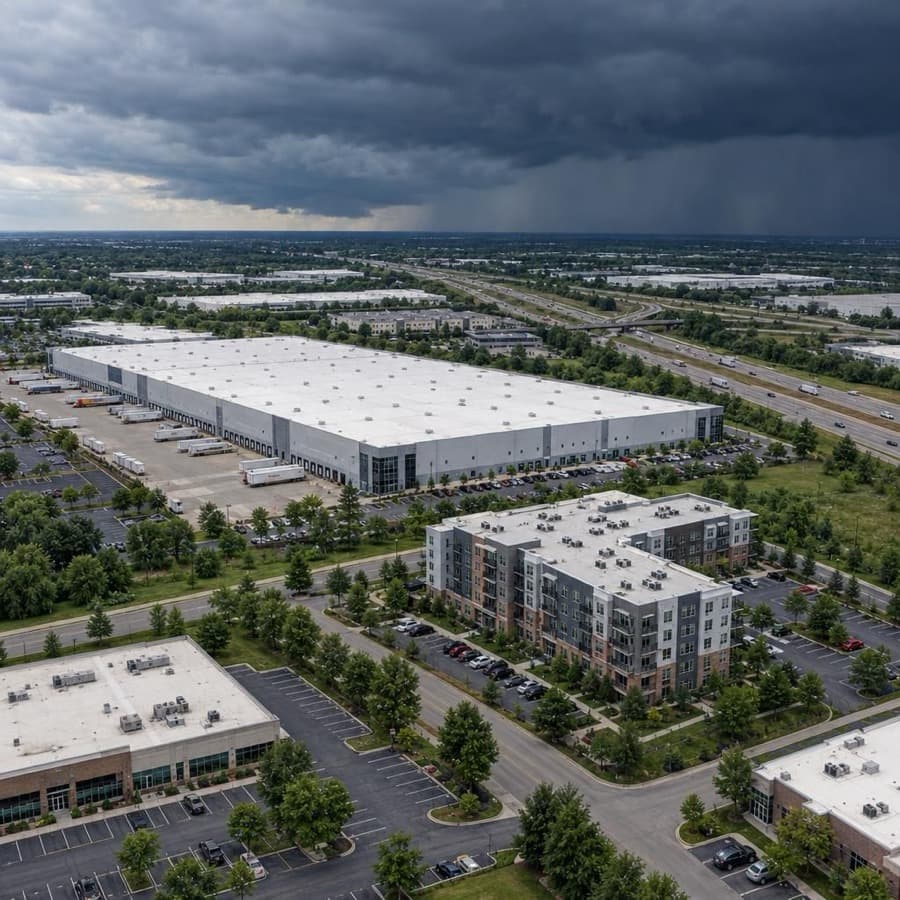
- Hail days near Peoria since 2010, the most in Illinois
- 76
- Largest hail reported, near Peoria
- 3.0 in
- Illinois cities tracked
- 3
Source: NOAA/NWS Storm Prediction Center
Data through November 1, 2026
Illinois cities by hail days
Source: NOAA/NWS Storm Prediction Center
Data through November 1, 2026
| City | Hail days since 2010 | Largest hail |
|---|---|---|
| Peoria | 76 | 3.0 in |
| Rockford | 67 | 3.0 in |
| Chicago | 65 | 2.75 in |
About this data
- Each city counts reports within 15 miles of its center, not of any one property.
- Reports come from trained spotters and the public, so they cluster near towns and roads.
- No report does not mean no hail. Hail can fall where no one is there to report it.
- This is not a damage or insurance assessment.
Storm risk in Illinois
For commercial and multifamily buildings in Illinois, hail and damaging thunderstorm wind are the most frequent storm risks, followed by tornadoes, flooding, and heavy snow and cold in the north. Illinois had the ninth most large hail events of any state in 2025 and averages 54 tornadoes a year, which the State Climatologist calls comparable to the Great Plains tornado alley. Floods account for well over 90 percent of the state's declared disasters.2,3,6
How often storms hit Illinois
| Hazard | How often | What it means for buildings |
|---|---|---|
| Hail | 167 hail events with stones 1 inch or larger in 2025, ninth among states (5,432 in the US). Hail days since 2010 within 15 miles of the city center: Peoria 76, Rockford 67, Chicago 65, with stones up to 3 inches near Peoria and Rockford. | Roof covers, skylights and rooftop HVAC condenser fins take the hits, and the same roof can be struck more than once in a season. |
| Damaging thunderstorm wind | Damaging wind reports on 46 days a year on average within 124 nautical miles of the Lincoln radar, and on 44 days around the Chicago radar (1980 to 2006). | Straight-line gusts, including long derecho wind swaths, peel roof edges and membranes, shift rooftop units and drop trees on buildings and parking. |
| Tornadoes | 54 a year on average (1991 to 2020), with 142 reported in 2024 and 126 in 2025. At any one point within 124 nautical miles of the Lincoln radar, the yearly chance of a tornado is 0.029 percent. | A direct hit on one building is rare, but across many buildings the odds add up, and strong tornadoes can destroy a structure. |
| Flooding | 13.6 percent of Illinois (4,334,841 acres) is in the 100-year floodplain, and over 250,000 buildings are estimated to sit in floodplains. | River floods reach ground floors and site work. Over 90 percent of urban flood damage claims from 2007 to 2014 were outside the mapped floodplain, much of it basement flooding and sewer backup. |
| Winter storms and cold | Average snowfall tops 35 inches a year in the northeast, with lake-effect snow near Chicago, and average winter lows fall below 10°F in the north. | Drifts at parapets and rooftop units add load, ice around roof drains traps meltwater, and IBHS calls burst pipes the leading cause of winter property damage. |
The city counts are days with at least one hail report within 15 miles of each city's center since 2010, so they show how often hail falls near a city, not on one building. The Storm Prediction Center radar figures cover a much larger circle, 124 nautical miles around each radar, and come from 1980 to 2006 reports.1,4,5
For an owner, the pattern matters more than any one storm. Hail and straight-line wind cause frequent, repeat damage to roofs and rooftop equipment, while tornadoes and floods are rarer at any one address but cause the largest single losses. Flood risk does not stop at the map line: most urban flood claims come from outside it.
Rules owners in Illinois should know
- FAIR Plan: the Illinois FAIR Plan Association sells basic property insurance to applicants who show 3 attempts to get coverage elsewhere (215 ILCS 5/524). Commercial policies cover apartment buildings of 5 or more units and mercantile and service risks up to $1,000,000 on the building, for limited named perils at actual cash value; vacant property (other than rehabilitation) and manufacturing risks are ineligible. From January 1, 2027, P.A. 104-645 opens it to nonresidential property anywhere in the state, not only urban areas, with applications through a registered Illinois-licensed agent.12,13,14
- Delay letters: on fire and extended coverage policies, an insurer that hasn't resolved a claim within 75 calendar days of the report, or 25 calendar days after receiving proof of loss if sooner, must explain the delay in writing and tell the insured how to reach the Department of Insurance (50 Ill. Adm. Code 919.80).15
- Suit deadline: when a policy limits the time to sue, that period is paused from the date proof of loss is filed until the claim is denied in whole or in part (215 ILCS 5/143.1).16
- Vexatious delay: if a court finds an insurer's handling or delay of a claim vexatious and unreasonable, it may award attorney fees and costs plus an added amount the statute limits to 60 percent of the recovery, $60,000, or the amount by which the recovery exceeds the insurer's settlement offer before suit (215 ILCS 5/155).17
- Public adjusters: they must hold an Illinois Department of Insurance license. For property other than a personal residence, their total fee is capped at 10 percent of claim payments when the damage came from a catastrophic event, unless the Director approves more, and the insured may void the contract for 5 business days after the insurer receives it (215 ILCS 5/1570 and 5/1575).18,19
- Roofer licenses: roofing work in Illinois may be done only by a roofing contractor licensed by the Department of Financial and Professional Regulation (225 ILCS 335/9). A limited license covers residential properties of 8 units or less; roofs on larger apartment, commercial and industrial buildings fall under the unlimited license.20,21
- Floodway permits: building, rebuilding or filling in the floodway of a state-regulated stream needs a permit from the IDNR Office of Water Resources, and where no floodway is mapped, IDNR generally requires one for work anywhere in the floodplain.22
Before the next storm
- Hail-rated roofs: when reroofing, IBHS calls for low-slope covers rated FM 4470 Class 1-SH or UL 2218 Class 4 in hail-prone areas, hail-rated skylights and hail guards over condenser fins, since Illinois had 167 large hail events in 2025.10,2
- Snow on flat roofs: after heavy snow, check drifts at parapets and rooftop units and clear roof drains. IBHS says to have snow removed once the load passes 20 to 25 pounds per square foot; 10 to 12 inches of new snow adds about 5.11
- Heat and sprinklers: keep building heat above 40°F, heat sprinkler valve rooms, and hold vacant space at 55°F, because IBHS ranks burst pipes as the leading cause of winter property damage.11
- Flood coverage timing: look up each building's flood zone and flood coverage dates before spring rains. FEMA says a new NFIP policy typically takes 30 days to start, and most Illinois urban flood claims come from outside the mapped floodplain.23,9
Sources
Written by the Cloudbreak team. Numbers, dates and rules cite the published sources below.
- 1. Cloudbreak: NOAA/NWS Storm Prediction Center storm reports, as counted on the Cloudbreak hail history page for Illinois
- 2. Insurance Information Institute (Triple-I): Facts + Statistics: Hail
- 3. Illinois State Climatologist, Illinois State Water Survey: Tornadoes in Illinois
- 4. NOAA Storm Prediction Center: ILX (Lincoln) Severe Weather Climatology, 1980 to 2006
- 5. NOAA Storm Prediction Center: LOT (Chicago) Severe Weather Climatology, 1980 to 2006
- 6. Illinois Department of Natural Resources, Office of Water Resources: The National Flood Insurance Program (NFIP)
- 7. NOAA NCEI and North Carolina Institute for Climate Studies: Illinois: 2025 State Climate Summaries
- 8. Illinois Department of Natural Resources, Office of Water Resources: 100-Year Floodplain in Illinois (September 2024)
- 9. Illinois Department of Natural Resources and Illinois State Water Survey: Report for the Urban Flooding Awareness Act (June 2015)
- 10. Insurance Institute for Business & Home Safety (IBHS): Commercial Roofs Best Practices Guide
- 11. Insurance Institute for Business & Home Safety (IBHS): Commercial Risk Engineering Bulletin: Winter Weather
- 12. Illinois FAIR Plan Association: Welcome to Illinois FAIR Plan Association: Commercial Insurance Update
- 13. Illinois FAIR Plan Association: Producer Summary: FAIR Plan Coverage Available
- 14. Illinois General Assembly: 215 ILCS 5/524, FAIR Plan Procedure (before and after P.A. 104-645)
- 15. Illinois General Assembly, Joint Committee on Administrative Rules: 50 Ill. Adm. Code 919.80, Required Claim Practices: Property and Casualty Companies
- 16. Illinois General Assembly: 215 ILCS 5/143.1, Periods of limitation tolled
- 17. Illinois General Assembly: 215 ILCS 5/155, Attorney fees
- 18. Illinois Department of Insurance: Public Adjuster Consumer Rights Notice
- 19. Illinois Department of Insurance: Review Requirements Checklist: Public Adjuster Contracts (effective January 1, 2024)
- 20. Illinois General Assembly: 225 ILCS 335/9, Roofing Industry Licensing Act: Licensure requirement
- 21. Illinois Department of Financial and Professional Regulation: Application for Licensed Roofing Contractor: Roofing License Types
- 22. Illinois Department of Natural Resources, Office of Water Resources: Water Resources FAQs: When is a permit required?
- 23. FEMA: Flood Insurance
Storms in Illinois
A State Water Survey study of hail records back to 1900 found about 2 hail days a year in the northern third of Illinois and about 2.5 in the southern two-thirds.1 Tornadoes in Illinois peak from April through June, when 63 percent of them occur.2
Notable storms
- April 17, 2026Wind-driven hail up to 2 inches fell along a path north across west central Illinois, including Ipava and Toulon, breaking windows and damaging siding on several houses. Preliminary NWS reports counted at least two dozen tornadoes that day, mainly north of I-72, with the most structural damage near Bloomington-Normal.3
- March 10, 2026Hail of 3 inches to locally 6 inches fell in and near Kankakee, and a 6.6-inch stone found there became the Illinois record. Homes around Kankakee, Bradley and Bourbonnais had broken windows and roof and siding damage, and hail up to 4.8 inches hit Darien. An EF3 tornado destroyed homes near Aroma Park and killed one person there.4,5,6,7
- July 15, 2024A derecho brought damaging winds of 60 to locally 100 mph across northern and central Illinois and 32 tornadoes in northeast Illinois and northwest Indiana, a record for one event in the NWS Chicago area. An EF2 tornado tracked about 35 miles from northeast of Morris through Channahon to Matteson.8
- May 21, 2014Hail up to 4 inches, the size of grapefruit, hit Tuscola, damaging the roofs, windows and siding of many houses and the windows and bodies of hundreds of vehicles. Two men were hurt by falling hailstones. NOAA's Storm Events Database lists $100 million in property damage in Tuscola.9
- November 17, 2013An EF4 tornado tracked through East Peoria and Washington, one of 10 tornadoes in central Illinois that day. In Washington it destroyed 633 homes and 7 apartment buildings and damaged hundreds more. It killed three people and injured 121, and NOAA's Storm Events Database lists an estimated $800 million in damage in Washington.10
- February 29, 2012An EF4 tornado with peak winds near 180 mph crossed the south and southeast sides of Harrisburg, heavily damaging or destroying more than 200 homes and about 25 businesses and leveling at least ten buildings. Eight people died and 95 were injured.11
Warnings and alerts
Five NWS offices cover Illinois: Chicago (northeast), Central Illinois (central), Quad Cities (northwest), St. Louis (west central and southwest) and Paducah, Kentucky (far south).12
Sources
- 1. Illinois State Water Survey, State Climatologist Office: Hail in Illinois
- 2. Illinois State Climatologist: Tornadoes in Illinois
- 3. NWS Lincoln: April 17, 2026 Severe Thunderstorms
- 4. NWS Chicago: March 10, 2026 Severe Weather
- 5. NOAA NCEI: Illinois State Record Hailstone, State Climate Extremes Committee report
- 6. NOAA NCEI: Storm Events Database: Hail, Bourbonnais, Kankakee County, March 10, 2026
- 7. NOAA NCEI: Storm Events Database: EF3 Tornado, Kankakee County, March 10, 2026
- 8. NWS Chicago: July 15, 2024 Derecho
- 9. NOAA NCEI: Storm Events Database: Hail, Tuscola, Douglas County, May 21, 2014
- 10. NOAA NCEI: Storm Events Database: EF4 Tornado, East Peoria and Washington, Tazewell County, November 17, 2013
- 11. NOAA NCEI: Storm Events Database: EF4 Tornado, Harrisburg, Saline County, February 29, 2012
- 12. National Weather Service: Public zone and county listing, Central Region
Hail history in other states
- Alabama
- Alaska
- Arizona
- Arkansas
- California
- Colorado
- Connecticut
- District of Columbia
- Florida
- Georgia
- Hawaii
- Idaho
- Indiana
- Iowa
- Kansas
- Kentucky
- Louisiana
- Maine
- Maryland
- Massachusetts
- Michigan
- Minnesota
- Mississippi
- Missouri
- Montana
- Nebraska
- Nevada
- New Hampshire
- New Jersey
- New Mexico
- New York
- North Carolina
- North Dakota
- Ohio
- Oklahoma
- Oregon
- Pennsylvania
- Rhode Island
- South Carolina
- South Dakota
- Tennessee
- Texas
- Utah
- Virginia
- Washington
- West Virginia
- Wisconsin
- Wyoming