Hail history in Nebraska
We counted the days with NOAA hail reports within 15 miles of the center of 2 Nebraska cities since 2010.
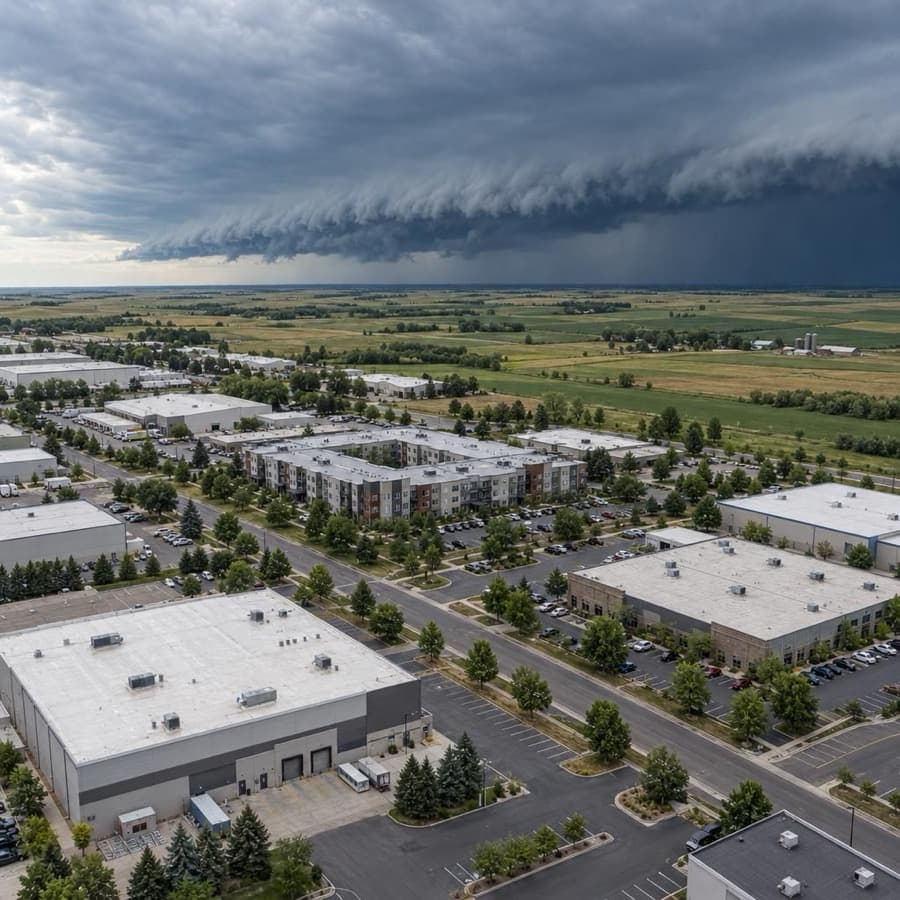
- Hail days near Omaha since 2010, the most in Nebraska
- 108
- Largest hail reported, near Lincoln
- 5.0 in
- Nebraska cities tracked
- 2
Source: NOAA/NWS Storm Prediction Center
Data through November 1, 2026
Nebraska cities by hail days
Source: NOAA/NWS Storm Prediction Center
Data through November 1, 2026
| City | Hail days since 2010 | Largest hail |
|---|---|---|
| Omaha | 108 | 4.5 in |
| Lincoln | 83 | 5.0 in |
About this data
- Each city counts reports within 15 miles of its center, not of any one property.
- Reports come from trained spotters and the public, so they cluster near towns and roads.
- No report does not mean no hail. Hail can fall where no one is there to report it.
- This is not a damage or insurance assessment.
Storm risk in Nebraska
Hail is the storm risk that matters most for buildings in Nebraska, followed by damaging thunderstorm wind, tornadoes, flooding and winter storms.2,3 Nebraska had 315 major hail events in 2025 by Storm Prediction Center counts, the fourth most of any state. The SPC also ranked the Omaha radar area third of 141 US radar areas for how often tornadoes touch down, for 1980 to 2006.2,3
How often storms hit Nebraska
| Hazard | How often | What it means for buildings |
|---|---|---|
| Hail | 83 to 108 hail days since 2010 within 15 miles of Omaha and Lincoln, the two Nebraska cities on this page, with hail up to 5 inches near Lincoln. Across the Omaha radar area, the SPC counted an average of 48 hail days a year from 1980 to 2006. | Hail breaks roof covers, skylights and the fins of rooftop units, and wind-driven hail cracks siding and windows. |
| Damaging wind | An average of 41 days a year with damaging wind reports in the Omaha radar area, 1980 to 2006. | Straight-line gusts peel roof edges and membranes, topple rooftop equipment and drive debris into walls and glass. |
| Tornadoes | About 49 a year statewide over the past 30 years, against a 1950 to 2022 average of 41, by NWS counts. | Weak tornadoes lift roof coverings and break windows; strong ones destroy whole buildings. |
| Flooding | About 4 percent of Nebraskans live in a mapped special flood hazard area. Floods and severe storms account for most of the state's 64 federal disaster, emergency and fire declarations from 1960 through the 2019 state plan: 18 for floods and 30 for severe storms. | River and flash floods soak ground floors, basements and mechanical rooms. State rules set how high new and rebuilt floors must sit in mapped floodplains. |
| Winter storms and cold | Blizzards, heavy snow and ice storms; over the same period, 2 federal declarations were for snow and 2 for severe ice storms. | FEMA says drifting snow and rain on snow can overload a roof past its design, and hard freezes burst pipes and sprinkler lines. |
The city hail counts are days with at least one NOAA hail report within 15 miles of a city's center, not hits on any one building. Reports come from people, so they cluster in towns and along roads, and a low count for a rural site does not mean hail missed it. The SPC radar-area figures cover a circle of about 124 nautical miles around the Omaha radar, so they describe eastern Nebraska and nearby Iowa as a whole.1,3
Rules owners in Nebraska should know
- Claim handling (210 NAC 60): an insurer must acknowledge a claim and open its investigation within 15 working days of notice, and accept or deny it within 15 working days after receiving a proof of loss or settlement information. If it needs longer, it must say why within that time and write again every 30 working days. Once the claimant accepts an offer, payment is due within 15 working days, and a denial must be in writing and cite the policy provision it relies on.6
- Attorney fees (Neb. Rev. Stat. 44-359): a policyholder who wins a judgment against an insurer on a policy is allowed a reasonable attorney fee on top of the recovery, unless the judgment is no more than an offer the insurer made under section 25-901.7
- Time to sue (Neb. Rev. Stat. 44-357): a policy issued in Nebraska may not cut the time to bring a lawsuit below the regular period in the state's statutes of limitations, or require another state's law to govern it.8
- Contractor contracts (Insured Homeowners Protection Act, Neb. Rev. Stat. 44-8601 to 44-8608): the act covers buildings for one to four families, so it reaches duplexes and fourplexes but not larger apartment or commercial buildings. On those properties an owner may cancel an insurance-paid contract with a residential contractor by midnight of the third business day after signing, or after the insurer says in writing that all or part of the claim is not a covered loss. The contractor may not promise to rebate any part of the deductible.9,10,11
- Post-loss assignments (same act): a residential contractor who takes an assignment of the claim must notify the insurer within five business days, state that it has made no assurance the loss will be fully covered, give the owner and insurer an itemized estimate before work starts, and leave the owner and lender free to deal with the insurer directly. A contract that breaks these rules is void.11
- Floodplain building (455 NAC 1, section 004): in a mapped floodplain, new and substantially improved residential buildings must have the lowest floor, basement included, at least one foot above the base flood elevation; non-residential buildings may instead be floodproofed watertight below that height. Nebraska also bars new structures for human habitation in the floodway.12,13
Before the next storm
- Hail-rated roofs: when a roof is due for replacement, IBHS recommends FM 4470 Class 1-SH or UL 2218 Class 4 for low-slope roofs and UL 2218 Class 4 or FM 4473 Class 3 or 4 for steep roofs in hail-prone areas, since Class 4 covers stay functional after two hits in the same spot from 2-inch test balls.14
- Rooftop units and skylights: fit hail guards over condenser fins and air intakes and use skylights with a hail impact rating. IBHS says hail on unguarded components can impair a unit's operation.14
- Deductibles and repair windows: the Nebraska Department of Insurance notes that some insurers charge a higher deductible for wind and hail than for other perils, and that replacement cost policies require repairs within a set time, usually 180 days, before paying more than actual cash value.16
- Snow drifts: after a blizzard, have a qualified person check drifts at parapets, roof steps and rooftop equipment, where FEMA says snow piles into concentrated loads. Sagging ceiling tiles, sprinkler heads dropping below the ceiling and doors that stick are its warning signs.15
- Warnings: keep NOAA Weather Radio or another alert source at each site. The NWS says the radio network broadcasts warnings from the nearest office 24 hours a day.4
Sources
Written by the Cloudbreak team. Numbers, dates and rules cite the published sources below.
- 1. Cloudbreak: NOAA/NWS Storm Prediction Center storm reports, as counted on the Cloudbreak hail history page for Nebraska
- 2. Insurance Information Institute: Facts + Statistics: Hail
- 3. NOAA Storm Prediction Center: OAX (Omaha) Severe Weather Climatology, 1980 to 2006
- 4. NWS Omaha/Valley: Iowa/Nebraska Severe Weather Awareness Week 2023
- 5. Nebraska Emergency Management Agency: 2019 State of Nebraska Hazard Mitigation Plan
- 6. Nebraska Department of Insurance: Title 210, Chapter 60: Unfair Property and Casualty Settlement Practices Rule
- 7. Nebraska Legislature: Neb. Rev. Stat. 44-359: Policies; actions; attorney's fees
- 8. Nebraska Legislature: Neb. Rev. Stat. 44-357: Policies; stipulations forbidden
- 9. Nebraska Legislature: Neb. Rev. Stat. 44-8602: Insured Homeowners Protection Act, terms defined
- 10. Nebraska Legislature: Neb. Rev. Stat. 44-8603: Right to cancel; residential contractor duties
- 11. Nebraska Department of Insurance: Consumer Alert: Post-Loss Assignments
- 12. Nebraska Administrative Code (text via Cornell LII): 455 Neb. Admin. Code ch. 1, section 004: Minimum standards for obstructions and substantial improvements in floodplains
- 13. Nebraska Department of Water, Energy, and Environment: State of Nebraska Floodplain Management Administrative Procedures Guide
- 14. IBHS: Commercial Roofs Best Practices Guide
- 15. FEMA: Snow Load Safety Guidance (FEMA P-957)
- 16. Nebraska Department of Insurance: Hail Damage: Does My Roof Need Repair?
Storms in Nebraska
About 70% of Nebraska hail reports from 1955 to 2015 came in May through July. From 2003 to 2012, places in Nebraska averaged 7 to 11 days a year with hail over 1 inch within 25 miles.1 In NWS Cheyenne's area, which includes the western Panhandle, hail peaks in June with a second peak in late July, and the Sidney area averages more than 6 severe hail days a year.2
Notable storms
- July 31, 2024Storms swept the Lincoln and Omaha areas with measured gusts of 92 mph near Denton and 90 mph at Eppley Airfield, and damage pointed to winds near 100 mph in Omaha. Homes in northeast Gretna lost windows and large parts of their roofs. NOAA's Storm Events Database lists $35 million in property damage in Douglas County and $15 million in Sarpy County.3,4,5
- June 29, 2024A late-night storm dropped hail up to 4 inches on Cozad and 2.75-inch hail on Gothenburg along a 27-mile path, breaking windows and damaging roofs, siding and vehicles. Few structures in Cozad escaped damage. NOAA's Storm Events Database lists $50 million in property damage from the hail in Dawson County.6,7
- June 25, 2024A slow-moving storm dropped hail mostly 1 to 2.75 inches across (quarter to baseball size) in a swath across northern and eastern Sarpy County. The largest stone, 4.5 inches across, fell in northern Bellevue.8
- April 26, 2024NWS Omaha says the day's tornadoes damaged or destroyed hundreds, possibly thousands, of homes and businesses across Nebraska and Iowa. The strongest, an EF4 with 170 mph winds, ran 31.2 miles through Elkhorn, Bennington and Blair and left many Elkhorn homes with only small interior rooms standing. An EF3 tracked from northeast Lincoln toward Waverly.9,10
- June 7, 2022Hail of 2 to 4 inches hit in and near Ravenna, and golf ball to 2.5-inch hail with 66 mph gusts hit Hastings. Both towns reported broken windows and siding damage. NOAA's Storm Events Database lists $12 million in property damage for the Hastings hail.11,12
- June 16, 2014One storm produced 4 EF4 tornadoes across Stanton, Cuming and Wayne counties. One hit Pilger directly, damaging nearly 75% of the town's structures and destroying those near its path's center. The tornadoes killed 2 people, and 20 were injured in the Pilger tornado.9,13,14
Warnings and alerts
NWS offices in Omaha, Hastings and North Platte cover most of Nebraska. NWS Cheyenne covers eight western Panhandle counties, NWS Goodland covers Dundy, Hitchcock and Red Willow counties, and NWS Sioux Falls covers Dixon and Dakota counties.15
Sources
- 1. University of Nebraska-Lincoln Extension: Hail: Information on weather-ready landscapes
- 2. NWS Cheyenne: Hail Climatology
- 3. NOAA NCEI: Storm Events Database: Douglas County thunderstorm wind, July 31, 2024
- 4. NOAA NCEI: Storm Events Database: Sarpy County thunderstorm wind, July 31, 2024
- 5. NOAA NCEI: Storm Events Database: Lancaster County thunderstorm wind, July 31, 2024
- 6. NOAA NCEI: Storm Events Database: Dawson County hail, Cozad, June 29, 2024
- 7. NOAA NCEI: Storm Events Database: Dawson County hail, Gothenburg, June 29, 2024
- 8. NOAA NCEI: Storm Events Database: Sarpy County hail, June 25, 2024
- 9. NWS Omaha: Tornado Outbreak of April 26, 2024
- 10. NOAA NCEI: Storm Events Database: Douglas County tornado, April 26, 2024
- 11. NOAA NCEI: Storm Events Database: Buffalo County hail, June 7, 2022
- 12. NOAA NCEI: Storm Events Database: Adams County hail, June 7, 2022
- 13. NOAA NCEI: Storm Events Database: Stanton County tornado, June 16, 2014
- 14. NOAA NCEI: Storm Events Database: Cuming County tornado, June 16, 2014
- 15. National Weather Service: Nebraska County Warning Forecast Areas
Hail history in other states
- Alabama
- Alaska
- Arizona
- Arkansas
- California
- Colorado
- Connecticut
- District of Columbia
- Florida
- Georgia
- Hawaii
- Idaho
- Illinois
- Indiana
- Iowa
- Kansas
- Kentucky
- Louisiana
- Maine
- Maryland
- Massachusetts
- Michigan
- Minnesota
- Mississippi
- Missouri
- Montana
- Nevada
- New Hampshire
- New Jersey
- New Mexico
- New York
- North Carolina
- North Dakota
- Ohio
- Oklahoma
- Oregon
- Pennsylvania
- Rhode Island
- South Carolina
- South Dakota
- Tennessee
- Texas
- Utah
- Virginia
- Washington
- West Virginia
- Wisconsin
- Wyoming