Hail history in Kentucky
We counted the days with NOAA hail reports within 15 miles of the center of 2 Kentucky cities since 2010.
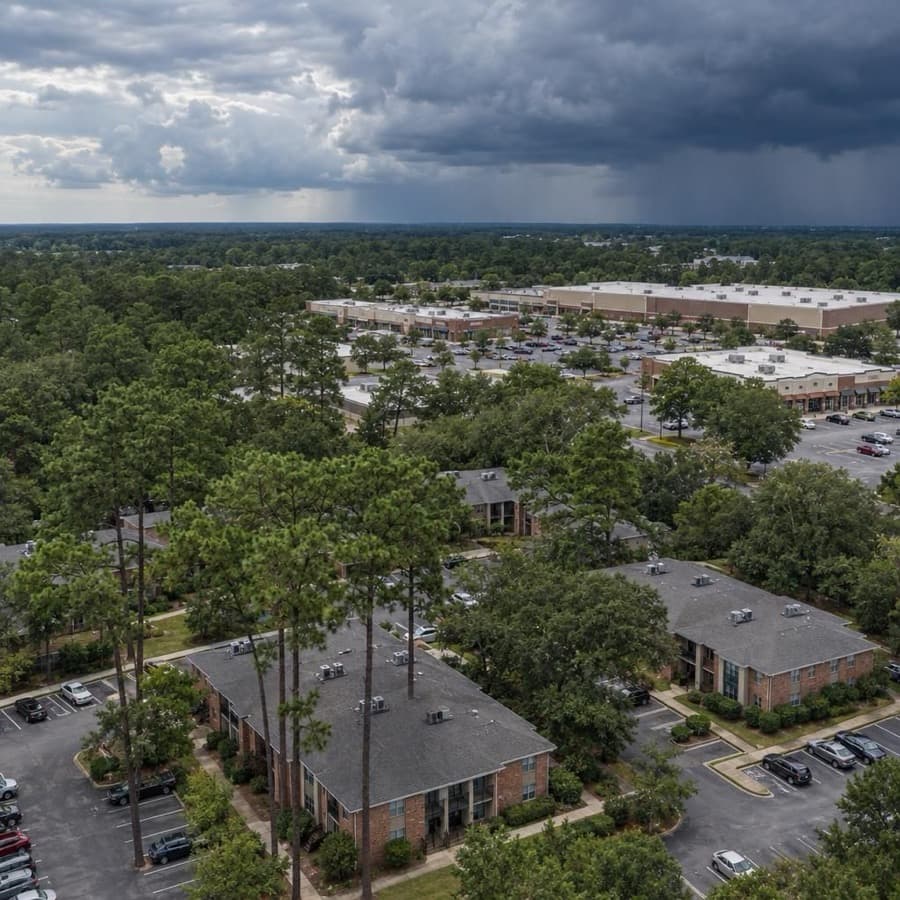
- Hail days near Louisville since 2010, the most in Kentucky
- 49
- Largest hail reported, near Lexington
- 3.0 in
- Kentucky cities tracked
- 2
Source: NOAA/NWS Storm Prediction Center
Data through November 1, 2026
Kentucky cities by hail days
Source: NOAA/NWS Storm Prediction Center
Data through November 1, 2026
| City | Hail days since 2010 | Largest hail |
|---|---|---|
| Louisville | 49 | 2.0 in |
| Lexington | 31 | 3.0 in |
About this data
- Each city counts reports within 15 miles of its center, not of any one property.
- Reports come from trained spotters and the public, so they cluster near towns and roads.
- No report does not mean no hail. Hail can fall where no one is there to report it.
- This is not a damage or insurance assessment.
Storm risk in Kentucky
For commercial and multifamily buildings in Kentucky, hail and damaging thunderstorm wind are the most frequent storm risks, followed by tornadoes, flash flooding, and winter ice and cold. Kentucky averages 27 tornadoes a year (1995 to 2024), and the area around the Louisville radar ranks 18th of 141 US radar areas for density of severe weather reports.2,3
How often storms hit Kentucky
| Hazard | How often | What it means for buildings |
|---|---|---|
| Hail | Hail days since 2010 within 15 miles of the city center: Louisville 49 and Lexington 31, with hail up to 3 inches near Lexington. Large hail on 33 days a year on average within 124 nautical miles of the Louisville radar (1980 to 2006). | Hail cracks roof covers and skylights and flattens rooftop condenser fins, and the same roof can be hit more than once in a season. |
| Damaging thunderstorm wind | Damaging wind reports on 54 days a year on average around the Louisville radar and 53 around the Paducah radar (1980 to 2006), more days than hail or tornadoes. | Straight-line gusts peel roof edges and membranes, shift rooftop units and drop trees on buildings and parking. |
| Tornadoes | 27 a year on average from 1995 to 2024. At any one point within 124 nautical miles of the Paducah radar, the yearly chance of a tornado is 0.033 percent; around the Louisville radar it is 0.027 percent. | A direct hit on one building is rare, but across a portfolio the odds add up, and violent tornadoes can destroy a structure. |
| Flooding | Flash floods from heavy thunderstorm rain, often in low-lying and urban areas. Over July 25 to 30, 2022, 14 to 16 inches of rain fell in parts of eastern Kentucky, causing extensive damage across 13 counties. | Water fills ground floors, basements and mechanical rooms. Roofs and pavement speed runoff, and repairs in a floodplain need a state permit. |
| Winter storms and hard freezes | Ice storms and snowstorms in winter, and temperatures that often fall below 0°F for several days a year in many parts of the state. | Ice brings down trees and power lines, and a power loss in freezing weather lets pipes and sprinkler lines freeze. |
The city counts are days with at least one hail report within 15 miles of each city's center since 2010, so they show how often hail falls near a city, not on one building. The radar figures come from Storm Prediction Center reports from 1980 to 2006 and cover a much larger circle, 124 nautical miles around each radar.1,3,4
For an owner, the pattern matters more than any one storm. Wind and hail cause frequent, repeat damage to roofs and rooftop equipment, while tornadoes and floods are rarer at any one address but cause the largest single losses.
Rules owners in Kentucky should know
- FAIR Plan: The Kentucky FAIR Plan, set up under KRS Chapter 304, Subtitle 35, is the residual market for owners who have exhausted the standard market. It writes commercial property, apartments included, up to $1,000,000 per location in fire protection classes 1 to 9 and $250,000 in class 10, on an actual cash value basis.5,6
- Prompt payment: Under KRS 304.12-235, an insurer must pay a claim within 30 days after it receives notice and proof of claim in the form the policy requires. If it makes no good faith attempt to settle in that time, the settlement bears 12 percent annual interest, and if the delay had no reasonable foundation, the insured is owed reasonable attorney's fees.7
- Claim updates: Kentucky's claims settlement regulation (806 KAR 12:095) requires an insurer to acknowledge a claim within 15 days, counting weekdays only. If it needs more time after proof of loss, it must say why within 30 calendar days and write again every 45 days. It may not keep settling directly with an unrepresented claimant near a policy or legal deadline without written notice of that deadline at least 30 days before it runs out.8
- Contractors and claims: For contracts signed on or after June 27, 2025, Kentucky's law on work paid from insurance covers commercial as well as residential real estate (KRS 367.620 to 367.628). A contractor can't act for the owner on the claim, offer to pay or rebate the deductible, give the owner anything worth more than $100, or file a mechanic's lien for charges above what the insurer pays.9,11
- Right to cancel: An owner who signs such a contract may cancel it before midnight of the fifth business day after the insurer gives written notice that all or part of the claim is not a covered loss (KRS 367.622).10
- Floodplain permit: Kentucky requires a Division of Water floodplain permit before any demolition, repair, renovation or construction of a structure in a floodplain, and the first floor of a new building must sit at least one foot above the 100-year flood level (KRS Chapter 151).12
Before the next storm
- Roof ratings: When a roof is due for replacement, choose a hail-rated cover. IBHS recommends FM 4470 Class 1-SH or UL 2218 Class 4 for low-slope roofs and hail guards over rooftop condenser fins, which hail can damage enough to impair a unit.13
- Freeze protection: Insulate or heat pipes in attics, crawl spaces and outside walls, keep wet sprinkler areas above 40°F and vacant space at 55°F or more, and heat sprinkler valve rooms. IBHS says burst pipes are the leading cause of winter weather property damage.14
- Tornado refuge: Have a qualified architect or structural engineer pick the best available refuge areas in each building, usually interior rooms at or below ground level with little glass. FEMA notes these areas are where survival is most likely, not safe rooms.15
- Flood coverage: Check each building's flood zone and flood policy well before it is needed. FEMA says a new flood policy typically takes effect 30 days after purchase.16
Sources
Written by the Cloudbreak team. Numbers, dates and rules cite the published sources below.
- 1. Cloudbreak: NOAA/NWS Storm Prediction Center storm reports, as counted on the Cloudbreak hail history page for Kentucky
- 2. NOAA NCEI and North Carolina Institute for Climate Studies: Kentucky: 2025 State Climate Summaries
- 3. NOAA Storm Prediction Center: LVX (Louisville) Severe Weather Climatology, 1980 to 2006
- 4. NOAA Storm Prediction Center: PAH (Paducah) Severe Weather Climatology, 1980 to 2006
- 5. Kentucky FAIR Plan Reinsurance Association: Kentucky FAIR Plan: Producers (program limits)
- 6. Kentucky FAIR Plan Reinsurance Association: Kentucky FAIR Plan: Purpose and Mission
- 7. Kentucky Legislative Research Commission: KRS 304.12-235, Time of payment of claims
- 8. Kentucky Legislative Research Commission: 806 KAR 12:095, Unfair claims settlement practices for property and casualty insurance
- 9. Kentucky Revised Statutes (text via Justia): KRS 367.628, Acts prohibited for contractor
- 10. Kentucky Revised Statutes (text via Justia): KRS 367.622, Right to cancel real estate goods or services contract
- 11. Kentucky Revised Statutes (text via Justia): KRS 367.620, Definitions for KRS 367.620 to 367.628
- 12. Kentucky Energy and Environment Cabinet, Division of Water: Flood Plain Management (fact sheet, June 2024)
- 13. Insurance Institute for Business & Home Safety (IBHS): Commercial Roofs Best Practices Guide
- 14. Insurance Institute for Business & Home Safety (IBHS): Commercial Risk Engineering Bulletin: Winter Weather
- 15. FEMA: Tornado Protection: Selecting Refuge Areas in Buildings (FEMA P-431)
- 16. FEMA: Waiting Period for Activating Flood Policy?
Storms in Kentucky
A Kentucky Climate Center climatologist told WKYT that April through June is the busiest stretch for severe thunderstorms in Kentucky.1
Notable storms
- May 16, 2025An EF4 tornado with winds near 170 mph tracked from Russell County past Somerset to southeast of London, killing 19 people. London's mayor reported 817 homes affected in Laurel County, 280 of them destroyed. Earlier, hail up to 4.5 inches around Barlow in Ballard County broke many windows and damaged roofs, siding and gutters.2,3
- March 15, 2025Hail up to 2.75 inches fell from near St. Joseph through the south and east sides of Owensboro, breaking siding and windows and damaging roofs and scores of vehicles. NOAA's Storm Events Database lists $2 million in property damage in Daviess County.4
- December 10, 2021An EF4 tornado tracked 165.7 miles from northwest Tennessee across 11 western Kentucky counties, killing 57 people. Downtown Mayfield was nearly destroyed, and over 3,778 homes, 183 commercial properties and 103 other buildings were damaged or destroyed there. NWS Paducah puts outbreak damage in its region at up to $3.5 billion.5
- May 10, 2016Hail up to 2 inches fell on the south and southwest sides of Owensboro, leaving minor damage on many homes and vehicles, and 2.75-inch hail fell about a mile south of Greenville in Muhlenberg County. Storm Events lists $1 million in property damage in the Owensboro area.6,7
- March 2, 2012Eighteen tornadoes hit Kentucky, killing 24 people and causing over $150 million in damage, NWS Jackson reports. An EF3 about a mile wide crossed downtown West Liberty, and baseball to apple size hail did extensive damage to buildings in downtown Campton in Wolfe County.8,9,10
Warnings and alerts
Five NWS offices serve Kentucky: Paducah, Louisville and Jackson in Kentucky, plus Wilmington, Ohio, and Charleston, West Virginia.11
Sources
- 1. WKYT: Spring severe weather season approaching in Kentucky, climate data shows rising temps and rainfall
- 2. NWS Jackson: May 16-17, 2025: Late Spring Storm System Brings Catastrophic Long-Track Tornado as well as Damaging Winds and Large Hail to Eastern Kentucky
- 3. NOAA NCEI: Storm Events Database: Hail, Ballard County, May 16, 2025 (4.5 inches)
- 4. NOAA NCEI: Storm Events Database: Hail, Daviess County, March 15, 2025
- 5. NWS Paducah: The Violent Tornado Outbreak of December 10-11, 2021
- 6. NOAA NCEI: Storm Events Database: Hail, Daviess County, May 10, 2016 (Owensboro)
- 7. NOAA NCEI: Storm Events Database: Hail, Muhlenberg County, May 10, 2016
- 8. NWS Jackson: 2012 Top 10 Weather Events
- 9. NWS Jackson: Summary of the March 2, 2012 Tornadoes
- 10. NOAA NCEI: Storm Events Database: Hail, Wolfe County, March 2, 2012
- 11. NWS Louisville: Kentucky Weather
Hail history in other states
- Alabama
- Alaska
- Arizona
- Arkansas
- California
- Colorado
- Connecticut
- District of Columbia
- Florida
- Georgia
- Hawaii
- Idaho
- Illinois
- Indiana
- Iowa
- Kansas
- Louisiana
- Maine
- Maryland
- Massachusetts
- Michigan
- Minnesota
- Mississippi
- Missouri
- Montana
- Nebraska
- Nevada
- New Hampshire
- New Jersey
- New Mexico
- New York
- North Carolina
- North Dakota
- Ohio
- Oklahoma
- Oregon
- Pennsylvania
- Rhode Island
- South Carolina
- South Dakota
- Tennessee
- Texas
- Utah
- Virginia
- Washington
- West Virginia
- Wisconsin
- Wyoming