What wind speed damages a commercial roof?
Short answer
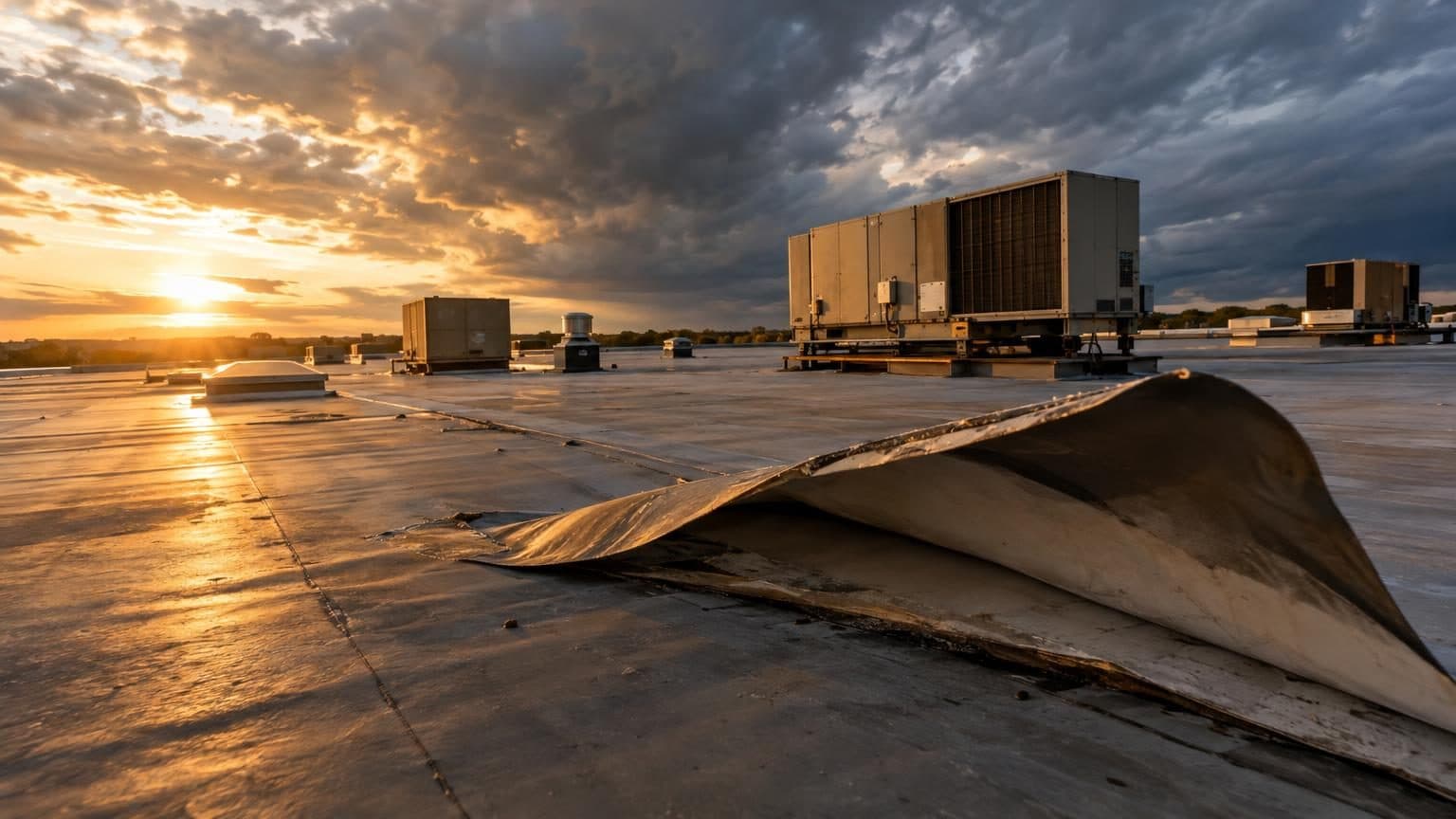
Commercial roofs start losing their covering at gusts of about 80 mph: the Enhanced Fujita scale expects strip malls, motels, low-rise offices, big-box stores and warehouses to lose some roof cover at 80 to 83 mph.1 Visible damage to these buildings begins near 65 to 68 mph, and roof decking lifts near 95 to 103 mph, when big-box stores and warehouses also lose rooftop HVAC units.1 Each building is designed for a wind speed set by its location and use, but a roof rarely fails evenly. The edges and corners take the most uplift, and that is where most roofs give way first.
Cloudbreak team · Updated October 28, 2026 · 6 min read · 17 sources
Wind speeds that damage each commercial building type
A useful published guide to the wind it takes to damage a given building is the damage scale used to rate tornadoes. The Enhanced Fujita (EF) scale lists 28 damage indicators, each with degrees of damage and the wind speed expected to cause them.2,1
| Building type | Visible damage | Roof cover lost (under 20%) | Roof deck lifted | Roof structure lifted or collapsed |
|---|---|---|---|---|
| Apartments, condos, townhouses (3 stories or less) | 76 | 99 | 124 | 138 |
| Motel | 66 | 80 | 95 | 123 |
| Strip mall | 65 | 80 (lifted at eaves and corners) | 101 | 122 |
| Big-box retail | 68 | 81 | 103 (rooftop HVAC lost) | 122 (long spans collapse) |
| Low-rise building, 1 to 4 stories (offices, medical, banks) | 68 | 80 | 101 (metal deck at eaves and corners) | 133 |
| Warehouse (tilt-up or heavy timber) | 68 | 83 | 103 (rooftop HVAC lost) | Not a listed step |
| Metal building system | 67 | 95 (roof or wall panels pulled off) | Not a listed step | 118 (roof purlins buckle) |
Read the numbers as estimates. They are gusts estimated from the damage itself, not readings from an instrument, and they will differ from the wind a nearby weather station reported. They also assume a sound, code-built, maintained building; a weaker one fails sooner.
The scale gives bounds for weaker and stronger buildings: 66 to 100 mph for a strip mall's eave and corner cover loss. EF0 covers 65 to 85 mph and EF1 86 to 110 mph, so most roof damage in the table is EF0 or EF1 wind.2,1
What 58, 70 and 80 mph warnings mean
The National Weather Service calls a thunderstorm severe when it can produce gusts over 58 mph or hail 1 inch or larger; some exceed 100 mph.3
Severe thunderstorm warnings can carry a damage threat tag: "considerable" for 70 mph winds and "destructive" for 80 mph, which also sends a Wireless Emergency Alert to phones. A destructive warning is the one that lines up with roof cover loss on the EF scale.4
Hurricane categories in gust terms
Hurricane categories are measured differently from roof design speeds. The Saffir-Simpson scale rates hurricanes only by maximum sustained wind, while building codes and the EF scale use short gusts, so the two have to be converted before they can be compared.
FM's wind design data sheet converts Category 1 one-minute sustained winds of 74 to 95 mph over open water to 3-second gusts of 82 to 108 mph over land, overlapping the EF speeds for roof cover loss, and Category 2 winds of 96 to 110 mph to gusts of 108 to 130 mph.1,5
What a roof is designed for
Building codes set a design wind speed for each site, and the roof's attachment is engineered to hold the pressure that wind creates. The pressure grows with the square of the wind speed, so a modest rise in speed means a much larger load, and it is highest at the corners and perimeter because wind speeds up at the building edge.
The International Building Code uses ASCE 7 for loads. In ASCE 7-16 and 7-22, a building's basic wind speed is a 3-second gust at 33 feet above open ground (Exposure C), read from a map for its risk category.6,7,8
Risk category follows use, and essential facilities are Risk Category IV, the highest. The ASCE 7-16 maps match return periods of 300, 700, 1,700 and 3,000 years for Categories I to IV; a Category II building has a 6.9% chance its mapped speed is exceeded over a 50-year life.7,9
For example, in Mayfield, Kentucky, ASCE 7-16 basic wind speeds are 106 mph for Category II, 113 mph for III and 117 mph for IV.7
ASCE 7-22 raised basic wind speeds along the south Texas coast by about 10 mph. It also added tornado loads that can apply to Risk Category III and IV buildings in the tornado-prone region, with design tornado speeds of 60 to 138 mph, roughly EF0 to EF2.6,10
What FM roof wind ratings mean
FM Approvals rates a complete roof assembly by the highest uplift pressure, in pounds per square foot (psf), it holds for one minute in the ANSI FM 4474 test, in 15 psf steps.11
In a listing such as 1-90, the 1 means the assembly passed FM's interior fire test (Class 1) and the 90 is the wind rating in psf. FM's wind data sheet, revised April 2026, says roof ratings start at 60 psf and reach several hundred psf.5,12
FM multiplies the design wind pressure by 2.0 to get the minimum rating, so a roof zone with a 45 psf design pressure needs at least a 90 psf assembly.5,13
| Roof zone | Where | Minimum rating (psf) |
|---|---|---|
| Zone 3 (corners) | Corner areas, 18 by 18 by 6 ft | 210 |
| Zone 2 (perimeter) | 0 to 18 ft from the edge | 150 |
| Zone 1 | 18 to 36 ft from the edge | 120 |
| Zone 1' (interior) | More than 36 ft from the edge | 75 |
Edge metal is rated separately. FM's perimeter flashing data sheet, revised October 2025, dropped wind ratings for edge, coping and gutter systems; it uses only their vertical (uplift) and horizontal (outward) pressure resistances.14
Where commercial roofs fail first
- Edges. Lifted metal edge flashing and coping, followed by the membrane peeling back, is the most common way roofs lose their membrane.
- Windward edge. RICOWI inspected roofs after Hurricane Michael, mostly where estimated 3-second gusts were 120 to 140 mph, and found almost all low-slope failures began at the windward edge.15
- Rooftop equipment. After Michael, dislodged equipment tumbling across the roof caused most punctures and tears, and unit fasteners pulled out or tore the housing even with the designed number of fastening points.15
- Age. In the same survey, 84% of inspected roofs over 10 years old were or were likely leaking, against 45% of younger roofs.15
- Newer codes don't remove the edge problem. After Hurricane Ian (Category 4 landfall), IBHS found damage rates above 50% on low-slope commercial roofs, most with flashing or coping failures, even under newer codes. Metal roofs had about 12% damage and held up well below 130 mph.16
- Interior. Building frames are seldom damaged in windstorms, but a small breach in the roof or walls can let wind and water destroy a large area inside.
Texas coast: windstorm program wind speeds
In Texas, TDI's windstorm program set the wind speeds for coastal work: from January 1, 2008, to March 31, 2020, work had to resist 3-second gusts of 130 mph seaward of the Intracoastal Canal, 120 mph inland within about 25 miles of the coast east of TDI's boundary line and in certain Harris County areas, and 110 mph west of that line.8
Under TDI's 2020 rule, the engineer's inspection verification states the wind speed the work is certified to withstand, with its exposure and risk category.8
Windstorm certificate applications in Texas from April 1, 2026, must be certified to the 2024 International Building or Residential Code, with each structure's wind speed set by location, for example with the ASCE 7 Hazard Tool.17
How Cloudbreak helps
Storm monitoring
Our proprietary predictive storm engine, built with AI and backed by meteorologists, watches every building against its own roof-based thresholds; our on-call team picks up urgent matches within 15 minutes, day or night.
Pre-loss documentation
A dated record of every roof section, elevation and rooftop unit, in photos, drone video and notes, with original files and timestamps intact.
Free hail history
Every hail and wind day near any address since 2010, with a free PDF and storm alerts.
Questions
- What wind speed damages a commercial roof?
- On the EF scale, visible damage to most commercial building types is expected near 65 to 68 mph gusts and roof cover loss near 80 to 83 mph.1
- How much wind can a flat roof withstand?
- A code-built roof is designed for its site's basic wind speed, a 3-second gust. On the ASCE 7-16 maps, a Risk Category II building has a 6.9% chance of that speed being exceeded in 50 years. In FM's 110 mph example, corners need a 210 psf rating and the interior 75 psf.5,6,7,9
- What does an FM 1-90 rating mean?
- The 1 means the roof assembly passed FM Approvals' interior fire test (Class 1); the 90 means it held 90 psf of uplift for one minute in FM's wind test. FM sets the minimum rating at twice the design pressure, so a 1-90 fits a roof zone with a design pressure up to 45 psf.5,13,11,12
Cloudbreak
The owner-side property protection team for commercial and multifamily owners in storm country: a dated record of every building, nightly storm checks and a review of your policy, before a loss.
Sources
Written by the Cloudbreak team. Numbers, dates and rules cite the published sources below.
- 1. Wind Science and Engineering Center, Texas Tech University, hosted by NOAA Storm Prediction Center: A Recommendation for an Enhanced Fujita Scale (EF-Scale), Revision 2 (October 10, 2006)
- 2. NOAA Storm Prediction Center: Enhanced Fujita Tornado Damage Scale
- 3. NOAA National Weather Service: Severe Thunderstorm Safety
- 4. NOAA National Weather Service: New "Destructive" Severe Thunderstorm Warning category to trigger Wireless Emergency Alerts on mobile phones (July 22, 2021)
- 5. FM (formerly FM Global): Property Loss Prevention Data Sheet 1-28: Wind Design (October 2015 edition, revised April 2026)
- 6. FEMA and NIST: Design Guide for New Tornado Load Requirements in ASCE 7-22 (January 2023)
- 7. FEMA: Essential Facilities Located in Tornado-Prone Regions: Recommendations for Facility Owners, Recovery Advisory 1 (February 2023)
- 8. Texas Department of Insurance: Commissioner's Order 2020-6285: windstorm building codes, 28 TAC 5.4011 and 5.4012 (March 2020)
- 9. American Society of Civil Engineers: Wind Speeds and Related Risks, chapter 3 of Wind Loads (March 25, 2020)
- 10. FEMA: Highlights of Significant Changes to the Wind Load Provisions of ASCE 7-22 (August 2022)
- 11. FM Approvals: ANSI FM 4474: Evaluating the Simulated Wind Uplift Resistance of Roof Assemblies Using Static Positive and/or Negative Differential Pressures (December 2020)
- 12. FM Approvals: FM Approved roofing (September 8, 2024)
- 13. FM (formerly FM Global): Property Loss Prevention Data Sheet 1-52: Field Verification of Roof Wind Uplift Resistance (February 2020 edition, revised October 2024)
- 14. FM (formerly FM Global): Property Loss Prevention Data Sheet 1-49: Perimeter Flashing (October 2021 edition, revised October 2025)
- 15. RICOWI: Wind Investigation Report: Hurricane Michael (October 28, 2019)
- 16. Insurance Institute for Business and Home Safety: Observations of Building Performance in Southwest Florida During Hurricane Ian (2022), Part I: Roof Cover Damage Assessment on Residential and Light Commercial Structures
- 17. Texas Department of Insurance: Adopted Building Codes (windstorm inspection program)