Wind damage or wear on a commercial roof
Short answer
Wind damage on a commercial roof starts where uplift is strongest, at the corners, the perimeter and the windward edge. It shows as lifted or missing edge metal and coping, membrane peeled back from the edge, pulled fasteners, and creased, torn or missing shingles. Age and wear look different and are spread more evenly: cracked, alligatored bitumen, crazed membrane surfaces, splits from shrinkage, standing water long after rain, and shingle overlaps unsealed on every slope rather than mainly on the windward side. The two also combine. Age weakens a roof before the storm comes: after three hurricanes, RICOWI found corroded fasteners and deteriorated wood on damaged roofs.1,2
Cloudbreak team · Updated October 28, 2026 · 6 min read · 13 sources
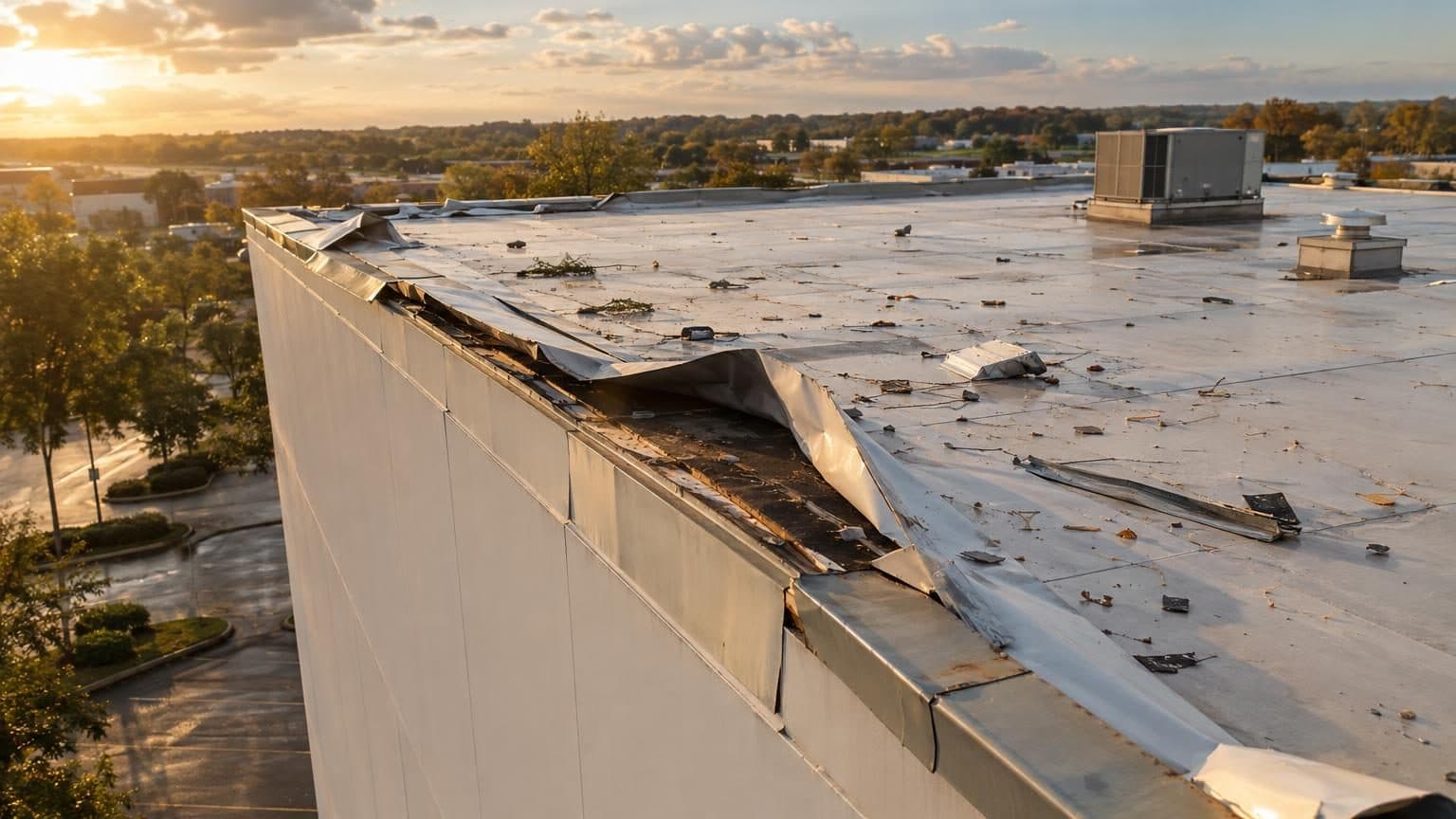
Where wind damage starts
Wind speeds up as it flows over the edge of a building, and that faster air pulls up on the roof. The pull is strongest at the corners and along the perimeter, weaker in the middle of the roof, the field. So wind damage almost always begins at an edge and works inward.
FM Global notes that uplift peaks at the corners when wind blows at about 45 degrees to the roof, and along the windward edge when it blows at 90 degrees to that edge.3
The usual sequence is that the edge metal or coping lifts first, and the membrane then peels back from the edge. FM Global calls this the most common cause of membrane loss. After Hurricane Michael, the Roofing Industry Committee on Weather Issues (RICOWI) found that almost all low-slope roof failures began at the windward edge, and that without a peel stop (a bar fastened over the membrane near the edge flashing or coping), edge failure frequently spread across the roof.4,5,6
Other wind damage to look for: perimeter flashing removed or loosened; cover or insulation removed, or lifted and dropped back into place; deck panels dislodged or lifted; impact from wind-blown objects; and vents, skylights and pipes knocked loose.
Wind damage and wear by roof type
| Roof part | Wind damage | Age, wear, installation or upkeep |
|---|---|---|
| Edge metal, coping and gutters | Edge metal lifted, cleats bent or missing; coping and fascia lifted and peeled; gutters lifting the edge flashing and starting a progressive membrane peel | Corroded fasteners or metal; edges loose from weak fastening, a rotted or missing wood nailer, or membrane shrinkage |
| Single-ply (TPO, PVC, EPDM) | Billowing from air under the membrane and base flashing; fasteners pulled out at termination bars; tears at fasteners; debris cuts and punctures | Crazing and erosion of the surface; splits from shrinkage, embrittlement or thermal contraction; fasteners loose or backed out from overdriven, underdriven or crooked placement |
| Built-up and modified bitumen | Edge metal, coping or wood nailer lifted, then membrane torn around fasteners and peeled back from the edge | Alligatoring; granule loss; blisters over voids; ridges over insulation joints; splits from weak attachment or deck movement |
| Metal panels | Edge securement failures; panels dislodged where fasteners missed solid framing, or where a failed wall or door pressurized the building | Components distorted or loosened by thermal expansion and contraction |
| Asphalt shingles (smaller buildings) | Creased, flipped, torn or missing tabs on windward eaves, ridges and tops of valleys; a lost first course where the starter strip never sealed | Cupping, clawing and splitting from shrinkage; overlaps unsealed in a repeating diagonal or vertical pattern on every slope |
| Rooftop equipment | Units dislodged, fasteners pulled out or housings torn; access panels blown off; membrane torn by equipment tumbling across the roof | Fasteners not put back after equipment service |
Some symptoms can have either cause, so one sign is rarely enough. A 1993 Army Corps of Engineers single-ply manual lists wind among the causes of loose edge metal and of failed fasteners, and the Army's 2010 modified bitumen manual lists wind erosion at roof corners among the causes of granule loss, next to poor granule embedment in manufacturing and water erosion from downspouts.7,8
Signs of age and wear
- Ponding. Water still on the roof more than 48 hours after rain counts as ponded, from poor drainage design, an uneven membrane surface or clogged drains and scuppers. NRCA defines positive drainage as a roof that drains within 48 hours of rain in drying conditions.7,12
- Alligatoring. Hairline cracking across the surface, from too much bitumen or from aging bitumen combined with weathering and temperature cycling.
- Aging shingles. Asphalt dries out, shrinks and cracks with age, and the sealant strips deteriorate, lowering wind resistance. Cupping, clawing and splitting come from shrinkage, not wind.
- Metal panels. Expansion and contraction can distort metal components and loosen them from the substrate, and a metal roof built without room for that movement is more vulnerable to wind damage, as NRCA noted in 2003.11
Shingles also lose wind resistance with age. Insurance Institute for Business & Home Safety (IBHS) tests of shingles weathered 10 years in South Carolina, Wisconsin and Ohio found that many products' wind resistance rose in their first few years, then most began to decline between years 5 and 10. IBHS called unsealing the single greatest driver of wind vulnerability (September 22, 2026).13
How engineers tell them apart
Engineers look at the whole roof, not one spot: where the damage is, which way each damaged slope faces, the pattern of any unsealed shingles across every slope, and the wind direction during the storm.
- Direction and location. Wind damage concentrates on the windward sides, especially at eaves, ridges and tops of valleys. Unsealed shingle overlaps on every slope are not wind, Haag engineers write, because wind does not come from several directions with just enough force to unseal each one.9
- Lasting marks. In Haag's experience, a sealed shingle moved by wind leaves creases, folds, tears or missing pieces. In its wind simulator, which reaches 175 mph, every new shingle that came unsealed had at least creases, though some took close inspection by hand to find.10
- Hidden weaknesses. FM Global says most deficiencies that lead to uplift failures are not readily visible on completed roofs, and that field uplift tests should not be used to find the cause of storm damage unless comparable tests were run just before the storm and earlier damage or deficiencies are ruled out.6
Why the roof's earlier condition matters
A roof in poor shape fails at lower wind speeds, and the insurer will ask how much of the damage the storm caused and how much the roof's condition did. Hurricane surveys show how much age and upkeep matter.
- On 93 low-slope roofs inspected after Hurricanes Charley and Ivan, the conditions RICOWI most often found with damage included deteriorated attachment (corroded fasteners, deteriorated wood and base sheets) and perimeters and corners with no added fastening.1
- After Hurricane Ike, RICOWI found deteriorated wood and corroded fasteners on both damaged and undamaged roofs around Houston, and wrote that regular inspections may have found them before the storm.2
- After Hurricane Michael, RICOWI compared roofs of different ages to test code changes made since 2000. With nearly all inspections in areas of estimated 3-second gusts of 120 to 140 mph, 84% of inspected roofs over 10 years old were or were likely leaking, against 45% of roofs under 10 years old.4
Records made before a storm settle many of these questions. FM Global recommends written or computer records with pictures of problem areas, and inspection of roofs, flashing, drains and rooftop equipment at least twice a year and before and after severe storms. FEMA recommends spring and fall inspections plus one after high winds.5,3
How Cloudbreak helps
Pre-loss documentation
A dated record of every roof section, elevation and rooftop unit, in photos, drone video and notes, with original files and timestamps intact.
Storm monitoring
Our proprietary predictive storm engine, built with AI and backed by meteorologists, watches every building against its own roof-based thresholds; our on-call team picks up urgent matches within 15 minutes, day or night.
Free hail history
Every hail and wind day near any address since 2010, with a free PDF and storm alerts.
Questions
- How can you tell wind damage from wear on a commercial roof?
- By location and pattern. Wind damage concentrates at corners, perimeters and windward edges and leaves creases, tears, lifted edge metal and pulled fasteners. Wear is spread across the roof, and shingle overlaps unsealed on every slope point to thermal cycling and sealant wear, not wind.
- What does wind damage look like on a flat roof?
- Lifted or missing edge metal, coping and gutters; membrane peeled back from the windward edge; billowing; pulled fasteners; and cuts, punctures and tears from debris and displaced rooftop equipment.
- Are unsealed shingles wind damage?
- Not by themselves, in Haag engineers' view, on a question they call controversial. They count creased, folded, torn or missing shingles as wind damage and list aging, installation errors, manufacturing and thermal cycling among other causes of unsealing. IBHS calls unsealing the single greatest driver of shingle wind vulnerability.10,13
- Can wind damage a roof without leaving visible signs?
- Sometimes. Wind can lift a roof cover and drop it back into place, and FM Global says most deficiencies behind uplift failures are not readily visible. On shingles, Haag engineers say a sealed shingle moved by wind leaves lasting evidence that shows when the roof is examined carefully.3,6,10
Cloudbreak
The owner-side property protection team for commercial and multifamily owners in storm country: a dated record of every building, nightly storm checks and a review of your policy, before a loss.
Sources
Written by the Cloudbreak team. Numbers, dates and rules cite the published sources below.
- 1. Roofing Industry Committee on Weather Issues (RICOWI): Hurricanes Charley and Ivan Investigation Report (March 2006)
- 2. Roofing Industry Committee on Weather Issues (RICOWI): Hurricane Ike Investigation Report (December 2009)
- 3. FM Global: Property Loss Prevention Data Sheet 1-28: Wind Design (October 2015 edition, interim revision April 2026)
- 4. Roofing Industry Committee on Weather Issues (RICOWI): Wind Investigation Report: Hurricane Michael (October 28, 2019)
- 5. Federal Emergency Management Agency: FEMA P-2181 Fact Sheet 3.3.2: Roof Systems, Low-Slope Roofs (March 2022)
- 6. FM Global: Property Loss Prevention Data Sheet 1-52: Field Verification of Roof Wind Uplift Resistance (February 2020 edition, interim revision October 2024)
- 7. U.S. Army Corps of Engineers, Engineer Research and Development Center: Membrane and Flashing Condition Indexes for Modified Bitumen Roofs: Inspection and Distress Manual, ERDC/CERL TR-10-5 (March 2010)
- 8. U.S. Army Corps of Engineers, Construction Engineering Research Laboratories: ROOFER: Membrane and Flashing Condition Indexes for Single-Ply Membrane Roofs, Inspection and Distress Manual (April 1993)
- 9. Haag Engineering: Wind Effects on Asphalt Shingles (Marshall, Morrison, Herzog and Green, 29th Conference on Hurricanes and Tropical Meteorology, 2010)
- 10. IIBEC: Misconceptions of Wind Damage to Asphalt Composition Shingles (Lopez, Goode and Morrison, Haag Engineering, December 28, 2017)
- 11. Professional Roofing, NRCA: Thermal movement in metal roof systems (Joan P. Crowe, October 2003)
- 12. National Roofing Contractors Association (NRCA): Glossary: Positive drainage
- 13. Insurance Institute for Business & Home Safety: IBHS Research Reveals Critical Links in Asphalt Shingle Wind Performance After 10 Years of Aging (September 22, 2026)