Sustained wind vs wind gust
Hail and wind · Cloudbreak team · Updated October 29, 2026 · 14 sources
Definition
Sustained wind is the average wind speed over a set period. A wind gust is a brief burst of higher speed, lasting seconds, that rises above that average and drops back. In US reports, sustained wind is a 2-minute average in NWS observations and a 1-minute average for National Hurricane Center (NHC) hurricane intensity. The NWS counts a gust when speed swings 10 knots or more between peaks and lulls.1,2,3
How it works
Wind speed rises and falls all the time. Averaging it over a minute or two gives the sustained wind, the steady figure that forecasts, warnings and hurricane categories use. A gust is a short peak within that period, so it is always higher than the sustained speed.
The averaging period matters. A shorter average of the same wind reads higher than a longer one, so speeds averaged differently are not directly comparable.
Gusts matter for buildings. Wind pressure rises with the square of speed, so a brief burst well above the sustained wind loads a roof much harder. Building design wind speeds and the Enhanced Fujita (EF) tornado scale are therefore based on gusts, not averages.4,5
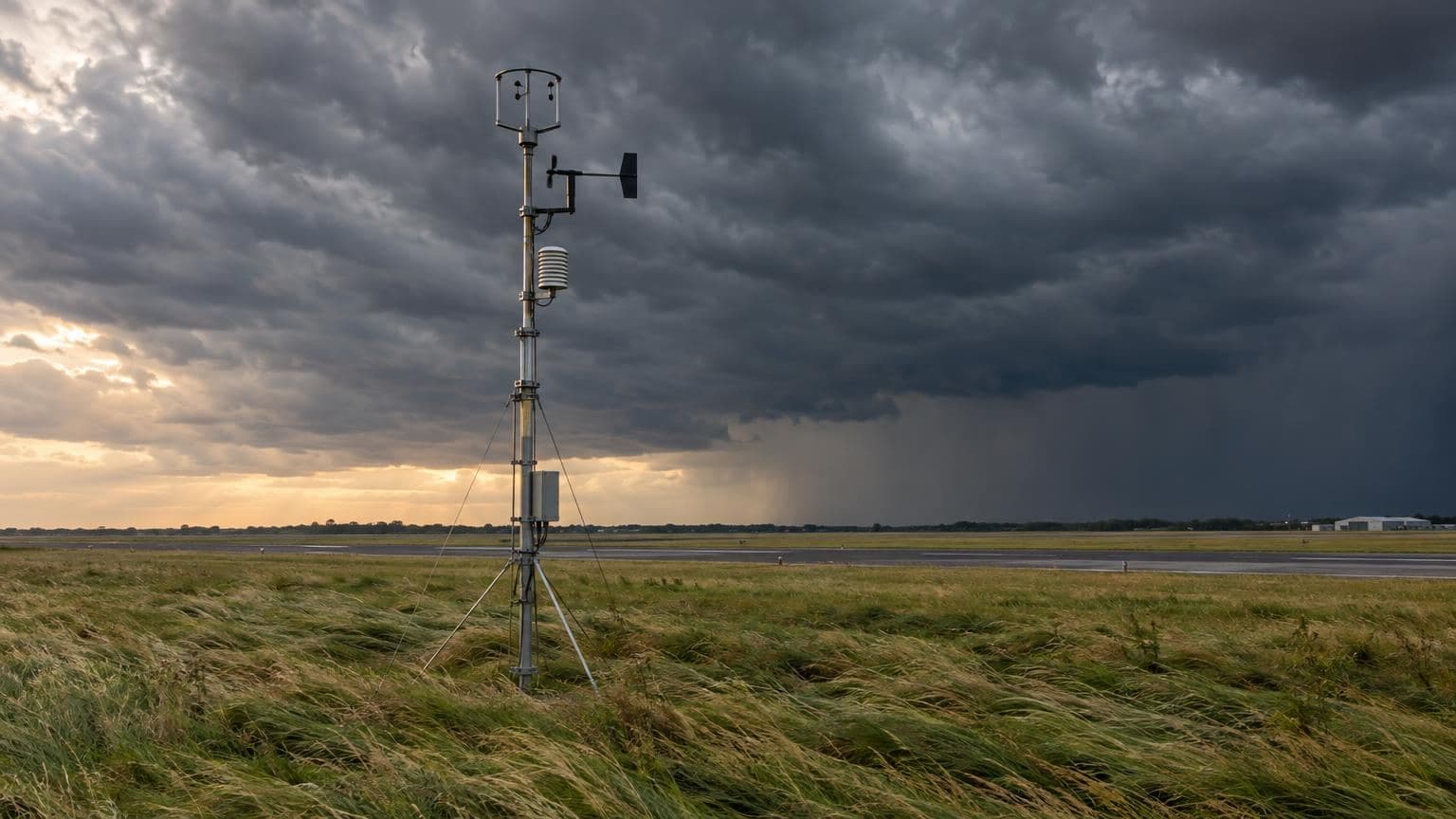
How US agencies measure it
At automated airport stations (ASOS), reported wind speed is a 2-minute average of twenty-four 5-second averages. ASOS sonic wind sensors report gusts to the World Meteorological Organization's 3-second standard.6,7
ASOS stores a gust when a short peak beats the 2-minute average by 5 knots or more and that average is at least 9 knots. It reports the gust only if the peak is also at least 10 knots above the lowest 5-second speed of the past 10 minutes.7
NHC rates hurricanes only by maximum sustained wind: the highest 1-minute average at 10 meters (33 feet) with unobstructed exposure. The EF scale and FM Global's design wind speeds use 3-second gusts, and the SPC notes that the EF scale's gust is not the same wind as standard surface observations.2,8,5,4
NWS land products use both. A High Wind Warning is generally for sustained winds of 40 mph or more for 1 hour or longer, or 58 mph or more for any duration; a Wind Advisory is generally for sustained winds of 30 to 39 mph for 1 hour or longer.9,10
| Sustained wind | Wind gust | |
|---|---|---|
| What it is | Average speed over a set period | Rapid fluctuation in speed of 10 knots or more between peaks and lulls; its speed is the maximum instantaneous speed |
| Averaging time | 2 minutes (NWS, ASOS); 1 minute (NHC hurricane intensity) | 3-second gust standard on ASOS sonic sensors |
| When reported | In every observation | Only when the wind is varying enough to meet the gust rule |
| Used by | Saffir-Simpson scale; Wind Advisory and High Wind Warning duration criteria | EF scale; FM Global design wind speeds; Severe Thunderstorm Warning wind tags |
Example
NHC's Hurricane Harvey report lists a University of Florida research tower near Rockport, Texas, that measured an 88 knot sustained wind (1 minute at 10 m) and a 122 knot gust on August 26, 2017 (UTC). At about 1.15 mph per knot, that is roughly 101 mph sustained and 140 mph in the gust.12,13
In FM Global's wind design formula, velocity pressure rises with the square of wind speed. So the tower's gust carried about (122 / 88) squared, or 1.9 times, the pressure of its sustained wind.4,12
FM Global's data sheet converts Saffir-Simpson Category 1 sustained winds of 74 to 95 mph (1 minute, over open water) to 3-second gusts of 82 to 108 mph over land, and Category 2 winds of 96 to 110 mph to gusts of 108 to 130 mph.4
Peak winds often go unmeasured: NHC wrote that Harvey's maximum winds, over an unpopulated and unmonitored area, were probably not sampled by any anemometer.12
Where you'll see it
- Airport observations (METAR): a gust value in the wind group, and a "PK WND" peak wind remark.7
- NHC advisories and Tropical Cyclone Reports: maximum sustained wind, plus station tables of sustained wind and gusts.2,12
- NWS warnings: Wind Advisories and High Wind Warnings use sustained speed and duration. Severe Thunderstorm Warnings end with a "MAX WIND GUST...XX MPH" tag, rounded to the nearest 10 mph.9,10,11
- Storm Data: High Wind entries carry an S or G before the value, and wind entries are coded as measured or estimated gusts or sustained winds (MG, EG, MS, ES).14
- Wind design documents: FM Global's design wind speed is a 3-second gust at 33 feet above open terrain (Exposure C).4
Questions
- Is a hurricane's category based on gusts?
- No. The Saffir-Simpson scale uses only maximum sustained wind, which NHC defines as the highest 1-minute average at 10 meters.8,2
- What is a peak gust?
- The highest instantaneous wind speed observed or recorded. At ASOS stations, the peak wind remark (PK WND) gives the highest speed above 25 knots since the last hourly report.3,7
- How much higher are gusts than sustained winds?
- It varies with the storm, the terrain and the averaging period. FM Global's table pairs Category 1 sustained winds of 74 to 95 mph over water with 3-second gusts of 82 to 108 mph over land, and a Rockport tower in Hurricane Harvey measured a gust about 39% above its 1-minute sustained wind.4,12

Cloudbreak
Cloudbreak's proprietary predictive storm engine, built with AI and backed by meteorologists, tracks every storm against every building, before it hits and after it passes.
Sources
Written by the Cloudbreak team. Numbers, dates and rules cite the published sources below.
- 1. NOAA National Weather Service: NWS Glossary: Sustained Wind
- 2. NOAA National Hurricane Center: Glossary of NHC Terms
- 3. NOAA National Weather Service: NWS Glossary: Wind Gust
- 4. FM Global: Property Loss Prevention Data Sheet 1-28: Wind Design (October 2015 edition, interim revision April 2026)
- 5. NOAA Storm Prediction Center: Enhanced Fujita Tornado Damage Scale
- 6. NOAA National Weather Service: Technical Implementation Notice 03-15: ASOS Wind Sensor Replacement (March 19, 2003)
- 7. NOAA National Weather Service: Automated Surface Observing System (ASOS) User's Guide (March 1998)
- 8. NOAA National Hurricane Center: Saffir-Simpson Hurricane Wind Scale
- 9. NOAA National Weather Service: NWS Glossary: High Wind Warning
- 10. NOAA National Weather Service: NWS Glossary: Wind Advisory
- 11. NOAA National Weather Service: NWS Instruction 10-511: WFO Severe Weather Products Specification (January 26, 2023)
- 12. NOAA National Hurricane Center: Tropical Cyclone Report: Hurricane Harvey, August 17 to September 1, 2017
- 13. NOAA National Weather Service: NWS Glossary: Knot
- 14. NOAA National Weather Service: NWS Instruction 10-1605: Storm Data Preparation (July 26, 2021)