Storm season checklist for commercial and apartment properties
Short answer
Before storm season, inspect and repair roofs and rooftop equipment, clear drains, record the building's current condition in writing and photos, go over the policy with your broker, and set up a contact plan with several ways to get weather alerts. Thunderstorms, which bring hail, are most likely in spring and summer, and the greatest US severe weather threat runs from Texas to southern Minnesota. The Atlantic hurricane season runs June 1 to November 30.1,2,3
Cloudbreak team · Updated October 28, 2026 · 7 min read · 23 sources
When to get ready
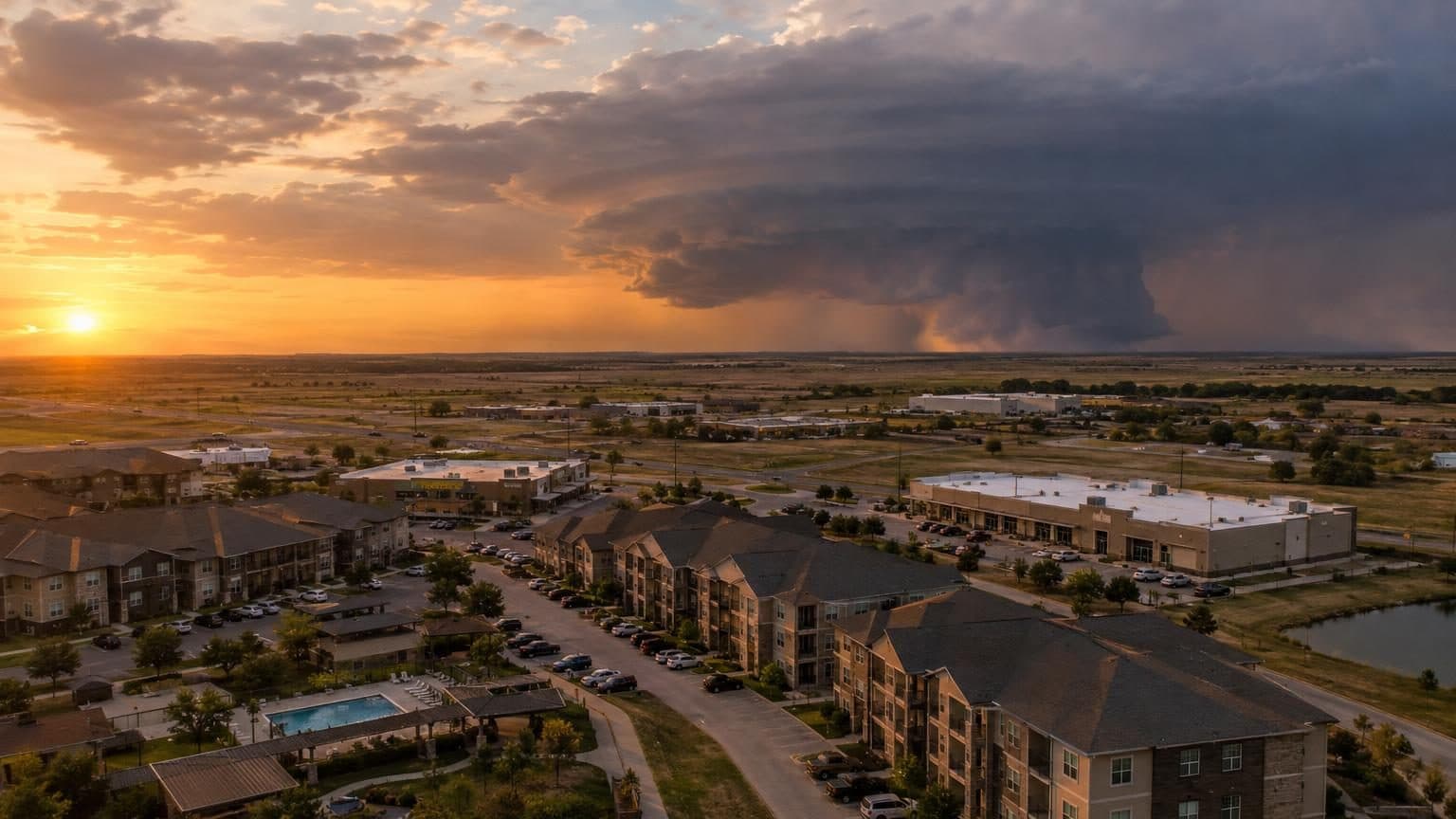
Hail and damaging wind can come in any month, so the aim is to finish inspections and repairs before the busiest weeks, not to wait for a date on the calendar.
Atlantic hurricane activity is heaviest from mid-August to mid-October. NRCA recommends roof inspections at least twice a year, preferably spring and fall, plus after any hurricane, tornado or hailstorm.1,4
Roof checks
Most storm damage starts at a weak spot that was already there: an open seam, a loose edge or a fastener working its way out. These are the checks IBHS lists for low-slope commercial roofs, by roof type:5
- Single-ply membrane: tears, punctures, worn or failed seams, fasteners backing out and brittleness. On fully adhered membranes, also loose areas and blisters.5
- Built-up and modified bitumen: blisters, cracks, wear around connections and missing protective coating.5
- Metal panels: dents, loose screws, worn rubber washers, worn paint and rust.5
- Edge flashing: rust and wavy or loose fascia. Pull on the bottom flange to find a loose edge.5
- Roof hatches and skylights: loose hardware, cracked seals, leaks and signs of hail damage.5
Fix what turns up before the season. IBHS's list includes repairing punctures, tears and flashing, adding fasteners at corners and perimeters, a wind uplift test, and cables and straps over roof-mounted equipment. If the roof is under warranty, NRCA suggests having the installing contractor make the repairs.6,4
Roofs wear out faster where hail is common. IBHS cites insurance industry data that roofs in severe hail-prone areas often must be replaced every 7 to 10 years.7
Rooftop equipment, skylights and openings
- Hail guards on HVAC condensers. Condenser fins and coils are extremely susceptible to small hail. In severe and very severe hail areas, FM recommends guards with openings no larger than 0.5 by 1 inch (13 by 25 mm), checked for condition and attachment.8
- How the guards are built and fitted. IBHS says common coil guards use 0.5 by 1 inch galvanized wire mesh or louvered panels on an aluminum frame, and that guards should sit off the fins, be fastened against wind and be watched for reduced airflow. No standardized test compares them.9
- Nonmetallic skylights and smoke vents. Cracks, crazing, yellowing or cloudiness mean the plastic is getting brittle. FM names hail-punctured skylights as one of the main causes of water damage.8
- Condenser attachment. Units strapped to the stand, curb or deck with little to no slack, every service panel fastener in place, and curbs free of loose connections, rusted flashing, leaks and rot.5
- Packaged terminal air conditioner (PTAC) units installed to resist wind-driven rain, typically tilted 2 degrees toward the outside and caulked between the building and the sleeve.6
- Roll-up doors with tight brackets, no major dents or rust, and a wind label.6
Drainage and flood exposure
- Roof drains, gutters and downspouts clear, gutters strapped, and downspouts discharging at least 3 feet from the foundation.5
- Ponding that isn't caused by a blockage looked at by a roofer. Water that stands for long periods ages a membrane and makes it brittle.
- Site drains clear, especially at shipping and receiving areas, and checked again when a hurricane watch is issued.6
- Trees trimmed back from roofs. Overhanging branches damage roofs and clog drains.
- Flood risk looked up on FEMA's Flood Map Service Center, with the lowest floor compared to the base flood elevation. Flooding can also happen outside high-risk areas.6
Records to have before the season
A claim is easier to prove when you can show what the building looked like before the storm. Gather these and keep copies away from the property.
- Roof inspection reports, written and photographed. NRCA says the file gives a basis for comparing conditions at later inspections.4
- A photo inventory of building components, equipment and inventory, stored offsite and in the cloud. IBHS notes a claim will likely require itemizing losses.5
- Copies of building plans, insurance policies, bank account and employee contact information in a waterproof container, with a set stored offsite.10
- Policy numbers and claim filing instructions in a secure, convenient place.11
- The insurance agent's contact details, saved in a phone and offsite.
Policy terms to go over with the broker
Storm losses often turn on a few policy terms that are easy to miss until a claim. Ask your broker or agent how each one applies to each building.
- Wind and hail: whether they are covered, excluded or written on a separate policy.
- Deductibles: a hurricane deductible applies only after a trigger, such as the National Weather Service naming a storm or issuing a watch or warning, while a wind and hail deductible applies to any wind damage. The Insurance Information Institute describes these for homeowners policies. Ask for each deductible in dollars and its trigger.12
- Roofs at actual cash value: which buildings have them, since depreciation then comes out of a roof claim.
- Flood: most commercial property policies exclude it, and a new flood policy starts after a 30-day wait.13
- Business income: payments typically begin 24 to 48 hours after the loss or after a deductible is paid, and usually exclude weather-related evacuations and utility outages not caused by damage to the property. Ask whether separate wind or flood policies include it.14
Contacts, plans and alerts
- A contact list: fire, police, tree services, utilities and the insurance agent.
- Who handles last-minute preparations, and how staff, residents and customers get updates.
- At least three alert sources, such as the National Hurricane Center, the local National Weather Service office, a hand-crank NOAA Weather Radio and Wireless Emergency Alerts.5
- When a hurricane watch is issued: start the continuity plan, close roll-up doors all the way, secure outdoor items and check drains again.6
Phone alerts miss many hail warnings. A severe thunderstorm warning sends a Wireless Emergency Alert only when tagged destructive: hail at least 2.75 inches (baseball) or wind at least 80 mph, so golf ball hail (1.75 inches) does not. The Storm Prediction Center forecasts severe weather up to seven days ahead.15
Reducing risk across a portfolio
- Rank buildings by hail zone. FM's hail maps divide areas into moderate, severe and very severe; damaging hail also falls outside the severe zones, less often.8
- Rank roofs by age against the 14 to 18 year average life of single-ply and multi-ply covers.8
- Plan for one storm hitting several sites: hail swaths range from a few acres to 10 miles wide and 100 miles long.3
- At reroofing in hail-prone areas, IBHS recommends low-slope covers rated FM 4470 Class 1-SH or UL 2218 Class 4.16
- FORTIFIED Multifamily, an IBHS standard for apartment buildings, has three levels (Roof, Silver, Gold) and an optional hail supplement. Each building is designated separately, for 5 years.17,18
Texas rules
- In Texas, TDI's filing checklist says a commercial property form may exclude windstorm, hurricane or hail only in TDI's designated catastrophe area, unless the exclusion is optional and priced, and the insured must sign the exclusion or a disclosure. On the coast and in Harris County on Galveston Bay, TDI says policies probably don't cover wind and hail; TWIA offers it.13,19
- In Texas, forms for large risks, such as $5 million or more in insured property, are exempt from TDI filing.19
- In Texas, TDI has allowed roofs to be covered at actual cash value when that is limited to wind and hail losses.19
- Texas coast, for property insured through TWIA: while a hurricane is in the Gulf of Mexico or within 80 degrees west and 20 degrees north, TWIA takes no new or increased coverage. TWIA renewals paid within 10 days of expiration continue.20
- Texas coast, for property insured through TWIA: a Windstorm Certificate of Compliance (WPI-8) is required for TWIA eligibility. Replacing a roof or repairing a significant part of one needs a certificate; temporary storm repairs do not. TDI has an online database of most certificates.21
Dallas-Fort Worth hail season
In the Dallas-Fort Worth area, hail peaks in April and May. Within 124 nautical miles of the Dallas Fort Worth radar, hail reports averaged 106 in April and 105 in May from 1980 to 2006, against 49 in March and 55 in June. The Storm Prediction Center dates the area's primary severe weather season March 21 to July 3.22
NWS Fort Worth says storms with large hail can occur all year but are most common in spring, so roof and rooftop equipment work there is best finished by early spring.23
How Cloudbreak helps
Pre-loss documentation
A dated record of every roof section, elevation and rooftop unit, in photos, drone video and notes, with original files and timestamps intact.
Storm monitoring
Our proprietary predictive storm engine, built with AI and backed by meteorologists, watches every building against its own roof-based thresholds; our on-call team picks up urgent matches within 15 minutes, day or night.
Policy review
Your deductibles, limits, exclusions and roof endorsements read against each property, with questions for your broker; a licensed broker approves every report.
For portfolios
One agreement covers every property, inspections are scheduled wherever your buildings are, and there's no upfront cost.
Questions
- What should owners do to get apartment communities ready for storm season?
- Inspect roofs in spring and fall and fix what turns up, strap rooftop units and fit hail guards, clear drains, check PTAC units, photograph the property, and set up three alert sources.6,5,8,4
- What documentation should a commercial property owner have before hail and hurricane season?
- Written, photographed roof inspection reports, a photo inventory stored offsite, copies of policies and the agent's contact details. For coastal Texas property insured through TWIA, add the windstorm certificate of compliance.5,4,21
- What should I check in my commercial property insurance policy before storm season?
- Whether wind and hail are covered or excluded, each deductible in dollars and its trigger, whether roofs are at actual cash value, flood coverage and its 30-day wait, and when business income starts paying.13,14,12
- How do I reduce storm damage risk across a portfolio of commercial buildings?
- Rank buildings by hail zone and roof age, reroof the worst with hail-rated covers, add hail guards to rooftop units, and consider IBHS FORTIFIED designations building by building.8,16,17
- What should we do before hail season at our Dallas-Fort Worth commercial properties?
- Finish before spring, since hail reports there peak in April and May: inspect roofs and fix what turns up, fit rooftop units with securely fastened hail guards, clear gutters and drains, trim branches over roofs, and keep roof inspection reports, a photo inventory and policies stored offsite.6,5,4,10,22,9

Cloudbreak
The owner-side property protection team for commercial and multifamily owners in storm country: a dated record of every building, nightly storm checks and a review of your policy, before a loss.
Sources
Written by the Cloudbreak team. Numbers, dates and rules cite the published sources below.
- 1. NOAA National Hurricane Center: Tropical Cyclone Climatology
- 2. NOAA National Severe Storms Laboratory: Severe Weather 101: Thunderstorm Basics
- 3. NOAA National Severe Storms Laboratory: Severe Weather 101: Hail Basics
- 4. National Roofing Contractors Association: The benefits of maintenance, Professional Roofing, April 2012
- 5. Insurance Institute for Business & Home Safety (copy hosted by ICAT): Make Your Business Hurricane Ready: Prepare Your Business Annually Before Hurricane Season
- 6. Insurance Institute for Business & Home Safety: Hurricane Ready, Business (IBHS21V1)
- 7. Insurance Institute for Business & Home Safety: Hail Guidance for Home and Business Owners
- 8. FM: Property Loss Prevention Data Sheet 1-34, Hail Damage (interim revision April 2026)
- 9. Insurance Institute for Business & Home Safety: Hail Guards: Protection for Roof-Mounted HVAC Equipment
- 10. Federal Emergency Management Agency: Stay in Business after a Disaster by Planning Ahead (October 30, 2018)
- 11. Ready.gov, Federal Emergency Management Agency: Document and Insure Your Property (FEMA P-1097, July 2018)
- 12. Insurance Information Institute: Background on: Hurricane and windstorm deductibles
- 13. Texas Department of Insurance: Commercial property insurance guide
- 14. Texas Department of Insurance: Business Interruption Coverage
- 15. NOAA National Weather Service: New "Destructive" Severe Thunderstorm Warning category to trigger Wireless Emergency Alerts on mobile phones (July 22, 2021)
- 16. Insurance Institute for Business & Home Safety: Commercial Roofs Best Practices Guide
- 17. FORTIFIED Commercial, a program of IBHS: Multifamily FAQs
- 18. Insurance Institute for Business & Home Safety: 2025 FORTIFIED Multifamily Standard
- 19. Texas Department of Insurance: Review Requirements Checklist: Commercial Property (updated November 16, 2021)
- 20. Texas Windstorm Insurance Association (filed with the Texas Department of Insurance): TWIA Instructions and Guidelines Manual (effective February 27, 2026)
- 21. Texas Windstorm Insurance Association: Windstorm Certification
- 22. NOAA Storm Prediction Center: FWS Severe Weather Climatology (Dallas Fort Worth radar, 1980 to 2006)
- 23. National Weather Service Fort Worth: The Mayfest Storm: May 5, 1995