Wind and hail deductible
Coverage · Cloudbreak team · Updated October 29, 2026 · 9 sources
How it works
Many property policies carry their own deductible for windstorm or hail. When wind or hail causes the damage, that deductible applies in place of the policy's regular deductible for other causes of loss.
It comes in two forms. A flat deductible is a fixed dollar amount, such as $1,000. A percentage deductible is figured on the amount of insurance on the damaged property, not on the size of the claim, so a small percentage can still be a large dollar figure.2,3
Percentage wind and hail deductibles usually apply separately to each damaged building, and to the contents of each building, for each storm. A storm that damages three buildings can bring three deductibles.
A wind and hail deductible is broader than a hurricane or named storm deductible. Those apply only when the storm meets the policy's trigger, such as a declared hurricane. A wind and hail deductible applies to wind or hail damage of any kind.
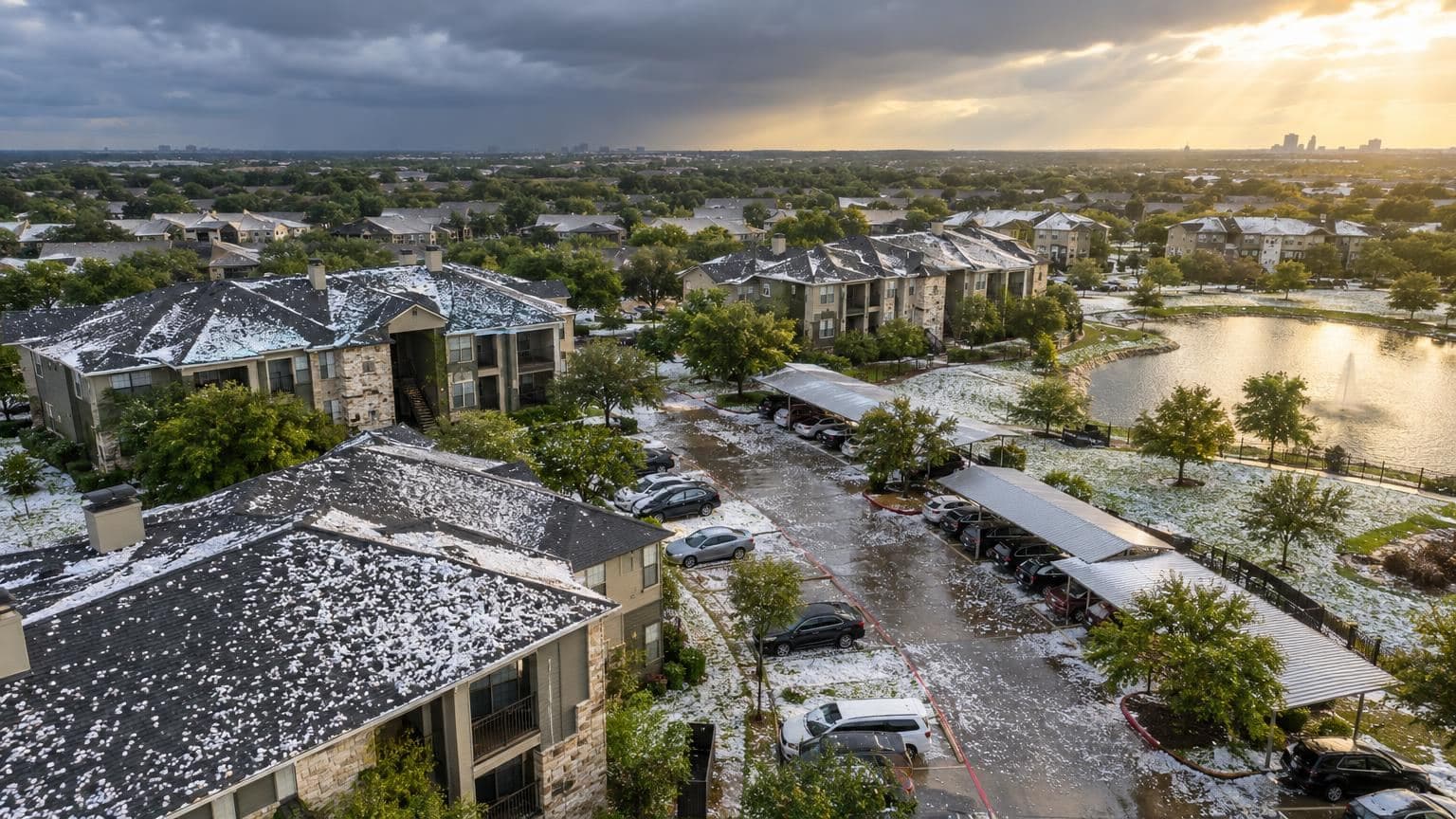
How the standard ISO endorsement works
ISO's Windstorm or Hail Percentage Deductible endorsement (CP 03 21, October 2012 edition) is the standard form of this deductible on commercial property policies. It applies to each occurrence of windstorm or hail and sets a separate deductible for each damaged building, for the personal property at each building, and for personal property in the open. A building and the personal property in it each get their own.1
For property not on a value reporting form, under specific insurance (a separate limit for each building), the percentage is taken from the damaged property's limit of insurance. Under blanket insurance (one limit over two or more items), it is taken from the damaged property's value on the latest statement of values on file with the insurer.1
That differs from the flat deductible in ISO's base Building and Personal Property Coverage Form (CP 00 10), which applies only once per occurrence even when several buildings with separate limits are damaged. In both forms, any coinsurance reduction is made first and the deductible comes off after.1,4
Example
ISO's endorsement gives this blanket example: Buildings 1 and 2 are listed at $500,000 each and Building 3 at $1,000,000 on the statement of values. The blanket limit of $1,800,000 meets a 90% coinsurance requirement. A storm does $40,000 of damage to Building 1 and $20,000 to Building 2, with a 2% deductible.1
| Building 1 | Building 2 | Total | |
|---|---|---|---|
| Value on statement of values | $500,000 | $500,000 | $1,000,000 |
| Deductible (2%) | $10,000 | $10,000 | $20,000 |
| Loss | $40,000 | $20,000 | $60,000 |
| Insurer pays | $30,000 | $10,000 | $40,000 |
- Insurer pays$40,000
- 2% deductibles on Buildings 1 and 2$20,000
- Total$60,000
For comparison, with no endorsement and an example flat deductible of $10,000, the base form's once per occurrence rule takes the deductible off the same $60,000 loss once, leaving $50,000.4
Where you'll see it
- The declarations page or the CP 03 21 schedule, which lists each premises and building number with its percentage; anything missing from the schedule is shown in the declarations.1
- Lender insurance requirements. For Fannie Mae multifamily loans, a wind/hail deductible (unrelated to a catastrophic peril) may not exceed 5% of total insurable value, or, stated only in dollars, $50,000 below $10 million of insurable value and $100,000 at $10 million or more.5
State rules
- Texas coast: TDI says a business on the Texas coast or in Harris County on Galveston Bay probably lacks wind and hail coverage in its regular policy, and the Texas Windstorm Insurance Association (TWIA) offers it.6
- Texas, TWIA policies: TWIA commercial policies offer only 1%, 2% or 5% per item, per occurrence, with a $1,000 minimum, figured on the insurance amount of each item. The deductible is mandatory on items rated from TWIA's commercial rate tables and applies without an endorsement.7
- Texas, TWIA declarations: the deductible appears under "Per Item/Per Unit Deductible" in the Property and Form Description table.8
- Texas, paying the deductible: Insurance Code section 707.002 requires a person insured under a property policy to pay any applicable deductible. Under section 707.004, an insurer with replacement cost coverage may hold back recoverable depreciation until it receives reasonable proof the deductible was paid, such as a canceled check or credit card statement.9
Questions
- How is a 2% wind and hail deductible calculated?
- It is 2% of the insured value of the damaged property, not 2% of the claim. Under ISO's CP 03 21, a building with a $500,000 limit or statement of values figure has a $10,000 deductible for each occurrence.1,3
- Does a wind and hail deductible apply per building?
- Usually, yes. Under ISO's CP 03 21, a separate deductible applies to each damaged building and to the personal property at each building, for each occurrence. In Texas, TWIA commercial deductibles also apply per item, per occurrence.1,7
- Is a wind and hail deductible the same as a named storm deductible?
- No. A wind and hail deductible applies to any windstorm or hail. A named storm deductible typically applies only when the damage comes from a storm the National Weather Service has named.

Cloudbreak
Cloudbreak is the owner-side property protection team for commercial and multifamily owners. Our policy review reads your property policy against your buildings and values, and a licensed insurance broker approves every report. Policy reviews are free for any owner.
Sources
Written by the Cloudbreak team. Numbers, dates and rules cite the published sources below.
- 1. Insurance Services Office (copy hosted by Independent Insurance Agents of Texas): Windstorm or Hail Percentage Deductible, CP 03 21 10 12
- 2. Insurance Information Institute: Background on: Hurricane and windstorm deductibles
- 3. Texas Office of Public Insurance Counsel: Decoding Residential Property Deductibles (September 27, 2021)
- 4. Insurance Services Office (copy hosted by Independent Insurance Agents of Texas): Building and Personal Property Coverage Form, CP 00 10 10 12
- 5. Fannie Mae: Multifamily Selling and Servicing Guide, Part II Chapter 5: Property and Liability Insurance (effective October 26, 2026)
- 6. Texas Department of Insurance: Commercial property insurance guide (last updated December 9, 2025)
- 7. Texas Windstorm Insurance Association: TWIA Rating Rules (effective February 13, 2024)
- 8. Texas Windstorm Insurance Association: Factors that Affect the Claim Payment Amount
- 9. Texas Legislature: Texas Insurance Code Chapter 707, Payment of Insurance Deductible