Why storm damage claims get reduced or denied
Short answer
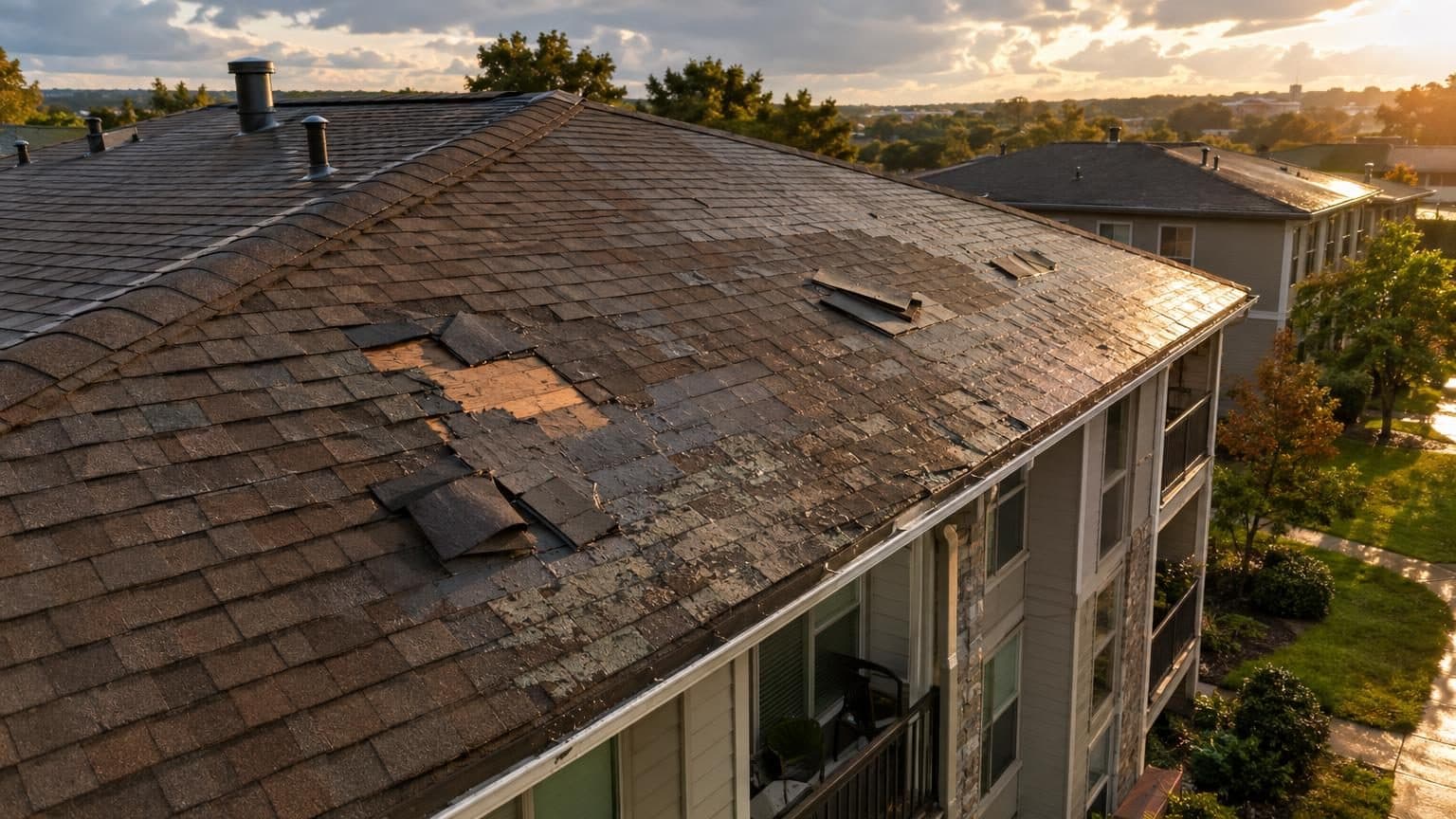
Most hail and wind claims on apartment and commercial buildings that get cut or denied come down to the policy's own terms: exclusions for wear and tear and poor maintenance, coverage only for damage that begins during the policy period, notice and proof duties, deductibles, and roof terms such as actual cash value and cosmetic damage exclusions. The disputes usually turn on one question: was this storm damage, or age and wear that was already there? A record of the roof's age, maintenance and condition before the storm is what answers it.
Cloudbreak team · Updated October 28, 2026 · 7 min read · 12 sources
Common reasons at a glance
| Reason | What it means | Where it's written |
|---|---|---|
| Wear and tear | Wear and tear, deterioration, latent defects and faulty maintenance are excluded | CP 10 30, exclusions B.2.d and B.3.c |
| Damage from before the policy | Only loss or damage that begins during the policy period is covered | CP 00 90 (July 1988), condition H |
| Late notice | Prompt notice is required | CP 00 10, loss condition E.3 |
| Cosmetic damage | Marring or pitting that leaves the roof keeping out the elements is not paid | CP 10 36, paragraph B |
| Deductible above the loss | Nothing is paid if the loss is at or below the deductible | CP 00 10, section D; CP 03 21 |
| Roof at actual cash value | Roof surfacing is valued at actual cash value, even under replacement cost | CP 10 36, paragraph A |
| Replacement cost not yet due | Replacement cost is not paid until the property is actually repaired or replaced, as soon as reasonably possible | CP 00 10, optional coverage G.3.d |
| Rain inside the building | Not paid unless a covered cause first damages the roof or walls | CP 10 30, limitation C.1.c |
| Slow leaks | Continuous or repeated seepage or leakage of water over 14 days or more is excluded | CP 10 30, exclusion B.2.f |
| Further damage after the storm | Reasonable steps to protect the property are required | CP 00 10, E.3.a(4); CP 10 30, B.2.m |
| Missing proof | Inspections, records, samples and a sworn proof of loss within 60 days of a request | CP 00 10, loss condition E.3 |
Wear, tear and deterioration
Property insurance pays for sudden damage, not for a building getting old. Most special form commercial policies exclude wear and tear, so the most common fight after a storm is over whether the damage came from the storm or was already there.
The standard ISO special causes of loss form does not pay for wear and tear; rust or other corrosion, decay, deterioration, or hidden or latent defect; settling, cracking, shrinking or expansion; or faulty, inadequate or defective maintenance. If one of these leads to a covered cause of loss, such as windstorm or hail, the damage from that cause is still paid.1
On composition shingles, rule out other causes before assuming hail: cupped or curled edges and craze cracks or splits as weathered asphalt shrinks, blisters, and diagonal patterns that generally come from a manufacturing defect. Hail leaves random strike marks with a bruise in the mat, and granule loss alone does not prove hail.6
Damage from before the policy or the storm
A policy covers only damage that begins while it is in force. Hail from an earlier storm, or from before the owner bought the policy, is not covered by the current one.3
Forensic engineers can date hail by comparing surfaces of known age. In one Nelson Forensics case, metal items installed about 6 to 8 years before the site visits lacked the hail dents found elsewhere, and condenser coils on units made within about 10 years had dents about 1/4 inch wide against up to 1 inch on older units; the damaging hail came before the period in question.7
Late notice
The ISO building form asks for prompt notice and, as soon as possible, how, when and where the damage occurred. It sets no number of days, so a long gap between the storm and the report invites the question of what happened in between.2
A policyholder who settles at actual cash value first must give notice within 180 days after the loss to claim replacement cost later.2
Cosmetic damage exclusions
Paragraph B of ISO endorsement CP 10 36 excludes cosmetic wind or hail damage to roof surfacing (shingles, tiles, metal or synthetic sheeting, moisture protection and flashing): marring, pitting or other superficial damage that does not stop the roof from keeping out the elements as before. It applies only to buildings listed in its schedule.4
Wind and hail deductibles larger than the damage
A loss at or below the deductible gets no payment; otherwise the deductible is subtracted. A percentage deductible makes this common, because it grows with the building's value, not with the damage.
ISO's windstorm or hail percentage deductible (CP 03 21) is 1%, 2% or 5% of each damaged building's limit or, under blanket insurance, of its value on the latest statement of values, figured separately per building.5
Actual cash value roofs
Actual cash value is replacement cost minus depreciation, the loss in value from age and wear. An older roof settled this way pays well under the cost of a new one.
The ISO building form generally values property at actual cash value unless replacement cost is added as an optional coverage, and paragraph A of CP 10 36 puts roof surfacing on listed buildings back at actual cash value even when the rest of the building is at replacement cost.2,4
In arithmetic: a roof worth 75% of a new one before the storm gets 75% of the repair cost, less the deductible.6
Proof and inspections the insurer may require
A claim can also be cut or denied when the owner doesn't meet the policy's duties after a loss. The ISO building form's duties include:
- Inventories of damaged and undamaged property on request.2
- Inspection of the property and of books and records, and samples for testing.2
- A signed, sworn proof of loss within 60 days after the insurer asks.2
- Cooperation with the investigation, and examination under oath.2
Keep copies of every document you send and receive, and ask the insurer to show the policy language it is using to settle the claim. ISO's common policy conditions also let the insurer make inspections and surveys at any time.8
Protecting the property after the storm
The ISO building form requires all reasonable steps to protect the property from further damage, with a record of the expenses; later damage from an uncovered cause is not paid. The special causes of loss form separately excludes neglect to use all reasonable means to save and preserve property at and after the time of loss.1,2
In practice: make temporary repairs to stop more damage, save the receipts, and hold off on permanent repairs until the adjuster has seen the damage.
Records that show condition before a storm
RICOWI's roof survey guide, published by IBHS, aims to tell natural aging and normal wear from storm damage. Before a survey it gathers:9
- Age of the roof covering, and the reason for a new roof if it is not original.9
- Manufacturer and warranty information.9
- Maintenance history, building history and known issues such as leaks.9
- How the roof performed in earlier weather events.9
- Building permits and aerial photos.9
The survey then compares what it finds to those earlier records, if they exist, to separate damage from weathering. Forensic engineers do the same with historical aerial imagery and the known ages of roofs and equipment to bound when dents formed, and Nelson Forensics notes that hail burnish marks fade as surfaces weather, so evidence from a past storm gets harder to read with time.9,7
Texas rules
- In Texas, an insurer has 15 days after notice of a claim (30 business days for surplus lines) to acknowledge it, start investigating and request the items and forms it expects to need, and may ask for more later.10
- In Texas, an insurer must accept or reject a claim in writing within 15 business days after it receives everything it asked for, and a rejection must state the reasons. If it needs more time, it must say why within that time and decide within 45 days of that notice. TDI can add 15 days after a disaster.10,11
- In Texas, a TWIA policyholder must file a claim within one year of the date the damage occurs (Texas Insurance Code 2210.573). The insurance commissioner can extend that by up to 180 days for good cause.12
How Cloudbreak helps
Pre-loss documentation
A dated record of every roof section, elevation and rooftop unit, in photos, drone video and notes, with original files and timestamps intact.
Storm monitoring
Our proprietary predictive storm engine, built with AI and backed by meteorologists, watches every building against its own roof-based thresholds; our on-call team picks up urgent matches within 15 minutes, day or night.
Policy review
Your deductibles, limits, exclusions and roof endorsements read against each property, with questions for your broker; a licensed broker approves every report.
Questions
- Why do storm damage insurance claims on apartment buildings get denied or reduced?
- Most often because of terms in the policy itself: wear and tear exclusions, damage from before the policy period, late notice, deductibles above the loss, and actual cash value or cosmetic damage terms for roofs.
- Why was my roof claim denied for wear and tear?
- Most commercial property policies, including the ISO special form, exclude wear and tear, deterioration, latent defects and faulty maintenance. The insurer is saying the damage came from age or upkeep, not the storm. Records of the roof's condition before the storm are the usual answer. In Texas, a written rejection must state the reasons.1,10
- Can a hail damage claim pay nothing because of the deductible?
- Yes. Under the ISO building form nothing is paid when the loss is at or below the deductible. Under ISO's windstorm or hail percentage deductible endorsement, a 1%, 2% or 5% deductible is figured separately for each damaged building.2,5
- Does insurance cover storm damage from before the policy started?
- No. A policy covers only loss or damage that begins during its policy period.

Cloudbreak
The owner-side property protection team for commercial and multifamily owners in storm country: a dated record of every building, nightly storm checks and a review of your policy, before a loss.
Sources
Written by the Cloudbreak team. Numbers, dates and rules cite the published sources below.
- 1. Insurance Services Office (copy hosted by Independent Insurance Agents of Texas): Causes of Loss, Special Form, CP 10 30 10 12
- 2. Insurance Services Office (copy hosted by Independent Insurance Agents of Texas): Building and Personal Property Coverage Form, CP 00 10 10 12
- 3. Insurance Services Office (insurer-hosted copy): Commercial Property Conditions, CP 00 90 07 88
- 4. Insurance Services Office (copy hosted by Independent Insurance Agents of Texas): Limitations on Coverage for Roof Surfacing, CP 10 36 10 12
- 5. Insurance Services Office (copy hosted by Independent Insurance Agents of Texas): Windstorm or Hail Percentage Deductible, CP 03 21 10 12
- 6. Nebraska Department of Insurance: Hail Damage (revised January 2019)
- 7. Nelson Forensics (author copy of a paper from the ASCE Forensic Engineering 9th Congress): Dating Hail: Investigation and Determination of the Date of Occurrence of Hail Impact Damage (Verhulst, Bosley and Donaldson, Nelson Forensics, November 2022)
- 8. Insurance Services Office (copy hosted by Independent Insurance Agents of Texas): Common Policy Conditions, IL 00 17 11 98
- 9. Insurance Institute for Business and Home Safety: RICOWI Roof Guide: Survey Practices
- 10. Texas Legislature: Texas Insurance Code Chapter 542, Processing and Settlement of Claims (sections 542.055 and 542.056)
- 11. Texas Department of Insurance: Consumer rights for commercial property insurance
- 12. Texas Legislature: Texas Insurance Code Chapter 2210, Texas Windstorm Insurance Association (sections 2210.205 and 2210.573)