Hail damage or wear and tear on a commercial roof
Short answer
Hail leaves a recognizable signature: impacts scattered at random, fresh fractures or bruises at those impacts, and matching dents and spatter marks on nearby metal. Foot traffic, blisters, weathering and installation flaws leave different patterns. Old hail marks weather and fade, so the freshness of each mark and dated records of the roof's earlier condition show which storm, if any, caused the damage. Weather records show hail reported or estimated near a site, not what struck a given roof.
Cloudbreak team · Updated October 27, 2026 · 6 min read · 14 sources
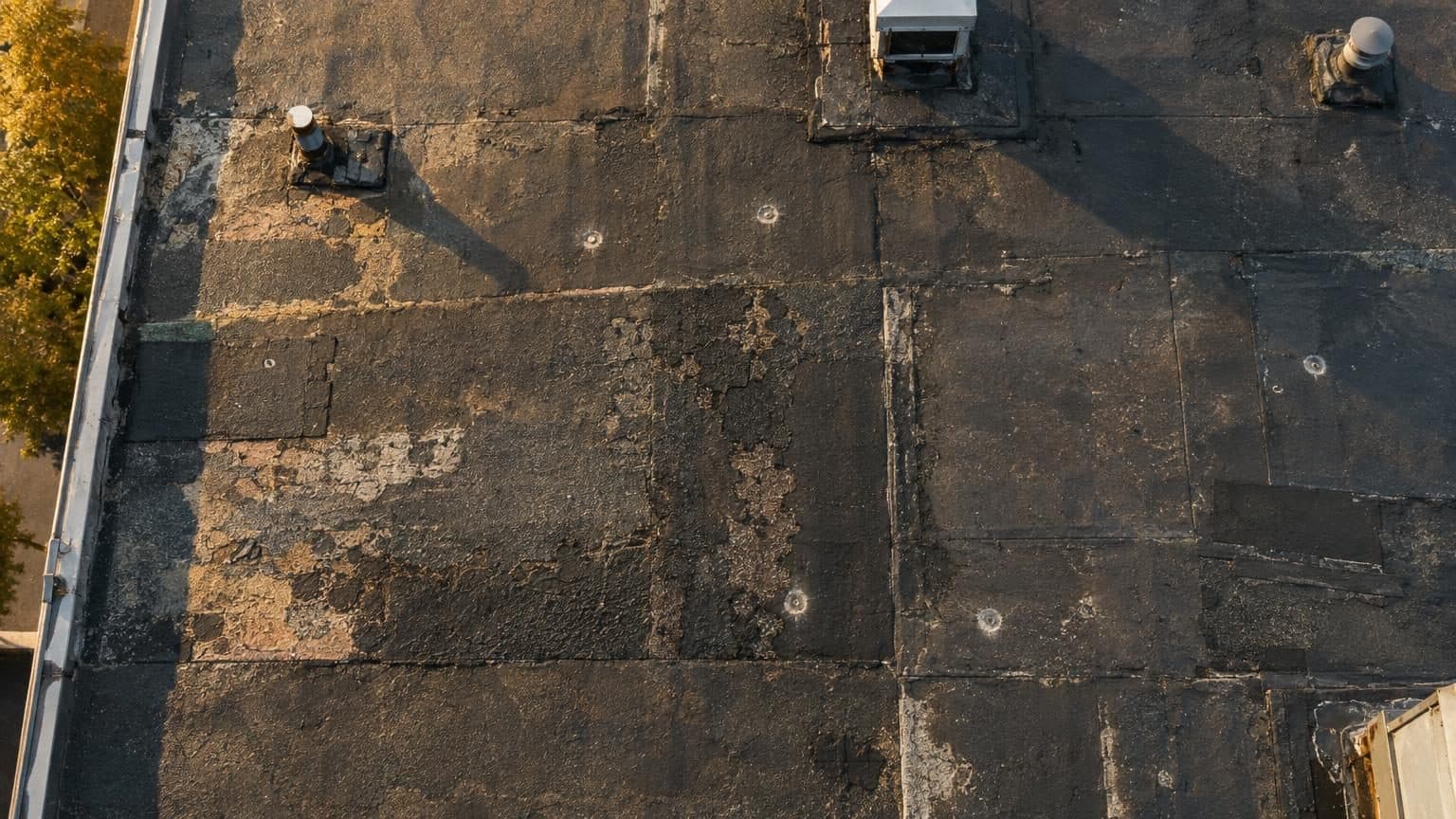
What inspectors look for on any roof
Hail damage is functional when it reduces the roof's weather resistance or shortens its expected service life. An inspector reads the whole roof and the metal around it, not one mark.
- Pattern: hail falls in random patterns, with its main direction set by the wind.
- Spatter marks: hail cleans grime off surfaces, leaving marks that show hail size and direction. They typically last about a year, depending on exposure and climate.1
- Metal: metal keeps a lasting record of every hailstorm it has been through. In aluminum fins of air-conditioning units, a dent's width is typically 80% of the hailstone's diameter.1
- Test areas: a common steep-roof protocol examines a marked area on each slope, away from trees and foot traffic, marking hail X, foot traffic F and weathering W.2
- Samples: on low-slope roofs, cut samples show the underside, where impact fractures start; labs can dissolve the bitumen or backlight thermoplastic membranes.
Hail marks and look-alikes by roof type
| Roof | Hail damage | Often mistaken for hail |
|---|---|---|
| Asphalt shingles | Bruise or fracture under roughly circular granule loss; freshly exposed asphalt is shiny black | Scuffs with a ridge of asphalt and granules at the edge; factory flaws in columns; steep-sided blister pits; gray flaking |
| Built-up | Fresh black bitumen where the flood coat and gravel were knocked out; broken felts that feel soft and show on the underside | Mopping voids (air pockets trapped between plies) that can feel soft; top-felt dents from construction traffic |
| Modified bitumen | Soft spots; concentric fractures on top, star-shaped beneath | Installation traffic marks; granule loss with more granules just below, not counted as damage |
| TPO and PVC | Crescent cuts 1/16 to 1 inch long at stress plates; fractures that line up with spatter marks | Older hail fractures: rounder, darker, wider, with no matching spatter mark |
| Metal panels | Widespread random round dents in light-gauge panels; ruptures or opened laps | Dents from other impacts |
| Rooftop units | Dented condenser coil fins, which deform from even minor impact | Fin damage from earlier storms, sorted out by comparing units of different ages and exposures |
| Tile and slate | Fractures radiating from one impact point | Near-straight fractures from foot traffic |
Mopping voids are common enough to matter: engineers found them in 51.5% of more than 1,200 hot-mopped membrane samples sent to their lab, and cores with lab delamination tell voids from hail.6
Age, foot traffic and earlier storms
Age lowers hail resistance. In FM Global's examples, a 20-year-old alligatored built-up roof was damaged by 1-inch (25 mm) hail, and a 15-year-old single-ply roof was fractured by about 1.75-inch (44 mm) hail while 10-year-old areas of the same construction were not.8
FM Global puts the average life of most single-ply and multi-ply roof covers at 14 to 18 years.8
To separate storms, compare surfaces that take both a dent and a spatter mark: a dent with a matching spatter mark points to recent hail, and a dent without one to an earlier storm.
Build dates bound the hail too. In one case, metal buildings built by late 2003 had hail dents and those built from late 2005 did not, dating the hail to 2003 to 2005; the build dates came from aerial imagery.5
Marks fade at different rates. At a site hit in April 2016 and April 2018, the 2016 marks had not significantly faded on cap flashing by August 2018 but were faded or gone on other surfaces.5
Records of the roof's earlier condition
Because marks fade, inspect soon after hail. Dated records help show when damage formed:
- Installation dates of roofs and rooftop equipment, which bound when dents formed.
- Historical aerial imagery.
- Written or digital inspection records with pictures of problem areas, from inspections at least twice a year and before and after severe storms.
Limiting foot traffic, particularly on membrane roofs, also keeps traffic marks from muddying the picture.
What weather records show and don't
NOAA's Storm Events Database holds National Weather Service Storm Data from January 1950, and NCEI certifies reports on request.9
Hail reports give approximate locations and sizes, and a spotter report rarely falls at the building in question. Where few people live, hail may go unreported, and sizes judged against everyday objects can be too high or too low.
The radar estimate MESH uses a grid of about 0.6 mile (1 km), and its original formula was designed to overestimate so that 75% of observed hail sizes fall below it. It also tends to underestimate hail in some storms, such as highly tilted ones.10,11
Commercial weather reports combine observations, radar and proprietary algorithms; they estimate hail rather than confirm it, and vendors can differ.
After the April 11, 2016 North Texas storm, RICOWI found extensive damage at an apartment complex in Sachse but minimal to none at an apartment complex 0.5 to 0.75 mile away in Wylie. In Little Elm, at the center of a hail map's largest ring of 1.5 to 1.75 inch hail, its team found spatter marks of 0.25 to 0.5 inch and no damage.12
So on-site evidence is the most reliable data, and weather data supports it.
Policy wording
The ISO special causes of loss form (CP 10 30, September 2017 edition) excludes wear and tear, deterioration and latent defects.13
The same form does not pay for rain damage inside a building unless a covered cause first damages the roof or walls the rain enters through.13
Ask the insurer to show the policy language it is using to settle the claim, and keep copies of all documents. Which coverage form a policy uses, basic, broad or special, and what it excludes are questions for a licensed broker or agent.
Texas rules
In Texas, an insurer must accept or reject a claim in writing within 15 business days after receiving everything it requires to secure final proof of loss, and a rejection must state the reasons.14
If it needs more time, it must say why within that period and decide within 45 days of that notice. After a weather-related catastrophe or major natural disaster, as defined by the commissioner, these deadlines extend by 15 days.14
In Texas, a property insurer must provide, within 30 days of a policyholder's written request, a list of claims charged against the policy and payments made on each.14
How Cloudbreak helps
Pre-loss documentation
A dated record of every roof section, elevation and rooftop unit, in photos, drone video and notes, with original files and timestamps intact.
Storm monitoring
Our proprietary predictive storm engine, built with AI and backed by meteorologists, watches every building against its own roof-based thresholds; our on-call team picks up urgent matches within 15 minutes, day or night.
Policy review
Your deductibles, limits, exclusions and roof endorsements read against each property, with questions for your broker; a licensed broker approves every report.
Questions
- How do insurance adjusters decide if roof damage is from hail or just age?
- Engineers compare the marks with how hail behaves: random impacts, fresh fractures or bruises, and matching dents and spatter marks on metal. Old fractures have rounded, weathered edges.
- How do I prove hail damage on a commercial roof wasn't pre-existing?
- Show how fresh each mark is and bring dated evidence: installation dates, aerial imagery, inspection records with pictures and weather data. A dent with a matching spatter mark points to recent hail.
- Our insurer says the roof damage on our apartment complex is wear and tear, not hail. What can we do?
- Cause turns on evidence: mark patterns and freshness, sample results, records of the roof's earlier condition and weather data. In Texas, an insurer that rejects a claim must state its reasons in writing.14
Cloudbreak
The owner-side property protection team for commercial and multifamily owners in storm country: a dated record of every building, nightly storm checks and a review of your policy, before a loss.
Sources
Written by the Cloudbreak team. Numbers, dates and rules cite the published sources below.
- 1. Professional Roofing, NRCA: Learn how to identify hail damage on roof systems (Scott J. Morrison, Haag Engineering, May 2009)
- 2. North American Conference on Roofing Technology, NRCA: Protocol for Assessment of Hail-Damaged Roofing (Haag Engineering, 1999)
- 3. Professional Roofing, NRCA: Holy hail! Learn how to identify hail damage on low-slope roof systems (Scott J. Morrison, Haag Engineering, June 2009)
- 4. Haag Engineering: Identifying Hail-Caused Fractures in Thermoplastic Roofing (Steve R. Smith, February 5, 2018)
- 5. ASCE Forensic Engineering 9th Congress: Dating Hail: Investigation and Determination of the Date of Occurrence of Hail Impact Damage (Verhulst, Bosley and Donaldson, Nelson Forensics, November 2022)
- 6. Nelson Forensics: Hail Evaluation of Bituminous Roofing Membranes: Understanding Interply Mopping Voids (Donaldson, DeLeon and Verhulst)
- 7. IIBEC Interface: Testing Built-up and Modified Bitumen Roofs for Hail Damage (Roof Technical Services, July 2022)
- 8. FM Global: Property Loss Prevention Data Sheet 1-34: Hail Damage (March 2018 edition, revised April 2026)
- 9. NOAA National Centers for Environmental Information: Storm Events Database
- 10. Weather and Forecasting, American Meteorological Society: An Hourly Climatology of Operational MRMS MESH-Diagnosed Severe and Significant Hail with Comparisons to Storm Data Hail Reports (Wendt and Jirak, February 24, 2021)
- 11. NOAA NWS Warning Decision Training Division: Maximum Estimated Size of Hail (MESH)
- 12. RICOWI: Hailstorm Investigation Report: North Texas, April 11, 2016
- 13. Insurance Services Office (ISO): Causes of Loss: Special Form, CP 10 30 09 17
- 14. Texas Legislature: Texas Insurance Code Chapter 542: Processing and Settlement of Claims