Cosmetic damage exclusions and hail damage to rooftop HVAC
Short answer
A cosmetic damage exclusion removes coverage for wind or hail damage that only changes how roof surfacing looks, such as marring or pitting, while the roof still keeps out the elements as well as before. In ISO's commercial version, CP 10 36, it applies only to buildings marked in the schedule, and roof surfacing means the covering, what secures it, moisture protection and flashing, with no mention of rooftop HVAC units.1 Whether hail damage to rooftop HVAC is paid turns on the policy's covered property, causes of loss, exclusions, endorsements and deductible. Fin dents matter less than they look: in lab tests on two residential-type condensers, dented fins cut cooling capacity little until about 60% of the fin area was flattened.2,3
Cloudbreak team · Updated October 27, 2026 · 5 min read · 11 sources
What the ISO cosmetic damage exclusion says
- Paragraph A: replacement cost does not apply to roof surfacing, which is valued at actual cash value for any covered cause of loss.1
- Paragraph B: "We will not pay for cosmetic damage to roof surfacing caused by wind and/or hail."1
- Cosmetic damage: marring, pitting or other superficial damage that altered the roof surfacing's appearance but does not prevent the roof from continuing to function as a barrier to the elements to the same extent as before.1
- Roof surfacing: shingles, tiles, cladding, metal or synthetic sheeting or similar materials, plus the materials securing them, moisture protection applied to or under them, and roof flashing.1
The CP 10 36 schedule lists each premises and building and marks Paragraph A, B or both. The cosmetic option applies only to wind and hail, and both options can apply to the same building. Many insurers write their own versions with different definitions, so the policy's own wording is what counts.1
Cosmetic versus functional damage on metal roofs
Metal roofs usually come through hail without functional damage but can be permanently dented, which is where the exclusion matters most. Aesthetic damage affects appearance but not performance; functional damage reduces water shedding and expected service life. A 2005 U.S. Steel technical bulletin on coated sheet steel roofing draws the line this way.4
In North Texas after April 11, 2016, 11 of 13 steep-slope metal roofs had dents but no fractures or opened seams, which RICOWI considered cosmetic only; one roof hit by 3 to 3.5 inch hail had distorted seams.5
How hail damages rooftop HVAC units
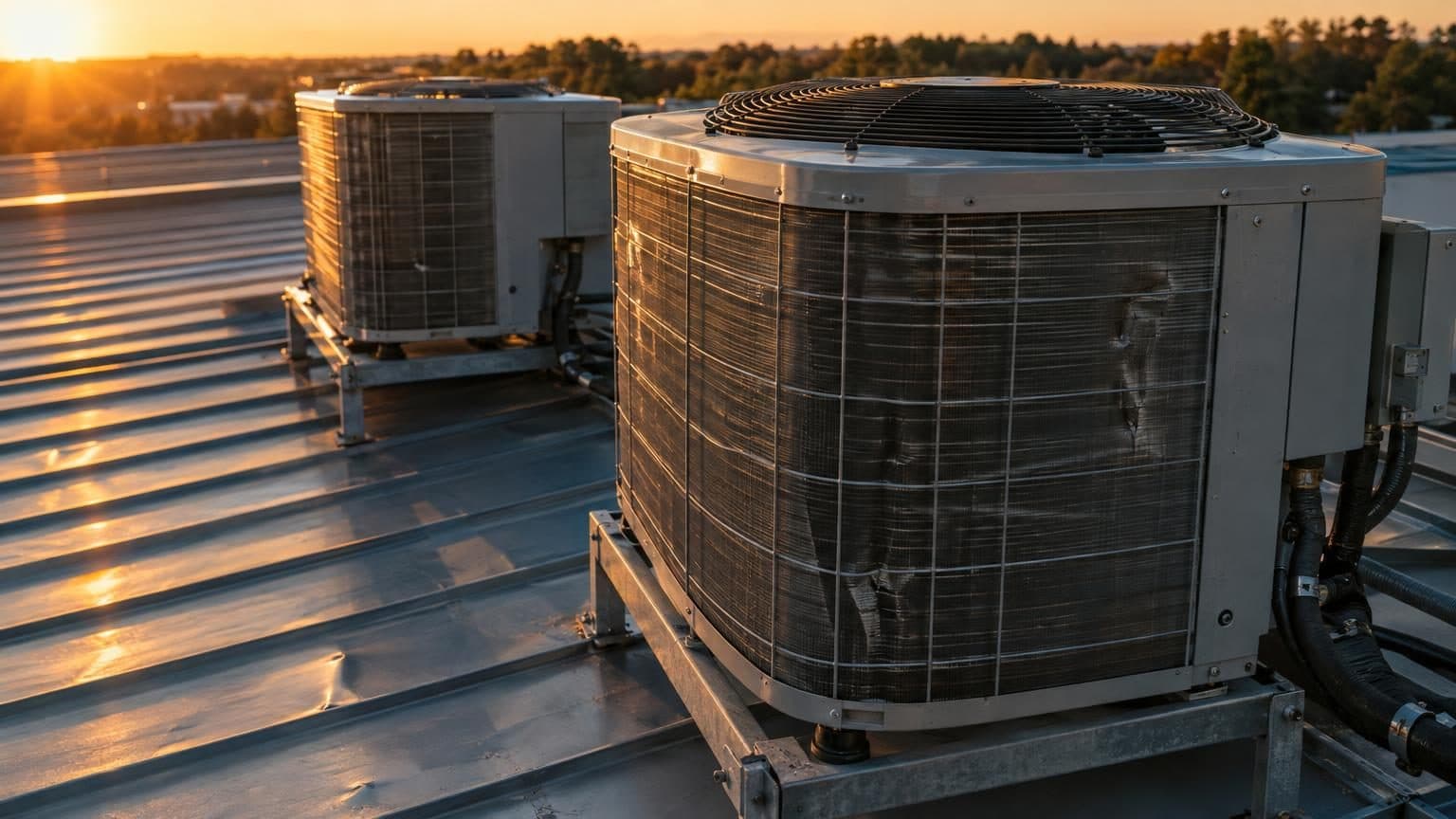
Condenser coils and cooling fins dent easily, even in small hail. In FM Global's loss history, most hail damage is to roofs, followed by rooftop HVAC fins and coils, and then skylights.6
Equipment commonly hit includes condenser coils and fan blades on rooftop units and air-cooled chillers, cooling tower fill, and rooftop exhaust fans.
What dented fins do to cooling performance
| Fin area flattened | Cooling capacity | Efficiency (SEER) |
|---|---|---|
| 41% to 45%, dents over the whole coil | Little to no change | Down 2% and 5% |
| 60%, columns folded flat | Down about 4% | Down 9% (one unit) |
| 100% | Down 23% and 27% | Down 34% |
| 100%, then combed | Within 1% and 4% of undented | Within 4% and 6% of undented |
Lab dents do not fully match field conditions, and wind-borne debris and brushing objects also dent fins, so a dented coil alone does not show when or how the damage happened.
What decides whether HVAC hail damage is paid
In ISO's building and personal property form CP 00 10, Building includes fixtures, including outdoor fixtures, and permanently installed machinery and equipment.7
Basic form policies usually list hail as a covered cause. Special form policies cover every cause the policy does not exclude, and most exclude wear and tear.
ISO's special form CP 10 30 excludes, with stated exceptions, wear and tear; rust, corrosion and deterioration; and mechanical breakdown.8
Equipment breakdown coverage, also called boiler and machinery coverage, covers air conditioning units and similar machinery and is usually sold for an extra cost.
- Items to confirm with a licensed agent or broker: whether CP 10 36 or an insurer version is attached, and which buildings and paragraphs its schedule marks.1
- How the policy defines cosmetic damage and the property it applies to, since insurer versions vary.
- Whether rooftop equipment is insured as Building, and which causes of loss form applies.
- Which deductible applies to wind and hail, such as ISO's CP 03 21 windstorm or hail percentage deductible, which is listed for use in Texas.9
Records that show equipment condition
Under CP 00 10, the insured must let the insurer inspect the property proving the loss, examine books and records, and take samples of damaged and undamaged property, and must give complete inventories of damaged and undamaged property on request. The insured must also take reasonable steps to protect property from further damage and keep a record of those expenses.7
ANSI/ASHRAE/ACCA Standard 180-2018 sets minimum HVAC inspection and maintenance practice for commercial buildings. It excludes single-family houses and multifamily buildings of three or fewer stories, and compliance is voluntary unless a jurisdiction makes it mandatory. It makes the building owner responsible and calls for:10
- An equipment inventory with manufacturer information, location and capacity.10
- Documented condition, including visual appearance and working order, tracked over time as a condition history.10
- Documentation of each inspection and maintenance task, archived for future reference.10
- Documentation of degraded condition or performance, whether found in scheduled work or on other occasions.10
Inspectors use hail spatter on HVAC units to judge hail size and direction and measure dents in steel ductwork. Fin damage can differ sharply from one side of a unit to another, so photos of every side help.
Where the exclusion is approved
The cosmetic exclusion is not approved in every state because of conflicting state laws, Insurance Journal columnist Bill Wilson wrote on September 7, 2026.11
An FC&S forms list dated July 26, 2024 shows CP 10 36 10 12 for Texas and 44 other jurisdictions, but not for Connecticut, Florida, Hawaii, Indiana, Massachusetts, Missouri, New Hampshire, West Virginia or Wyoming.9
How Cloudbreak helps
Policy review
Your deductibles, limits, exclusions and roof endorsements read against each property, with questions for your broker; a licensed broker approves every report.
Pre-loss documentation
A dated record of every roof section, elevation and rooftop unit, in photos, drone video and notes, with original files and timestamps intact.
Storm monitoring
Our proprietary predictive storm engine, built with AI and backed by meteorologists, watches every building against its own roof-based thresholds; our on-call team picks up urgent matches within 15 minutes, day or night.
Questions
- What does a cosmetic damage exclusion mean on a commercial property policy?
- The insurer will not pay for wind or hail damage that only alters how roof surfacing looks, if the roof still keeps out the elements as well as before. ISO's CP 10 36 applies it only to buildings marked for Paragraph B.1
- Hail damaged the rooftop HVAC units on our building. Is that covered by insurance?
- The policy wording decides it. ISO's CP 00 10 treats permanently installed equipment as Building. Basic form policies usually cover hail and special form policies cover all causes not excluded; ISO's special form excludes, with stated exceptions, wear and tear, deterioration and mechanical breakdown. Endorsements, insurer versions and the deductible also affect what is paid.7,8
- Does a cosmetic damage exclusion apply to rooftop HVAC units?
- ISO's CP 10 36 applies to roof surfacing: the roof covering, the materials securing it, moisture protection and flashing. It does not name HVAC units. Insurer versions can define the property differently.1,11
- Are cosmetic damage exclusions allowed in Texas?
- An FC&S list dated July 26, 2024 shows ISO's CP 10 36 for use in Texas.9

Cloudbreak
The owner-side property protection team for commercial and multifamily owners in storm country: a dated record of every building, nightly storm checks and a review of your policy, before a loss.
Sources
Written by the Cloudbreak team. Numbers, dates and rules cite the published sources below.
- 1. Insurance Services Office: CP 10 36 10 12: Limitations on Coverage for Roof Surfacing (ISO form, Rockford Mutual copy)
- 2. ASHRAE Transactions, via Free Online Library: Effect of Dents in Condenser Fins on Air-Conditioner Performance (Sitzmann, Smith and Lu, 2010)
- 3. ASME: Hail Effects on Air-Conditioner Performance (Sitzmann, Lu and Smith, IMECE2007-41518)
- 4. U.S. Steel: Hail Damage on Coated Sheet Steel Roofing, Technical Bulletin (2005)
- 5. RICOWI: Hailstorm Investigation Report: North Texas, April 11, 2016
- 6. FM Global: Property Loss Prevention Data Sheet 1-34: Hail Damage (March 2018 edition, revised April 2026)
- 7. Insurance Services Office, hosted by Independent Insurance Agents of Texas: CP 00 10 10 12: Building and Personal Property Coverage Form (ISO form)
- 8. Insurance Services Office, hosted by New York State Office of General Services: CP 10 30 09 17: Causes of Loss, Special Form (ISO sample form)
- 9. FC&S, PropertyCasualty360: ISO Commercial Property Forms List (July 26, 2024)
- 10. ASHRAE: ANSI/ASHRAE/ACCA Standard 180-2018: Standard Practice for Inspection and Maintenance of Commercial Building HVAC Systems (preview)
- 11. Insurance Journal: Beware These Commercial Property Endorsements! (Bill Wilson, September 7, 2026)