What size hail damages a roof? Commercial roofs by type
Short answer
Most roof materials start to show hail damage between 1.25 and 2 inches (32 to 51 mm), RICOWI found in its field surveys after the May 24, 2011 and April 11, 2016 hailstorms in North Texas.1,2 Hail under 1 inch (25 mm) did almost no damage in the 2011 survey, except to badly deteriorated or unsupported material.1 Between 1 and 2 inches, the result depends on the material, its age, the slope and what supports it: membranes over low-strength boards were damaged most often, metal mostly dented, and built-up roofs with loose and embedded aggregate and unreinforced EPDM have resisted hail over 2 inches.1,2
Cloudbreak team · Updated October 28, 2026 · 7 min read · 14 sources
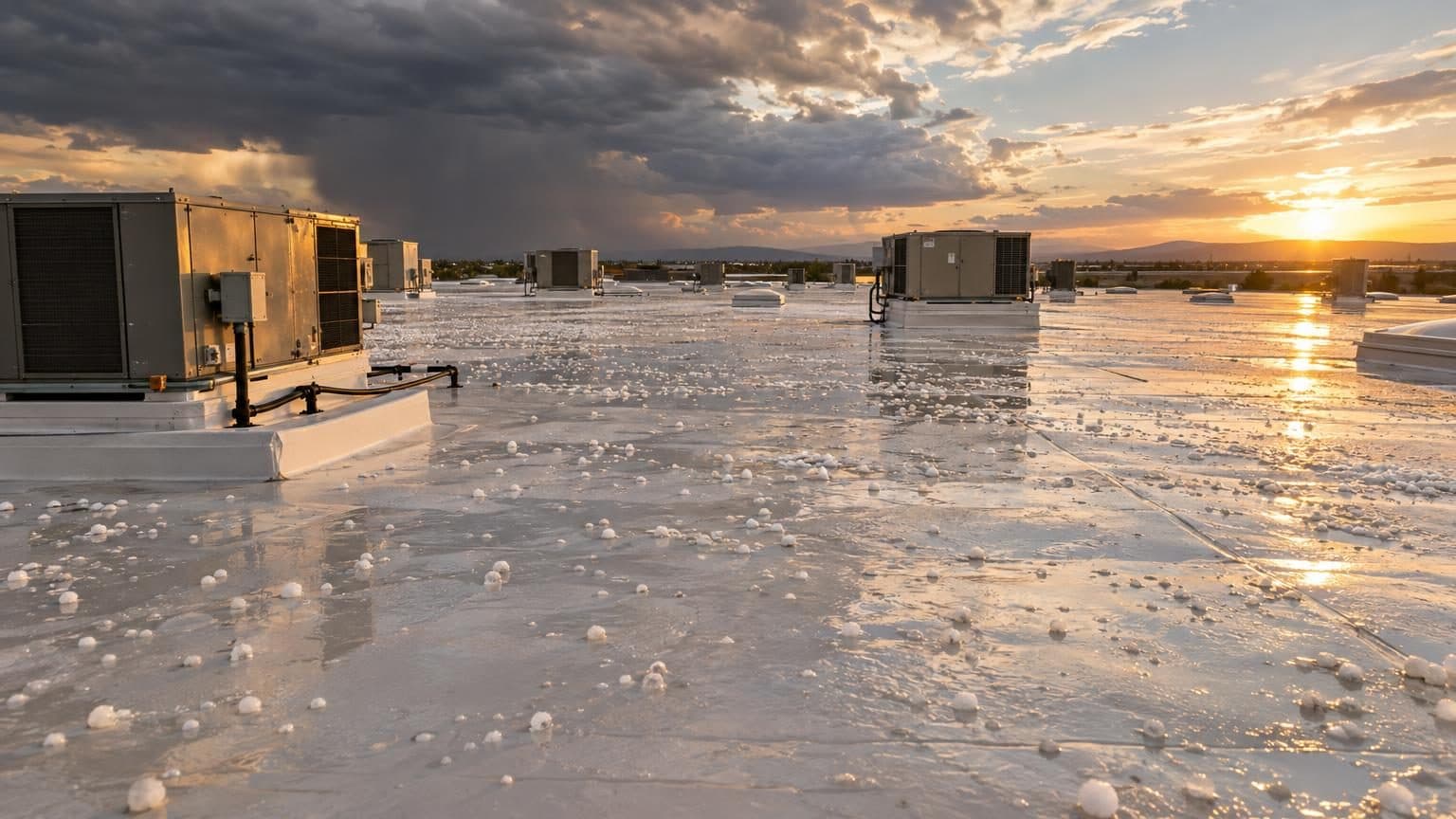
Hail size where damage started, by roof type
| Roof type | Where damage started | What moved it |
|---|---|---|
| Asphalt shingles | 1 in. (25 mm) for 3-tab, 1.25 in. (32 mm) for laminated | Unsupported ridges, hips and valleys; impact-rated shingles did better; age mattered in 2011 but not in 2016 |
| Modified bitumen | 1.5 in. (38 mm) over standard foam insulation; 1.25 in. on one poorly supported roof | Low-strength board directly below; age over 10 years |
| Built-up | 2.5 in. (64 mm) for gravel-surfaced roofs in Haag field surveys; moderate damage on 3 aggregate roofs hit by 1.5 in. or larger hail in 2016; 1 in. on one 20-year-old alligatored roof | Gravel and a hard deck raised it; brittleness lowered it |
| TPO and PVC | Few single-ply roofs failed below 1.5 in. (38 mm); two aged thermoplastic roofs fractured at fastener plates in 1.25 to 1.5 in. hail | Age, fastener plates, membrane thickness |
| EPDM | No punctures or fractures on 3 roofs hit by 1 to 3 in. (25 to 76 mm) hail in 2016; unreinforced EPDM has resisted hail over 2 in. (51 mm) | Aggregate ballast, especially No. 4 aggregate |
| Metal panels | Dents only up to 2 in. (51 mm); seam distortion at 2.5 in. and up; no fractures | Steel thickness and yield strength |
What the research found for each roof type
Membrane thickness and age matter. FM Global shows a 0.045 inch (1.1 mm) single-ply membrane over polyisocyanurate insulation that hail cut throughout, while a reportedly thicker membrane on the adjacent roof was not damaged; the cut membrane was also reportedly 15 years old.3
Fastener plates are a weak spot. Researchers at GAF, a roofing manufacturer, reported ice-ball tests in June 2016 using one brand of each material and two 2-inch hits per spot: new TPO passed in the field of the sheet but failed at every thickness when hit over a fastener plate.6
PVC grows more vulnerable as plasticizer leaves it: one supplier's stiff 3-year-old membranes fractured under hail smaller than 1 inch, while another's supple 8-year-old membrane came through 2-inch hail.7
Unreinforced EPDM holds up well. In tests commissioned by the EPDM Roofing Association, an industry group, on samples from two EPDM makers, 76 of 81 new and aged 60-mil (1.5 mm) unreinforced EPDM samples did not split under ice balls up to 3 inches.8
Modified bitumen laid directly over low-strength insulation was the system most prone to leak-causing damage in all three RICOWI hail investigations.2
In 2011, no leaks were found under metal panels even with moderate to severe denting; in 2016, one low-slope metal roof hit by 3.5-inch (89 mm) hail had dented panels, bent seams and leaks.1,2
What raises or lowers the threshold
- Age: roofs turn brittle as they age. In FM Global's example, a 15-year-old single-ply roof fractured in about 1.75-inch (44 mm) hail while 10-year-old areas of the same construction did not. RICOWI's 2016 survey found shingle damage not strongly tied to age, unlike its earlier surveys.3,2
- Support below: in 2016, over 43% of membranes over low-strength boards had significant damage, while 25% of those over high-strength boards had damage.2
- Cover board: in GAF's tests, 2-inch ice balls crushed standard polyisocyanurate about 0.5 inch (13 mm) deep and shattered gypsum cover board cores, while high-density polyisocyanurate held up better and 80-mil fleece-back TPO over it showed no damage. In the field, membranes over high-strength boards, gypsum included, performed well.6,2
- Wind: in an idealized IBHS calculation, an assumed constant 60 mph horizontal wind gave many 1 to 1.25 inch stones energy approaching a Class 2 test ball, and damage in the Texas surveys concentrated on windward slopes.9,1,2
- Quantity: in 2011, size mattered more than count; in 2016, large amounts of 1.25 to 1.75 inch hail damaged virtually every shingle on the windward sides of some roofs.1,2
How roofs are rated for hail
| Test | What hits the sample | Ratings |
|---|---|---|
| UL 2218 (steep slope) | Steel balls of 1.25, 1.5, 1.75 and 2 in., dropped to match the energy of hail that size, two hits per spot | Class 1 to 4 |
| FM 4473, 2005 edition (rigid tiles and planks) | Ice balls of 1.25 to 2 in. at free-fall energy, two hits per spot, new material only | Class 1 to 4 |
| FM 4470 (membrane roof assemblies) | 2 in. steel ball dropped 81 in. (8 ft-lb) or 141.5 in. (14 ft-lb) | Moderate (MH), Severe (SH) |
| FM 4470 VSH | 2 in. ice ball at 152 to 160 ft/s (53 to 58 ft-lb) | Very Severe (VSH) |
FM Approvals described these FM 4470 tests on October 18, 2018: MH and SH use one new and one UV-weathered sample, VSH adds a sample that is UV-weathered and heat-aged, and VSH energy equals a hailstone up to 2.5 inches (64 mm).10
UL 2218 applies to steep-slope coverings and fails a shingle only for openings visible on its back, not for dents or crushed granules. UL states the test does not evaluate weathering, temperature or aging; low-slope systems fall under UL 2218A.11,12
In UL 2218 tests IBHS reported in August 2014 on 22 shingle products, none, Class 4 products included, passed more than Class 2 impacts at every location.11
Hail of 3 inches (76 mm) near solid ice carries 2.2 times the VSH test energy, and FM Approved perimeter flashing is not tested for hail.3
FM Global hail zones
FM Global maps zones by hail size at a 15-year mean recurrence interval: moderate up to 1.75 inches (44 mm), severe from 1.75 to 2 inches (51 mm), and very severe above 2 inches.3
For very severe zones it recommends VSH-rated roofs or roofs covered with poured concrete or concrete pavers.3
Its March 2018 map stretched the very severe zone from Texas to North Dakota and from Wyoming to Missouri; FM Global updated the US map in April 2025.10,3
Functional versus cosmetic damage
The usual definition comes from Haag Engineering's Scott Morrison in 1999: roof damage is reduced water-shedding ability or a reduction in the roofing's expected long-term life. Marks that change only appearance are cosmetic.4
By that test, dents in metal without fractures or opened seams are cosmetic, and splits or punctures in cedar shakes and shingles are functional.
For membranes, definitions range from dimpling to puncture. A dimple can mark crushed insulation beneath, and after repeated hits on a gypsum cover board a membrane can be left with little support.
What hail damage looks like on a roof
- Circular or starburst fractures with clean, unweathered surfaces, unlike weathering cracks.
- Freshly exposed dark asphalt where granules were knocked loose.
- Splits in membranes at fastener plates and unsupported base flashings.
- Dimples over crushed insulation; a cover board core can be badly damaged under an intact facer.
- Fractures inside the plies of modified bitumen and built-up roofs that may show only when a sample is cut and the plies separated.
- Damaged condenser fins on rooftop HVAC units, which dent easily even in small hail, and punctured skylights.
A visual check often misses serious damage such as weakened granule adhesion, fractures, punctures and damage to the layers below, and some damage may not show for months or years, a 1997 NRCA paper notes. It recommends a thorough inspection after large hail, focused on flashings, seams, material edges and unsupported areas, with samples tested when substantial damage is suspected.14
How Cloudbreak helps
Pre-loss documentation
A dated record of every roof section, elevation and rooftop unit, in photos, drone video and notes, with original files and timestamps intact.
Storm monitoring
Our proprietary predictive storm engine, built with AI and backed by meteorologists, watches every building against its own roof-based thresholds; our on-call team picks up urgent matches within 15 minutes, day or night.
Free hail history
Every hail and wind day near any address since 2010, with a free PDF and storm alerts.
Questions
- What size hail damages a roof?
- Research puts the start at about 1 inch (25 mm) for aged 3-tab shingles and 1.25 to 2 inches (32 to 51 mm) for most roof coverings; above 2 inches most roofing was damaged or dented.1,2,4
- What size hail damages a metal roof?
- In Texas field surveys, metal panels only dented in hail up to 2 inches (51 mm), seams distorted at 2.5 inches (64 mm) and larger, and denting alone was classed as cosmetic. One low-slope metal roof hit by 3.5-inch (89 mm) hail leaked.1,2
- What is hail damage on a roof?
- Hail damage is hail impact that reduces a roof's water-shedding ability or shortens its expected life. Marks that change only appearance are classed as cosmetic.
- Can 1 inch hail damage a commercial roof?
- RICOWI found almost no damage below 1 inch except on badly deteriorated or unsupported material. FM Global shows a 20-year-old alligatored built-up roof damaged by 1-inch hail, and an FM Global engineer said in 2018 that some 10-year-old roofs with no visible deficiencies were damaged by 1-inch hail.1,3,10
- Does a Class 4 or VSH rating mean a roof resists all hail?
- No. Class 4 uses a 2-inch (51 mm) projectile and VSH the energy of hail up to about 2.5 inches (64 mm), on new or lab-aged samples. In 2016, RICOWI found scattered large fractures and punctures on a Class 4 shingle roof hit by 3.5 to 4 inch hail.1,2,10,12,13
- Our property was in a hail storm but nobody reported leaks. Should we still get the roof inspected?
- Yes. A visual check often misses serious damage, and some damage may not show for months or years, so a 1997 NRCA paper recommends a thorough inspection after large hail.14
Cloudbreak
The owner-side property protection team for commercial and multifamily owners in storm country: a dated record of every building, nightly storm checks and a review of your policy, before a loss.
Sources
Written by the Cloudbreak team. Numbers, dates and rules cite the published sources below.
- 1. RICOWI: Hailstorm Investigation Report: Dallas/Fort Worth, TX, May 24, 2011
- 2. RICOWI: Hailstorm Investigation Report: North Texas, April 11, 2016
- 3. FM Global: Property Loss Prevention Data Sheet 1-34: Hail Damage (March 2018 edition, revised April 2026)
- 4. American Meteorological Society, 21st Conference on Severe Local Storms: Hail Damage Threshold Sizes for Common Roofing Materials (Marshall, Herzog, Morrison and Smith, Haag Engineering)
- 5. U.S. Steel: Hail Damage on Coated Sheet Steel Roofing, Technical Bulletin (2005)
- 6. Professional Roofing, NRCA: A Lasting Impression (Bhawalkar, Taylor and Yang of GAF, June 2016)
- 7. NRCA Technical Library: Aging and Hail Research of PVC Membranes (Foley, Koontz and Valaitis)
- 8. EPDM Roofing Association: Hail Impact Testing of EPDM Roof Assemblies (Koontz and Hutchinson, commissioned by the EPDM Roofing Association)
- 9. IBHS: 2013 Characteristics of Severe Hail Field Research Summary (February 25, 2014)
- 10. FM Approvals: New Tools Can Help Reduce Losses from Hail (October 18, 2018)
- 11. IBHS: Relative Impact Resistance of Asphalt Shingles: Summary of UL 2218 Impact Tests (August 2014)
- 12. UL Standards & Engagement: UL 2218: Impact Resistance of Prepared Roof Covering Materials (revised May 28, 2024)
- 13. FM Approvals: FM 4473: Specification Test Standard for Impact Resistance Testing of Rigid Roofing Materials by Impacting with Freezer Ice Balls (July 2005 edition)
- 14. National Roofing Contractors Association: Hail Damage to Roofing: Assessment and Classification (Cullen, Proceedings of the Fourth International Symposium on Roofing Technology, September 1997)