Hail damage on flat roofs
Roofing and building · Cloudbreak team · Updated November 1, 2026 · 16 sources
Definition
Hail damage on a flat roof is hail impact that breaks, punctures or bruises a low-slope roof's membrane or coating, knocks off its protective surfacing, or crushes the insulation below. Flat roofs are low-slope roofs, generally 3:12 or less, covered by a continuous membrane rather than overlapping shingles.1
How it works
A flat roof is a layered assembly: a membrane, often a cover board, insulation and the deck. The membrane may be built-up roofing, modified bitumen, a single-ply sheet such as TPO, PVC or EPDM, spray foam, or a coating over an older roof. Hail damage depends on the membrane and, just as much, on what supports it.
Some rules hold across types. Thicker membranes resist hail better. Bituminous and thermoplastic membranes grow brittle as they weather. The stiffer the layer beneath, the more hail the membrane takes, and gravel surfacing gives substantial protection. Fractures start on the membrane's underside, and base flashing is usually damaged before the rest of the roof because it is exposed and poorly supported.2
Support showed up plainly in the field. After the April 11, 2016 North Texas storm, over 43% of membranes on low compressive strength boards had significant damage, against 25% of those on high compressive strength boards such as gypsum or wood fiber board.3
Damage is not always visible or immediate. Insulation under a membrane can be dented or fractured, which may count as functional damage. Water that gets through a small break can spread through wet insulation, so a small puncture can grow into a large repair.2,10
TPO and modified bitumen roofs have their own pages, Hail damage on TPO roofs and Hail damage on modified bitumen roofs, and spray foam is covered under Spray foam roof. PVC behaves much like TPO, with one added risk: depending on the plasticizer its maker uses, a PVC sheet can turn brittle with age and more vulnerable to hail. The sections below cover built-up roofs, EPDM and coatings.10
Built-up roofs
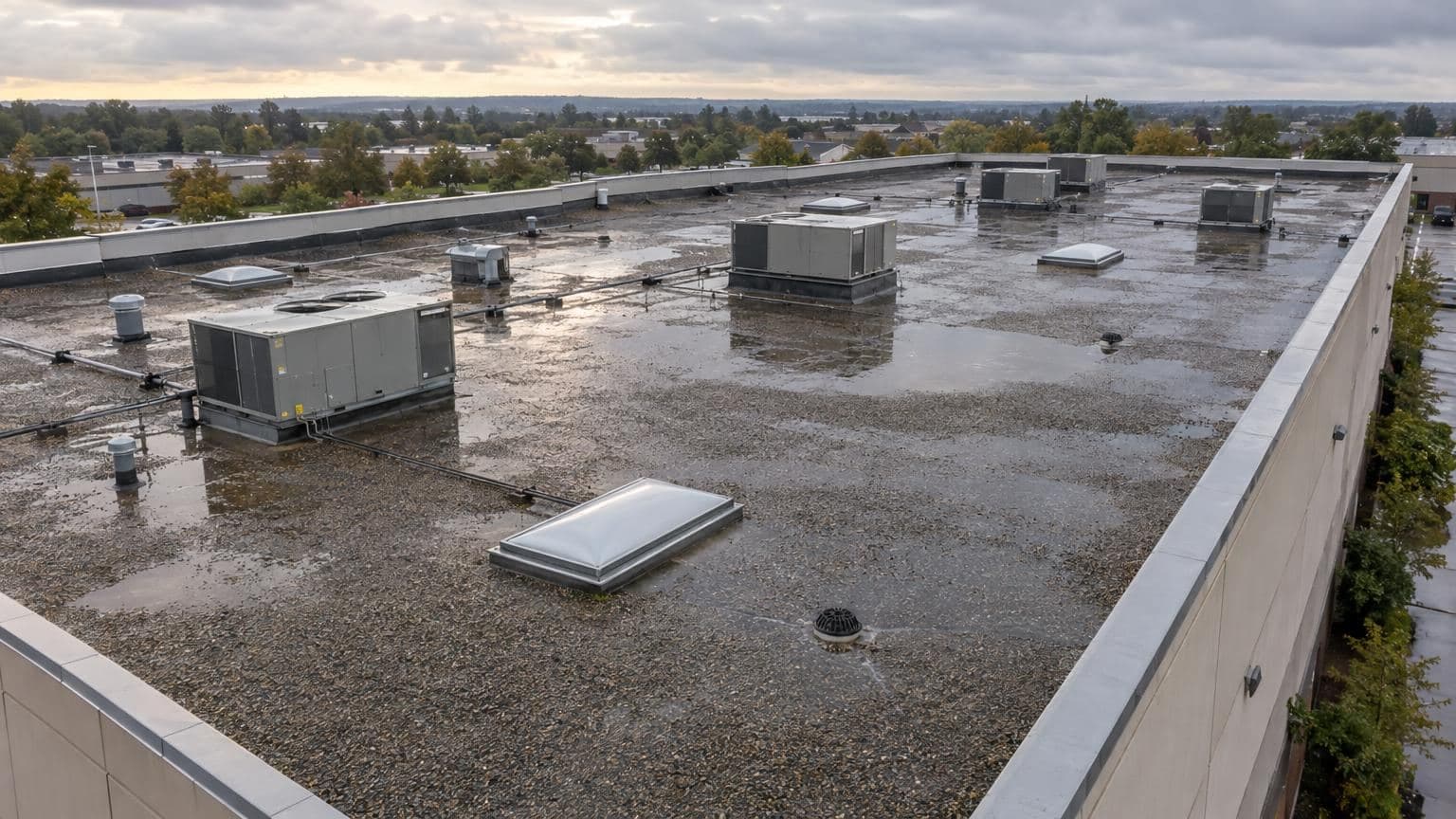
A built-up roof is several plies of felt or mat bonded with hot asphalt or coal tar pitch and topped with gravel, a flood coat, a coating or a granule cap sheet. Gravel spreads a hailstone's energy, so gravel-surfaced built-up roofs are less likely to be damaged than smooth-surfaced ones.1,10
In Haag Engineering's field surveys, gravel-surfaced built-up roofs had the highest damage threshold of the roofs studied, 2.5 inches, and in its lab tests 8-year-old gravel samples over perlite needed 2-inch ice to start damage. RICOWI's surveys agree: in 2011, six built-up roofs, five of them hit by hail 2.25 inches or larger, showed little damage beyond scuffing and displaced gravel. In 2016, aggregate-surfaced roofs hit by 1.5-inch or larger hail took moderate damage at three sites, and two hit by large hail had damage only at the perimeter flashing.5,4,3
Age cuts the threshold sharply. FM shows a 20-year-old four-ply built-up roof, severely alligatored, damaged by 1-inch hail. Alligatoring is the cracking that forms as solvents leave the aging asphalt and it turns brittle.6
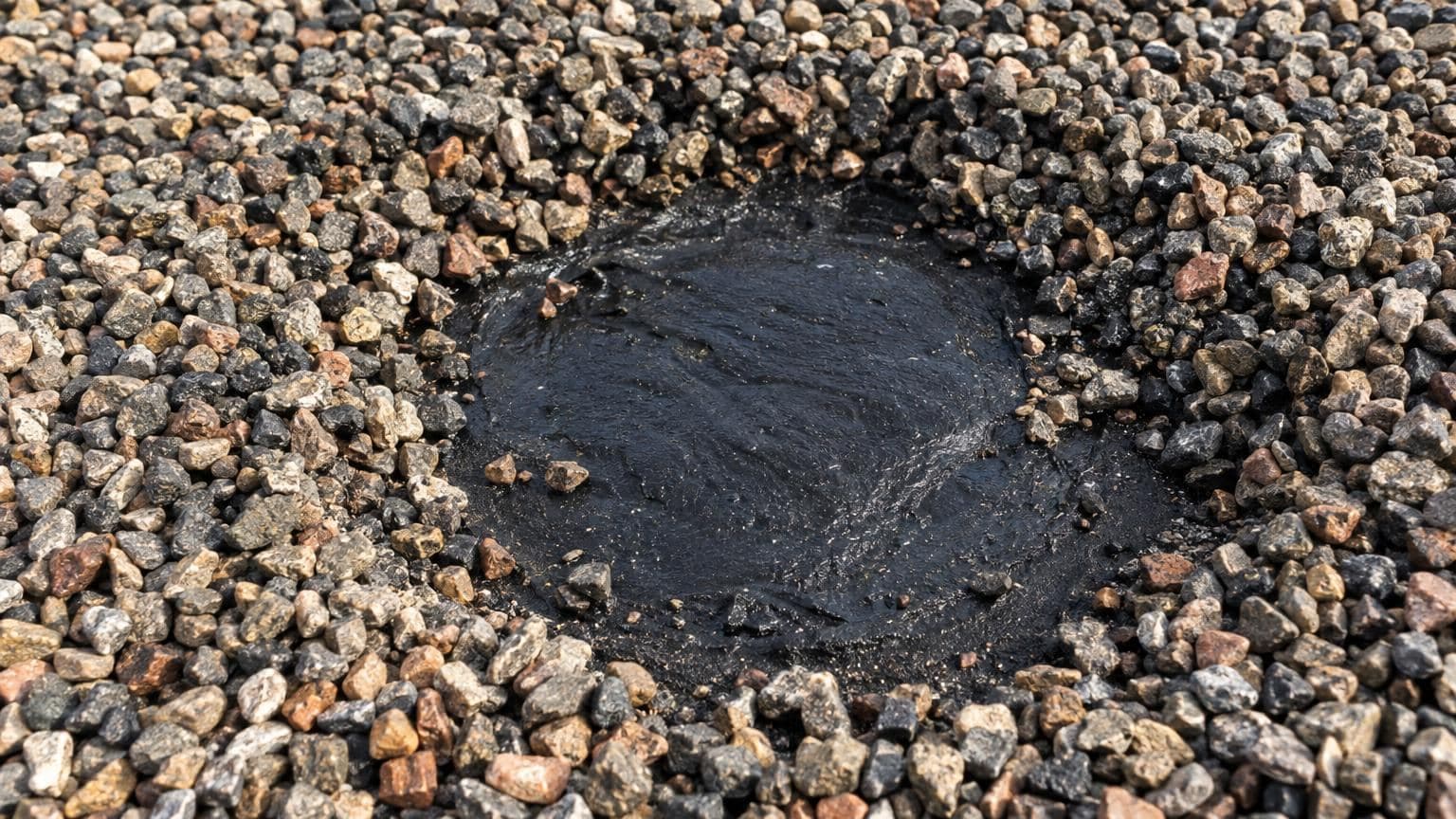
To inspect a gravel roof, the loose gravel is swept or blown aside to look for fresh black bitumen where hail knocked out the flood coat and embedded gravel. On smooth roofs, impact marks are found by close looking and touch, and broken felts feel soft. Fractures always show on the membrane's underside, which is why samples are cut. Losing the flood coat, gravel or coating can shorten the roof's life even without a fracture.2
Two lab findings matter here. In 2022 tests with a steel missile matching 2.5-inch hail, aged gravel-surfaced samples lost surfacing at every impact, but their felts fractured only over insulation, not over a firm base. And mopping voids, air pockets trapped between plies when the roof was built, can feel soft and strip surfacing above them: engineers found voids in 51.5% of over 1,200 hot-mopped samples they examined. On aluminum-coated roofs, irregular discolored patches in the coating are a common sign of a void below.7,8
EPDM
EPDM is a synthetic rubber sheet, loose-laid under ballast, mechanically attached or fully adhered. Being elastic, it does not build up stress or fatigue when struck by many hailstones.2,10
In 2016, RICOWI found no punctures or fractures on three EPDM roofs hit by hail of 1 to 3 inches. In tests commissioned by the EPDM Roofing Association, 76 of 81 new, heat-aged and field-aged nonreinforced EPDM samples over polyiso, wood fiber, plywood and OSB did not fail under ice balls up to 3 inches. Across three RICOWI investigations, unreinforced EPDM, especially with No. 4 aggregate ballast, held up to hail larger than 2 inches.3,9
Thickness and ballast still matter. EPDM comes in 45, 60 and 90-mil sheets, with 90-mil offering higher resistance, and ice-ball tests failed 45-mil membrane with a 3-inch ball at 133.2 feet per second. Rock ballast absorbs some of the impact.10
Coatings
A roof coating is a liquid film over an existing roof or over spray foam. Hail hits the coating first. Coatings that resist hail are flexible yet tough, typically polyurethanes, and some acrylic and silicone coatings have passed severe hail tests in UL and FM Approvals listings. Coatings often harden as they weather, so results on aged coatings matter as well as results on new ones.11
FM's roof standard 4470, which sets the MH, SH and VSH hail ratings, also covers liquid-applied roof assemblies. On the one coated spray foam roof RICOWI inspected in 2016, 1.5-inch hail caused significant damage: frequent coating fractures with dents in the foam.6,3
Example
| Roof type | Where damage started | What moved it |
|---|---|---|
| Built-up, gravel surfaced | 2.5 in. in Haag field surveys; 1 in. on one 20-year-old alligatored roof | Gravel and a hard deck raised it; brittleness lowered it |
| EPDM | No punctures or fractures on 3 roofs hit by 1 to 3 in. hail; 76 of 81 lab samples held ice up to 3 in. | Thickness, aggregate ballast |
| Coated spray foam | Significant damage on the one roof surveyed, at 1.5 in. | One roof only |
Impact energy explains the spread. Near solid ice, a 2-inch stone carries 22.9 ft-lb and a 2.5-inch stone 56.4 ft-lb. FM 4470 tests Severe Hail (SH) assemblies at 14 ft-lb and Very Severe Hail (VSH) at 53 to 58 ft-lb, and FM notes that 3-inch hail, at 117.8 ft-lb, carries 2.2 times the VSH minimum.6
How inspectors check
- Walk and touch: push on the membrane to find soft spots and dented insulation, sweep gravel aside, and tug at thermoplastic sheets to open small fractures. Water, snow and ice on a membrane can hide fractures completely.2
- Test areas: on low-slope roofs, RICOWI teams pick several random test areas and count the impacts in each.3
- Cut samples: RICOWI's 2011 report names built-up, modified bitumen and some thermoplastic membranes, with their laminated plies, as cases for further sampling. In a lab, bitumen can be dissolved out of the reinforcement, thermoplastic sheets backlit with strong light, and some samples X-rayed.4,2
- Moisture: infrared thermography and impedance meters show whether water has entered through hail openings.2
- Edges and equipment: base flashing is usually the first part of a low-slope roof that hail damages, and FM Approved perimeter flashing is not tested for hail. FM calls hail-punctured skylights one of the main causes of water damage to buildings and contents, and condenser fins dent even in small hail.2,6
Where you'll see it
- FM Approvals hail ratings for low-slope roof assemblies: MH (8 ft-lb), SH (14 ft-lb) or VSH (53 to 58 ft-lb). IBHS recommends FM 4470 Class 1-SH or UL 2218 Class 4 for roof covers sloped 3/12 or less in hail-prone areas.6,12
- FM hail hazard maps: moderate areas see hail up to 1.75 inches at a 15-year mean recurrence interval, severe areas 1.75 to 2 inches, and very severe areas larger than 2 inches. FM recommends VSH-rated, poured concrete or concrete paver covered roofs in very severe areas.6
- RICOWI hail investigation reports, which rate each roof 0 to 5, from no apparent damage to severe damage with potential leaks.3
- Lab reports on cut samples from built-up and modified bitumen roofs, which often cite ASTM D2829 and ASTM D3746.7
- Commercial property policies with endorsement CP 10 36, which defines roof surfacing to include synthetic sheeting or similar materials covering the roof. Paragraph A values roof surfacing at actual cash value; Paragraph B excludes cosmetic wind or hail damage that alters appearance but does not stop the roof from keeping out the elements.13
- The ISO special causes of loss form CP 10 30 (September 2017 edition), which excludes wear and tear, deterioration and latent defects, and does not pay for rain damage inside unless a covered cause first damages the roof or walls the rain enters through.14
- Multifamily loan insurance requirements: Fannie Mae and Freddie Mac require property coverage on a replacement cost basis but allow roof coverage on an actual cash value basis.15,16
Questions
- What size hail damages a flat roof?
- It ranges widely by roof type and support. RICOWI found the biggest change in damage for most roof coverings between 1.25 and 2 inches. Haag's field surveys put the damage threshold for gravel-surfaced built-up roofs at 2.5 inches, while one alligatored 20-year-old built-up roof was damaged by 1-inch hail.3,5,6
- Does gravel protect a flat roof from hail?
- Largely, yes. Gravel spreads a hailstone's energy, and in RICOWI's investigations built-up roofs with loose and embedded aggregate and unreinforced EPDM, especially with No. 4 aggregate ballast, held up to hail larger than 2 inches. For very severe hail areas, FM lists VSH-rated, poured concrete and concrete paver covered roofs.10,3,6
- Can a flat roof be damaged by hail without leaking right away?
- Yes. Fractures start on the underside, insulation can be crushed under an intact membrane, and water that gets in can spread through the insulation, turning a small puncture into a large repair. Infrared and impedance scans help find that water.2,10
Cloudbreak
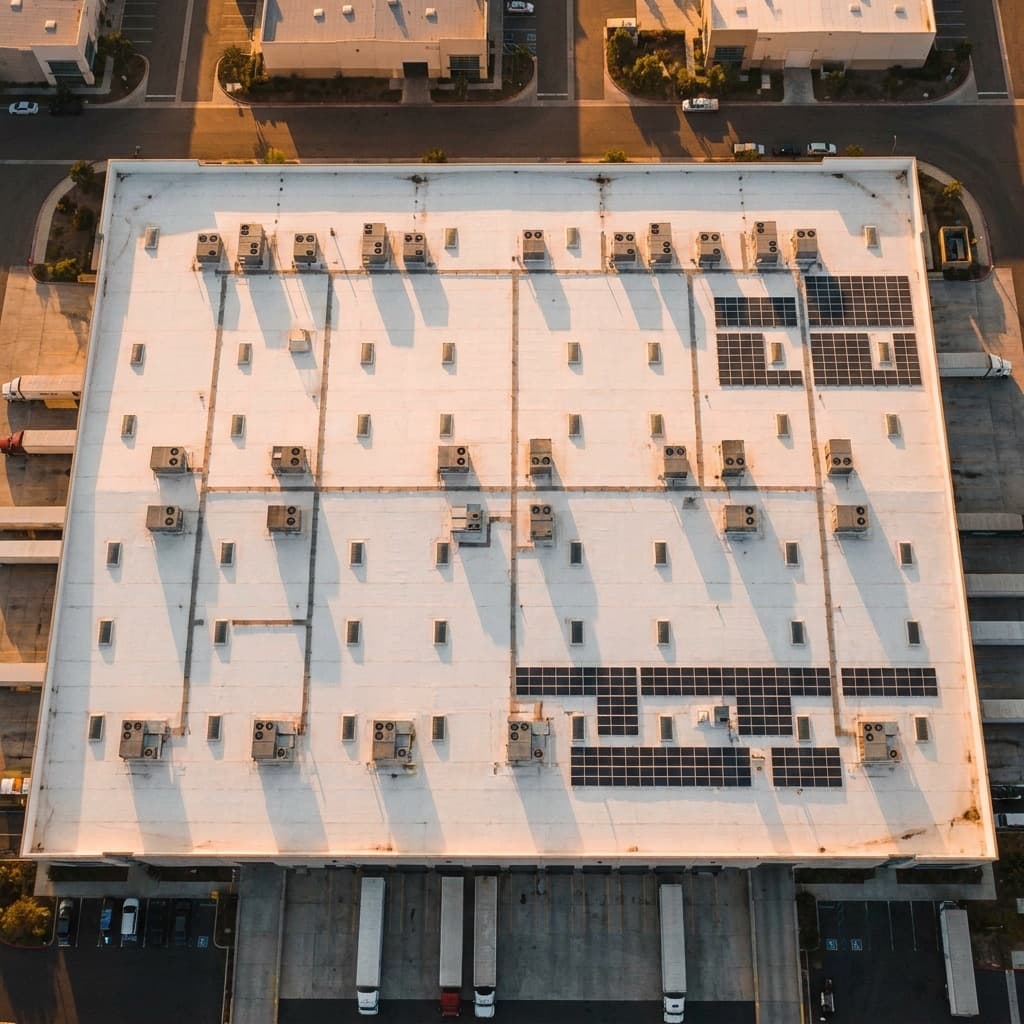
Cloudbreak records every roof section and rooftop unit before a storm, in photos, drone video and notes, so each roof's condition on a given date is on file.
Sources
Written by the Cloudbreak team. Numbers, dates and rules cite the published sources below.
- 1. National Roofing Contractors Association: Glossary of Roofing Terms
- 2. Professional Roofing, NRCA: Holy hail! Learn how to identify hail damage on low-slope roof systems (Scott J. Morrison, June 2009)
- 3. RICOWI: Hailstorm Investigation Report: North Texas, April 11, 2016
- 4. RICOWI: Hailstorm Investigation Report: Dallas/Fort Worth, TX, May 24, 2011
- 5. Haag Engineering, American Meteorological Society conference paper: Hail Damage Threshold Sizes for Common Roofing Materials (Marshall, Herzog, Morrison and Smith)
- 6. FM: Property Loss Prevention Data Sheet 1-34: Hail Damage (March 2018 edition, interim revision April 2026)
- 7. IIBEC: Testing Built-up and Modified Bitumen Roofs for Hail Damage (Roof Technical Services, IIBEC Interface, July 2022)
- 8. Nelson Forensics: Hail Evaluation of Bituminous Roofing Membranes: Understanding Interply Mopping Voids (Donaldson, DeLeon and Verhulst)
- 9. RCI 24th International Convention proceedings, hosted by the EPDM Roofing Association: Hail Impact Testing of EPDM Roof Assemblies (Koontz and Hutchinson, commissioned by the EPDM Roofing Association, 2009)
- 10. Professional Roofing, NRCA: Standing up to hail (Ric Vitiello, June 2007)
- 11. Professional Roofing, NRCA: Climate conscious (Steve Heinje, June 2007)
- 12. Insurance Institute for Business & Home Safety: Commercial Roofs Best Practices Guide
- 13. Insurance Services Office, hosted by Independent Insurance Agents of Texas: CP 10 36 10 12: Limitations on Coverage for Roof Surfacing
- 14. Insurance Services Office: Causes of Loss: Special Form, CP 10 30 09 17
- 15. Fannie Mae: Multifamily Selling and Servicing Guide, Part II Chapter 5: Property and Liability Insurance (effective October 26, 2026)
- 16. Freddie Mac: Multifamily Seller/Servicer Guide, Chapter 31: Insurance Requirements