Roof core sample
Roofing and building · Cloudbreak team · Updated October 29, 2026 · 10 sources
Definition
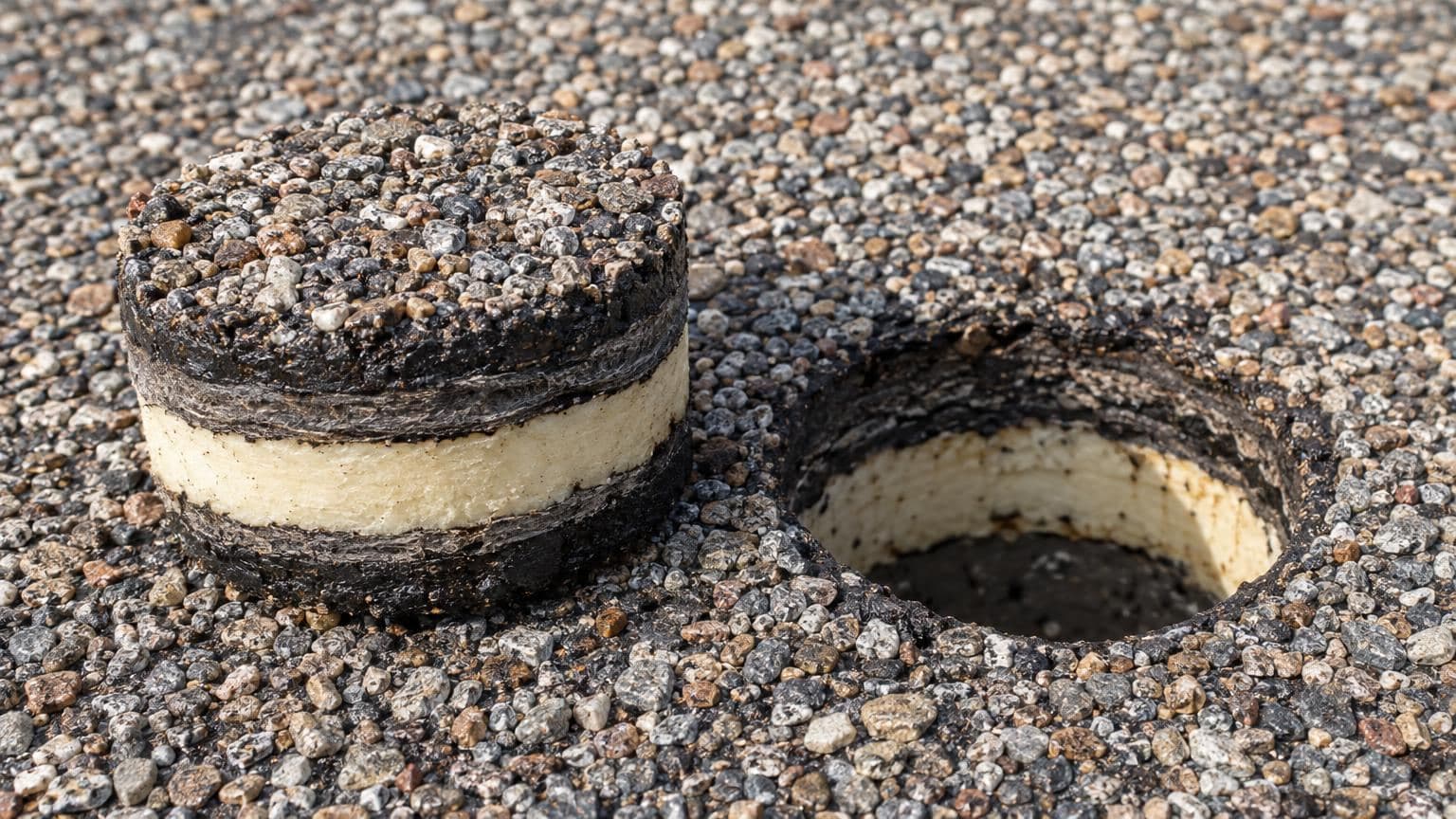
A roof core sample (core cut) is a sample cut through a low-slope roof to show how it is built. It can reveal the membrane type and surfacing, the approximate number of plies, the insulation type, thickness and condition, and the deck type.
How it works
A core is cut through the roof assembly, lifted out so its layers can be read, and the hole is patched. It tells an inspector what is on the roof without tearing any of it off, which matters before a repair, a reroof or a claim decision.
A core cut is mainly a qualitative look at how a roof is built. On spray polyurethane foam roofs, NRCA notes that cores also give measurements: foam thickness, coating thickness and adhesion, the thickness of each pass and how well the foam bonds to its substrate.1
For built-up roofs there is a standard method. ASTM D2829 covers cutting specimens from existing built-up roofs and estimating the amount of each part: insulation, felt plies, interply bitumen, top coating and surfacing. Roofs under construction use ASTM D3617 instead.2
Cores and moisture surveys
Scans find likely wet areas, and cores confirm them. Infrared, impedance and nuclear readings are only relative, and an infrared camera sees temperature differences, not water. ASTM C1153 requires infrared findings to be verified by cores or by cores with moisture probes, and ASTM D7954 covers verifying impedance scans with core samples.3,4,5
Cores are usually taken across the range of scan readings, so the lab results can calibrate the rest of the survey. In the lab, each layer is weighed, oven dried and weighed again to measure how much water it held.
Example
Gravimetric analysis gives moisture content by dry weight: wet weight minus dry weight, divided by dry weight, times 100. For example, an insulation layer from a core that weighs 60 grams wet and 40 grams after oven drying holds (60 minus 40) / 40 x 100 = 50% moisture by dry weight.5
That number alone does not settle whether the board is wet. Some roof insulation can hold more than 100% moisture by weight and still not technically be considered wet. Drying a gypsum cover board too hot also drives off chemically bound water and skews the result.6
The same core shows what is already on the deck, which decides whether a new roof can go over the old one. IBC Section 1512.3 does not permit a recover where the existing roof has two or more applications of any roof covering, or is water-soaked or too deteriorated to serve as a base. Because codes bar recovering a moisture-laden roof, moisture surveys are often run first.1,7,6
Core samples after hail
Hail fractures in low-slope membranes start on the underside, where tensile strain is greatest, so cutting out a sample lets an inspector see the side that cracks first. In a lab, bitumen can be dissolved away to expose the reinforcement, and thermoplastic sheets can be backlit with high-intensity light. Dented or fractured insulation under the membrane may count as functional damage.8
FM Global's hail data sheet (interim revision April 2026) shows a sample cut from a 15-year-old single-ply roof severely fractured by hail about 1.75 inches across. The membrane's unexposed lap section was more flexible than the weathered membrane in the sample, a sign the sheet had turned brittle.9
State rules
Florida: for roof moisture surveys in the High-Velocity Hurricane Zone, test protocol TAS 126-95 sets the steps. Cores must be at least 2 inches across and come from dry areas and from low, medium and high readings. Each is sealed in its own watertight container, labeled and logged on the field sheet, and the roof is repaired right after testing. A lab then separates the layers, weighs them, and dries them for 24 hours at 230°F, repeating until no weight is lost.10
Where you'll see it
- Moisture survey reports: core locations logged on the field record, with lab moisture results used to calibrate the scan readings.10,5
- Nuclear moisture surveys under ANSI/SPRI/IIBEC NT-1, where cores are typically taken at low, middle and high readings but not the highest.5
- Investigations of existing roofs: core analysis records the membrane, plies, insulation and deck, or for a built-up roof the approximate quantity of each component.1,2
- Hail damage investigations, where roofing samples go to a lab for closer examination under magnification.8
Questions
- What is a core cut on a roof?
- A sample cut through a low-slope roof to show its construction: the membrane and surfacing, the approximate number of plies, the insulation type, thickness and condition, and the deck.
- How big is a roof core sample?
- It depends on the method. Florida's TAS 126-95 moisture survey protocol requires cores at least 2 inches in diameter.10
- Why take core samples with an infrared roof scan?
- Infrared shows temperature differences, not water. ASTM C1153 requires infrared findings to be verified by cores, alone or with moisture probes.3,5
- Are core cuts patched?
- Yes, right after they are taken. Florida's TAS 126-95, for example, requires each cored area to be repaired as soon as the destructive testing ends.10
Cloudbreak
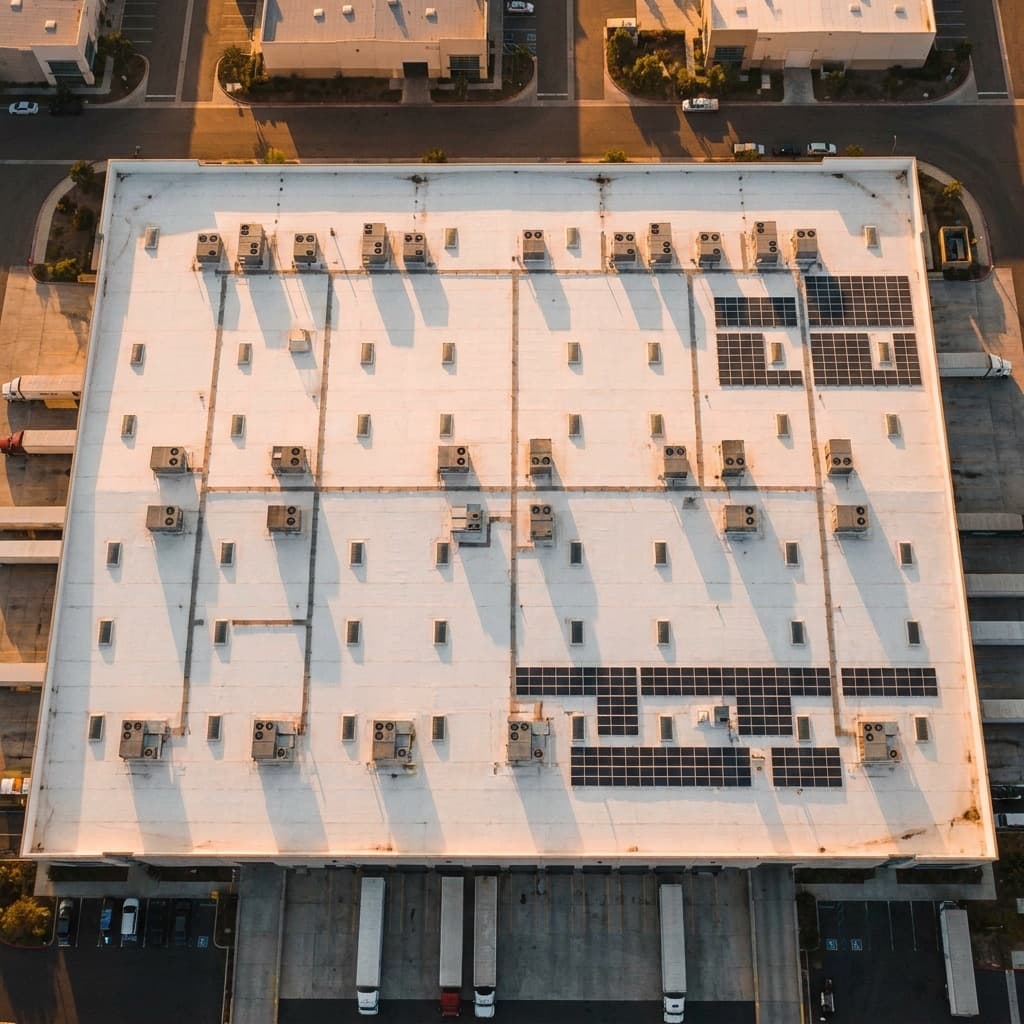
Cloudbreak records every roof section and rooftop unit before a storm, in photos, drone video and notes, so each roof's condition on a given date is on file.
Sources
Written by the Cloudbreak team. Numbers, dates and rules cite the published sources below.
- 1. National Roofing Contractors Association (NRCA): Glossary: Core cut (core sample)
- 2. ASTM International: D2829/D2829M-07(2023) Standard Practice for Sampling and Analysis of Existing Built-Up Roof Systems
- 3. ASTM International: C1153-23 Standard Practice for Location of Wet Insulation in Roofing Systems Using Infrared Imaging
- 4. ASTM International: D7954/D7954M-22a Standard Practice for Moisture Surveying of Roofing and Waterproofing Systems Using Nondestructive Electrical Impedance Scanners
- 5. Professional Roofing, NRCA: Surveying roof moisture (Michael T. Williams, December 2025 to January 2026)
- 6. Professional Roofing, NRCA: How wet is wet? (Matt Dupuis, October 2023)
- 7. International Code Council, via UpCodes: IBC Section 1512.3 Roof Recover
- 8. Professional Roofing, NRCA: Holy hail! Learn how to identify hail damage on low-slope roof systems (Scott J. Morrison, June 2009)
- 9. FM Global: Property Loss Prevention Data Sheet 1-34: Hail Damage (March 2018 edition, interim revision April 2026)
- 10. Florida Building Code, via UpCodes: Florida Test Protocols for High-Velocity Hurricane Zones, TAS 126-95 Standard Procedures for Roof Moisture Surveys, Section 12: Verification and Quantification