Hail damage on TPO roofs
Roofing and building · Cloudbreak team · Updated October 29, 2026 · 7 sources
Definition
Hail damage on a TPO roof is a crack, split or puncture in the thermoplastic olefin membrane, or a crushed or broken layer beneath it. The membrane can look intact while the cover board or insulation under a dimple is damaged.
How it works
TPO is a single-ply sheet, reinforced or not, blended from polypropylene and ethylene-propylene polymers. It is laid over insulation, often with a cover board between, and held down by fasteners and plates or by adhesive.1
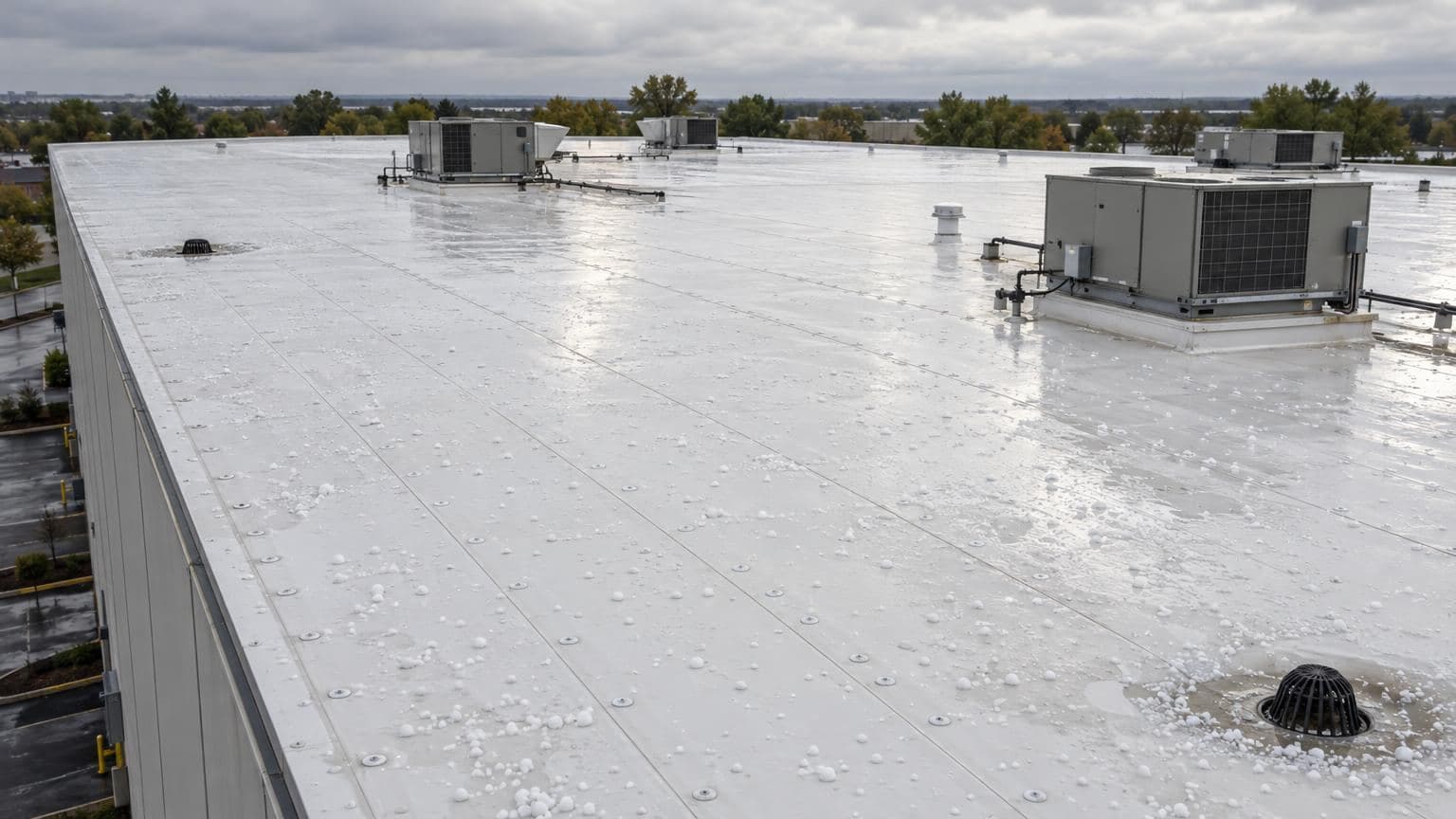
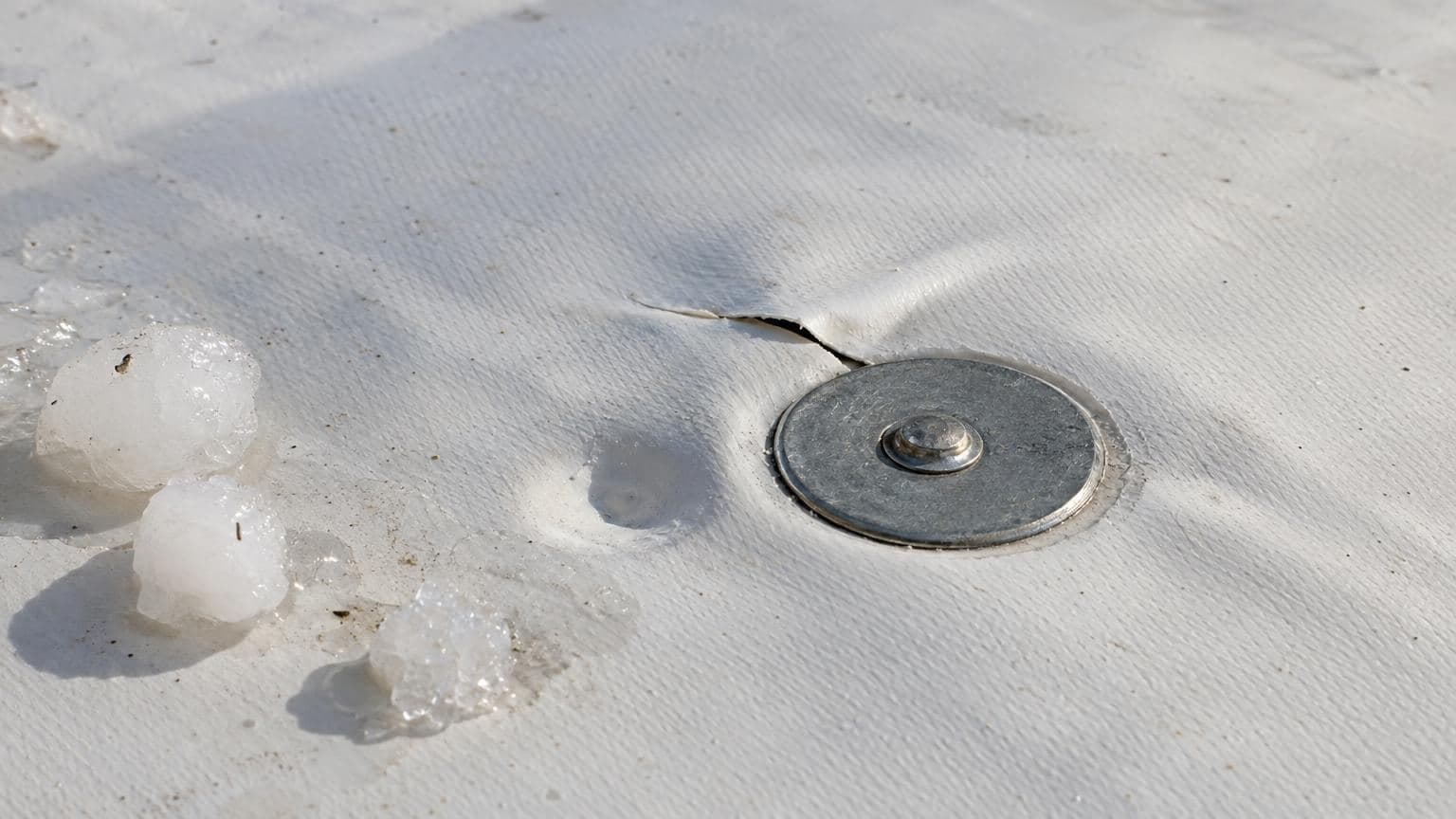
On a firm, evenly supported area, the sheet and the layers below absorb a hit and spread it. Damage comes where the support is uneven. Over a metal fastener plate, the ice presses the membrane onto the plate and screw head and can split it. Over soft insulation, the impact crushes the board and leaves a dimple, and the sheet above may or may not tear.
The sheet itself changes with time. TPO becomes stiffer and more brittle as it ages and weathers, so a roof that shrugged off hail when new can fracture in a smaller storm years later.
Not all damage shows. A dimple with no break in the sheet can sit over crushed insulation or a broken cover board core, and an impact that leaves no mark can still weaken the membrane, which shows up later as cracking. A check of the surface alone can miss both.
What tests and field surveys found
In the June 2016 tests, new TPO of every thickness survived two 2-inch hits in the field of the sheet but always failed when hit directly over a metal fastener plate. The ice deformed on impact, pressed the membrane onto the sharp edges of the screw head and split it.2
The layers below matter as much as the sheet. Two 2-inch ice balls crushed standard polyiso insulation about 1/2 inch deep and left a deep dimple in the membrane above it. Gypsum cover board cores were crushed to powder, while 80-mil fleece-back TPO over high-density polyiso cover board showed no damage. A cover board can look sound, with its facer unbroken, while its core is badly damaged.2
Damage can also show up later. In the same authors' January 2017 tests, membranes were hit by 2-inch ice balls that left no visible damage, heat-aged to the equivalent of 10 years, then hit again in the same spots. Some failed. The authors concluded that even 2-inch impacts that leave no visible mark can affect long-term performance.3
Example
| Hail size | Impact energy | Result |
|---|---|---|
| 1.25 to 1.5 in. | 3.4 to 7.2 ft-lb | Two unballasted thermoplastic roofs, 12 to 15 and over 15 years old, fractured at fastener plate edges (North Texas, April 11, 2016) |
| 1.75 in. | 13.3 ft-lb | A 15-year-old single-ply roof severely fractured; 10-year-old areas of the same construction were not damaged (FM case) |
| 2 in. | 22.9 ft-lb | New TPO in the lab: passed in the field of the sheet, failed over every fastener plate |
| 2.5 in. | 56.4 ft-lb | An 11-year-old TPO roof without high-density cover board had major damage and large punctures (North Texas, 2016) |
Impact energy rises far faster than size. Near solid ice, a 2-inch stone carries about 3 times the energy of a 1.5-inch stone (22.9 vs 7.2 ft-lb). The 2016 lab tests used 23.75 to 26.13 ft-lb, the FM Class 4 criterion.4,2
Age matters. FM Data Sheet 1-34 says 1.75-inch hail should not damage a new FM Approved SH-rated roof, yet hail that size severely fractured the 15-year-old roof in the table.4
What changes the hail size that does damage
- Fasteners: hits over fastener plates split new membranes in the lab and aged ones in the field.2,5
- Support: in RICOWI's 2016 survey, over 43% of membranes on low compressive strength substrates had significant damage, while only 25% of those on high compressive strength substrates had damage.5
- Thickness: FM Data Sheet 1-34 shows a 0.045-inch (45-mil) single-ply membrane, reportedly 15 years old, cut all over by hail next to a reportedly thicker roof that was not damaged.4
- Age: FM Data Sheet 1-34 says single-ply and multi-ply roofs average 14 to 18 years of life, and many become brittle as they age and weather.4
Where you'll see it
- RICOWI hail investigation reports, which rate each single-ply roof 0 to 5 against the estimated largest hail at the site.5
- FM Approvals hail ratings for low-slope roof assemblies: MH (8 ft-lb), SH (14 ft-lb) or VSH (53 to 58 ft-lb). IBHS recommends FM 4470 Class 1-SH or UL 2218 Class 4 for low-slope roof covers in hail-prone areas.4,6
- Commercial property policies with endorsement CP 10 36. Where scheduled, its Paragraph B excludes cosmetic wind or hail damage to roof surfacing, which the form defines to include synthetic sheeting.7
Questions
- What size hail damages a TPO roof?
- There is no single size: it depends on the membrane's age, what supports it and where the fasteners are. RICOWI's 2016 North Texas survey found few single-ply roofs damaged by hail under 1.5 inches, and several that held up to hail of 2 inches or more. Still, two aged thermoplastic roofs fractured at fastener plates in 1.25 to 1.5-inch hail.5
- Can hail damage a TPO roof without visible marks?
- Yes. In lab tests, cover board cores were crushed under intact facers, and membranes with no visible damage from 2-inch ice balls showed failures after heat aging.2,3
- Does a cover board help a TPO roof resist hail?
- In the 2016 lab tests, several fleece-back TPO combinations over high-density polyiso cover board took 2-inch ice balls with essentially no damage, while gypsum board cores were crushed. RICOWI's field teams found membranes over high compressive strength substrates, gypsum board products included, performed well.2,5
- Is fully adhered TPO more hail resistant than mechanically attached TPO?
- In the 2016 lab tests, every hit over a fastener plate failed, while hits in the field of the sheet passed. The researchers recommended fully adhered systems with no fasteners directly below the membrane in high-frequency hail areas.2,3
Cloudbreak
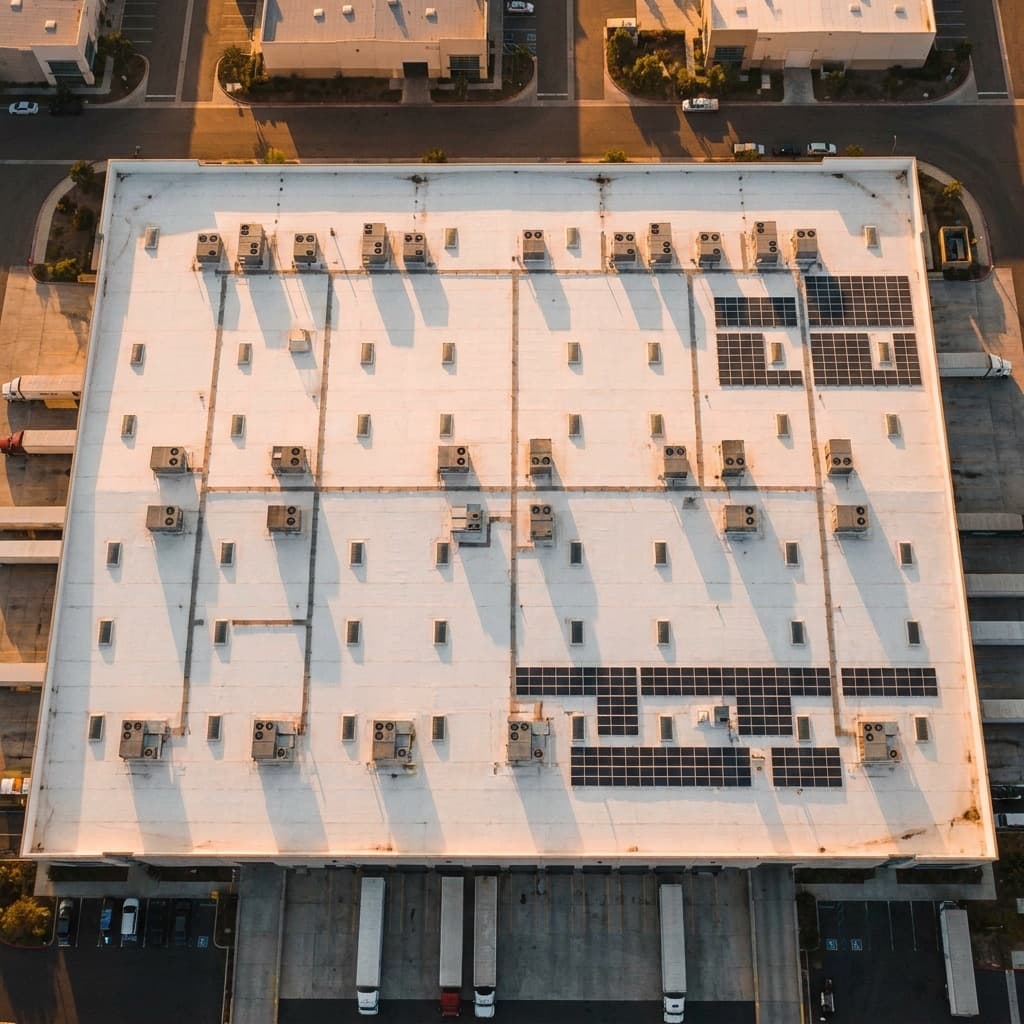
Cloudbreak records every roof section and rooftop unit before a storm, in photos, drone video and notes, so each roof's condition on a given date is on file.
Sources
Written by the Cloudbreak team. Numbers, dates and rules cite the published sources below.
- 1. National Roofing Contractors Association: Glossary of Roofing Terms
- 2. Professional Roofing, NRCA: A Lasting Impression (Bhawalkar, Taylor and Yang, June 2016)
- 3. IIBEC Interface: Ice Ball Impact Resistance of Heat-Aged TPO Roofing Membranes (Bhawalkar, Yang and Taylor, January 2017)
- 4. FM: Property Loss Prevention Data Sheet 1-34: Hail Damage (March 2018 edition, interim revision April 2026)
- 5. RICOWI: Hailstorm Investigation Report: North Texas, April 11, 2016
- 6. Insurance Institute for Business & Home Safety: Commercial Roofs Best Practices Guide
- 7. Insurance Services Office, hosted by Independent Insurance Agents of Texas: CP 10 36 10 12: Limitations on Coverage for Roof Surfacing