Spray foam roof
Roofing and building · Cloudbreak team · Updated October 29, 2026 · 9 sources
Definition
A spray polyurethane foam (SPF) roof is formed in place by mixing and spraying isocyanate and a polyol resin into a rigid, fully adhered, water-resistant insulating layer, then covering it with a liquid-applied protective coating.1
How it works
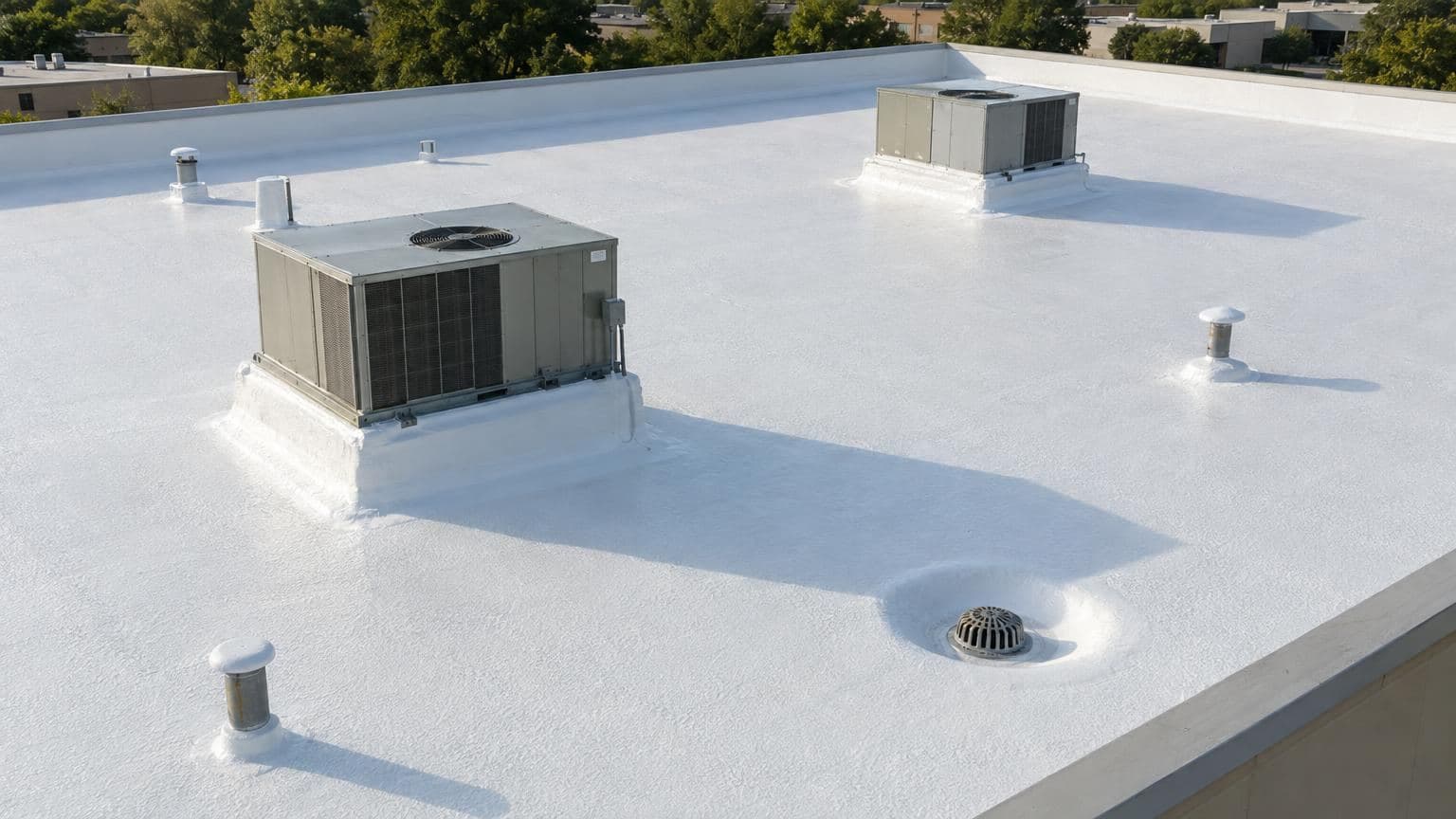
The two liquids mix as they are sprayed, expand and harden into rigid foam that bonds to the deck below. Because it goes on wet, the foam has no seams and wraps around drains, curbs and rooftop equipment. Exposed foam breaks down in sunlight, so it is covered with a protective coating, the layer that weathers and gets renewed over the roof's life.
SPFA's guide specification calls for foam that meets ASTM C1029 or D7425, has a compressive strength of at least 40 psi and no more than 10% open cells, and is sprayed in lifts of 1/2 to 1-1/2 inches to a total of at least 1 inch.2
The 2024 International Building Code requires a design slope of at least 1/4 inch per foot and an acrylic (ASTM D6083), silicone (ASTM D6694) or moisture-cured polyurethane (ASTM D6947) coating, applied 2 to 72 hours after the foam. Granules are optional in SPFA's guide specification; when specified, they go into the final coat while it is still wet.2,3
Core cuts measure foam thickness, coating thickness and adhesion, and the bond between passes and to the substrate. Slit samples, half-moon cuts about 1 by 1/2 by 1/2 inch, measure coating film thickness. Worn coating can be renewed: IBC Section 1512.3 allows a new coating over an existing SPF roof without tear-off, unless the roof is water-soaked or too deteriorated to serve as a base.1,3
How hail damages it
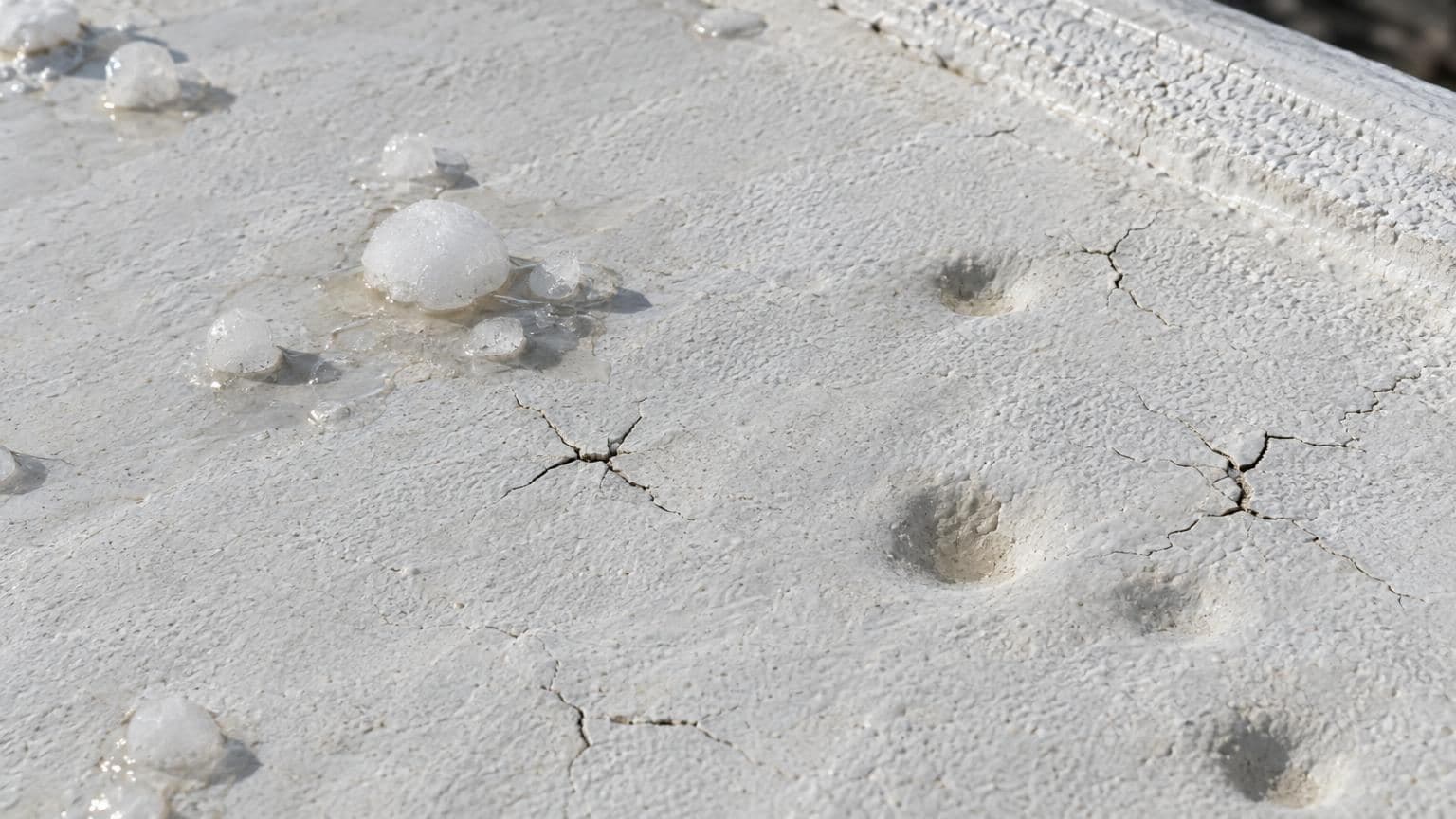
Hail hits the coating first. It can crack, gouge or puncture the coating and dent, crack or gouge the foam below. A dent in closed-cell foam does not usually leak right away; the larger risk is time, because a cracked coating lets sunlight degrade the foam and lets moisture in.
SPFA describes coating cracks shaped like crow's feet or semicircles and foam dents 1/8 to 3/4 inch deep.4
After the April 11, 2016 North Texas storm, RICOWI inspected one SPF roof, surfaced with an elastomeric coating. It had significant damage from 1.5-inch hail: frequent coating fractures with foam indentations. The site contact reported leaks, but RICOWI did not investigate their cause.5
A 2000 paper by SPFA's technical director and a roofing contractor cites a 1998 National Roofing Foundation study: hail damage on SPF roofs stayed in the upper surface of the foam, and mechanically damaged roofs are not in imminent danger of leaking unless the penetration goes all the way through the foam. In 2024, two forensic engineers wrote that, in their experience, impact fractures generally do not saturate closed-cell roofing SPF, which has more than 90% of its cells closed.6,7
Delay matters. Coating cracks can let UV degrade the foam, and SPFA-139 says damage found months or years after a storm may need larger repairs because UV has degraded the foam or moisture has entered through the breached coating.4,6
Example
| Grade | Dent or crack size | Fewer than 10 per 100 sq ft | More than 20 per 100 sq ft |
|---|---|---|---|
| Light | 1/2 in. across, or under 1/8 in. deep | Caulk and coat | Recoat to fill cracks |
| Moderate | 1/2 to 3/4 in. across, or under 1/4 in. deep | Coat or caulk cracks | Recoat to seal cracks |
| Heavy | 3/4 to 1-1/2 in. across, or 1/4 to 1/2 in. deep | Remove damaged foam, caulk, recoat | Scarify 1/2 in., refoam and coat |
| Severe | 1-1/2 in. or larger, or 1/2 in. deep or more | Remove damaged foam, caulk, recoat | Scarify 3/4 in., refoam and coat |
In this example, one 100 sq ft grid has 25 dents, each about 1 inch across and 3/8 inch deep. That size grades Heavy, and with more than 20 in the grid, SPFA-139 calls for scarifying 1/2 inch, refoaming and coating. With six such dents, it calls only for removing the damaged foam, caulking and recoating.4
The 2016 Casa View Elementary School case study by Arizona State University researchers, which argues for SPF roofs on cost, reported tests on a Dallas roof installed in 1987. Of 10 drops of a 1.75-inch steel ball from 17 ft 9 in. (the FM severe hail method, 14 ft-lb), 9 passed; of 3 drops of a 3-inch ball, only 1 did. Coating thickness was one of the main differences between passing and failing cores.8,9
Where you'll see it
- Building code: 2024 IBC Section 1507.13 sets the slope, foam and coating standards; Section 1512.3 allows recoating without tear-off.3
- Project specifications based on SPFA-104, SPFA's guide specification, which has the finished coating checked by slit samples under magnification.2
- Post-storm inspections: Knowles and Best (2000) suggest a moisture survey, at least 1 coating slit sample per 2,500 sq ft and at least 1 foam sample per 10,000 sq ft. SPFA-139 grades the damage on a 100 sq ft grid.6,4
- RICOWI hail investigation reports, which list SPF roofs separately from membranes.5
Questions
- How does a spray foam roof hold up to hail?
- It depends on the coating and foam. RICOWI found one SPF roof significantly damaged by 1.5-inch hail in 2016, while the 2016 Casa View Elementary School case study reported a 1987 roof passing 9 of 10 drops at FM severe hail energy.5,8,9
- Can a hail-damaged spray foam roof be repaired instead of replaced?
- Yes, often. SPFA-139 sets repairs by dent size and count, from caulking and recoating up to scarifying 1/2 to 3/4 inch and refoaming. Knowles and Best (2000) cite a National Roofing Foundation study that found most hail-damaged SPF roofs were repaired rather than replaced.4,6
- Does water soak into hail-damaged spray foam?
- Two forensic engineers reported in 2024 that, in their experience, impact fractures generally do not saturate SPF roofs. SPFA-139 warns that damage left for months or years can let moisture in through breached coating.7,4
- What coatings go on a spray foam roof?
- The 2024 IBC lists acrylic (ASTM D6083), silicone (ASTM D6694) and moisture-cured polyurethane (ASTM D6947) coatings, applied 2 to 72 hours after the foam.3
Cloudbreak
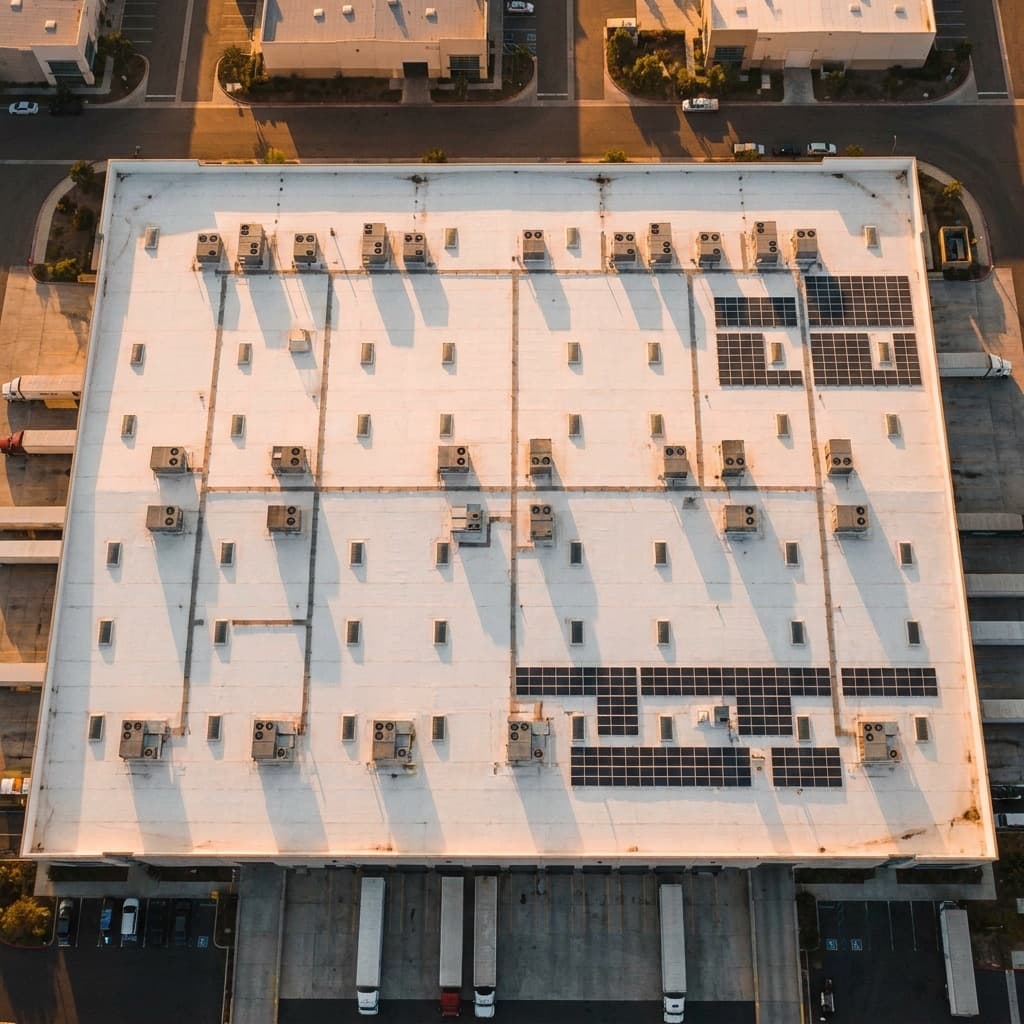
Cloudbreak records every roof section and rooftop unit before a storm, in photos, drone video and notes, so each roof's condition on a given date is on file.
Sources
Written by the Cloudbreak team. Numbers, dates and rules cite the published sources below.
- 1. National Roofing Contractors Association: Glossary of Roofing Terms
- 2. Spray Polyurethane Foam Alliance: SPFA-104: Spray Polyurethane Foam Systems for New and Remedial Roofing (January 2023 update)
- 3. International Code Council: 2024 International Building Code, Chapter 15: Roof Assemblies and Rooftop Structures (Sections 1507.13 and 1512.3)
- 4. Spray Polyurethane Foam Alliance: SPFA-139: Repair of Spray Polyurethane Roof Systems Due to Hail and Wind Driven Damage (1994, revised August 2015)
- 5. RICOWI: Hailstorm Investigation Report: North Texas, April 11, 2016
- 6. IIBEC: Inspection, Evaluation and Repair of SPF Roofing Systems after a Windstorm or Hail Event (Knowles and Best, February 2000)
- 7. ASCE Forensic Engineering Congress: Assessing the Waterproofing Performance and Repairability of Spray Polyurethane Foam Roofing Distressed by Hail or Debris Impact (Donaldson and Seader, October 2024)
- 8. Journal for the Advancement of Performance Information and Value: The Cost Effectiveness of Alpha SPF Roofs: Casa View Elementary School Roofing Case Study (Kashiwagi, Zulanas and Gajjar, Arizona State University, October 2016)
- 9. IIBEC Interface: Simulated Hail Damage and Impact Resistance Test Procedures (Crenshaw and Koontz, May 2001)