After a hailstorm: a 48-hour checklist for commercial and apartment properties
Short answer
First, wait 30 minutes after the last thunder, stay 10 feet from downed power lines and keep workers off a damaged roof until its strength is checked; then cover holes and broken windows, photograph the damage, save every receipt and report the damage to the insurer.1,2,3,4,5 Whether hail damaged the roof is settled by inspecting it, and public storm reports help show that hail fell nearby. Report the loss promptly and ask the insurer which claim deadlines apply; state rules come later on this page.
Cloudbreak team · Updated October 28, 2026 · 7 min read · 22 sources
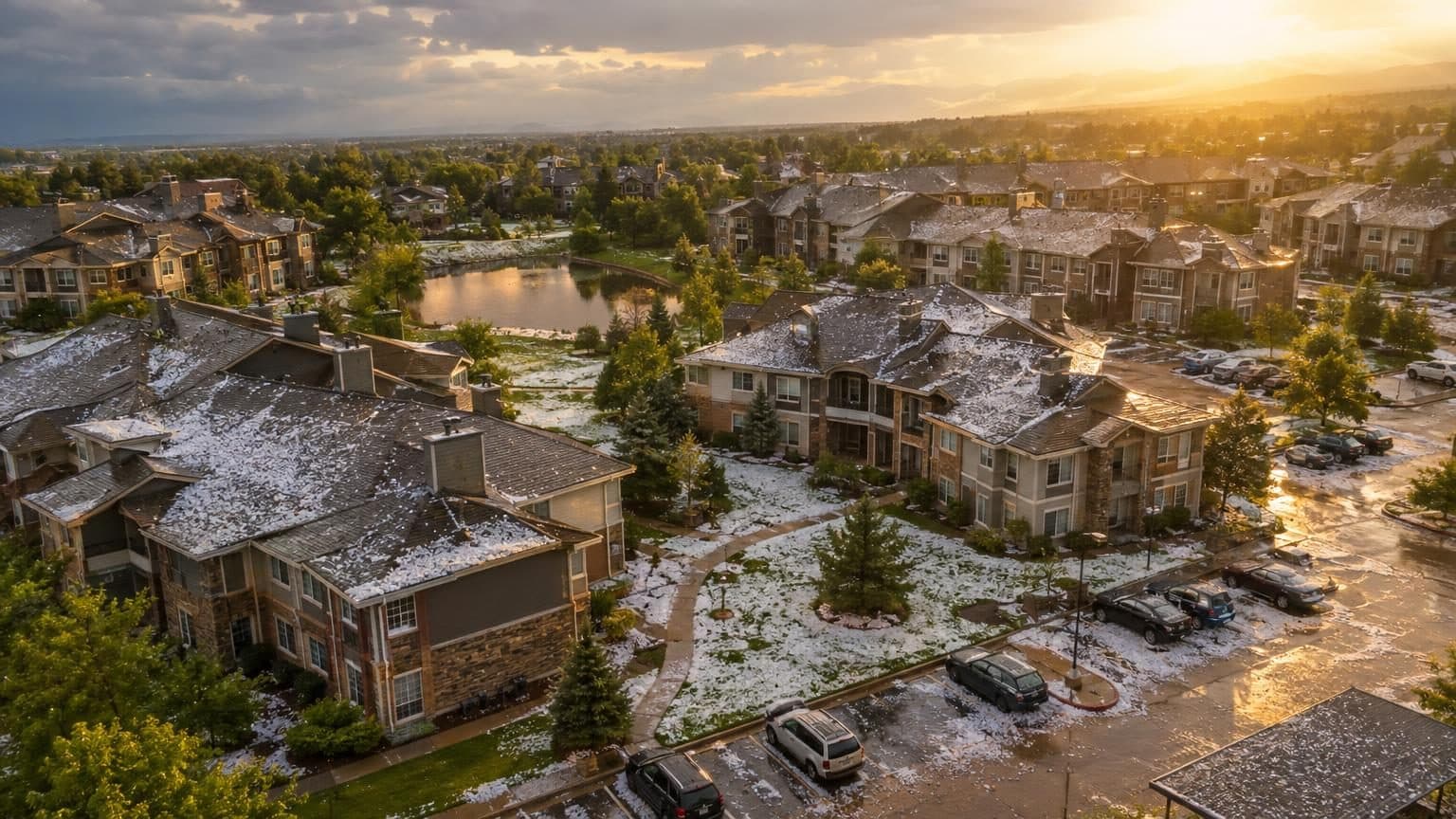
Before anyone goes on the roof
Wait 30 minutes after the last lightning or thunder before going back outside, not just until the rain ends.1
- Treat every downed power line as live and stay at least 10 feet away.2
- Keep workers off a damaged roof until its strength and structural integrity have been checked.
- Never put up tarps while it is windy or raining. A tarped roof is slippery, and tarped skylights are hard to see.
- Don't inspect a roof alone or climb a ladder in the dark.
Stop more damage and keep receipts
The ISO Building and Personal Property Coverage Form (CP 00 10, 2012 edition) requires the insured to take all reasonable steps to protect the property from further damage and to keep a record of what that costs for the claim. Where feasible, damaged property is set aside for examination.5
The ISO special causes of loss form (CP 10 30, 2012 edition) excludes loss caused by an insured's neglect to use all reasonable means to save and preserve property at and after a loss. It does not pay for rain damage inside a building unless the roof or walls first sustain damage from a covered cause, and it pays to board up openings when glass repair is delayed.6
- Cover holes and broken windows, and remove standing water.
- Keep a list of repairs and save every receipt.
- Hold off on permanent repairs until the adjuster sees the damage.
- Don't puncture blisters or spread coating or mastic over damage. It hides the evidence a roofer needs to find the problem.
Photos and records
Keep these records:
- Photos and video of all damage before any repairs.
- Photos of nearby undamaged areas, for context.
- A written list of damage inside and outside.
- Damaged items kept until the adjuster says they can go.
- Notes on every call with the insurer, adjusters and repair firms.
- Roof records a surveyor will ask for: known leaks, roof age and type, the covering's manufacturer, building and maintenance history, warranty, past storm performance, building permits and any earlier inspection reports to compare against.
The ISO commercial form adds duties on request: complete inventories of damaged and undamaged property with quantities, costs and values; access to inspect the property and examine books and records; and a signed, sworn proof of loss within 60 days of the insurer's request.5
How to tell if hail damaged the roof
Roof inspections usually happen several days to several months after the storm. Witness statements and weather reports show whether hail fell at the site, and dents in thin aluminum fixtures such as vents and flashing help confirm it.
Surface checks often miss serious damage such as fractures, punctures and weakened granule adhesion, and some damage shows only after months or years. A good inspection walks the whole roof with attention to flashings, seams, edges and unsupported areas, looks at the size and direction of spatter marks and dents, checks rooftop units, and looks inside for leaks and stains on ceilings, deck and insulation. If substantial damage is suspected, it takes samples for testing.
| Roof system | Damage to look for |
|---|---|
| Built-up | Membrane fracture, flashing puncture and cracking, ply fracture or separation, substrate damage |
| Modified bitumen | Granule loss, cracking, puncture, insulation facer separation, substrate delamination |
| Single-ply | Indentation, puncture, cracking, shatter, fracture at fasteners, delamination from substrate |
| Metal | Indentation, creasing, coating adhesion loss, puncture |
| Asphalt shingles | Granule loss, fracture, puncture, valley flashing damage |
| Sprayed polyurethane foam | Indentation, fracture, surface cracking, coating damage |
Check the weather records
The NOAA Storm Prediction Center posts preliminary local storm reports by day, running from 1200 UTC to 1159 UTC the next day. They are listed "as is"; for official documentation, SPC points to NCEI.8
The NCEI Storm Events Database adds National Weather Service Storm Data 75 to 90 days after each month ends, searched by county. It lists only events strong enough to cause deaths, injuries, significant property damage or disruption to commerce, or that are unusual and rare. NCEI certifies search results on request.9,10
No report near the building does not mean no hail. Reports depend on someone being there to see and report it: a 2015 study of the SPC hail record found more reports where population is large or growing, along road networks and where storm chasers go.11
Notice to the insurer
The ISO form requires prompt notice of the loss with a description of the property, and, as soon as possible, how, when and where it happened. It says "prompt" rather than a number of days.5
Ask the insurer or agent which claim deadlines apply, and write each one down. One storm can mean claims with more than one insurer, for example when wind and hail are insured on a separate policy.
Texas claim deadlines
On the Texas coast and in Harris County on Galveston Bay, a commercial policy probably doesn't cover wind and hail damage; TWIA sells that coverage, so one storm can mean claims with two insurers.12,13
| Policy | Deadline to file |
|---|---|
| TWIA wind and hail policy | One year from the date of damage |
| Insurers that write wind and hail in the catastrophe area named in the TWIA law | Policy may require filing within one year of the loss; must allow later filing for good cause and disclose the period in writing at issue or renewal |
| Other policies | Set by the policy |
| Step | Deadline |
|---|---|
| Acknowledge the claim and request what it needs | 15 days |
| Approve or deny in writing | 15 business days after all needed information arrives |
| More time, with reasons given | 45 more days |
| Pay after approval | 5 days after the notice |
| Disaster | TDI can extend all deadlines by 15 days |
Tenants in Texas apartments
Texas Property Code Chapter 92 covers residential landlords and tenants only.18
- Repair clock: when hail or a similar insured casualty causes a condition, the landlord's repair period does not start until the insurance proceeds arrive (Section 92.054).18
- Unit totally unusable: if the tenant, the tenant's family or guests did not cause the loss, either side may end the lease by written notice before repairs are done; the tenant gets a pro rata rent refund from move-out and any security deposit refund the law requires.18
- Unit partly unusable: if the tenant did not cause the loss, rent drops in proportion to the unusable part, but only on a county or district court judgment, unless the written lease says otherwise.18
Apartments: residents and wet units
- Wet units: dry water-damaged areas and items within 24 to 48 hours to prevent mold.19
- Resident notices: renters insurance typically covers tenants' belongings and extra living costs, not the building, which the owner's policy covers.
- Roofers: ask for proof of insurance, a written proposal, a license or bond and in-state references, and avoid roofers who want cash only or money before materials arrive.
Fort Worth, Texas: repair permits
Fort Worth's Building Administrative Code requires a permit to repair a building, except listed exemptions and ordinary repairs (Sections 105.1 and 105.2.2). Its roof repair exemption covers only Group R-3 buildings; the city's permit form counts apartments, 3 or more units on a lot, as commercial construction. For emergency repairs, the permit application is due the next business day (Section 105.2.1).20,21
Anyone pulling a Fort Worth building, mechanical, plumbing or electrical permit needs a city Contractor Registration on file; mechanical contractors also need a Texas air conditioning and refrigeration license.22
How Cloudbreak helps
Storm monitoring
Our proprietary predictive storm engine, built with AI and backed by meteorologists, watches every building against its own roof-based thresholds; our on-call team picks up urgent matches within 15 minutes, day or night.
Pre-loss documentation
A dated record of every roof section, elevation and rooftop unit, in photos, drone video and notes, with original files and timestamps intact.
Free hail history
Every hail and wind day near any address since 2010, with a free PDF and storm alerts.
Questions
- Our apartment complex was just hit by hail. What should we do first?
- Wait 30 minutes after the last thunder, keep people 10 feet from downed lines and off the roof until it is checked, then cover openings, photograph damage before repairs, save receipts and call the insurer.1,2,3,4
- Hail just hit two of our apartment communities in Fort Worth. What should we do this week?
- Report damage at each property, cover openings, dry wet units within 24 to 48 hours and photograph damage before repairs. Fort Worth's permit form counts apartments as commercial construction, its roof repair permit exemption covers only Group R-3 buildings, and emergency repairs need a permit application by the next business day.19,20,21
- As a property manager, what should I do right after a hailstorm hits a property I manage?
- Give the insurer prompt notice describing the property, take reasonable steps to prevent more damage and record their cost, keep damaged items until the adjuster says they can go, take notes on every call, and have roof age, warranty and maintenance records ready, which roof surveyors ask for.
- How long do I have to file a hail or wind claim in Texas?
- For TWIA policies, one year from the date of damage. Insurers that write wind and hail in the catastrophe area named in the TWIA law may require filing within one year of the loss but must allow later claims for good cause. Other policies set their own deadline, and the standard ISO commercial form requires prompt notice.14,15,16,5
- How do I know if a hailstorm damaged my building's roof?
- Signs include hail marks on thin aluminum fixtures, spatter marks where coating was knocked off, dents, and leaks or stains inside. Serious damage such as fractures often is not visible, so inspectors walk the roof with attention to seams, flashings and edges, and may test samples.
Cloudbreak
The owner-side property protection team for commercial and multifamily owners in storm country: a dated record of every building, nightly storm checks and a review of your policy, before a loss.
Sources
Written by the Cloudbreak team. Numbers, dates and rules cite the published sources below.
- 1. National Weather Service: Overview: Lightning Safety
- 2. Occupational Safety and Health Administration: Keeping Workers Safe during Disaster Cleanup and Recovery, FS-3698
- 3. Occupational Safety and Health Administration: Roof Tarping (Blue Roof) Safety, FS-3926
- 4. Texas Department of Insurance: Help after a storm
- 5. Insurance Services Office (copy hosted by Independent Insurance Agents of Texas): Building and Personal Property Coverage Form, CP 00 10 10 12
- 6. Insurance Services Office (copy hosted by Independent Insurance Agents of Texas): Causes of Loss, Special Form, CP 10 30 10 12
- 7. National Roofing Contractors Association: Hail Damage to Roofing: Assessment and Classification (Proceedings of the Fourth International Symposium on Roofing Technology)
- 8. NOAA Storm Prediction Center: Severe Weather Summaries
- 9. NOAA National Centers for Environmental Information: Storm Events Database FAQ
- 10. NOAA National Centers for Environmental Information: Storm Events Database
- 11. Electronic Journal of Severe Storms Meteorology (Allen and Tippett, 2015): The Characteristics of United States Hail Reports: 1955 to 2014
- 12. Texas Department of Insurance: Commercial property insurance guide
- 13. Office of Public Insurance Counsel: Recovering From Hurricane Beryl
- 14. Texas Windstorm Insurance Association: Claims process
- 15. Texas Legislature: Texas Insurance Code Chapter 2301, Policy Forms (Section 2301.010)
- 16. Texas Department of Insurance: Home insurance guide
- 17. Texas Department of Insurance: Consumer rights for commercial property insurance
- 18. Texas Legislature: Texas Property Code Chapter 92, Residential Tenancies
- 19. US Environmental Protection Agency: A Brief Guide to Mold, Moisture and Your Home
- 20. City of Fort Worth (American Legal Publishing): Fort Worth Building Administrative Code, City Code Section 7-1
- 21. City of Fort Worth Development Services: Submittal Requirements for Residential Remodels and Building Permit Application
- 22. City of Fort Worth Development Services: Contractor Registration