El Niño and commercial property: winter 2026 to 2027
Short answer
NOAA's Climate Prediction Center has an El Niño Advisory in effect and, as of October 8, 2026, puts the chance of a strong to very strong El Niño through January to March 2027 at more than 83%.1 NOAA's winter outlook, released October 15, 2026, favors wetter than average weather across the southern US from California to Florida and along the East Coast, with warmer than average temperatures in the North, and warns that too much precipitation on dry soil can fuel flash floods and mudslides.2 Most business insurance does not cover flood damage, and in many cases a new National Flood Insurance Program (NFIP) policy takes effect only 30 days after purchase, so flood coverage has to be in place before the storms arrive.3,4
Cloudbreak team · Updated October 28, 2026 · 6 min read · 13 sources
Where El Niño stands now
El Niño is a warming of the tropical Pacific that shifts the jet stream and, with it, the paths winter storms take. It changes the odds of wet, dry, warm or stormy weather region by region; it does not decide any single storm.
The Climate Prediction Center's next monthly El Niño update is scheduled for November 12, 2026.1
NOAA's outlook for December 2026 to February 2027
- Wetter than average conditions are most likely across the southern tier, from the Southwest to the Southeast, and along the East Coast.2
- Warmer than average temperatures are favored for northern California, the Pacific Northwest, the Midwest, the Mississippi Valley, much of the East and Alaska; near normal temperatures are most likely for parts of the Southeast, including Florida.2
- Drier than average conditions are favored for Hawaii, much of Alaska, the northern Mountain West and some areas of the Great Lakes.2
- Drought is forecast to improve or end in the Southwest, the Southern Great Plains, the Southeast and parts of the East Coast.2
National Weather Service director Ken Graham said a very strong El Niño will likely shift the jet stream south and east, which tilts the odds toward stormier weather across the South.2
What past El Niño winters brought
El Niño's effects on US temperature and precipitation come mostly from October through March, NOAA wrote in June 2014. The most reliable is a wetter than average Gulf Coast from Texas to Florida, seen in more than 80% of El Niño events in the 100 years before then.5
In California and the Southwest, the effect depends on strength. The two strongest events in the 60 years before 2014, 1982 to 1983 and 1997 to 1998, brought much above median rainfall across all of California, with heavy rain, flooding and landslides, while some other strong events gave only small surpluses in the south of the state.5
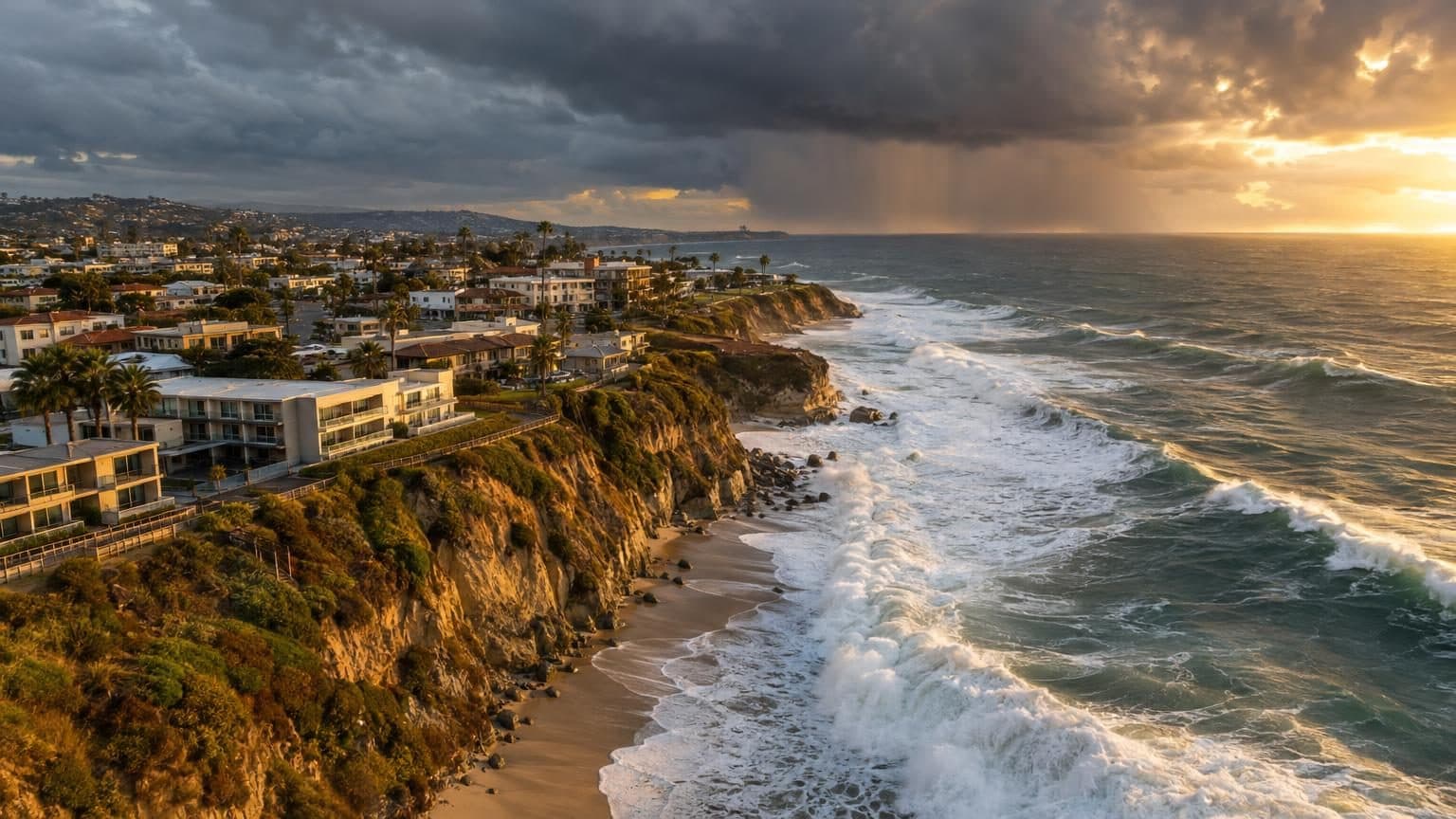
Rain is not the only risk on the coast. USGS counts 2015 to 2016 as one of the three strongest El Niños on record, with 1982 to 1983 and 1997 to 1998. That winter Southern California got 70% less rain than in the two big El Niños before it, but the waves were among the largest ever recorded, and most California beaches studied eroded past their historical extremes.6
In Florida, El Niño can shift the subtropical jet stream far enough south to lie over the peninsula, with stronger winds than normal and more wind shear, which raises the odds of an active spring severe weather season. The National Weather Service in Melbourne expected one in 1998 for that reason, and on February 22 to 23, 1998, seven significant tornadoes hit central Florida overnight.7
These patterns are odds, not certainties: no impact is assured in any El Niño, even the strongest.
Hail, tornadoes and hurricanes
Spring (March to May) tornadoes and hailstorms in the southern central US tend to be less frequent during El Niño and more frequent during La Niña, a 2015 study in Nature Geoscience found. El Niño weakens the surface winds that carry warm, moist air from the Gulf of Mexico over Texas and neighboring states.8
The El Niño or La Niña state of midwinter often lasts into spring, so it helps predict spring tornado and hail activity. The link for summer storms, when severe storms peak across much of the US, is less clear.
El Niño tends to suppress Atlantic hurricane activity, mainly through stronger vertical wind shear, and to favor stronger activity in the central and eastern Pacific. NOAA wrote in May 2014 that in a high activity Atlantic era, such as the one in place since 1995, El Niño typically brings a near normal Atlantic season.9
Region by region
| Region | Typical El Niño winter | Past impacts on record |
|---|---|---|
| Gulf Coast, Texas to Florida | Wetter than average in more than 80% of events in the 100 years before 2014 | Central Florida tornado outbreak, February 22 to 23, 1998 |
| California and the Southwest | Wetter more reliably in strong events; a weak link in weak and moderate ones | California flooding and landslides in 1982 to 1983 and 1997 to 1998; most California beaches studied eroded past historical extremes in 2015 to 2016 |
| Ohio Valley | Drier than average | |
| Pacific Northwest and northern Rockies | Drier, a less reliable signal | Several Pacific Northwest beaches retreated in 2015 to 2016; after 1997 to 1998, some took a decade to recover |
| Northern US | Milder than average, less stormy | |
| Hawaii | Often drier, late fall to early spring |
Flood insurance facts for the season
- Most business insurance does not cover flood damage.
- Under federal rules, the most NFIP building coverage available is $500,000 per building, both for nonresidential buildings and for other residential buildings, including multifamily buildings.11
- NFIP contents coverage tops out at $500,000 for nonresidential property, such as a business's equipment, furniture and inventory, and at $100,000 for residential property.3,12,11
- Building and contents coverage are typically bought separately and have separate deductibles.
- In many cases a new NFIP policy goes into effect 30 days after purchase, so a policy bought once storms arrive may not be in force in time.4
- Keep business records digitally, with backups, or away from the property. Detailed accounting receipts help the adjuster handle a flood claim quickly and accurately.
Some items are not covered by an NFIP policy no matter the cause of flooding, including property outside an insured building, such as landscaping, decks, fences and swimming pools, and financial losses caused by business interruption.3
How Cloudbreak helps
Pre-loss documentation
A dated record of every roof section, elevation and rooftop unit, in photos, drone video and notes, with original files and timestamps intact.
Storm monitoring
Our proprietary predictive storm engine, built with AI and backed by meteorologists, watches every building against its own roof-based thresholds; our on-call team picks up urgent matches within 15 minutes, day or night.
Policy review
Your deductibles, limits, exclusions and roof endorsements read against each property, with questions for your broker; a licensed broker approves every report.
Questions
- Is there an El Niño in 2026?
- Yes. NOAA's Climate Prediction Center has an El Niño Advisory in effect. On October 8, 2026 it said El Niño continues to strengthen, with a strong to very strong event likely through January to March 2027 (a chance of more than 83%).1
- What will El Niño mean for winter 2026 to 2027 in the US?
- NOAA's winter outlook favors wetter than average conditions across the southern US from California to Florida and along the East Coast, warmer than average temperatures in the North, and drier than average conditions in Hawaii, much of Alaska and the northern Mountain West.2
- Does El Niño cause more property damage?
- It tilts the odds toward certain winter weather, such as wetter conditions across much of the South. The two strongest El Niños before 2014 brought heavy rain, flooding and landslides to California, the 2015 to 2016 event brought record beach erosion on the West Coast, and a deadly central Florida tornado outbreak struck during the strong 1997 to 1998 El Niño. NOAA notes these impacts are not ensured in every El Niño, not even the strongest.5,13,6,7
- Does El Niño mean fewer hurricanes?
- In the Atlantic, El Niño tends to suppress hurricane activity through stronger wind shear; in the central and eastern Pacific it tends to favor more activity.
- Does business insurance cover El Niño flooding?
- Most business insurance does not cover flood damage. NFIP building coverage tops out at $500,000 per nonresidential or multifamily building, and contents coverage at $500,000 for nonresidential property and $100,000 for residential property. In many cases a new NFIP policy takes effect 30 days after purchase.3,4,11
Cloudbreak
The owner-side property protection team for commercial and multifamily owners in storm country: a dated record of every building, nightly storm checks and a review of your policy, before a loss.
Sources
Written by the Cloudbreak team. Numbers, dates and rules cite the published sources below.
- 1. NOAA Climate Prediction Center: El Niño/Southern Oscillation (ENSO) Diagnostic Discussion, October 8, 2026
- 2. NOAA: El Nino looms large over U.S. Winter Outlook (October 15, 2026)
- 3. FEMA National Flood Insurance Program: Buy a Flood Insurance Policy
- 4. FEMA National Flood Insurance Program: Important Reminder for Your Clients (30-day waiting period, April 2024)
- 5. NOAA Climate.gov: United States El Niño Impacts (June 12, 2014)
- 6. U.S. Geological Survey: Severe Erosion on U.S. West Coast during 2015 to 16 El Niño (March 31, 2017)
- 7. National Weather Service Melbourne: February 1998 Central Florida Tornado Outbreak
- 8. NOAA Climate.gov: El Niño and La Niña affect spring tornadoes and hailstorms (June 5, 2015)
- 9. NOAA Climate.gov: Impacts of El Niño and La Niña on the hurricane season (May 30, 2014)
- 10. NOAA Climate Prediction Center: North American Winter Features: El Niño and La Niña
- 11. U.S. Government Publishing Office: 44 CFR 61.6 (FEMA): Maximum amounts of coverage available, October 1, 2025 edition
- 12. FEMA National Flood Insurance Program: Why Businesses Need Flood Insurance (December 2024)
- 13. NOAA Climate.gov: U.S. winter precipitation during every El Niño since 1950 (October 24, 2018)