Secondary water resistance
Roofing and building · Cloudbreak team · Updated October 29, 2026 · 5 sources
How it works
A roof deck is built from panels with joints between them. When wind strips the roof covering but leaves the deck in place, rain can drain in through those joints and soak the insulation, ceilings and contents below. SWR seals the joints, or covers the deck with a waterproof layer, so the deck keeps shedding most of the water until the roof is repaired.
Common methods tape the deck seams with self-adhered membrane before the underlayment goes down, or cover the whole deck with a fully adhered membrane. It is easiest to add when a roof is replaced and the deck is bare.
IBHS's FORTIFIED Home program assumes a roof cover will be lost in a significant high-wind event and requires a sealed roof deck as the backup for a FORTIFIED Roof.2,1
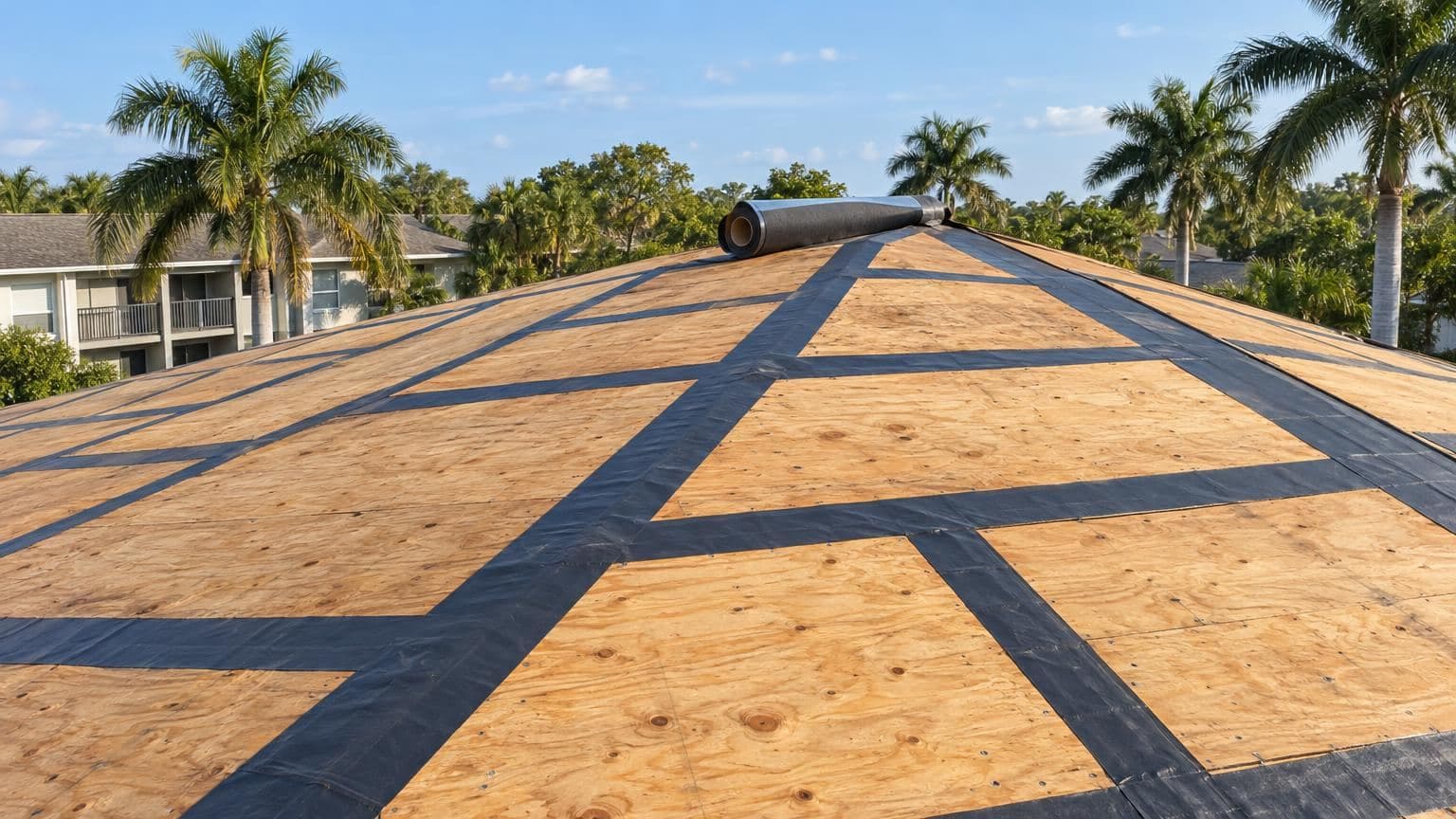
Example: IBHS tests
IBHS ran its first wind-driven rain test of a sealed roof deck at its research center in summer 2011. Later full-scale tests removed the roof cover and measured how much wind-driven rain came through bare and sealed decks.1,2
| Test | Finding |
|---|---|
| 2011 duplex, one half with a sealed roof deck | Adjusters estimated the unsealed half would cost three times more to repair; the sealed deck cost about $500 |
| Sealed roof deck overall | Water entry cut by as much as 95% compared with a bare deck |
| Tape over deck seams, roof cover and underlayment gone | Water entry cut at least 85% next to the eaves and at least 97% in nearly all other zones |
| Synthetic underlayment with taped seams | Water entry cut at least 93% in nearly every roof zone |
Florida rules
Florida records whether a building has SWR on its Uniform Mitigation Verification Inspection Form, OIR-B1-1802. Form OIR-B1-1802 accepts four kinds of sealed roof deck. Standard underlayment or hot-mopped felts do not qualify.3
- Fully adhered polymer-modified bitumen underlayment complying with ASTM D1970.3
- Tape over the roof deck seams under felt or synthetic underlayment: a strip at least 3.75 inches (95 mm) wide of ASTM D1970 self-adhering membrane or AAMA 711 Level 3 flashing tape.3
- Two layers of felt or synthetic underlayment with no tape: ASTM D226 Type II, ASTM D4869 Type III or IV, or ASTM D8257.3
- Spray foam installed along rafter and deck intersections and all panel joints.3
Section R908.7.2 of the 2023 Florida Building Code, Residential (8th edition), requires a secondary water barrier when a roof covering is removed and replaced on an existing structure with a wood roof deck; Boca Raton's re-roof packet quotes the same rule from Existing Building Section 706.7.2. Roofs with slopes under 2:12 that have a continuous roof system, and clay or concrete tile installed to code, are deemed to comply.4,5
Where you'll see it in Florida
- Question 8 of Florida's form OIR-B1-1802, "Sealed Roof Deck/Secondary Water Resistance (SWR)", answered A (sealed roof deck), B (none) or C (unknown or undetermined). At least one photo or document must back up the answer.3
- A FORTIFIED Home Roof, Silver or Gold certificate may be attached to validate the sealed roof deck answer instead.3
- The form is adopted by Rule 69O-170.0155, F.A.C., signed by a qualified inspector listed in section 627.711(2), Florida Statutes, and valid for up to five years if the structure has no material changes. It notes that some items may not qualify for a discount.3
- Multifamily buildings: the same form has a "flat roof" geometry answer for buildings with five or more units where at least 90% of the main roof slopes less than 2:12.3
- Florida re-roof permit packets, such as Boca Raton's, which ask which secondary water barrier method will be used and its manufacturer and product approval number.5
Questions
- How much water does a sealed roof deck keep out?
- IBHS found a sealed roof deck can cut water entry by as much as 95% compared with a bare deck. With the roof cover and underlayment gone, taped deck seams cut it by at least 85% next to the eaves and at least 97% in nearly all other zones.1,2
- Does synthetic underlayment count as secondary water resistance?
- Not as a single standard layer. Florida's form OIR-B1-1802 counts two layers of ASTM D226 Type II, ASTM D4869 Type III or IV, or ASTM D8257 underlayment, or felt or synthetic over taped deck seams.3
- How does an inspector verify a sealed roof deck?
- Florida's form OIR-B1-1802 requires at least one photo or document proving the answer to question 8. A FORTIFIED Roof, Silver or Gold certificate may also validate it.3
- Is secondary water resistance required on a new roof in Florida?
- Section R908.7.2 of the 2023 Florida Building Code, Residential, requires a secondary water barrier when the roof covering is removed and replaced on an existing structure with a wood roof deck. Continuous roof systems under 2:12 slope and code-installed clay or concrete tile roofs are deemed to comply.4,5
Cloudbreak
Cloudbreak records every roof section and rooftop unit before a storm, in photos, drone video and notes, so each roof's condition on a given date is on file.
Sources
Written by the Cloudbreak team. Numbers, dates and rules cite the published sources below.
- 1. IBHS: A Brief History of IBHS Sealed Roof Deck Research (July 21, 2020)
- 2. IBHS: Building Vulnerability to Wind-Driven Rain Entry and Effectiveness of Mitigation Techniques (Brown, Quarles, Giammanco and Brown, ICWE14)
- 3. Florida Office of Insurance Regulation: Uniform Mitigation Verification Inspection Form OIR-B1-1802 (Rev. 04/26)
- 4. Florida Building Commission (code text via UpCodes): Florida Building Code, Residential, 8th Edition (2023), Section R908.7.2: Roof Secondary Water Barrier for Existing Structures With Wood Roof Decks
- 5. City of Boca Raton Building Department: Re-Roofing Mitigation Package (quotes Florida Building Code, Existing Building, 8th Edition (2023), Section 706.7.2)