Quarter-size hail
Hail and wind · Cloudbreak team · Updated October 29, 2026 · 12 sources
How it works
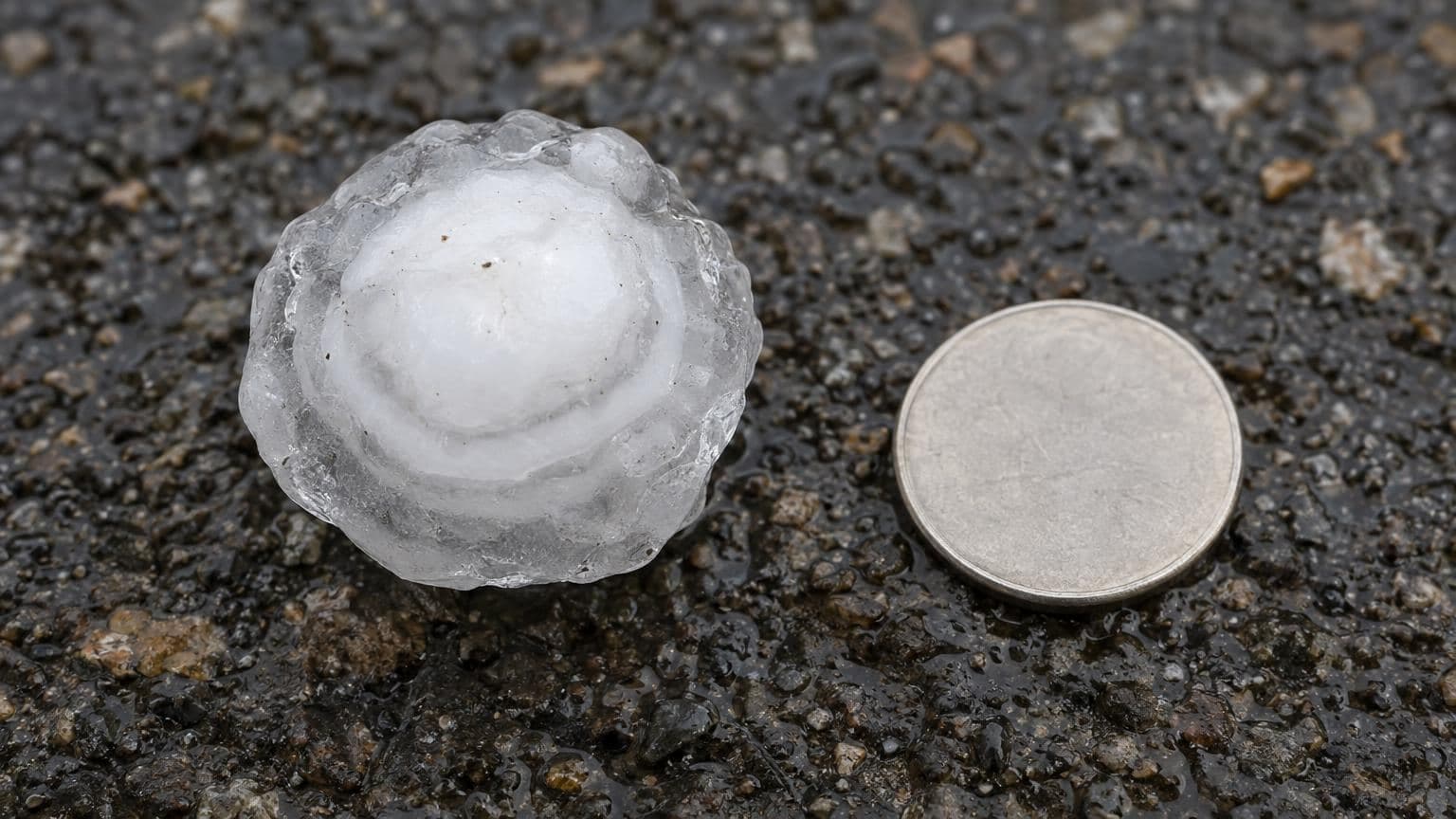
Few people measure hail, so size is usually reported by comparing stones with coins and balls of known width. On the National Weather Service scale, a penny is 0.75 inch, a nickel 0.88, a quarter 1.00, a half dollar 1.25 and a golf ball 1.75.1
Quarter size is where hail starts to count. A thunderstorm is severe when it has hail at least 1 inch across, gusts of 58 mph or more, or a tornado. Until January 5, 2010, the hail line was 3/4 inch (penny size).2,3
Since August 2, 2021, 1.00 inch has also been the bottom of the warning damage scale. A base warning covers 1.00 inch hail or 58 mph winds. The considerable level starts at 1.75 inches or 70 mph, and destructive at 2.75 inches or 80 mph. Only destructive warnings trigger a Wireless Emergency Alert.4
Example: how hard it hits
| Hail size | Median density | Near solid ice |
|---|---|---|
| 1.00 in. (quarter) | 0.8 ft-lb (1.1 J), 44 mph | 1.4 ft-lb (1.9 J), 49 mph |
| 1.25 in. (half dollar) | 2.1 ft-lb (2.8 J), 49 mph | 3.4 ft-lb (4.6 J), 56 mph |
| 1.75 in. (golf ball) | 8.1 ft-lb (10.9 J), 58 mph | 13.3 ft-lb (18.1 J), 66 mph |
| 2.00 in. (hen egg) | 13.8 ft-lb (18.8 J), 63 mph | 22.9 ft-lb (31.0 J), 71 mph |
Energy grows far faster than size. At median density, a 1.75-inch stone carries about 10 times the energy of a quarter-size stone (8.1 vs 0.8 ft-lb), though it is only 1.75 times as wide.5
Roof impact tests start above quarter size. Class 1 in UL 2218 uses a 1.25-inch steel ball, and Class 1 in the July 2005 edition of FM 4473 uses a 1.25-inch ice ball at 3.72 ft-lb (5.0 J). Class 4 in both uses a 2-inch ball.6,7
Wind adds energy. In an idealized IBHS calculation with a steady 60 mph horizontal wind, many measured stones of about 1 to 1.25 inches had energies approaching that of a Class 2 (1.5-inch) test projectile.8,6
Where you'll see it
- NWS Severe Thunderstorm Warnings, issued for hail 1 inch or larger. A warning with no damage tag is at the base level.3,4
- SPC Severe Thunderstorm Watches, which outline where organized hail 1 inch or larger is expected over 2 to 8 hours.2
- SPC Storm Reports, built from NWS local storm reports, with remarks such as "QUARTER SIZED HAIL". The NCEI Storm Events Database holds the final record.2
- Roof hail investigation reports, such as RICOWI's, which record the estimated largest hailstone at each inspected site.9
What 1-inch hail does to roofs
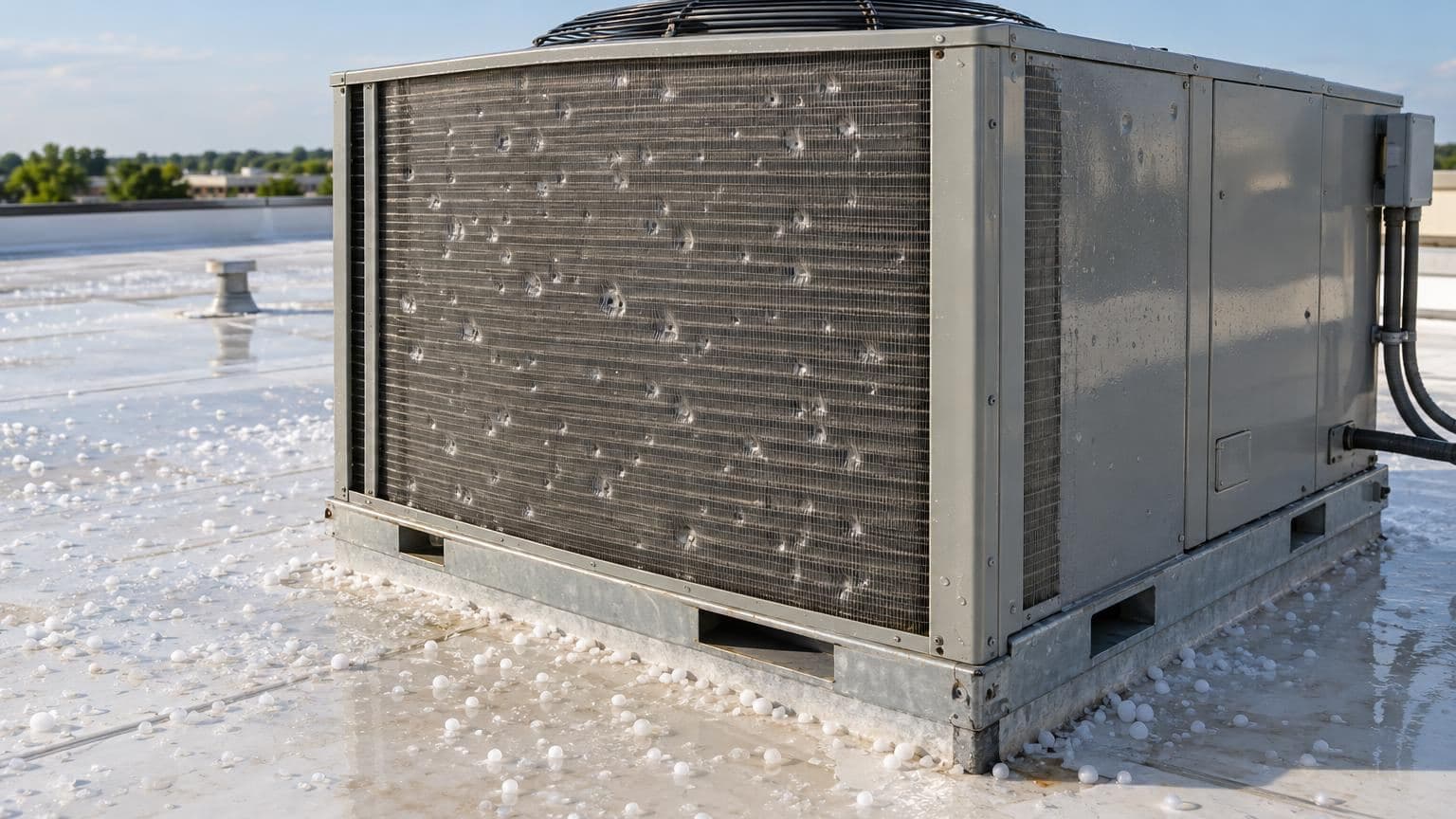
Quarter size is near the point where hail starts to damage common roof coverings. Whether it does depends mostly on the material and its age and condition: new, sound roofs usually show little or nothing, while weathered or brittle coverings and thin metal, such as the fins on rooftop condensers, are more vulnerable.
In Haag Engineering ice-ball tests published in 2002, 1-inch stones damaged only 1 of 9 roofing products: 11-year-old organic-mat 3-tab shingles, on half of the hits. Field surveys in the same paper put the onset of damage at these sizes:10,11
| Roof covering | Onset (inches) |
|---|---|
| 3-tab asphalt shingles | 1.00 |
| 30-year laminated shingles | 1.25 |
| Cedar shingles | 1.25 |
| Medium cedar shakes | 1.50 |
| Fiber-cement tiles | 1.50 |
| Concrete tiles | 1.75 |
| Built-up roofing with gravel | 2.50 |
After the May 24, 2011 Dallas/Fort Worth storm, RICOWI teams found almost no damage where the largest hail was under 1.0 inch, except on badly deteriorated or unsupported material. Where hail was under 1.0 inch, shingles showed no significant granule loss, even with 20 or more hits per square foot.9
Condition moves the line. FM Global shows a 20-year-old, alligatored four-ply built-up roof damaged by 1-inch hail, and calls HVAC condenser fins and coils extremely susceptible to small hail. An FM Global engineer said in 2018 that some 10-year-old roofs with no visible deficiencies were damaged by 1-inch hail.5,12
Where hail this size falls most often
Source: NOAA/NWS Storm Prediction Center. Data through November 1, 2026.
Average days a year with hail 1 inch or larger reported within 15 miles of the city center, 2016 to 2025.
| Rank | City | Days a year |
|---|---|---|
| 1 | Colorado Springs, CO | 8.9 |
| 2 | Oklahoma City, OK | 7.4 |
| 3 | Amarillo, TX | 6.2 |
| 4 | Wichita, KS | 5.9 |
| 5 | Tulsa, OK | 5.0 |
| 6 | Denver, CO | 4.8 |
| 6 | Omaha, NE | 4.8 |
| 6 | Lubbock, TX | 4.8 |
| 9 | Dallas, TX | 4.7 |
| 10 | St. Louis, MO | 4.6 |
Questions
- How big is quarter size hail?
- It is 1.00 inch (25 mm) across. It sits between nickel (0.88 inch) and half dollar (1.25 inches) on the NWS scale.1
- Is quarter size hail considered severe?
- Yes. Hail 1 inch or larger meets the National Weather Service definition of severe. Before January 5, 2010, the line was 3/4 inch (penny size).2,3
- Can quarter size hail damage a roof?
- It can on older or worn roofs. Research puts 1 inch at the start of damage for aged 3-tab shingles and roofs in poor condition. RICOWI found almost no damage below 1 inch except on deteriorated or unsupported material.10,9,5
- Can 1 inch hail damage rooftop AC units?
- FM Global calls the cooling fins and condenser coils on HVAC equipment extremely susceptible to damage from small hail, without naming a size.5

Cloudbreak
Cloudbreak's proprietary predictive storm engine, built with AI and backed by meteorologists, tracks every storm against every building, before it hits and after it passes.
Sources
Written by the Cloudbreak team. Numbers, dates and rules cite the published sources below.
- 1. NOAA National Weather Service: Glossary: Hail Size
- 2. NOAA Storm Prediction Center: SPC Frequently Asked Questions
- 3. NOAA National Weather Service, via NOAA Storm Prediction Center: Service Change Notice 09-52: National Change in Minimum Hail Size Criterion for Issuing Severe Thunderstorm Warning (SVR) and Severe Weather Statement (SVS) Products, Effective January 5, 2010
- 4. NOAA National Weather Service: New "Destructive" Severe Thunderstorm Warning Category to Trigger Wireless Emergency Alerts on Mobile Phones (July 22, 2021)
- 5. FM Global: Property Loss Prevention Data Sheet 1-34: Hail Damage (March 2018, interim revision April 2026)
- 6. IBHS: Relative Impact Resistance of Asphalt Shingles: Summary of UL 2218 Impact Tests (August 2014)
- 7. FM Approvals: FM 4473: Specification Test Standard for Impact Resistance Testing of Rigid Roofing Materials by Impacting with Freezer Ice Balls (July 2005)
- 8. IBHS: 2013 IBHS Characteristics of Severe Hail Field Research Summary (Giammanco and Brown, February 25, 2014)
- 9. RICOWI: Hailstorm Investigation Report: Dallas/Fort Worth, TX, May 24, 2011 (published May 2012)
- 10. American Meteorological Society, 21st Conference on Severe Local Storms: Hail Damage Threshold Sizes for Common Roofing Materials (Marshall, Herzog, Morrison and Smith, 2002)
- 11. NOAA National Weather Service, Albany, New York: Development of Warning Thresholds for One Inch or Greater Hail in the Albany New York County Warning Area (Eastern Region Technical Attachment 2011-05, August 2011)
- 12. FM Approvals: New Tools Can Help Reduce Losses from Hail (October 18, 2018)