Hail history in Denver, CO
On average, NOAA recorded hail within 15 miles of the center of Denver on 6.3 days a year from 2016 to 2025, 4.8 of them with hail 1 inch or larger. NOAA recorded hail within 15 miles of the center of Denver on 112 days since 2010. The largest hail reported was 4.5 in, in 2011. 92 of those days had hail of 1 inch or larger. June has the most hail days, 38 since 2010. The most recent was August 26, 2026. NOAA also recorded high wind on 82 days, with gusts up to 97 mph.
The 15 miles around the center of Denver reach into Aurora, so this page covers it too.
Ranks #6 of 200 US cities for days with hail 1 inch or larger, 2016 to 2025.
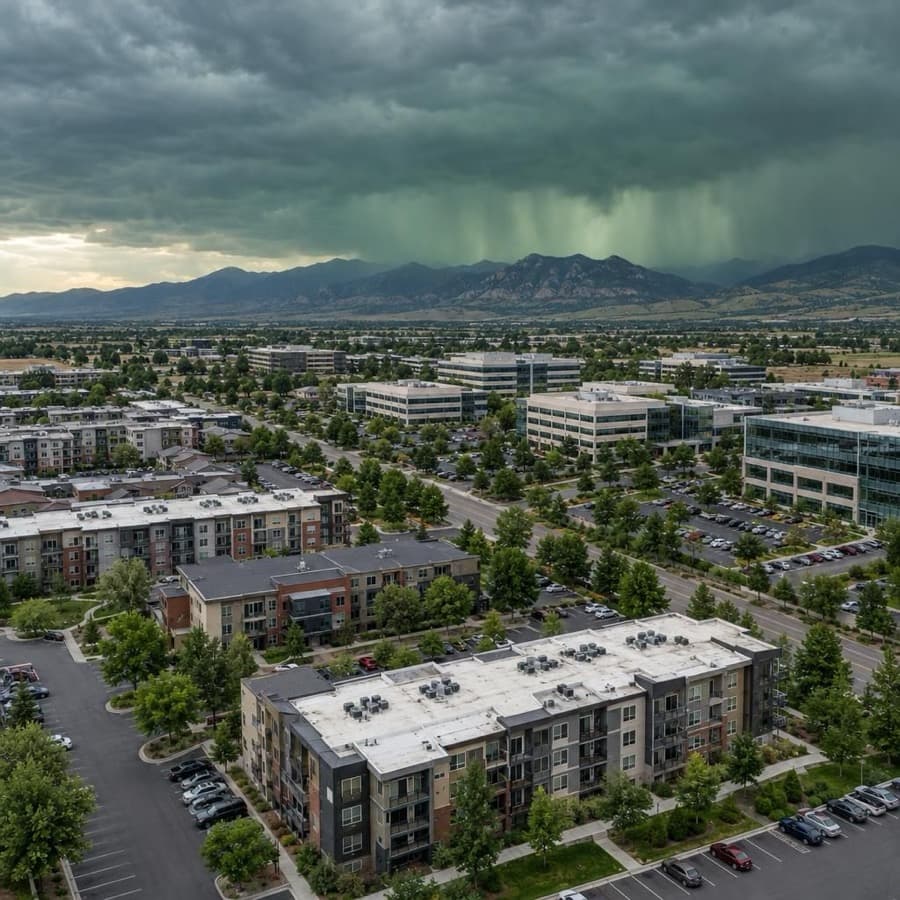
- Hail days since 2010
- 112
- Largest hail
- 4.5 in
- Highest gust
- 97 mph
Source: NOAA/NWS Storm Prediction Center
Data through November 1, 2026
112 hail days within 15 miles since 2010, largest 4.5 in
Source: NOAA/NWS Storm Prediction Center
Data through November 1, 2026
Hail days by year
Bar chart of hail days per year, 2010 to 2026. 112 hail days in total; the most was 15 in 2014.
Hail days by month
Hail days by month since 2010: Jan 0, Feb 0, Mar 0, Apr 4, May 29, Jun 38, Jul 25, Aug 13, Sep 3, Oct 0, Nov 0, Dec 0.
Most recent hail days
| Date | Largest hail | Nearest report |
|---|---|---|
| Aug 26, 2026 | 1.0 in | 11.7 mi |
| Aug 15, 2026 | 1.75 in | 13.9 mi |
| Aug 14, 2026 | 1.0 in | 9.7 mi |
| Aug 13, 2026 | 1.75 in | 10.7 mi |
| Jun 26, 2026 | 1.0 in | 11.7 mi |
| Jun 24, 2026 | 1.0 in | 12.2 mi |
| Jun 8, 2026 | 1.5 in | 10.6 mi |
| Jun 1, 2026 | 1.75 in | 2.2 mi |
| Jul 6, 2025 | 1.5 in | 2.6 mi |
| Jun 17, 2025 | 1.0 in | 10.0 mi |
About this data
- Distances are from the center of Denver, not from any one property. Look up a street address below for a single building.
- Reports come from trained spotters and the public, so they cluster near towns and roads.
- No report does not mean no hail. Hail can fall where no one is there to report it.
- This is not a damage or insurance assessment.
82 high-wind days within 15 miles since 2010, strongest gust 97 mph
Source: NOAA/NWS Storm Prediction Center
Data through November 1, 2026
Most recent high-wind days
| Date | Highest gust | Nearest report |
|---|---|---|
| Aug 29, 2026 | 58 mph | 14.0 mi |
| Aug 26, 2026 | 58 mph | 12.9 mi |
| Aug 15, 2026 | 64 mph | 14.0 mi |
| Aug 13, 2026 | Not recorded | 11.5 mi |
| Jul 22, 2026 | 62 mph | 13.7 mi |
| Jul 10, 2026 | 72 mph | 13.2 mi |
| Jun 8, 2026 | 66 mph | 13.7 mi |
| Aug 2, 2025 | 68 mph | 4.9 mi |
| Jul 22, 2025 | 60 mph | 13.9 mi |
| Jul 10, 2025 | 59 mph | 3.9 mi |
About this data
- Distances are from the center of Denver, not from any one property. Look up a street address below for a single building.
- Reports come from trained spotters and the public, so they cluster near towns and roads.
- No report does not mean no hail. Hail can fall where no one is there to report it.
- Wind speed is the highest reported gust; some reports have no speed.
- This is not a damage or insurance assessment.
Gusts, tornadoes and hurricanes in Denver
Estimated peak gusts
No day since October 1, 2021 had an estimated peak gust of 58 mph or more at Denver.
| Day | Estimated peak gust |
|---|---|
| Dec 17, 2025 | 50 mph or more |
| Jul 3, 2024 | 50 mph or more |
| Sep 2, 2022 | 50 mph or more |
| Apr 22, 2022 | 50 mph or more |
| Dec 15, 2021 | 50 mph or more |
Estimates: the highest gust of each storm day in NOAA’s hourly 2.5 km wind analysis (URMA), which fills in between weather stations. Analyses like this smooth out short thunderstorm gusts, so they are best for widespread wind (hurricanes, winter storms, high wind days); for thunderstorm wind, NOAA’s wind reports are the better record. Not a measurement at any building.
Tornadoes within 10 miles
NOAA recorded 49 tornadoes whose path came within 10 miles of Denver since 1950; the strongest was rated EF3.
| Day | Rating | Path length | Closest |
|---|---|---|---|
| Aug 14, 2026 | Not rated | 4.7 miles | |
| Apr 25, 2023 | Not rated | 0.01 miles | 7.5 miles |
| Jul 29, 2022 | Not rated | 0.01 miles | 6.3 miles |
| Jul 29, 2022 | Not rated | 0.01 miles | 7.7 miles |
| Jun 24, 2015 | EF1 | 2.8 miles | 2.1 miles |
| Jul 28, 2014 | EF0 | 0.1 miles | 6.8 miles |
| Jun 8, 2014 | EF1 | 0.25 miles | 5.7 miles |
| May 21, 2014 | EF0 | 0.1 miles | 3.8 miles |
Show all 49Show fewer
| Day | Rating | Path length | Closest |
|---|---|---|---|
| May 21, 2014 | EF0 | 0.1 miles | 5.7 miles |
| May 26, 2010 | EF0 | 0.1 miles | 6.9 miles |
| May 24, 2009 | EF0 | 0.1 miles | 4.8 miles |
| Jul 12, 1996 | EF0 | 0.1 miles | 8.1 miles |
| Jun 6, 1995 | EF0 | 0.1 miles | 10 miles |
| Jul 9, 1993 | EF0 | 0.1 miles | 1.7 miles |
| Jun 2, 1993 | EF1 | 0.1 miles | 3.1 miles |
| Aug 22, 1991 | EF0 | 0.1 miles | 3.3 miles |
| Jul 9, 1990 | EF0 | 0.3 miles | 3.3 miles |
| Jun 30, 1990 | EF0 | 0.1 miles | 8.1 miles |
| May 29, 1990 | EF0 | 0.8 miles | 3.4 miles |
| Jun 8, 1989 | EF1 | 0.1 miles | 3.3 miles |
| Jun 15, 1988 | EF3 | 2.5 miles | 3.4 miles |
| Jun 15, 1988 | EF2 | 0.5 miles | 3.4 miles |
| Jun 10, 1988 | EF0 | 0.1 miles | 2.8 miles |
| Jun 10, 1988 | EF0 | 0.2 miles | 4 miles |
| Jun 8, 1988 | EF1 | 0.5 miles | 8.1 miles |
| Jun 12, 1987 | EF0 | 0.1 miles | 3.4 miles |
| May 12, 1987 | EF1 | 0.7 miles | 3.4 miles |
| Jun 8, 1986 | EF2 | 1.1 miles | 2.9 miles |
| Jun 3, 1985 | EF1 | 0.5 miles | 8.2 miles |
| Jun 3, 1985 | EF1 | 0.5 miles | 2.8 miles |
| Jul 6, 1984 | EF1 | 1 miles | 3.5 miles |
| Jun 3, 1984 | EF1 | 2 miles | 2.8 miles |
| Jun 3, 1982 | EF0 | 0.3 miles | 7.9 miles |
| Aug 16, 1981 | EF0 | 0.5 miles | 8.6 miles |
| Jun 3, 1981 | EF2 | 2.3 miles | 9.1 miles |
| Jun 3, 1981 | EF2 | 0.1 miles | 7.7 miles |
| Jun 2, 1981 | EF1 | 0.5 miles | 9.2 miles |
| May 28, 1981 | EF1 | 0.1 miles | 4 miles |
| Sep 14, 1976 | EF0 | 0.1 miles | 8.6 miles |
| Sep 14, 1976 | EF0 | 0.1 miles | 9.7 miles |
| May 30, 1976 | EF2 | 5.4 miles | 2.6 miles |
| May 18, 1975 | EF3 | 4.1 miles | 8.5 miles |
| Jul 28, 1974 | EF0 | 0.1 miles | 8.6 miles |
| Apr 19, 1971 | EF0 | 0.3 miles | 6.9 miles |
| Jul 3, 1967 | EF0 | 0.1 miles | 6.1 miles |
| Jun 9, 1967 | EF0 | 0.1 miles | 3.3 miles |
| Jun 9, 1967 | EF1 | 0.3 miles | 4.7 miles |
| May 30, 1967 | EF1 | 0.5 miles | 5.4 miles |
| Apr 11, 1966 | EF0 | 0.1 miles | 5 miles |
Source: NOAA/NWS Storm Prediction Center. Ratings before 2007 are on the original Fujita scale.
Hurricanes and tropical storms
No hurricane or tropical storm in NOAA's records brought modeled tropical-storm-force winds (39 mph) to Denver.
Modeled from NOAA’s best tracks for open, flat ground; not measurements. How we model hurricane winds
74 radar hail days within 15 miles since 2020, largest 3.0 in or more
Source: NOAA MRMS radar (MESH), from October 14, 2020. Estimates of the largest hail in each 1 km cell, not measurements.
47 days with radar hail 1 inch or larger, 6 at 2 inches or larger, within 15 miles of Denver’s center.
Biggest radar hail days
- 0.75 in+
- 1.0 in+
- 1.5 in+
- 2.0 in+
- 2.5 in+
- 3.0 in+
Most recent radar hail days
| Date | Largest radar estimate |
|---|---|
| Sep 25, 2026 | 0.75 in or more |
| Sep 6, 2026 | 1.0 in or more |
| Aug 26, 2026 | 1.0 in or more |
| Aug 22, 2026 | 1.0 in or more |
| Aug 15, 2026 | 1.75 in or more |
| Aug 14, 2026 | 1.5 in or more |
Storms in Denver
Across Colorado, severe hail reports peak in mid-June, while thunderstorm wind gusts are most frequent in early to mid-July, per the Colorado Climate Center.1
Notable storms
- May 30, 2024A late-evening hailstorm tracked from northeast Broomfield across Thornton, Northglenn and Commerce City, then through Green Valley Ranch and northern Aurora between 9:30 and 11 p.m., per NWS Boulder. Hail reached baseball size in the Northfield area.2,3
- June 19, 2018Hail up to 3 inches across fell in Englewood, with 2.5-inch hail near Buckley Air Force Base, per NOAA's storm records. They report roofs that collapsed under hail, major hail damage across the northern Denver metro area and $276.4 million in property damage from the storm.4,5
- May 8, 2017A supercell that formed in the foothills west of Denver dropped hail up to baseball size across Denver and the western suburbs of Arvada, Lakewood and Wheat Ridge, per NWS Boulder, and radar estimates showed a swath of golf ball-size or larger hail 9 miles wide. NOAA's storm records list about $2.3 billion in property damage in the area.6,7
- July 13, 2011Hail up to golf ball size, heavy rain and gusts to 59 mph at Denver International Airport damaged 40 planes and 83 cars in airport lots, per NOAA's storm records, which list $164.8 million in property damage across the urban corridor.8
- July 20, 2009Late that evening a wet microburst with gusts to 80 mph and hail up to golf ball size hit Arvada, Wheat Ridge and Lakewood, downing hundreds of trees and snapping power poles, per NOAA's storm records. NOAA counts the storm as a billion-dollar disaster, about $1.5 billion in damage adjusted for inflation.9,10,11
- July 11, 1990A hailstorm that lasted more than 3 hours made a direct hit on Denver, per the Colorado Climate Center. NOAA puts its damage at about $2 billion adjusted for inflation, the most for any Colorado hailstorm at the time.12,10,11
Warnings and alerts
Warnings for Denver come from the National Weather Service office in Denver/Boulder.13 The City and County of Denver sends Reverse Emergency Notifications by call, text or email to residents who sign up with their home, work or school locations.14
Sources
- 1. Colorado Climate Center: Ramping up to peak severe thunderstorm and tornado season in Colorado
- 2. NWS Boulder: Denver Monthly Climate Summary, May 2024
- 3. NOAA NCEI Storm Events Database: Hail, Denver County, May 30, 2024
- 4. NOAA NCEI Storm Events Database: Hail, Arapahoe County, June 19, 2018 (Englewood)
- 5. NOAA NCEI Storm Events Database: Hail, Arapahoe County, June 19, 2018 (Buckley Air Force Base)
- 6. NWS Boulder: Top 12 Events of the 2010s in Colorado: May 8, 2017 Metro Denver
- 7. NOAA NCEI Storm Events Database: Hail, Jefferson County, May 8, 2017
- 8. NOAA NCEI Storm Events Database: Hail, Adams County, July 13, 2011
- 9. NOAA NCEI Storm Events Database: Hail, Jefferson County, July 20, 2009
- 10. NOAA NCEI: Billion-Dollar Weather and Climate Disasters: Events (CSV)
- 11. Denver7: At least 75 $1B+ climate disasters have impacted Colorado in the past 44 years, NOAA says
- 12. Colorado Climate Center (CoCoRaHS archive): Hail, Hail, Hail! The Summertime Hazard of Eastern Colorado
- 13. National Weather Service: Forecast for Denver, CO
- 14. City and County of Denver: Alerts, Notifications, and Warnings
Free hail history
See the hail history near your property.
Enter a street address to see every day since 2010 with NOAA hail and wind reports within 10 miles.
Get a hail report for your whole portfolio.
Send us your properties and we’ll pull the NOAA hail history for every address. Then Cloudbreak watches each one, and you hear from us when a storm tracks toward it.
Questions about hail in Denver
Source: NOAA/NWS Storm Prediction Center
Data through November 1, 2026
- How often does it hail in Denver?
- NOAA recorded hail within 15 miles of the center of Denver on 6.3 days a year on average from 2016 to 2025, 4.8 of them with hail 1 inch or larger. Since 2010 it recorded 112 hail days.
- When is hail season in Denver?
- June has the most hail days within 15 miles of the center of Denver, 38 since 2010, then May (29) and July (25).
- What is the largest hail recorded in Denver?
- 4.5 in, in 2011: the largest hail NOAA recorded within 15 miles of the center of Denver since 2010.
- When did it last hail in Denver?
- NOAA's most recent hail report within 15 miles of the center of Denver is from August 26, 2026, with hail up to 1.0 in reported 11.7 miles from the center. Data through November 1, 2026.