TPO vs EPDM
Roofing and building · Cloudbreak team · Updated October 29, 2026 · 12 sources
Definition
TPO (thermoplastic polyolefin) and EPDM (ethylene propylene diene terpolymer) are single-ply membranes for low-slope roofs. TPO softens with heat, so its seams are welded; EPDM is a vulcanized rubber that does not soften, so its seams are bonded with primer and tape.
How it works
The seam is the main practical difference. A welded TPO lap fuses the two sheets into one piece of plastic. An EPDM lap is glued with primer and seam tape, because cured rubber cannot be melted back together.
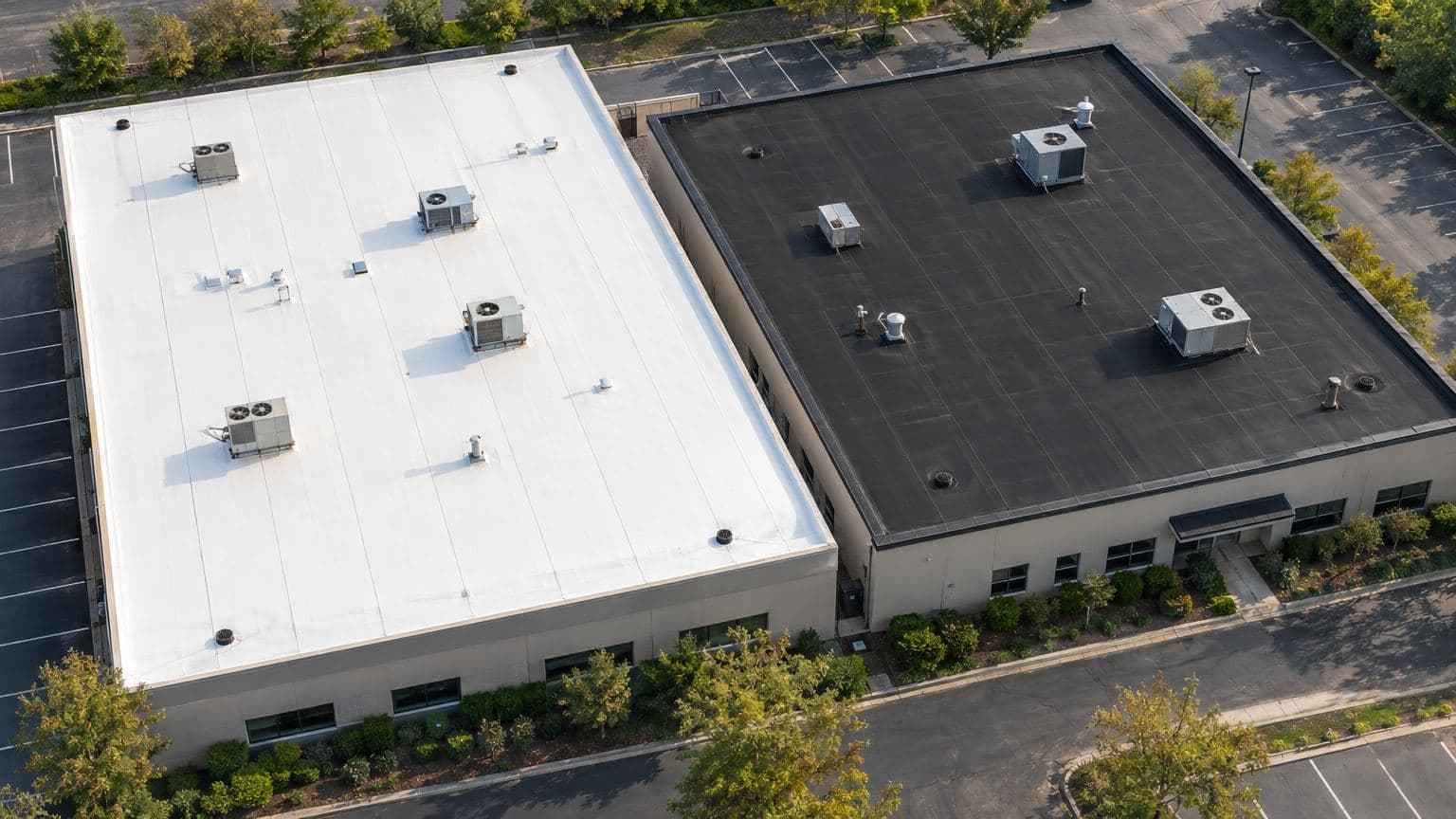
Both come in rolls in several thicknesses and can be fully adhered, mechanically fastened or ballasted. TPO is usually white and reflects sunlight. EPDM is usually black and absorbs it, though white EPDM is also made.
Hail resistance depends on the whole assembly and its age as much as on the membrane. On mechanically fastened roofs, the spots over fastener plates are weak points.
| TPO | EPDM | |
|---|---|---|
| Material | Thermoplastic polyolefin; softens when heated | Thermoset synthetic rubber, vulcanized |
| Reinforcement | Polyester scrim between two TPO plies | None in ASTM D4637 Type I sheets |
| Seams | Hot-air welded, at least 1.5 inches wide in mechanically fastened systems | Primer plus factory-applied or hand-applied seam tape |
| Material standard | ASTM D6878 | ASTM D4637 |
| Thicknesses offered | 45, 60 or 80 mil | 45, 60 or 90 mil |
| Reflectivity | White: solar reflectance 0.79 new, 0.70 after 3 years; SRI 99 new, 85 aged | White: solar reflectance 0.76 new, 0.64 after 3 years; SRI 105. Black: SRI 9 |
| Estimated useful life | 20 years (Fannie Mae PCA table) | 20 years (same table line) |
| Hail, lab | New sheets passed two 2-inch ice balls in the field of the sheet; every thickness failed over a fastener plate | 76 of 81 new and aged 60-mil sheets did not split under ice balls up to 3 inches |
| Hail, field (North Texas, April 11, 2016) | Two unballasted thermoplastic roofs (type not stated), 12 to 15 and over 15 years old, fractured at fastener plates in 1.25 to 1.5-inch hail | Three roofs hit by 1 to 3-inch hail: no punctures or fractures |
What the hail studies show
The lab tests had different sponsors. Researchers at a TPO maker tested one brand of each material, and the EPDM Roofing Association, an industry group, commissioned the EPDM work. RICOWI's 2017 report says its three hail surveys show aggregate-ballasted built-up roofs and unreinforced EPDM, especially with No. 4 ballast, performed successfully against hail over 2 inches.7,8,9
FM Data Sheet 1-34 (March 2018, revised April 2026) says thicker membranes and harder cover boards reduce damage, and that many roofs turn brittle with age: a 15-year-old single-ply roof fractured in about 1.75-inch hail that spared 10-year-old areas of the same construction.11
Example
The TPO study fired two 2-inch ice balls at each spot at 23.75 to 26.13 ft-lb, a Class 4 criterion its authors equate to a 2-inch ice ball falling at about 75 mph. New sheets passed the 2-inch shots in the field of the sheet; every thickness failed over a fastener plate.8
The EPDM study went up to 3-inch ice balls, and unreinforced EPDM mostly survived them. By FM Data Sheet 1-34's table, a nearly solid 3-inch hailstone carries 117.8 ft-lb, about 5 times the 22.9 ft-lb of a 2-inch stone.7,11
The studies differ in lab, sponsor and failure criteria, so this is not a head-to-head result. The TPO failures came over fastener plates, and the EPDM authors called direct hits over fasteners and plates extremely rare on the hundreds of roofs they examined.7,8
Where you'll see it
- Product data sheets: the ASTM standard met (D6878 or D4637), thicknesses, seam method and Cool Roof Rating Council reflectance.3,5
- Property condition assessments: Fannie Mae's estimated useful life table lists EPDM and TPO on one line at 20 years.10
- Insurer hail ratings: FM Approved roof assemblies (Class 4470) are rated MH, SH or VSH, tested at 8, 14 and 53 to 58 ft-lb.11
- Post-storm field reports: RICOWI's hail and hurricane investigations rate damage by roof type, hail size and attachment.9,12
Questions
- Is TPO or EPDM better for hail?
- No single test settles it. In separate lab tests, 76 of 81 unreinforced 60-mil EPDM samples did not fail under ice balls up to 3 inches. New TPO passed 2-inch ice balls in the field of the sheet but failed over fastener plates. In RICOWI's April 11, 2016 North Texas survey, three EPDM roofs hit by 1 to 3-inch hail had no punctures or fractures.7,8,9
- How long does a TPO or EPDM roof last?
- Fannie Mae's multifamily property condition assessment table gives both 20 years. FM Data Sheet 1-34 puts the average life of single-ply roofs at 14 to 18 years, depending on heat, UV, moisture, foot traffic, storms and manufacturer.10,11
- Is TPO more reflective than EPDM?
- White TPO and white EPDM are close; black EPDM is far less reflective. In one manufacturer's data, white TPO has a solar reflectance of 0.79 new and 0.70 after 3 years (SRI 99); white EPDM, 0.76 and 0.64 (SRI 105). Its black EPDM has an SRI of 9.3,5,6
- Can EPDM seams be heat welded?
- No. EPDM is a cured rubber that does not soften with heat, so its seams are bonded with primer and tape. TPO, a thermoplastic, is welded with hot air.
Cloudbreak
Cloudbreak records every roof section and rooftop unit before a storm, in photos, drone video and notes, so each roof's condition on a given date is on file.
Sources
Written by the Cloudbreak team. Numbers, dates and rules cite the published sources below.
- 1. National Roofing Contractors Association (NRCA): Glossary: Ethylene propylene diene terpolymer (EPDM)
- 2. National Research Council Canada: Thermoplastic Polyolefin Roofing Membranes, Construction Technology Update No. 30 (Paroli, Liu and Simmons, December 1999)
- 3. Carlisle SynTec Systems: Sure-Weld TPO Reinforced Membrane (Standard and HS): Product Data Sheet (December 3, 2025)
- 4. Carlisle SynTec Systems: Sure-Weld TPO Reinforced Membrane: Product Data Sheet (Minimum Thickness)
- 5. Carlisle SynTec Systems: Sure-Seal EPDM Kleen Non-Reinforced Membranes: Product Data Sheet (May 12, 2021)
- 6. Carlisle SynTec Systems: Sure-Seal, Sure-White, Sure-Tough Adhered EPDM Roofing System: Form-Spec (July 2026)
- 7. EPDM Roofing Association: Hail Impact Testing of EPDM Roof Assemblies (Koontz and Hutchinson, for the EPDM Roofing Association)
- 8. Professional Roofing, NRCA: A Lasting Impression (Bhawalkar, Taylor and Yang of GAF, June 2016)
- 9. RICOWI: Hailstorm Investigation Report: North Texas, April 11, 2016 (published April 30, 2017)
- 10. Fannie Mae: Instructions for Performing a Multifamily Property Condition Assessment (Version 2.0), Appendix F: Estimated Useful Life Tables
- 11. FM Global: Property Loss Prevention Data Sheet 1-34: Hail Damage (March 2018 edition, interim revision April 2026)
- 12. RICOWI: Wind Investigation Report: Hurricane Michael (October 28, 2019)