How to show when hail hit a building
Short answer
Showing when hail hit a building takes two kinds of evidence that agree: weather records that put hail near the site on a date, and marks on the building that fit that date, judged by how fresh they are and which parts, installed on known dates, carry them. Weather records are approximate, so evidence on the site carries the most weight, and dated notes and photos from earlier roof inspections give something to compare it with. Spatter marks tend to fade from oxidized surfaces after a year or two, so the best evidence of a recent storm is temporary and worth recording soon after it.1
Cloudbreak team · Updated October 28, 2026 · 6 min read · 20 sources
Weather records for the date
Start with NOAA's Storm Prediction Center (SPC) storm reports and the NCEI Storm Events Database, which give dates, reported hail sizes and approximate locations. They support a date but do not prove it alone. Read them with these limits in mind:
- Each SPC storm report page covers 1200 UTC to 1159 UTC the next day, which is 6 a.m. Central Time, so hail before that hour sits on the previous date's page.2,1
- Storm Data, the source of the Storm Events Database, records times in local standard time all year, so a 6:30 p.m. storm on Central daylight time is entered as 1730 CST.3,4
- Reports can lag the storm: evening storms reported the next day, storms after business hours on Friday reported on Monday, and some large events reported days to weeks later.5
- When the date is vague, a 2025 forensic engineering paper recommends reviewing weather data at least 30 days before and after it.5
- Locations are approximate. Storm Data places an event by latitude and longitude or by distance and direction from the center of a town, airport or inland lake. In a Tulsa, Oklahoma storm on April 4, 2017, the places described in SPC reports were 1.6 to 4.6 miles from the listed coordinates.3,6,5
- A missing record in NCEI's Severe Weather Data Inventory does not mean no severe weather occurred. In a Missouri storm on May 4, 2020, radar showed hail likely fell for about 20 minutes at a site in a 24-mile gap between two hail reports.7,5
NCEI, the official keeper of NWS weather records, certifies Storm Events reports on request. CoCoRaHS volunteers also report when hail started and turn in dented hail pads, which the network measures and archives with photos.4,3,8
Radar hail estimates by date
Radar fills the gaps between reports. NOAA's Multi-Radar Multi-Sensor system (MRMS), operational since 2014, produces MESH, an estimate of the largest hail size, on a grid of about 0.6 mile (1 km) every 2 minutes. MESH totals over periods such as 1 hour or 1 day help verify hail after the fact.9,10,11
For older storms, NOAA's MYRORSS reanalysis rebuilt radar products, hail size estimates among them, for April 1998 through December 2011 on a 0.01 degree grid (about 1 km) roughly every 5 minutes. NCEI's Severe Weather Data Inventory, which covers 1995 to the present, includes radar hail signatures.12,10,7
Radar is an estimate. MESH tends to underestimate hail in some storms, such as highly tilted ones and those with low-density hailstones, and radar-derived records show probable conditions, not confirmed events.
Private radar hail reports built from the same radar data can differ widely between providers, and as of 2015 no peer-reviewed study had shown accurate hail sizing at a specific address.1
How fresh the hail marks are
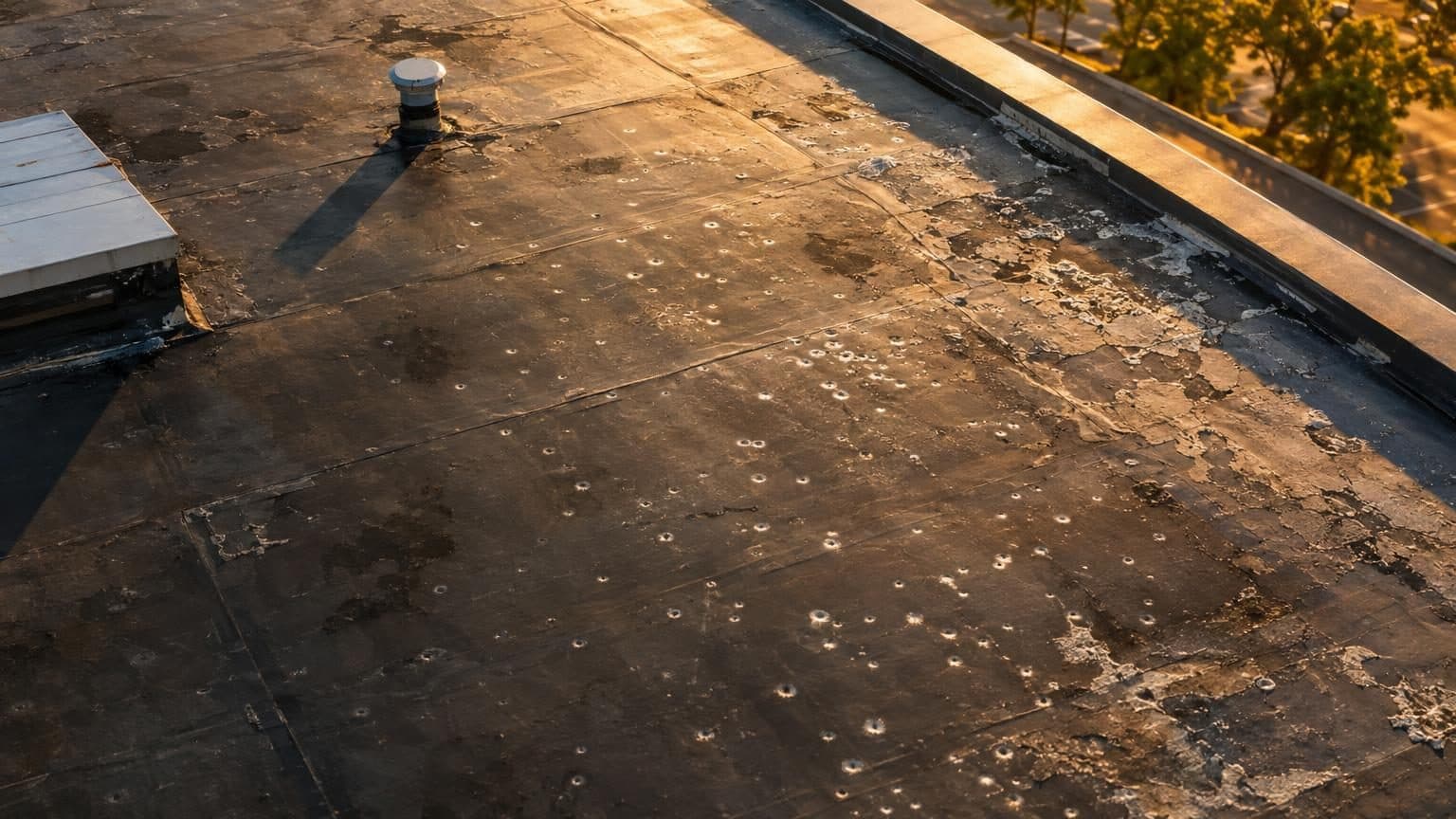
Hail leaves spatter marks, also called burnish marks, where it knocks grime, oxidation or algae off a surface. Weathering fades them, which makes them often the best evidence of recent hail.
| Surface | Recent hail | Older hail |
|---|---|---|
| Oxidized metal and painted surfaces | Visible spatter marks | Marks faded, often after a year or two; longer on some surfaces |
| Metal dents | Matching spatter mark, or a shiny dent where grime was knocked off | No matching spatter mark; hardened grime or growth inside the dent |
| Concrete tile and other brittle materials | Clean fracture with sharp edges | Stained fracture surface that comes to match the tile around it |
| Thermoplastic single-ply membranes | Tight fractures that may not show at first | Rounder, darker, wider fractures with no matching spatter mark |
| Asphalt shingles | Black, unweathered asphalt where granules are gone | Gray oxidized film after several months |
| HVAC coil fins | Dents on newer units as well as older ones | Larger dents on older units; newer units lack them |
Marks last longer on some surfaces than others. In one case, spatter from an April 2016 storm had not significantly faded on cap flashing by an August 2018 visit but was faded or gone on other surfaces.13
Fresh damage can also hide. A thermoplastic roof can look undamaged right after hail and leak months later: hail fractures start tight and become easier to see as the membrane relaxes and they collect grime.14
Dating with parts of known age
Parts of known age bound the date: hail marks on a part show the hail came after it was installed, and their absence shows the reverse. Three cases from a 2022 engineering paper:13
- 18 metal buildings: aerial imagery dated construction. Buildings finished by November 2003 had hail dents and those built from September 2005 did not, so the hail fell between 2003 and 2005; weather data showed two hail events in spring 2005.13
- Storms in April 2016 and April 2018: large, faded spatter marks up to 2.5 inches ran west to east, while smaller, fresher marks up to 0.5 inch had little or no direction. The west edge of a low roof, sheltered by a taller building, lacked the large marks. The team put the 2016 hail near 3 inches and the 2018 hail under 1 inch.13
- Nine school campuses: metal items installed about 6 to 8 years before the visit lacked hail dents, and HVAC units made in the prior 10 years or so had dents of about 1/4 inch or less, against up to 1 inch on older units. The damaging hail came before the period in question.13
Ask owners and tenants for photos or video of the hailstones or the storm, which can show hail size, duration and direction.
Records of the building before the storm
- Roof inspections at least twice a year, preferably spring and fall, and more after severe weather such as hailstorms, with conditions written down, photographed and filed for comparison at later inspections (NRCA).16
- Installation dates of roofs, rooftop units, vents, fans and copings, which bound when dents could have formed.13
- Aerial imagery: USDA's Aerial Photography Field Office said in 2013 that it holds USDA aerial imagery from 1955 to the present. NAIP imagery is refreshed on about a 3-year cycle, with the month and year it was taken in its metadata and file name.17,18
- Digital photos: the Exif DateTimeOriginal field records when the image was made, without a time zone, and GPS fields can record the location.19
Texas: why the date matters for TWIA claims
In Texas, a Texas Windstorm Insurance Association (TWIA) policyholder has one year from the date the property was damaged to report a claim, and TWIA claims examiners review weather reports along with the field adjuster's report.20
How Cloudbreak helps
Pre-loss documentation
A dated record of every roof section, elevation and rooftop unit, in photos, drone video and notes, with original files and timestamps intact.
Free hail history
Every hail and wind day near any address since 2010, with a free PDF and storm alerts.
Storm monitoring
Our proprietary predictive storm engine, built with AI and backed by meteorologists, watches every building against its own roof-based thresholds; our on-call team picks up urgent matches within 15 minutes, day or night.
Questions
- The insurance company says our roof damage happened before the storm date. How do I prove the date of loss?
- Match weather records for the date with site evidence: fresh spatter marks that line up with dents or fractures, damage only on parts installed before that date, and dated inspection records or photos of the roof's earlier condition. Evidence on the site carries the most weight.
- How do I prove which storm damaged our roof?
- List the hail dates reported or estimated near the site, then compare mark size, direction and freshness with each storm. In one case, engineers separated an April 2016 storm (hail near 3 inches, from the west) from an April 2018 storm (under 1 inch) this way.13
- How long do hail spatter marks last?
- They tend to fade from oxidized surfaces after a year or two, but last longer on some surfaces: in one case, April 2016 marks had not significantly faded on cap flashing in August 2018 but were faded or gone on other surfaces.1,13
- Does a missing NOAA hail report mean hail did not hit the building?
- No. A missing record does not mean no severe weather occurred. Reports thin out in rural areas and at night, and radar analysis has shown likely hail in gaps between reports.

Cloudbreak
The owner-side property protection team for commercial and multifamily owners in storm country: a dated record of every building, nightly storm checks and a review of your policy, before a loss.
Sources
Written by the Cloudbreak team. Numbers, dates and rules cite the published sources below.
- 1. Haag Engineering: Hailstorm Data Sources and Hail Characteristics (Richard F. Herzog, April 2015)
- 2. NOAA Storm Prediction Center: SPC Frequently Asked Questions
- 3. NOAA National Weather Service: NWS Instruction 10-1605: Storm Data Preparation (July 26, 2021)
- 4. NOAA National Centers for Environmental Information: Storm Events Database
- 5. Journal of the National Academy of Forensic Engineers: Assessing Weather Event Damage in Forensic Engineering: Data Sources and Challenges (Williams, Heady and Allen, June 2025)
- 6. NOAA National Centers for Environmental Information: Storm Data Export Format
- 7. NOAA National Centers for Environmental Information: Severe Weather Data Inventory (SWDI): Dataset Metadata
- 8. Community Collaborative Rain, Hail and Snow Network (CoCoRaHS): CoCoRaHS and Hail
- 9. NOAA National Severe Storms Laboratory: NSSL Projects: Multi-Radar/Multi-Sensor System (MRMS)
- 10. NOAA NWS Warning Decision Training Division: Maximum Estimated Size of Hail (MESH)
- 11. NOAA National Severe Storms Laboratory: Severe Weather 101: Hail Detection
- 12. NOAA Open Data Dissemination, Registry of Open Data on AWS: NOAA Multi-Year Reanalysis of Remotely Sensed Storms (MYRORSS)
- 13. ASCE Forensic Engineering 9th Congress: Dating Hail: Investigation and Determination of the Date of Occurrence of Hail Impact Damage (Verhulst, Bosley and Donaldson, Nelson Forensics, November 2022)
- 14. Haag Engineering: Identifying Hail-Caused Fractures in Thermoplastic Roofing (Steve R. Smith, February 5, 2018)
- 15. Haag Engineering: Hail Damage to Asphalt Roof Shingles (Marshall, Herzog and Morrison, Haag Engineering)
- 16. Professional Roofing, NRCA: The benefits of maintenance (Mark S. Graham, April 2012)
- 17. USDA Farm Service Agency, Aerial Photography Field Office: How To Order Aerial Imagery Products (May 2013)
- 18. U.S. Geological Survey: How often is orthoimagery in The National Map updated and what are the acquisition dates?
- 19. Adobe: XMP Specification: EXIF namespace
- 20. Texas Windstorm Insurance Association: Claims Process