Rooftop unit
Roofing and building · Cloudbreak team · Updated October 29, 2026 · 8 sources
Definition
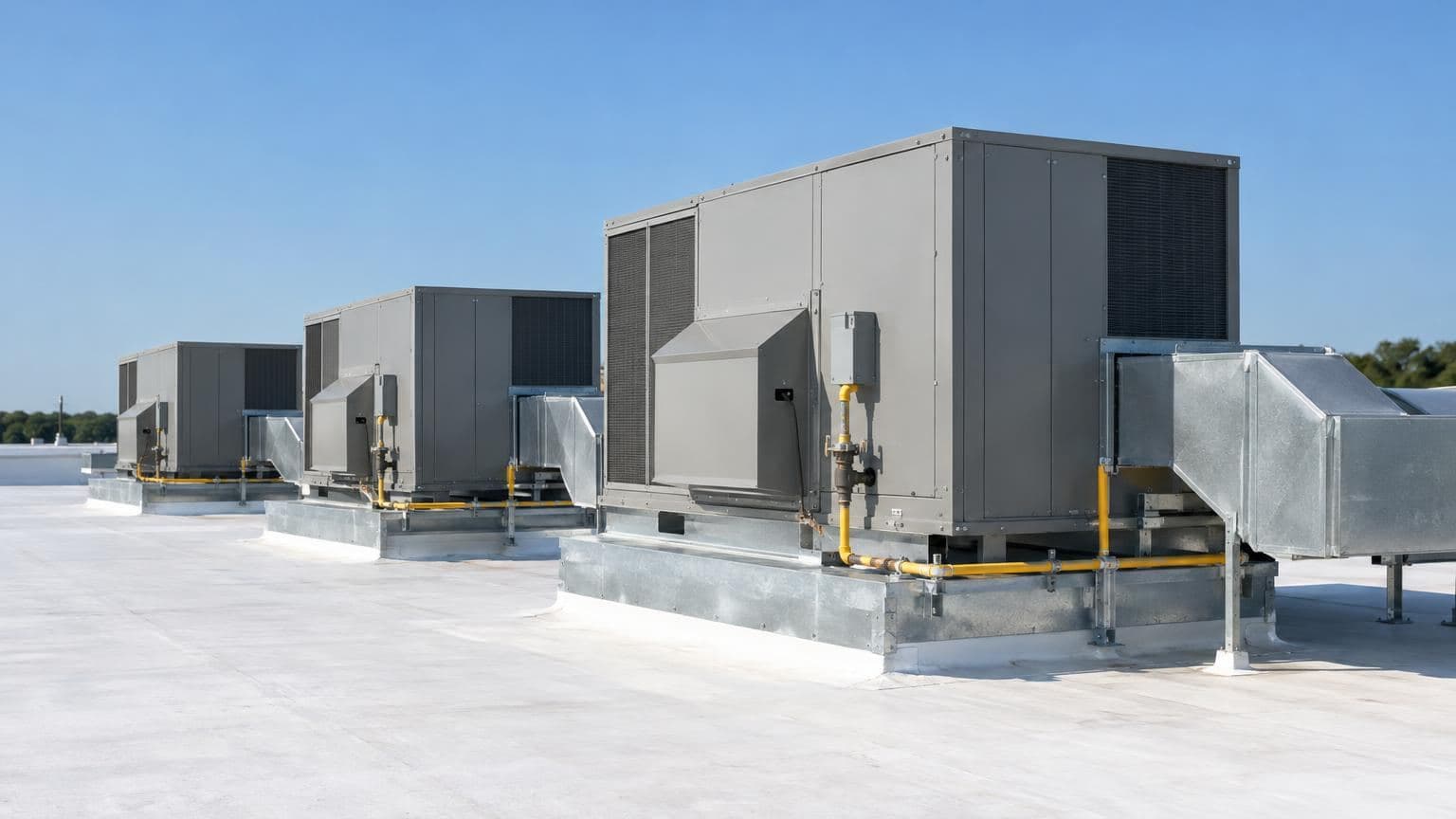
A rooftop unit (RTU) is a packaged HVAC system: every component sits in one factory-sealed cabinet, usually on the roof, that heats, cools and ventilates the building through ductwork. RTUs typically last 15 to 20 years.1
How it works
RTUs are the most common type of HVAC system in U.S. commercial buildings and are typical on large low-rise buildings such as supermarkets and warehouses. Because the unit arrives factory-sealed, it needs no field assembly.1
Most RTUs cool with refrigerant in a vapor compression cycle and heat with a natural gas furnace; heat pump and dual fuel models also exist. Cooling capacity, the main way units are sized, typically runs 5 to 100 tons. A building often has several units, installing one usually takes a crane, and added weight from an upgrade needs an engineer's approval.1
Most units sit on a metal curb over an opening in the roof, with ducts running down into the building. That puts the unit, its connections and the roof around it in the open, exposed to hail and wind.
Hail and wind damage
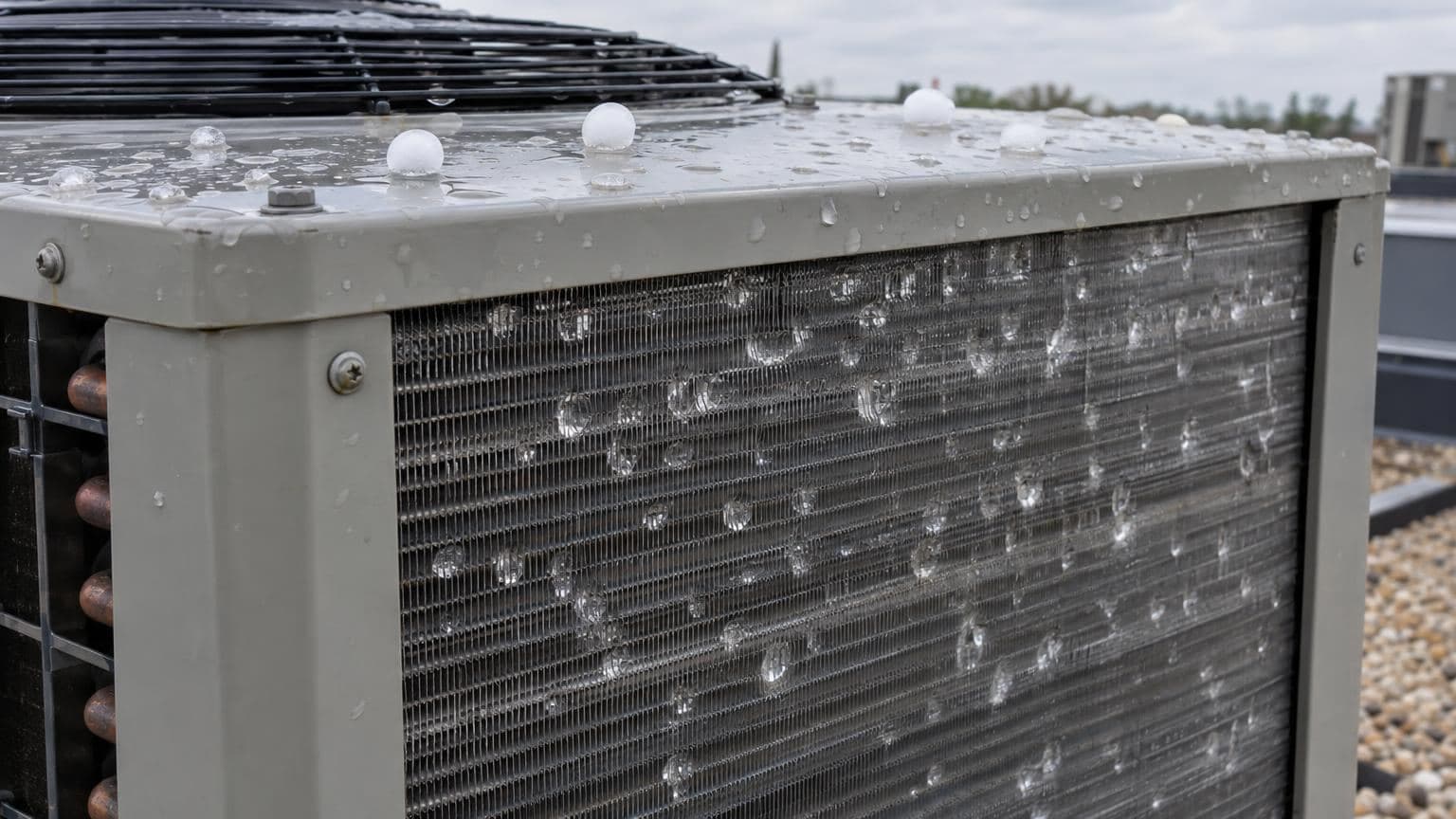
Hail damage shows up first in the condenser, whose thin metal fins dent easily. FM Global says the cooling fins and condenser coils on HVAC equipment are extremely susceptible to damage from small hail. In its loss history they rank second only to roofs, ahead of skylights. IBHS also lists condenser coils and fan blades on roof-mounted units among the equipment hail commonly damages.3,2
Wind damage starts at the attachment. After the 2017 hurricanes, FEMA found the most common rooftop equipment problems were weak anchorage, equipment not strong enough for the load, and corroded connectors. Units blew off their curbs and access panels tore loose. The debris punctured roof membranes, and water got in through the punctures and the open curbs.4
Example
How much dented fins cost in performance depends on how much of the coil is flattened. A lab study measured it on two condensing units:5
| Fin area flattened | Cooling capacity | Power use | Efficiency (SEER) |
|---|---|---|---|
| 41% to 45% (dents over the whole coil) | Little to no change | Up 3% and 5% | Down 2% and 5% |
| 60% (fin columns folded flat) | Down about 4% | Not stated | Not stated |
| 100% | Down 23% and 27% | Up 15% and 19% | Down 34% |
| 100%, then combed straight | Within 1% and 4% of undented | Not stated | Within 4% and 6% of undented |
Dents spread over the whole coil barely changed capacity. Flattening every fin cut it by about a quarter, and combing the fins straight restored most of it. The test units were outdoor condensing units paired with indoor air handlers, not packaged RTUs, and the authors say their lab study does not fully replicate field conditions.5
Lifespan
Age matters when planning repair or replacement. Fannie Mae's multifamily property condition assessment table gives packaged rooftop HVAC an estimated useful life of 20 years (15 years in its dwelling-unit equipment list). These are averages. The assessment consultant sets each unit's effective age and remaining useful life, weighing maintenance, environment and other factors.6
Hail guards and attachment
A hail guard is a cover over the condenser coils that still lets air through. IBHS says no standardized test compares hail guard systems. It advises keeping guards off the fins, fastening them against high wind and keeping them clean. It also warns to watch for lost airflow, which can lead to compressor failure.2
FM Global recommends hail guards over condenser cooling fins in its very severe and severe hail areas. Guard openings should be no larger than 0.5 by 1.0 inch (13 by 25 mm). Steel wire mesh should be at least No. 11 gauge on a steel frame, or one gauge heavier where the shortest span between frame members exceeds 6 feet.3
For wind, IBHS points designers to ASCE 7-16 Section 29.4 for loads on rooftop equipment, with a minimum factor of 1.67 on ASCE 7-16 allowable stress design loads. FEMA notes the 2016 edition dropped the old 60-foot height limit, so those criteria now apply at any roof height.7,4
Where you'll see it
- Property condition assessments: Fannie Mae's estimated useful life table lists "Packaged HVAC (roof top units)".6
- Property policies: ISO's CP 00 10 form (10 12 edition) defines Building to include fixtures, including outdoor fixtures, and permanently installed machinery and equipment.8
- Insurer loss prevention data sheets: FM Global Data Sheet 1-34 sets hail guard recommendations by hail hazard area and calls for inspecting guards for condition and securement.3
- Post-hurricane building science reports: FEMA's March 2018 recovery advisory on rooftop equipment gives an attachment schedule, the number of #12 screws for each side of a curb or flange.4
Questions
- How long does a commercial rooftop unit last?
- Typically 15 to 20 years. Fannie Mae's property condition assessment table uses 20 years for packaged rooftop HVAC.1,6
- Can hail damage a rooftop AC unit?
- Yes. The condenser fins and coils dent easily, and FM Global calls them extremely susceptible to small hail. In a 2010 lab study of two condensing units, dents across the whole coil changed capacity little, while fully flattened fins cut it by 23% to 27%.3,5
- What is a hail guard on a rooftop unit?
- It is a cover over the condenser coils or other parts that still lets air through. A common design is an aluminum frame holding 1/2 by 1 inch woven galvanized wire mesh or louvered panels.2
- What size are commercial rooftop units?
- Cooling capacity typically runs 5 to 100 tons, and it should be based on building load calculations rather than matching the old unit.1
Cloudbreak
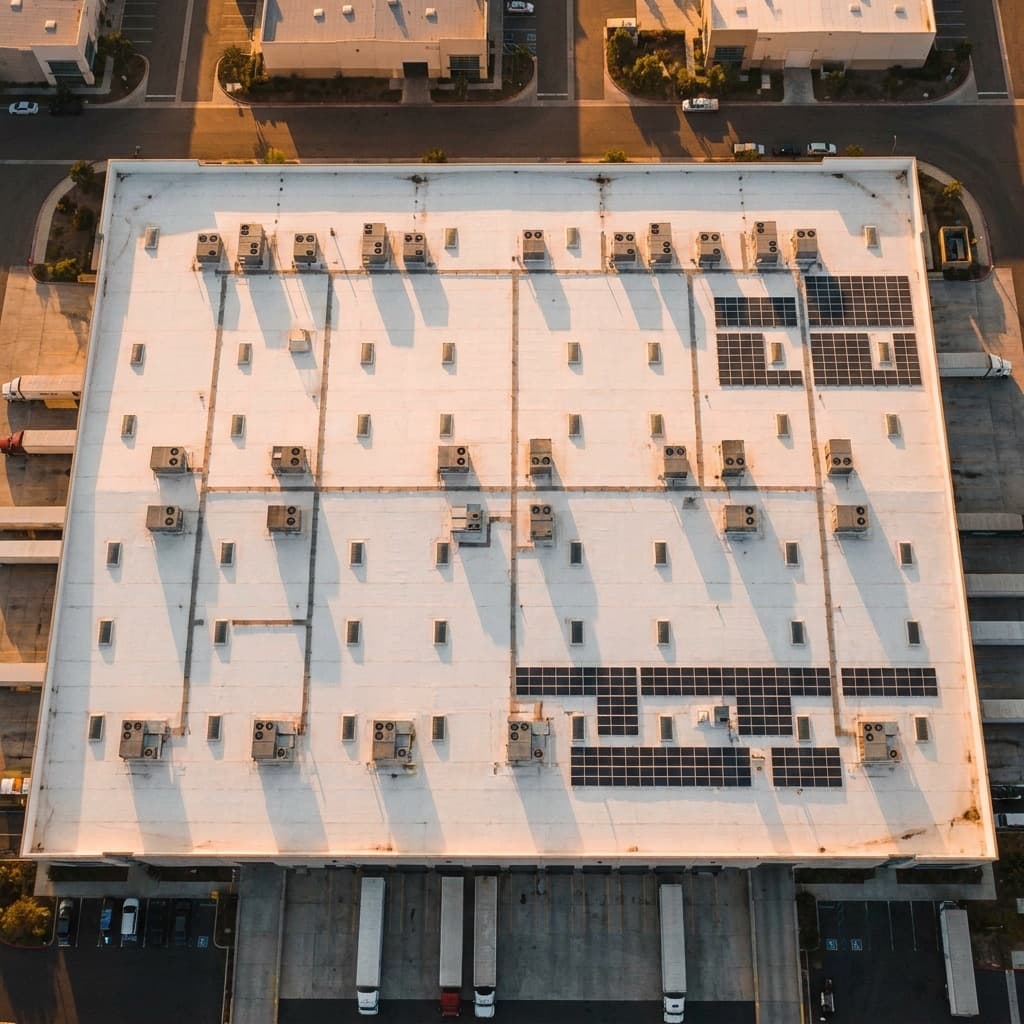
Cloudbreak records every roof section and rooftop unit before a storm, in photos, drone video and notes, so each roof's condition on a given date is on file.
Sources
Written by the Cloudbreak team. Numbers, dates and rules cite the published sources below.
- 1. National Laboratory of the Rockies, HVAC Resource Map: Packaged Systems
- 2. Insurance Institute for Business & Home Safety: Hail Guards: Protection for Roof-Mounted HVAC Equipment
- 3. FM Global: Property Loss Prevention Data Sheet 1-34: Hail Damage (March 2018 edition, interim revision April 2026)
- 4. FEMA Building Science Branch (copy hosted by the Virgin Islands Territorial Emergency Management Agency): Attachment of Rooftop Equipment in High-Wind Regions, Hurricanes Irma and Maria in the U.S. Virgin Islands, Recovery Advisory 2 (March 2018)
- 5. ASHRAE Transactions (2010), via Free Online Library: Effect of Dents in Condenser Fins on Air-Conditioner Performance (Sitzmann, Smith and Lu, 2010)
- 6. Fannie Mae: Instructions for Performing a Multifamily Property Condition Assessment (Version 2.0), Appendix F: Estimated Useful Life Tables
- 7. Insurance Institute for Business & Home Safety: Commercial Roofs Best Practices Guide
- 8. Insurance Services Office, hosted by Independent Insurance Agents of Texas: CP 00 10 10 12: Building and Personal Property Coverage Form (ISO form)