Hail damage on modified bitumen roofs
Roofing and building · Cloudbreak team · Updated November 1, 2026 · 13 sources
Definition
Hail damage on a modified bitumen roof is a puncture, tear or bruise in the polymer-modified asphalt membrane and its reinforcement, or protective surfacing knocked off so the bitumen is exposed. Fractures start on the underside and may show on top only as a soft spot.
How it works
Modified bitumen is asphalt blended with a polymer, either rubber-like SBS or plastic-like APP, and reinforced with polyester or fiberglass mats. It is usually laid in two or more plies, set in hot asphalt, torched or self-adhered, and its top is protected by granules, a foil or a field-applied coating. SBS sheets are usually granule-surfaced because the rubber in them breaks down in sunlight.1,8
A hailstone pushes the membrane down into whatever supports it. On a firm base it barely bends. Over soft insulation it bends further, which stretches the bottom plies until the reinforcement fractures. Because the fracture starts underneath, the top may show only a soft spot, or curved and concentric cracks with star-shaped cracks beneath them.1,2
Hail can also knock off granules or break the coating and leave bitumen bare, which can shorten the roof's service life. Granule loss alone is not always damage: where more granules lie just under the exposed bitumen, they still protect the sheet, and engineers count no functional damage.1
Weak spots are predictable. Unsupported membrane at base flashings, parapets and curbs is especially prone to hail damage, which is why FM calls cant strips at those junctions critical. Bituminous membranes over 10 years old showed reduced hail resistance in RICOWI's 2011 survey. APP's stiffness makes it somewhat vulnerable to fracture, while on SBS the granule surface can be knocked off.6,4,8

How hail damage differs from wear
| Cause | What it looks like |
|---|---|
| Hail | Marks scattered at random and sized like the hail, soft spots, fresh dark bitumen, concentric cracks on top; granule loss that lines up with dents on rooftop units and spatter marks nearby |
| Mopping voids | Air pockets trapped between hot-mopped plies at installation; they can feel soft and shed granules above them, are often irregular in shape and show in areas sheltered from hail too |
| Weathering | Granule loss where shrinkage cracks meet, on oxidized, cracked bitumen |
| Bird droppings | Granule loss bunched where birds gather, growing from half circles into full circles |
| Installation traffic | Marks from foot traffic while the roof was hot, common on virtually all bituminous roofs |
Mopping voids are common enough to matter. Engineers who examined over 1,200 hot-mopped bituminous samples, most sent in for hail evaluations, found at least one void in 51.5% of them, and 25.3% of the samples with voids had surface distress right over a void. They recommend cores and lab delamination whenever distress that could be hail is found.5

What field surveys and tests found
After the April 11, 2016 North Texas storm, RICOWI inspected 15 modified bitumen roofs hit by hail of 0.25 to 4 inches, most of them granule-surfaced SBS. Six were rated severely damaged, and none of those was supported by a high compressive strength substrate. One poorly supported roof was damaged by 1.25-inch hail, but significant damage to membranes laid directly over standard foam insulation generally came with hail 1.5 inches or larger.3
After the May 24, 2011 Dallas/Fort Worth storm, 4 of the 7 modified bitumen roofs inspected, hit by hail of 1.75 to 5 inches, were severely damaged, while one roof hit by 2-inch hail had no damage. The 2016 report adds that across all three RICOWI hail investigations, modified bitumen laid directly over low compressive strength insulation was the system most prone to damage causing leaks.4,3
Damage can hide under intact granules. In 2022 lab tests with a steel missile matching 2.5-inch hail, new granule-surfaced SBS kept its granules over both 1/2-inch gypsum and 3/4-inch perlite, yet the fiberglass ply beneath fractured at every impact, more so over perlite, and the asphalt between plies was crushed over perlite. An aged sample, at least 10 years old, lost some granules at the impacts.2
Ratings are not a ceiling. In FM Approvals research reported in 2015, 18 of 34 membrane specimens already rated for severe hail, modified bitumen and built-up among them, tore or cracked when struck twice per spot by 2-inch ice balls in a test based on FM 4473. Failures were more common over lower-density insulation board than over gypsum board and with thinner membranes, and some boards were damaged under a membrane that showed nothing.7
Example
| Hail size | Impact energy | Result |
|---|---|---|
| 1.25 in. | 3.4 ft-lb | One poorly supported roof damaged (North Texas, 2016) |
| 1.5 in. | 7.2 ft-lb | Where significant damage generally began on membranes laid directly over standard foam insulation (2016) |
| 2 in. | 22.9 ft-lb | One roof not damaged (Dallas/Fort Worth, 2011) |
| 2.5 in. | 56.4 ft-lb | Lab: base ply fractured under new SBS over gypsum and perlite, with granules still in place (2022) |
| 0.25 to 4 in. | Up to 376.5 ft-lb | Across 15 roofs, six severely damaged, none of them supported by a high compressive strength substrate (2016) |
For scale, an FM 4470 Severe Hail (SH) assembly is tested at 14 ft-lb, about the energy of near-solid 1.75-inch hail (13.3 ft-lb). A 2.5-inch stone carries about 4 times that.6
How inspectors check
On the roof, an inspector presses on areas with sizeable impact marks to feel for soft spots, which mark broken reinforcement, and probes bare spots to see whether more granules lie beneath. Test areas are picked at random and the impacts inside them counted. Dents in rooftop units and spatter marks help set the hail size, though condenser fins dent even in small hail.1,3,6
Because fractures start underneath, a visual check is often not enough. RICOWI's 2011 report names modified bitumen and built-up roofs, with their laminated plies, as cases where further sampling can be appropriate. A cut sample shows the underside; in a lab the plies are separated, following methods from ASTM D2829, and the bitumen is dissolved out of the reinforcement under ASTM D3746 so each mat can be examined under magnification. No ASTM test method is written specifically for hail damage on bituminous samples, so labs adapt these.4,2
Infrared and impedance scans can show whether water has entered the roof through hail openings.1
Where you'll see it
- FM Approvals hail ratings for low-slope assemblies, which include modified bitumen sheet roofs: MH (8 ft-lb), SH (14 ft-lb) or VSH (53 to 58 ft-lb). IBHS recommends FM 4470 Class 1-SH or UL 2218 Class 4 for low-slope roof covers in hail-prone areas.6,9
- FM hail hazard maps: moderate areas see hail up to 1.75 inches at a 15-year mean recurrence interval, severe areas 1.75 to 2 inches, and very severe areas larger than 2 inches.6
- Lab reports on cut samples, which describe the surfacing, the asphalt between plies and each ply's reinforcement, often with photos at each step and references to ASTM D2829, ASTM D3746 and FM 4470 criteria.2
- RICOWI hail investigation reports, which rate each roof 0 to 5, from no apparent damage to severe damage with potential leaks.3
- Commercial property policies with endorsement CP 10 36, which defines roof surfacing to include synthetic sheeting or similar materials covering the roof and materials applied to or under it for moisture protection. Paragraph A values roof surfacing at actual cash value; Paragraph B excludes cosmetic wind or hail damage that alters appearance but does not stop the roof from keeping out the elements.10
- The ISO special causes of loss form CP 10 30 (September 2017 edition), which excludes wear and tear, deterioration and latent defects.11
- Multifamily loan insurance requirements: Fannie Mae and Freddie Mac require property coverage on a replacement cost basis but allow roof coverage on an actual cash value basis.12,13
Questions
- What size hail damages a modified bitumen roof?
- It depends most on what lies beneath. In RICOWI's 2016 survey, significant damage to membranes laid directly over standard foam insulation generally came with hail 1.5 inches or larger, and one poorly supported roof was damaged at 1.25 inches. In 2011, one roof hit by 2-inch hail had no damage.3,4
- Can hail damage a modified bitumen roof without visible marks?
- Yes. Hail fractures start in the underside, and in 2022 lab tests a 2.5-inch impact fractured the ply beneath new granule-surfaced SBS while the granules stayed in place. A cut sample examined in a lab shows what the surface does not.1,2
- Is granule loss on a modified bitumen roof hail damage?
- Not always. Where more granules lie just under the exposed bitumen, engineers count no functional damage. Weathering, bird droppings and mopping voids between plies also leave bare spots, so the pattern, the hail size at the site and often a lab sample decide it.1,2,5
- Is SBS or APP modified bitumen more resistant to hail?
- Each has its own weak point. APP is stiffer and somewhat vulnerable to fracture by hail, while SBS relies on a granule surface that hail can displace; both can be damaged. Most of the membranes in RICOWI's 2016 survey were granule-surfaced SBS.8,3
Cloudbreak
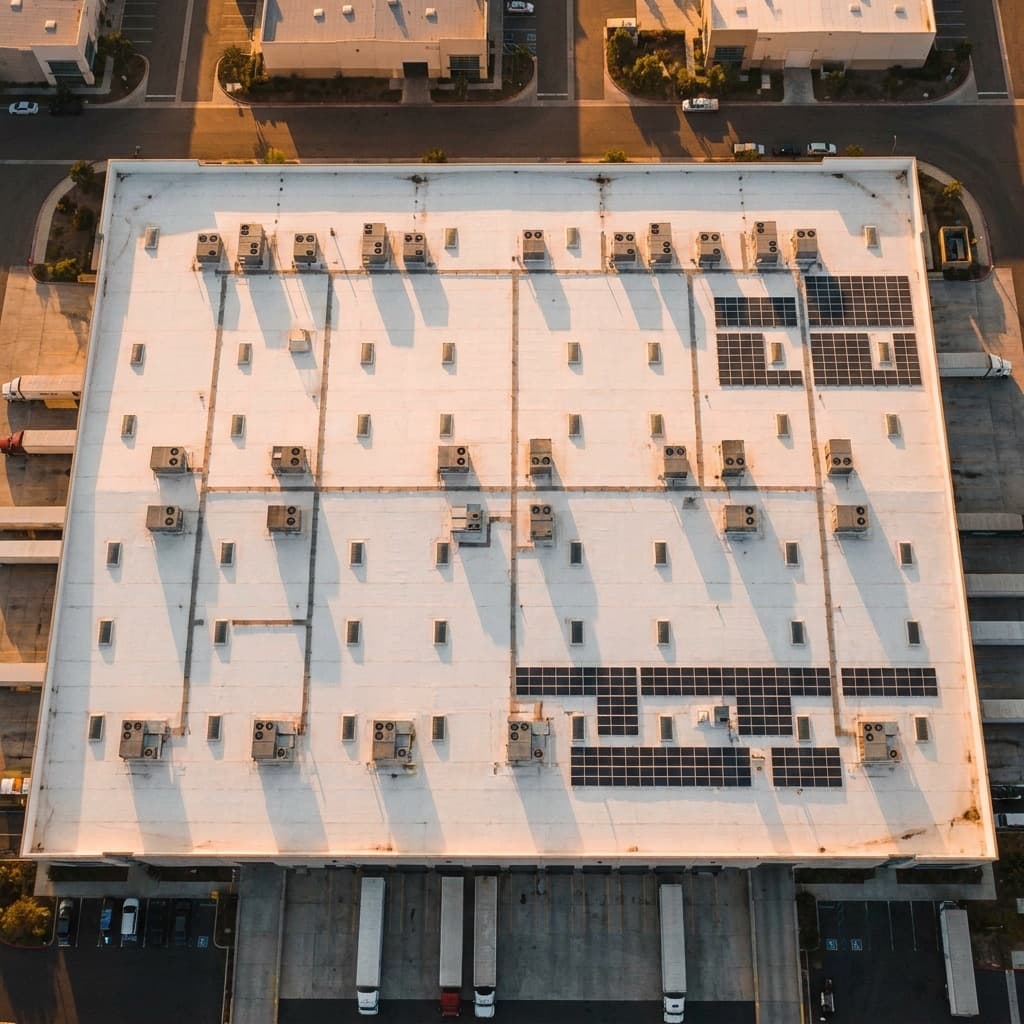
Cloudbreak records every roof section and rooftop unit before a storm, in photos, drone video and notes, so each roof's condition on a given date is on file.
Sources
Written by the Cloudbreak team. Numbers, dates and rules cite the published sources below.
- 1. Professional Roofing, NRCA: Holy hail! Learn how to identify hail damage on low-slope roof systems (Scott J. Morrison, June 2009)
- 2. IIBEC: Testing Built-up and Modified Bitumen Roofs for Hail Damage (Roof Technical Services, IIBEC Interface, July 2022)
- 3. RICOWI: Hailstorm Investigation Report: North Texas, April 11, 2016
- 4. RICOWI: Hailstorm Investigation Report: Dallas/Fort Worth, TX, May 24, 2011
- 5. Nelson Forensics: Hail Evaluation of Bituminous Roofing Membranes: Understanding Interply Mopping Voids (Donaldson, DeLeon and Verhulst)
- 6. FM: Property Loss Prevention Data Sheet 1-34: Hail Damage (March 2018 edition, interim revision April 2026)
- 7. IIBEC: Takeaways from ASTM's Symposium on Roofing Research and Standards Development (Walt Rossiter, March 1, 2016)
- 8. Professional Roofing, NRCA: Standing up to hail (Ric Vitiello, June 2007)
- 9. Insurance Institute for Business & Home Safety: Commercial Roofs Best Practices Guide
- 10. Insurance Services Office, hosted by Independent Insurance Agents of Texas: CP 10 36 10 12: Limitations on Coverage for Roof Surfacing
- 11. Insurance Services Office: Causes of Loss: Special Form, CP 10 30 09 17
- 12. Fannie Mae: Multifamily Selling and Servicing Guide, Part II Chapter 5: Property and Liability Insurance (effective October 26, 2026)
- 13. Freddie Mac: Multifamily Seller/Servicer Guide, Chapter 31: Insurance Requirements