Hail damage on metal roofs
Roofing and building · Cloudbreak team · Updated October 29, 2026 · 8 sources
Definition
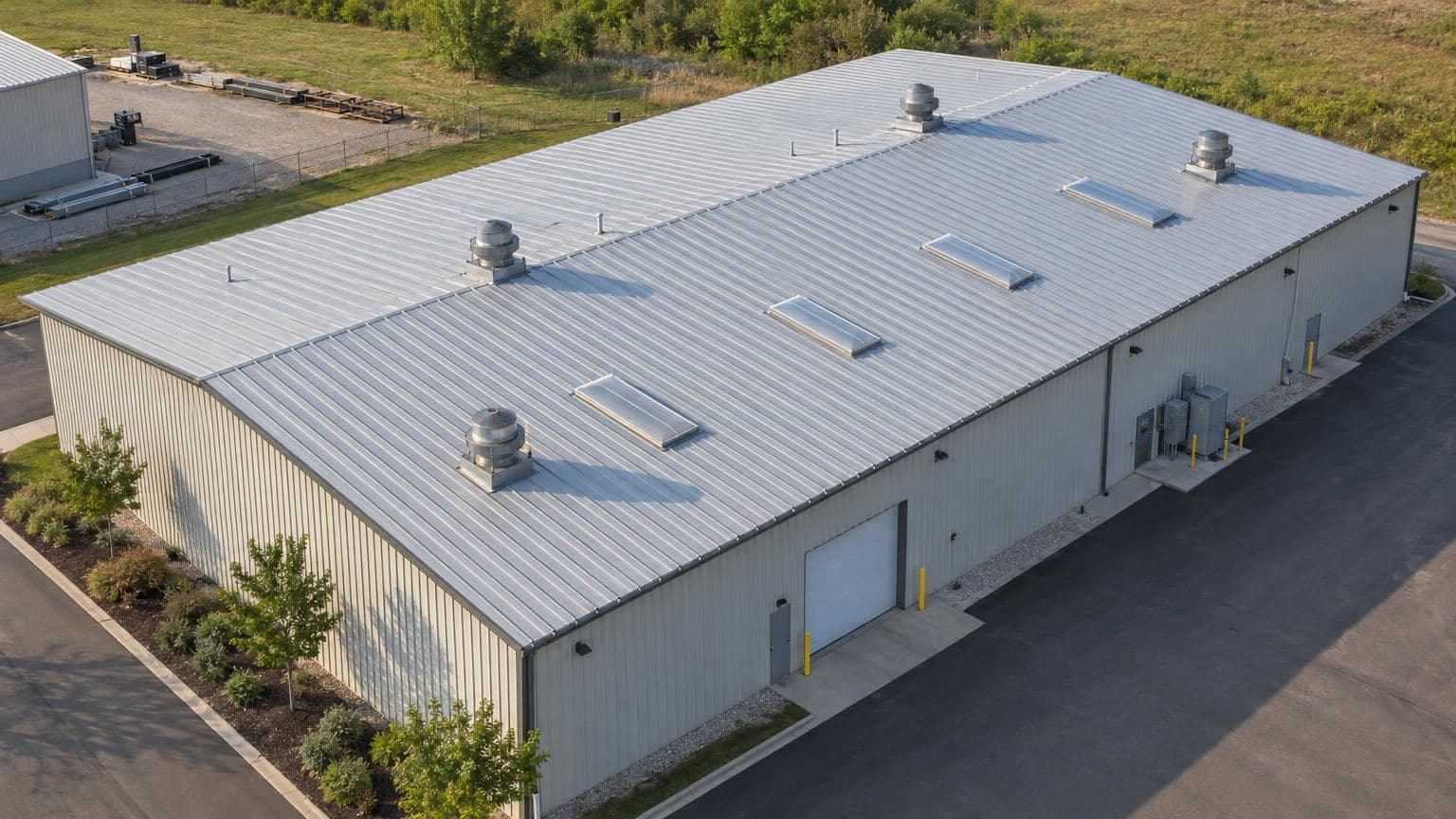
Hail damage on a metal roof is the denting and distortion hail leaves on metal panels, ribs, seams and trim. Most of it is aesthetic, changing how the roof looks. It is functional when it reduces the roof's ability to shed water or its service life, usually by opening seams or laps.1
How it works
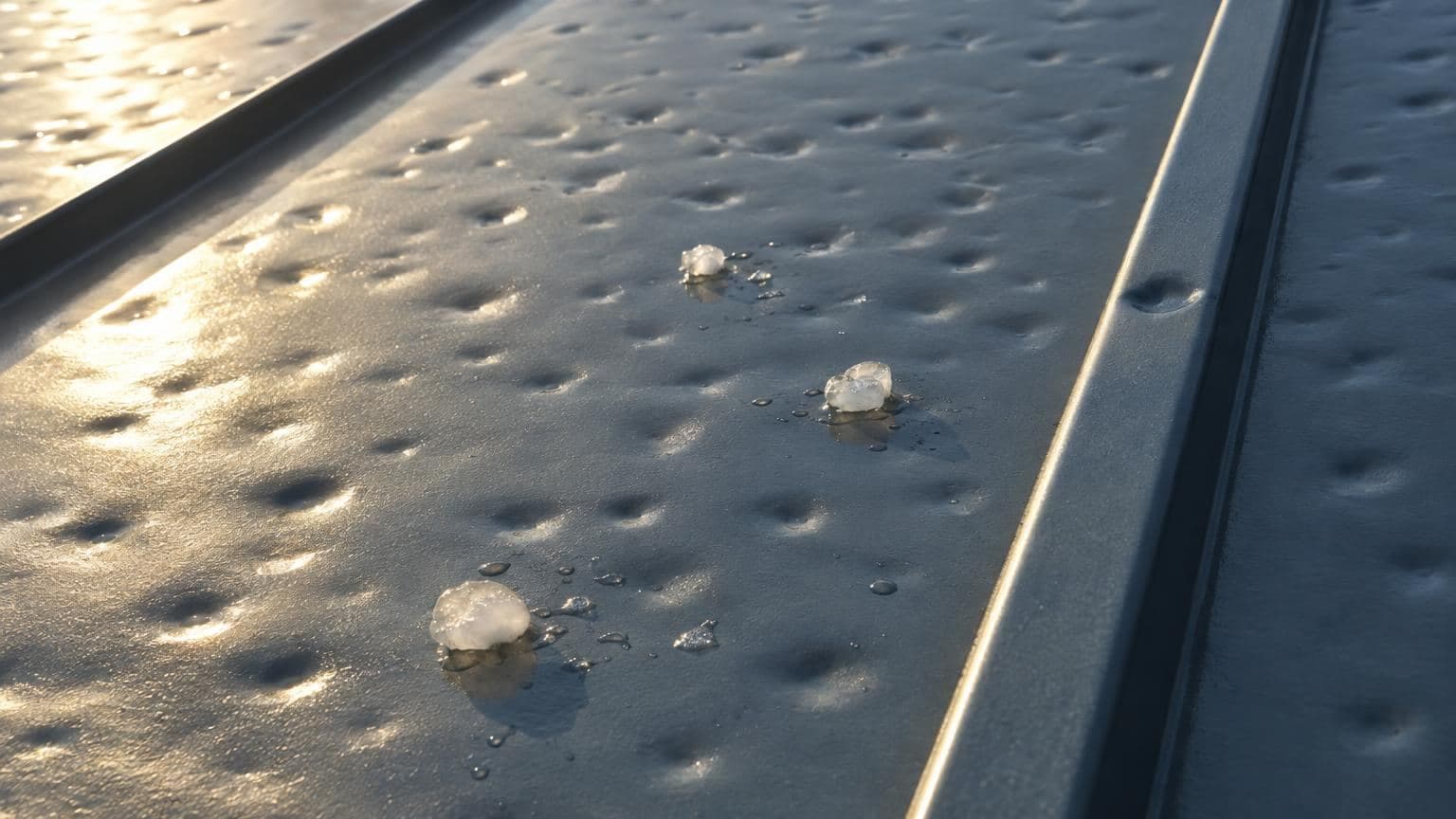
Metal bends instead of cracking, so hail leaves dents rather than fractures. How deep a dent goes depends on the size of the hailstone, the panel's thickness and strength, and the panel's shape.
Hail damage to metal is sorted into two kinds. Aesthetic, or cosmetic, damage changes appearance only. Functional damage lets water in or shortens the roof's life. The line matters for claims, because some commercial property policies exclude cosmetic damage to roof surfacing.
When leaks happen, they start at the joints rather than in the flat of the panel: lap seams pulled open by distortion, standing seams deformed, or panels pulled loose from their clips. Field reports tie this to very large hail and to thin, light-gauge panels.
What field surveys and tests found
IBHS says dents change how a roof looks, but there is currently no evidence that they affect how it works. On discontinuous metal roofs, denting can be worse at preformed shapes in the panels.2
In field surveys, dents seldom led to leaks. After the May 24, 2011 Dallas/Fort Worth storm, RICOWI teams inspected 16 metal roofs, most hit by hail of 1.5 to 4 inches, and found no fractures, punctures or leaks, even where denting was moderate to severe. In most cases, metal panels kept their water-shedding integrity up to 2.5-inch hail.3
After the April 11, 2016 North Texas storm, a light-gauge through-fastened R-panel hit by hail of at least 3.5 inches had lap seams pulled open by distortion. One team reported leaks on two standing seam roofs, 5 to 10 years old, hit by 2 and 2.5-inch hail; the panels were dented, deformed in places and occasionally dislodged from their clips. Koontz and White (2014) describe a corrugated roof about 40 years old that leaked in wind-driven rain after 2.5-inch hail distorted its side and end laps, and was replaced.4,5
Thickness and yield strength set how deeply a panel dents. The steel bulletin gives dent resistance as proportional to yield strength squared times sheet thickness to the fourth power, whatever the zinc or aluminum-zinc coating, and most roofing metals range from 33 to 80 ksi. In 2016, a thicker galvanized panel, believed to be 24 gauge, near the damaged R-panel had only shallow, rounded dents.1,5,4
Example
Take two sheets the steel bulletin plots, 0.029 inch and 0.0142 inch thick, at the same yield strength. By the bulletin's rule, (0.029 / 0.0142) to the fourth power is about 17, so the thicker sheet resists denting about 17 times as well. For a 0.023-inch sheet, raising yield strength from 33 to 80 ksi multiplies dent resistance by (80 / 33) squared, about 5.9.1
| Largest hail | Result |
|---|---|
| Under 0.75 in. | One steep-slope metal roof: not dented |
| 1 to 2 in. | Stone-coated steel, standing seam and aluminum shingle panels dented; largely cosmetic, no punctures |
| 2 in. or less, low slope | Denting only in the report summary; one team reported leaks on standing seam roofs hit by 2 and 2.5-inch hail |
| 2.5 in. and up, low slope | Large dents and some seam distortion; no fractures or panel punctures |
| 3 to 3.5 in. | Overlap seams distorted on a steep-slope roof; light-gauge R-panel lap seams opened |
Impact energy climbs steeply with size. FM Data Sheet 1-34 gives a 2.5-inch stone near solid ice 56.4 ft-lb, about 2.5 times a 2-inch stone's 22.9 ft-lb.6
In the lab, Koontz and White hit 10 panels, 24 to 32 gauge, with 1.5 and 2-inch ice and steel spheres. Every panel dented; only a 32-gauge corrugated panel was penetrated.5
Where you'll see it
- UL 2218 ratings on metal panels: Class 4 means still functional after two hits in the same spot by 2-inch steel balls. IBHS notes impact-rated metal can still dent.7
- RICOWI hail reports. Their 0 to 5 scale gives moderate to severe denting of metal its own level (4), and the 2016 report calls dents without fractures or opened seams cosmetic.4
- Commercial property policies with endorsement CP 10 36. Where scheduled, its Paragraph B excludes cosmetic wind or hail damage to roof surfacing, which the form defines to include metal sheeting.8
Questions
- Do hail dents make a metal roof leak?
- Usually not. Leaks come from seams and laps opened by very large hail, not from dents alone. RICOWI found no leaks below metal roofs after the 2011 Dallas/Fort Worth storm, even with moderate to severe denting. In 2016, leaks were reported on standing seam roofs hit by 2 and 2.5-inch hail, and lap seams opened on a light-gauge panel hit by hail of at least 3.5 inches.3,4
- What size hail dents a metal roof?
- It depends on the panel's thickness. In 2016, thinner patio cover panels were dented by hail under 3/4 inch, while thicker carport panels nearby were not. In lab tests, every panel dented when hit by 1.5 and 2-inch ice and steel spheres.4,5
- Can a Class 4 metal roof get hail dents?
- Yes. An impact rating is about function, not looks. IBHS says impact-resistant metal roofs are likely to survive hail without functional damage but can be permanently dented. In 2011, RICOWI found no fractures or open seams on Class 4 metal roofing hit by hail 2 inches or smaller.7,3
Cloudbreak
Cloudbreak records every roof section and rooftop unit before a storm, in photos, drone video and notes, so each roof's condition on a given date is on file.
Sources
Written by the Cloudbreak team. Numbers, dates and rules cite the published sources below.
- 1. United States Steel Corporation: Technical Bulletin Construction: Hail Damage on Coated Sheet Steel Roofing
- 2. Insurance Institute for Business & Home Safety: Natural Weathering and Hazard Exposure
- 3. RICOWI: Hailstorm Investigation Report: Dallas/Fort Worth, TX, May 24, 2011
- 4. RICOWI: Hailstorm Investigation Report: North Texas, April 11, 2016
- 5. IIBEC: The Effects of Hail on Metal Roofing Systems (Koontz and White, 29th RCI International Convention, March 2014)
- 6. FM: Property Loss Prevention Data Sheet 1-34: Hail Damage (March 2018 edition, interim revision April 2026)
- 7. Insurance Institute for Business & Home Safety: Commercial Roofs Best Practices Guide
- 8. Insurance Services Office, hosted by Independent Insurance Agents of Texas: CP 10 36 10 12: Limitations on Coverage for Roof Surfacing