Roof age and commercial property insurance
Short answer
Insurers look at a roof's age and material when they decide whether to offer coverage, what to charge, whether to inspect, and whether to insure the roof at replacement cost or actual cash value. After a loss, actual cash value takes depreciation off the repair cost, so the same hail damage pays less on an older roof. Commercial policies also exclude wear and tear on its own, so damage from age alone is not covered.
Cloudbreak team · Updated October 27, 2026 · 5 min read · 15 sources
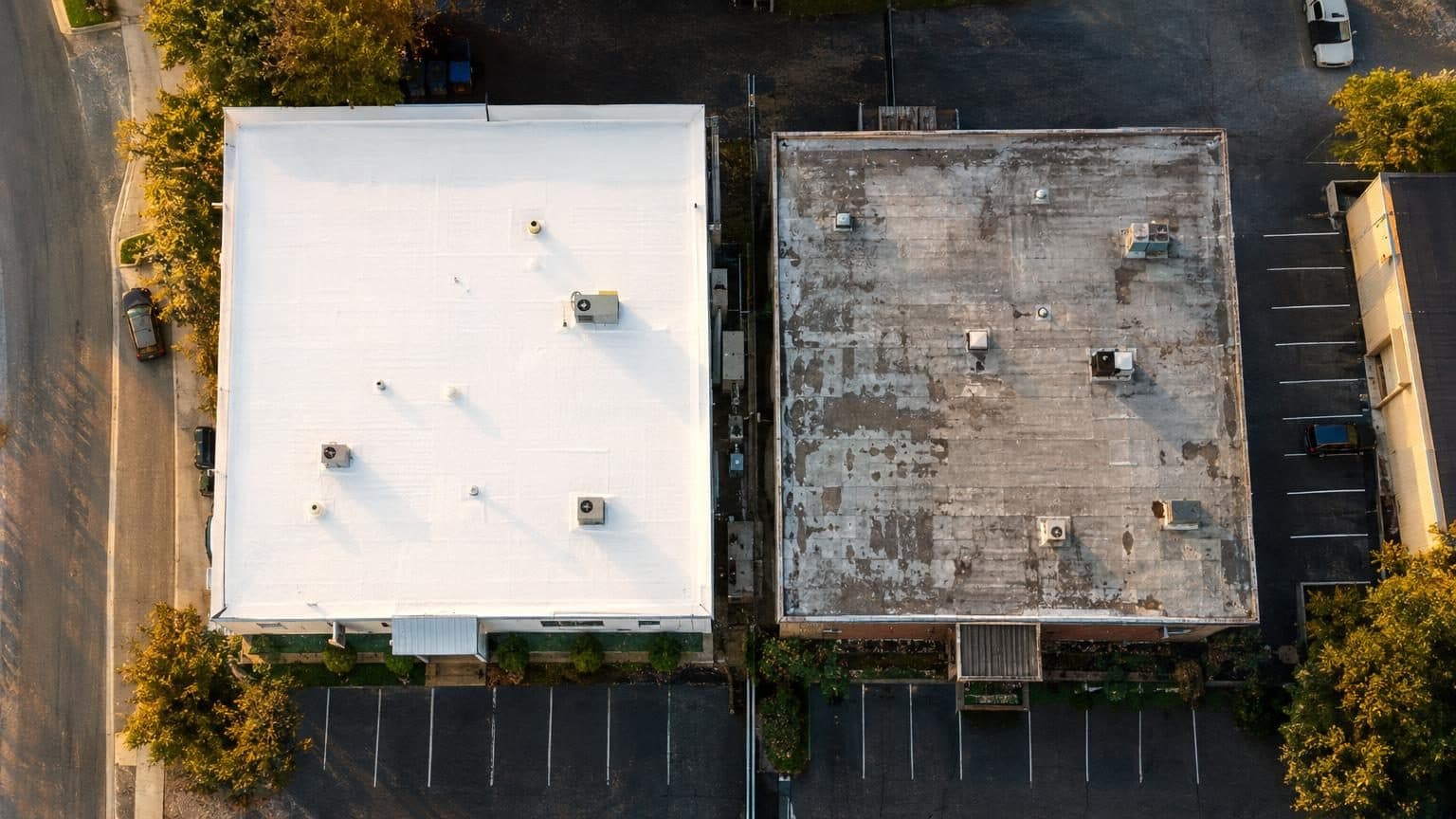
How insurers use roof age in underwriting
Most insurers combine roof age and material to choose between replacement cost and actual cash value for the roof, to decide whether matching or cosmetic damage is covered, and to decide whether to inspect or decline. Residential and commercial insurers set different thresholds; a roof over 15 to 20 years old may be ineligible or covered only at actual cash value.1
Most insurers require a roof over 20 years old to pass an inspection when a home or business applies. Some decline older roofs, and some move aging roofs to actual cash value at renewal. A roof in poor condition usually gets a set time to be replaced before the insurer cancels.2
The insurer learns the roof's age from the application: ACORD 140 (2014/12), the property section attached to the ACORD 125 commercial application, asks for each building's roof type and the year of its roofing improvements.3
How roof age changes a claim payment
Replacement cost pays what it costs today to repair or replace the roof. Actual cash value pays that cost minus depreciation, the value the roof has lost to age and wear. The older the roof, the bigger the gap.
| Step | Amount |
|---|---|
| Replacement cost | $20,000 |
| Depreciation: 5-year-old roof, 20-year expected life | minus $5,000 |
| Deductible | minus $4,000 |
| Paid at actual cash value | $11,000 |
| Paid at replacement cost: $11,000 first, then $5,000 after proof of repairs | $16,000 |
A commercial policy can put the roof alone on actual cash value while the rest of the building stays at replacement cost. ISO endorsement CP 10 36 (October 2012 edition) does this building by building, as scheduled, for roof surfacing: the covering, the materials securing it, moisture protection layers and flashing. ISO's CP 14 04 (August 2023 edition), for ISO's Commercial Coverage Form, settles roof surfacing at actual cash value only when windstorm or hail causes the damage.5,6
Wear and tear, deterioration and interior leaks
Damage from age itself is not covered. The ISO special causes of loss form (CP 10 30, October 2012 edition) excludes wear and tear; rust, decay and deterioration; and seepage or leakage of water that continues for 14 days or more. Faulty maintenance is excluded too, but if it leads to a covered cause of loss, the form pays for the loss from that covered cause.7
Interior rain damage is covered only if a covered cause first damages the roof or walls and the rain gets in through that opening, or if the water comes from thawing snow or ice on the building.7
Questions for the broker
Check that the roof age and material on each policy are right, and tell the insurer when a roof is replaced so the age on file changes. Then ask the broker:
- What roof age and material does the insurer have on file for each building, and where did that data come from?
- Does CP 10 36, CP 14 04 or another roof endorsement apply to any building, and from what roof age?5,6
- Did the renewal notice change any roof term, such as moving the roof to actual cash value?
- Texas coast: on a TWIA policy, is Form 164 or Form 165 shown on the declarations?8,9,4
Texas rules on roof age
TWIA, which offers wind and hail coverage on the Texas coast, has commercial Form TWIA-165: replacement cost for the building except the roof. It does not give replacement cost to roof coverings showing significant deterioration or damage, and it can be requested or applied by TWIA at its discretion.8,9,10
Texas rule 28 TAC 21.1006 bars insurers from declining residential property insurance, defined as homeowners and residential fire and allied lines policies, based on the property's age. Insurers may still decline based on physical condition, including the roof. The rule does not cover commercial property.11
For commercial property policies from admitted insurers, Texas Insurance Code Chapter 551, Subchapter B sets these rules:12
- Nonrenewal: written notice at least 60 days before expiration, or coverage runs to the 61st day after the notice.12
- Reasons: a notice of declination, cancellation or nonrenewal must state the reason, including the precise incident, circumstance or risk factors and the source of the information the insurer relied on.12
- Changes at renewal: a change that reduces coverage, changes its conditions or changes the insured's duties needs a conspicuous, plain-language notice at least 30 days before renewal (Section 551.056, for policies issued or renewed from January 1, 2020). It does not apply to large risks, such as insureds with $5 million or more in total insured property values, or to changes the insured requests or agrees to.12,13,14
In Texas, a change in roof coverage from replacement cost to actual cash value counts as a material change under TDI rules effective February 12, 2020, the commissioner of insurance told property and casualty insurers in a February 5, 2020 letter. The letter also said insurers using vendor roof age data must check its methods: some vendors rely on permits, and many cities do not require permits for roof replacements.15
How Cloudbreak helps
Pre-loss documentation
A dated record of every roof section, elevation and rooftop unit, in photos, drone video and notes, with original files and timestamps intact.
Policy review
Your deductibles, limits, exclusions and roof endorsements read against each property, with questions for your broker; a licensed broker approves every report.
Storm monitoring
Our proprietary predictive storm engine, built with AI and backed by meteorologists, watches every building against its own roof-based thresholds; our on-call team picks up urgent matches within 15 minutes, day or night.
Questions
- How does roof age affect commercial property insurance coverage and claims?
- Insurers use roof age and material to decide whether to offer coverage, the price, replacement cost or actual cash value for the roof, and whether to inspect. In a claim, actual cash value deducts depreciation, so an older roof pays less.
- Can an insurance company deny coverage because of roof age in Texas?
- For homeowners and residential fire and allied lines policies, 28 TAC 21.1006 bars declining based on age, but not based on the roof's physical condition. Commercial property policies from admitted insurers follow Insurance Code Chapter 551, Subchapter B instead: 60 days' notice of nonrenewal, 30 days' notice of a renewal change that reduces coverage, and a stated reason.11,12
- At what roof age do insurers switch to actual cash value?
- It varies by insurer. A roof over 15 to 20 years old may be ineligible or covered only at actual cash value.1
- Does a new roof lower commercial property insurance premiums?
- It can. The Insurance Information Institute says repairing or replacing a roof can help homes and businesses get more favorable rates.2

Cloudbreak
The owner-side property protection team for commercial and multifamily owners in storm country: a dated record of every building, nightly storm checks and a review of your policy, before a loss.
Sources
Written by the Cloudbreak team. Numbers, dates and rules cite the published sources below.
- 1. Moody's: The challenge of unlocking accurate roof age data (May 6, 2026)
- 2. Insurance Information Institute: How Your Roof Influences Your Home and Business Insurance
- 3. ACORD (copy hosted by NIF Group): Property Section, ACORD 140 (2014/12)
- 4. Texas Windstorm Insurance Association: Factors that Affect the Claim Payment Amount
- 5. Insurance Services Office (copy hosted by Independent Insurance Agents of Texas): Limitations on Coverage for Roof Surfacing, CP 10 36 10 12
- 6. Insurance Services Office (copy hosted by Missouri Farm Bureau Insurance): Windstorm or Hail Losses to Roof Surfacing, Actual Cash Value Loss Settlement, CP 14 04 08 23
- 7. Insurance Services Office (copy hosted by Independent Insurance Agents of Texas): Causes of Loss, Special Form, CP 10 30 10 12
- 8. Texas Windstorm Insurance Association (filed with the Texas Department of Insurance): TWIA Instructions and Guidelines Manual (effective February 27, 2026)
- 9. Texas Windstorm Insurance Association: Endorsement No. (TWIA) 165: Replacement Cost Coverage, Actual Cash Value Roofs
- 10. Texas Department of Insurance: Commercial property insurance guide
- 11. Texas Department of Insurance: Proposed amendments to 28 TAC 21.1006, Prohibition Against Declining to Write Residential Property Insurance Based on the Age or Value of the Property
- 12. Texas Legislature: Texas Insurance Code Chapter 551, Practices Relating to Declination, Cancellation, and Nonrenewal of Insurance Policies
- 13. Texas Legislature: S.B. 590, 86th Legislature, enrolled version
- 14. Texas Legislature: Texas Insurance Code Chapter 2301, Policy Forms (Section 2301.004, Exemption for Large Risks)
- 15. Texas Department of Insurance: Letter from Commissioner Sullivan about material changes (February 5, 2020)