Ordinance or law coverage
Coverage · Cloudbreak team · Updated October 29, 2026 · 9 sources
Definition
Ordinance or law coverage pays the extra costs that building codes and other laws add after a covered loss: the lost value of undamaged parts of a building that must be torn down, the cost to demolish and clear them, and the higher cost to repair or rebuild to current code. Standard commercial property forms exclude these costs; an endorsement adds them back.
How it works
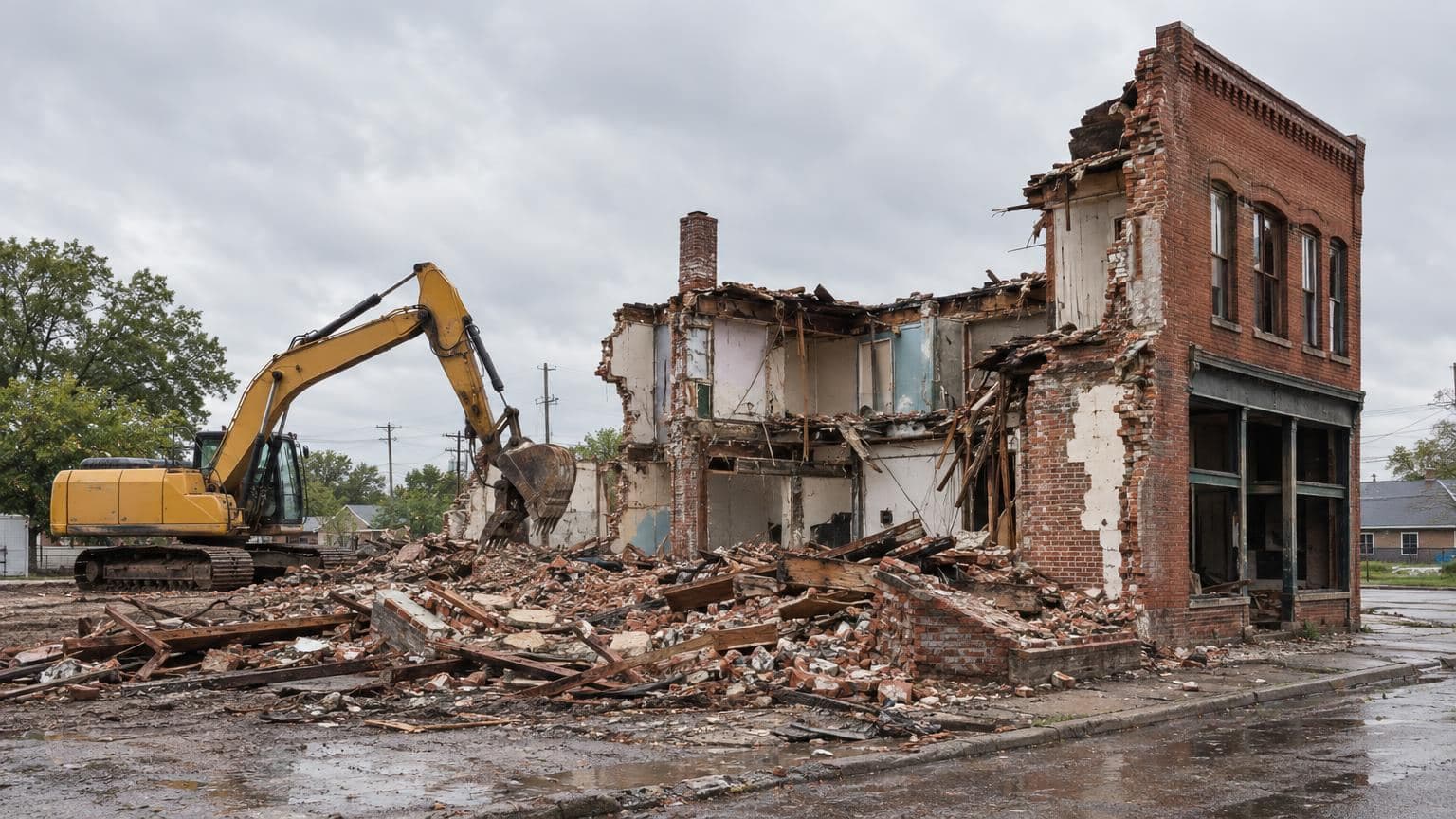
A damaged building is repaired under the codes in force when it is repaired, not the codes it was built under. An older building may need new wiring, HVAC, plumbing, roofing or accessibility features before it can be reopened, even where the storm never touched those systems. A building damaged past a local threshold may have to be torn down and rebuilt in full.
Many communities require a building damaged to a set extent, typically 50 percent, to be demolished and rebuilt to current code rather than repaired.1
These costs are caused by the law, not by the wind or hail, so standard commercial property policies leave them out. Ordinance or law coverage, added by endorsement, pays them in three parts:
- Coverage A, loss to the undamaged portion: the value of the part of the building that was not damaged but must be torn down anyway.
- Coverage B, demolition cost: the cost to tear down the undamaged parts and clear the site.
- Coverage C, increased cost of construction: the extra cost to repair or rebuild to current code, above what a like-for-like repair would cost.
The extra time a code rebuild takes is a separate gap. Standard business income coverage does not stretch to cover it, so lost income during the longer rebuild needs its own extension.
The standard ISO forms
ISO's Causes of Loss, Special Form (CP 10 30) excludes loss from enforcing any ordinance or law that regulates the construction, use or repair of property or requires tearing it down, including the increased cost to comply while repairing after a physical loss.2
ISO's building form CP 00 10 includes a small Increased Cost of Construction additional coverage: for buildings with the Replacement Cost option, the lesser of $10,000 or 5% of the building's limit, as additional insurance.3
ISO's Ordinance or Law Coverage endorsement, CP 04 05, adds Coverages A, B and C, each chosen in its schedule. Its main terms:4
- Coverage A sits within the building limit and does not increase it.4
- Coinsurance does not apply to Coverage B or Coverage C.4
- Coverage C covers excavation, foundation, pilings and underground pipes, and is not paid until the building is repaired or replaced, within two years unless extended in writing.4
- It responds only to the minimum requirements of an ordinance in force at the time of loss, and not to a law the owner already had to meet before the loss and did not.4
- When covered and uncovered damage together trigger the ordinance, it pays the covered share; if the covered damage alone would have triggered it, it pays in full.4
Example
Fannie Mae's guide works the required limits for a single-building property with a $10 million insurable value in a town whose ordinance threshold is 75% damage.5
| Coverage | Rule | Required limit |
|---|---|---|
| A, undamaged portion | 100% of insurable value minus the 75% threshold | $2,500,000 |
| B, demolition | 10% of insurable value | $1,000,000 |
| C, increased cost of construction | 10% of insurable value | $1,000,000 |
| A, B and C combined | Sum | $4,500,000 |
CP 04 05 prints a proportional example. A $200,000 building has $100,000 of damage: $30,000 from wind (covered) and $70,000 from flood (excluded). The ordinance applies at 50% damage, and the Coverage C loss is $60,000. Covered share: $30,000 / $100,000 = 0.30, so the most paid is $60,000 x 0.30 = $18,000.4
- Paid: covered share (30%)$18,000
- Not paid: share tied to excluded flood damage$42,000
- Total$60,000
What triggers code work
Ordinances that can apply after a loss include building, zoning, energy and accessibility rules. Fannie Mae's examples list bulk, building, zoning, energy management, green and Fair Housing Act accessibility rules.5
In mapped flood hazard areas, FEMA's substantial damage rule requires a building to meet flood provisions when restoring it would cost 50 percent or more of its market value before the damage.6
Where you'll see it
- Endorsement CP 04 05: its schedule lists each building with Coverage A, and limits for B and C or one combined B and C limit.4
- Causes of loss form CP 10 30: the Ordinance or Law exclusion.2
- CP 00 10: the Increased Cost of Construction additional coverage.3
- Business income forms: endorsement CP 15 31 extends the period of restoration to include the extra time needed to rebuild to code.7
- Fannie Mae multifamily loans: a property that is non-conforming under current land use law must carry Coverages A, B and C, plus the increased period of restoration endorsement if any building is 5 stories or more.5
State rules
- Florida: a 2021 Florida Building Commission staff analysis quotes Section 706.1.1 of the 7th Edition (2020) Florida Building Code, Existing Building: no more than 25 percent of a roof area or roof section may be repaired, replaced or recovered in any 12-month period unless the whole roof system or section is replaced to current code.8
- Texas: the Texas Department of Insurance's commercial property guide lists ordinance or law among the coverages most companies offer to add to a policy for an extra cost, paying extra construction or repair costs to meet current building codes.9
Questions
- What are Coverage A, B and C in ordinance or law coverage?
- Coverage A pays the lost value of the undamaged part of a building that must be torn down, Coverage B the cost to demolish it and clear the site, and Coverage C the increased cost to rebuild to code. ISO's CP 04 05 uses these labels.4
- Does a standard commercial property policy cover building code upgrades?
- Mostly no. ISO's special causes of loss form excludes ordinance or law costs, and CP 00 10 adds only the lesser of $10,000 or 5% of the building limit for increased cost of construction, and only with replacement cost. Endorsements add more.2,3
- Does ordinance or law coverage pay for the longer rebuild?
- Not by itself. Lost income during the extra time goes under business income endorsement CP 15 31, which extends the period of restoration to include it. Fannie Mae notes that without it, business income coverage does not include that increased period.7,5

Cloudbreak
Cloudbreak is the owner-side property protection team for commercial and multifamily owners. Our policy review reads your property policy against your buildings and values, and a licensed insurance broker approves every report. Policy reviews are free for any owner.
Sources
Written by the Cloudbreak team. Numbers, dates and rules cite the published sources below.
- 1. IRMI: Ordinance or law coverage
- 2. Insurance Services Office (ISO): Causes of Loss: Special Form, CP 10 30 09 17
- 3. Insurance Services Office (copy hosted by Independent Insurance Agents of Texas): Building and Personal Property Coverage Form, CP 00 10 10 12
- 4. Insurance Services Office (copy hosted by Independent Insurance Agents of Texas): Ordinance or Law Coverage, CP 04 05 10 12
- 5. Fannie Mae: Multifamily Selling and Servicing Guide, Part II Chapter 5: Property and Liability Insurance (effective October 26, 2026)
- 6. Federal Emergency Management Agency: Substantial Damage Estimator Tool (last updated December 3, 2021)
- 7. Insurance Services Office (copy hosted by Independent Insurance Agents of Texas): Ordinance or Law, Increased Period of Restoration, CP 15 31 10 12
- 8. Florida Building Commission: Declaratory Statement DS 2021-007 Staff Analysis (Existing Building Section 706.1.1, 25 percent threshold)
- 9. Texas Department of Insurance: Commercial property insurance guide (last updated December 9, 2025)