Creased shingles
Roofing and building · Cloudbreak team · Updated October 29, 2026 · 5 sources
Definition
A creased shingle is an asphalt shingle tab with a fold line across it, left when wind breaks the sealant bond and folds the tab back. The crease stays after the tab lies flat again, so it marks a shingle that wind has lifted.
How it works
Self-sealing asphalt shingles carry a heat-activated adhesive strip that bonds the lower edge of each exposed shingle to the shingle below. IBHS wind testing found the strength of that seal is the most important factor in how these shingles perform in high wind.1
Once wind breaks the bond, the lifted tab catches more wind and draws more uplift. The tab flips back and bends, usually at the top of the exposed section, just below the edge of the shingle above it. That bend leaves the crease. Repeated flipping can tear the tab off and carry it downwind.
Uplift is highest along windward corners, rakes, eaves and ridges, so wind damage starts there. Three-tab shingles have lighter tabs that act like a flap on an aircraft wing, so they flip more easily once the seal fails.2
On new, pliable shingles a crease can be faint and easy to miss.
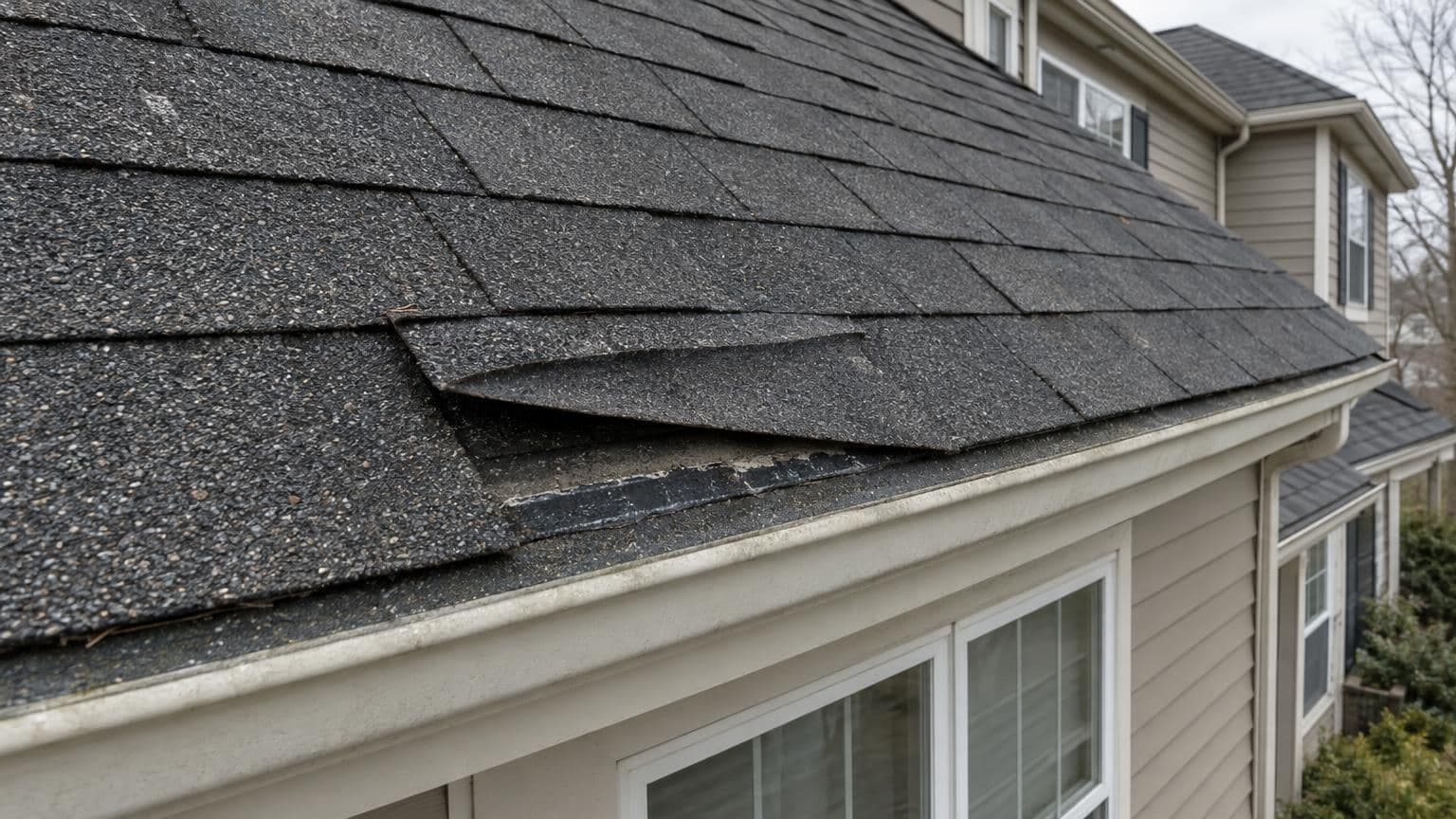
Creased, unsealed or aged
Unsealed is not the same as creased. Sealant can let go from age, heat cycling, dirt or poor installation, with no storm involved. Engineers writing for IIBEC in 2017 say a sealed shingle affected by wind leaves lasting evidence: creases, folds, tears or missing pieces. They also say a shingle that is unsealed but not creased, folded, torn or missing is not evidence of wind damage.3
A 2014 study of shingle roofs at 30 sites in Florida and Texas found patterns of partially unsealed field shingles on 22 of them, with more on older roofs.4
| Creased | Unsealed only | Cupped or clawed | |
|---|---|---|---|
| Cause | Wind lifts a sealed tab and folds it | Sealant aging, heat cycling, dirt or installation errors | Shingle shrinks with age |
| What you see | Fold line across the tab | Tab lifts by hand with no fold | Corners curl up (cupping) or down (clawing) |
| Pattern | Windward edges, eaves and ridges | Regular diagonal or vertical runs on every slope | Develops slowly, not tied to one storm |
Example
Hurricane Frances made landfall on Hutchinson Island, Florida, as a Category 2 storm on September 5, 2004; an instrumented tower at Fort Pierce recorded a peak gust of 107 mph. After the 2004 storm, a survey of 280 shingle roofs in Vero Beach, Stuart and Fort Pierce found four primary failure modes: creasing, flipping, tearing or removal, and debris abrasion.2
| Three-tab | Laminated | |
|---|---|---|
| Roofs surveyed | 129 | 151 |
| Little to no damage | 57 (44%) | 132 (87%) |
| 10 to 50% damage | 11 (9%) | 6 (4%) |
| More than 50% damage | 60 (47%) | 13 (9%) |
On 10 of the 11 roofs examined in detail, nails or staples had been driven in or above the sealant strip and missed the underlying shingle.2
In a wind simulator test reported in 2017, on a machine that can reach 175 mph, every shingle that came unbonded had at least a crease. On new, pliable shingles the creases were faint: seeing them took close inspection and hand pressure from underneath.3
Where you'll see it
- Wind damage assessments. Engineers describe wind damage as a mix of uplifted and creased, flipped and removed shingles, typically concentrated on the windward side of a roof along eaves, ridges and the tops of valleys.2
- Shingle wind ratings. The ASTM D3161 fan test, as described in 2010, blows at 60 to 110 mph for two hours; a shingle fails if a free portion stands upright or bends back on itself. Sealed shingles rated Class D, G or H under ASTM D6381 and UL 2390 resist winds up to 90, 120 or 150 mph.2
- Manufacturer bulletins. One shingle maker's September 10, 2025 technical bulletin lists broken sealant bonds with uplifted or creased tabs among the forms of wind damage, alongside blown-off shingles, granule loss and debris punctures.5
Questions
- What does a creased shingle look like?
- It shows as a fold line across the tab, usually at the top of the exposed section just below the overlying shingle, where wind bent the tab back. On new shingles the crease can be faint and visible only up close.2,3
- Is a creased shingle wind damage?
- A crease shows that wind lifted the tab and bent it back. Engineers writing for IIBEC in 2017 say a sealed shingle affected by wind leaves lasting evidence such as a crease, fold, tear or missing piece, though they note the subject is disputed in roofing. One shingle maker's 2025 wind damage bulletin lists creased tabs among the forms of wind damage.3,5
- Do wind-lifted shingles reseal on their own?
- One shingle maker's 2025 bulletin says shingles are unlikely to reseal on their own once wind breaks the sealant bond, and recommends hand-sealing those with no other damage. Age, sun and heat, dirt in the sealant and whether the shingles lie flat all affect resealing.5
- Are three-tab shingles more likely to crease?
- After Hurricane Frances in 2004, 44% of surveyed three-tab roofs had little or no damage, against 87% of laminated roofs. Once the seal broke, the lighter three-tab tabs folded back and creased along their tops.2
Cloudbreak
Cloudbreak records every roof section and rooftop unit before a storm, in photos, drone video and notes, so each roof's condition on a given date is on file.
Sources
Written by the Cloudbreak team. Numbers, dates and rules cite the published sources below.
- 1. IBHS: Wind Uplift of Asphalt Shingles
- 2. American Meteorological Society, 29th Conference on Hurricanes and Tropical Meteorology, 2010: Wind Effects on Asphalt Shingles (paper P2.17)
- 3. International Institute of Building Enclosure Consultants (IIBEC): Misconceptions of Wind Damage to Asphalt Composition Shingles (December 28, 2017)
- 4. Journal of Wind Engineering and Industrial Aerodynamics, vol. 130: The influence of unsealing on the wind resistance of asphalt shingles (Dixon et al., 2014)
- 5. GAF: Technical Advisory Bulletin TAB-R-143: Damage to Shingles Caused by Wind Events (September 10, 2025)